Types of modern lighting fixtures
Lighting devices are used everywhere. Without them, it is difficult to imagine the modern world, so there are many varieties that differ in design, features of use and other parameters. At the same time, all types of home equipment have common features, which allows them to be grouped and divided into categories.
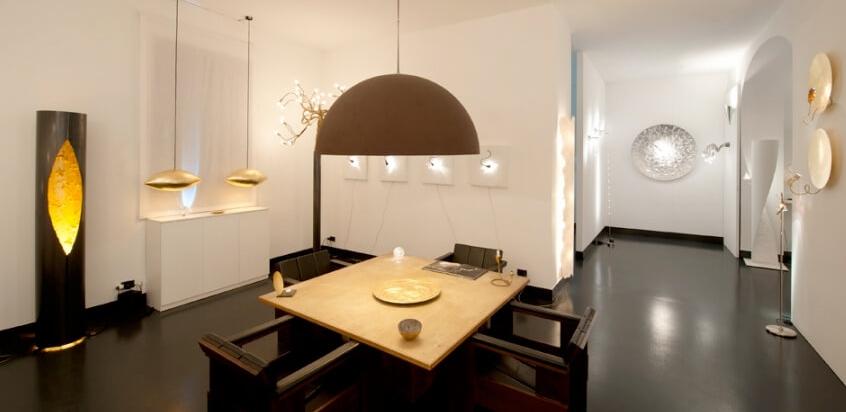
Lighting device
Regardless of the type and purpose of use, the design always consists of several main parts:
- Light source. It can be either a replaceable lamp or built-in LEDs. Power directly depends on this element. It is often possible to replace the light bulb with a more powerful one or vice versa, which allows you to provide the desired quality of light.
- Lighting fittings. It includes a housing, a diffuser or reflector and a cartridge in which the light source is installed.The design is different, it all depends on the type of equipment and the requirements that apply to it. At the same time, the design must comply with safety standards, they are prescribed in GOST and TU.
- Ballast equipment. Provides optimal working conditions and prevents the lamp from burning out when it is started. There are not all lamps, since for some light sources the presence of a ballast is not necessary.
- Protection and control devices. There can be many options here, since now lighting systems are often included in the Smart Home complex, etc.
- Wiring. Voltage is applied through it, it is selected according to the characteristics of the light source and the installation site of the structure. Sometimes the equipment may run on battery power (emergency lighting) or from a solar battery.
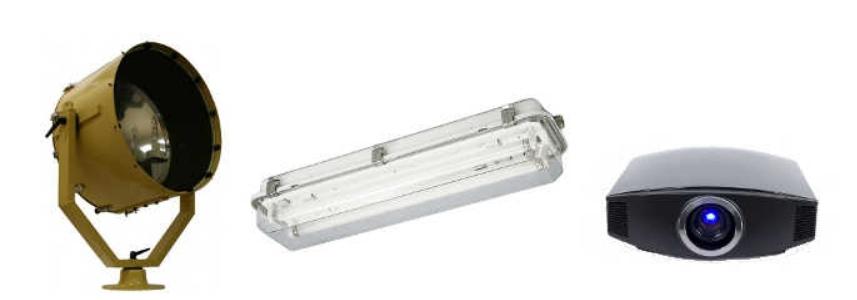
By the way! Often, lighting devices are combined with light sensors or movementsto turn on when signaled.
Lighting parameters
There are several parameters that affect the choice of equipment. To find the optimal solution, you need to consider them:
- Energy efficiency. Most often, this indicator is indicated by efficiency; you can compare different types of equipment to choose the most economical one.
- illumination shows strength luminous fluxwhich is per square metre. This indicator most of all influences the choice of a lamp, since the creation of comfortable conditions in a living room or workplace directly depends on it. Measured in lux.
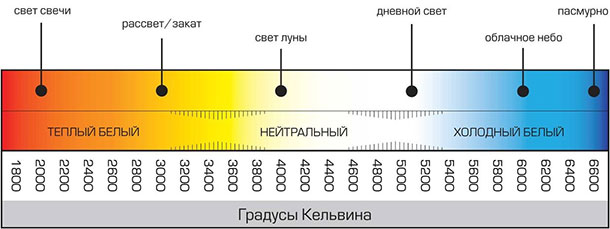
- Colorful temperature. It can vary over a wide range, for simplicity, the range is divided into 3 segments - warm, neutral and cold light. The specific option is selected depending on the nature of the use of the equipment and the place of its installation.
![Types of modern lighting fixtures]() Color temperature is an important parameter of lighting equipment.
Color temperature is an important parameter of lighting equipment. - The color rendering index is designated Ra and indicates how accurately colors are reproduced in comparison with natural light. It can be from 0 to 100, the higher the value, the more natural shades are perceived.
- Ripple factor shows the change in the brightness of the light source. Often the pulsation cannot be seen, but because of it, the eyes get tired much faster. Therefore, GOST standards indicate the limit values \u200b\u200bfor different types of lighting equipment.
- blindness. Shows how the lamp has a blinding effect on human vision. It is used for models with directional light, the indicators are strictly normalized so as not to create a danger to people.
Each type of equipment has additional parameters that are relevant in certain conditions.
The main types of lighting fixtures
The general classification includes several main categories. The main types of lighting devices are as follows:
- Depending on destination lamps are general and local lighting. The first option is designed to provide uniform light. Most often, this is a fairly powerful equipment that allows you to provide the desired level of illumination. The second type is used for a separate part of the room or for lighting the workplace. This also includes decorative lighting used in the design facades or indoor interiors.
- By design allocate open and closed options with varying degrees of protection from adverse effects. As a rule, the simplest types are used in heated rooms. For the street and unheated premises, more reliable models are suitable. And for extreme conditions of use, especially durable lamps are made.
- depending on light distribution There are three types: direct, diffused and reflected light. The first type directs the light flux to a certain area directly. The second is placed in a diffuser and evenly distributes light around. The third is directed to the ceiling or walls and illuminates the premises due to the reflected rays.
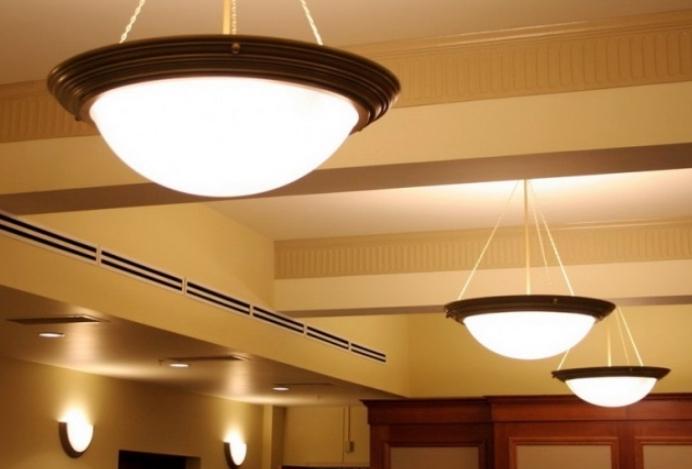
Classification of lighting fixtures
Equipment can be divided into different groups according to several criteria. They differ not only in design features, but also in operating parameters, as well as the degree of security.
Classification by place of application
Lighting devices are used almost everywhere. Therefore, in the manufacture, the conditions of use are taken into account, in total there are three options for use:
- In the premises. The most common group, used in the residential and industrial sector, as well as in public buildings. There are many options - from traditional chandeliers and built-in lamps to table lamps and various types of lighting. The level of protection against adverse conditions varies, as devices are often placed in rooms with high humidity.
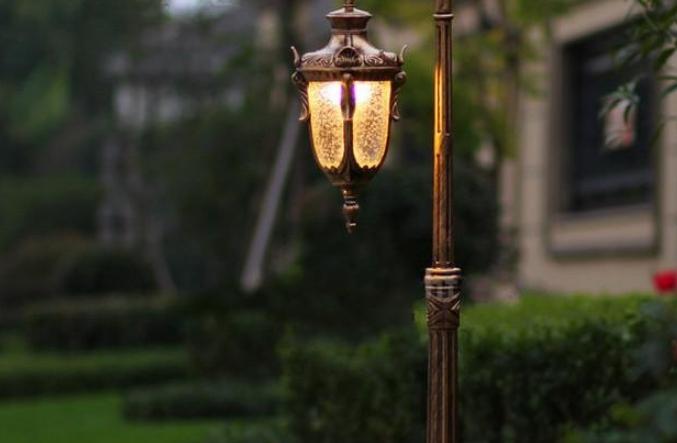
- In open spaces. Here the requirements are much higher, since the equipment is affected by precipitation, temperature changes and other adverse factors. This group includes all devices that are installed outdoors and in unheated rooms.
![Types of modern lighting fixtures]() Street lights must withstand precipitation and temperature changes.
Street lights must withstand precipitation and temperature changes. - in extreme environments. Often you have to put lamps under water, in mines, in the conditions of the Far North, in places with a danger of falling stones, etc. Most often, fixtures are designed for specific conditions.
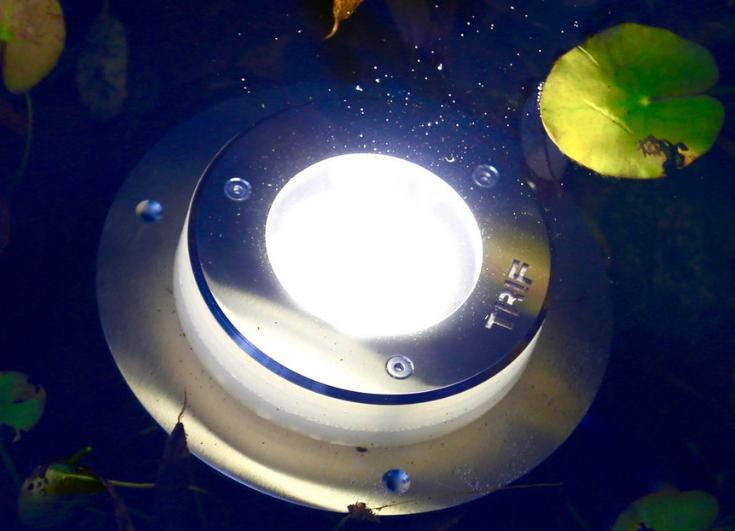
Options for open space can be used indoors, but you should not do the opposite.
Environmental classification
Degree of protection denoted by the letters IP and is available for almost all equipment. Therefore, when choosing, you need to pay attention to the marking, there are several main types:
- IP20. The lowest class, which protects the light source only from large elements. The equipment is suitable for residential and heated premises, does not withstand water and other adverse effects.
- IP44. Option with normal protection against moisture ingress. It can be used both for outdoor lighting and in rooms with high humidity. In this case, splashing water is also undesirable.
- IP54-IP65. Options with excellent protection against dust and moisture, can be used in almost any environment. Withstand a direct hit of a jet of water and do not let even fine dust into the case.
- IP68. Suitable for difficult operating conditions, can be installed even under water.
Classification of luminaires for premises by design
This is the largest group, in which there are dozens of varieties. There are several main ones:
- Suspended. They are located at some distance from the ceiling and can be mounted on a rigid leg or a flexible element (cord, chain, etc.). The second type is convenient in that you can adjust the height of the location. Chandeliers can have different sizes and shapes.
- Embedded. Suitable for hollow structures, most often installed in stretch and plasterboard ceilings. The case is located in a niche, only the outer part is visible from the outside, most often it is a diffuser or an adjustable ceiling. There are semi-overhead options, they are partially hidden under the ceiling.
![Types of modern lighting fixtures]() Built-in options are ideal for stretch ceilings.
Built-in options are ideal for stretch ceilings. - Wall lights. These can be classic sconces or more modern options with the ability to change the direction of light.
- Desktop and floor lamps. The first type is placed on the countertop or attached to its end with a special clamp. The second - floor lamps, placed near the sofa or armchair, to provide comfortable conditions for reading.
- Built-in panel elements. They are used in suspended ceiling systems made of slabs. They fit standard cells in size, so they are easy to install and look neat.
- Ceiling lamps. Most often they are small in size and evenly distribute light around due to the scattering element. The modern version is LED panels.
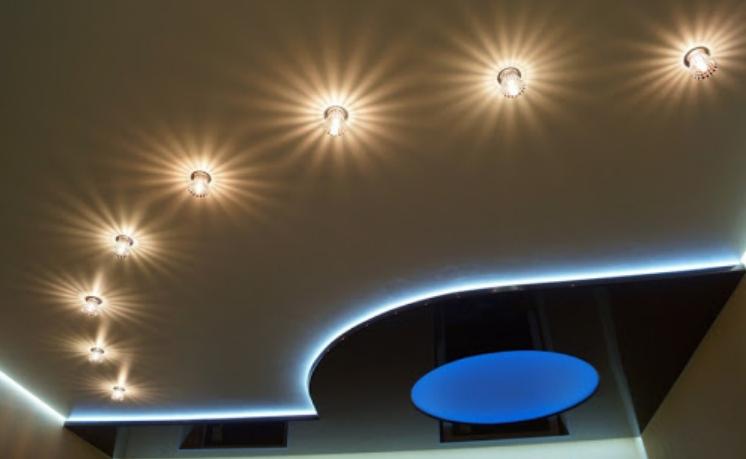
LED strips can be used not only as decorative, but also as the main lighting, if several rows are placed in a box with a diffuser.
Type of lamps used
In lamps, several main varieties are used, the most common are:
- Incandescent lamps. An inexpensive solution that is used less and less due to high energy consumption.
- Fluorescent models are characterized by low power consumption and good light characteristics.
- Halogen give good light, but consume a lot of electricity.
- LED most economical to date. Provide even light and last many times longer than analogues.
Related video: Types of lighting lamps.
Choosing a lighting device is not difficult, given the operating conditions and the desired level of illumination. To achieve the best effect in the premises, it is worth combining different types of equipment.