How to make lighting for a child's room
To make competent lighting in the children's room is a paramount task in planning the "nest" for the baby. In order for the child to fall asleep peacefully, play happily, do homework thoughtfully, you need the right lighting for the entire room and individual zones. The article will talk about the basic principles of organizing lighting in a nursery, methods of zoning and local lighting, and interesting solutions.
Requirements for the lighting of the children's room
You need to think about the organization of lighting in the children's room at the stage of choosing a room for it in the apartment. A simple rule: as a nursery, it is better to choose the brightest room, where enough natural light penetrates. For a child, this is extremely important. It is good if the windows face south or east.
There is no standard for the number of lamps in the nursery and their exact location. The choice is made according to several parameters:
- How old is the child;
- room size;
- what materials were used for decoration;
- the number of windows, as well as their sizes;
- Do the windows face the sunny side?
There are also a number of basic principles that should be followed during the planning stage:
- For proper lighting of the nursery, one lantern is definitely not enough. In addition to the main light, it is necessary to emphasize individual local areas.
- The material from which the lamp is made is the most important moment. It directly affects the health of the baby. The flashlight must not overheat.
- Design cannot be neglected either. Lamps should look organically in the interior, not look catchy, not cause negative emotions among the inhabitants of the nursery.
How to properly distribute light
Regardless of the style in which the nursery is decorated, the role of the main lighting should be performed by a chandelier with at least 3 shades.
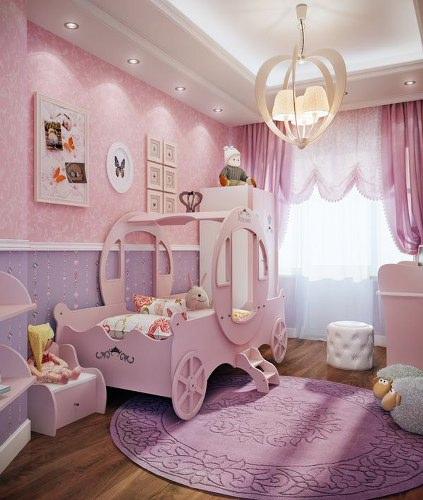
If the ceilings are low, and the child is active and jumpy, you should either buy a chandelier with plastic shades, or stop at those built into the ceiling point models. Crystal or openwork glass are dangerous materials, given the possibility of a ball or hard toy falling into it.
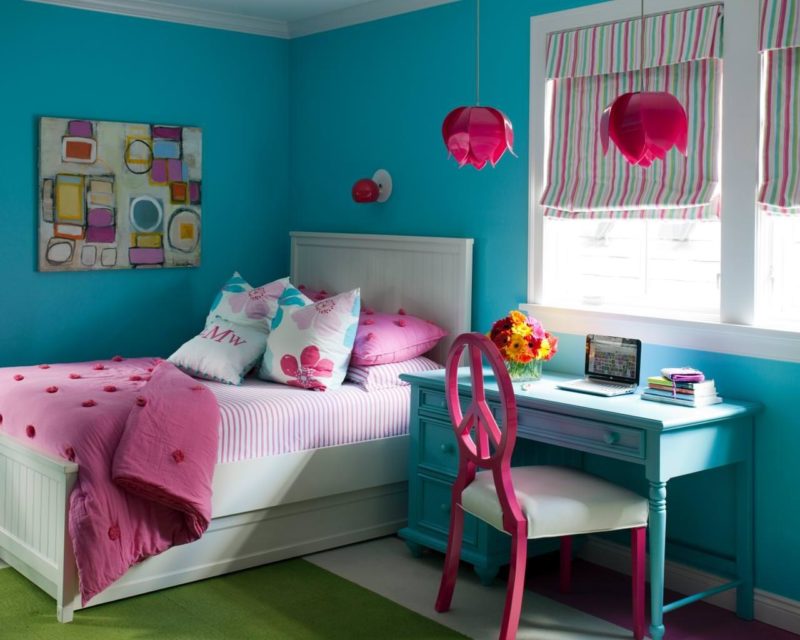
No less importance than the main one is given to two more categories of lighting - side and local. In particular, this applies to a large room. Directly above the bed you need to hang a single lantern with a matte shade. Good fit sconce: it will come in handy when reading, and it will help you fall asleep.
Organization of artificial lighting in the nursery
Local illumination
Now about the local illumination of individual zones and multi-level zoning. There is almost always a table in the nursery.The schoolboy does his homework on it, and the “kinder” of preschool age spends time with coloring books and toys. This area must be illuminated with a table lamp or lamps, which clings to the table. The light should be soft and warm. No need to use lamps more powerful than 60 watts.
Important. The higher the light source, the more beneficial it is for the child's eyes. So the light will diverge evenly throughout the area.
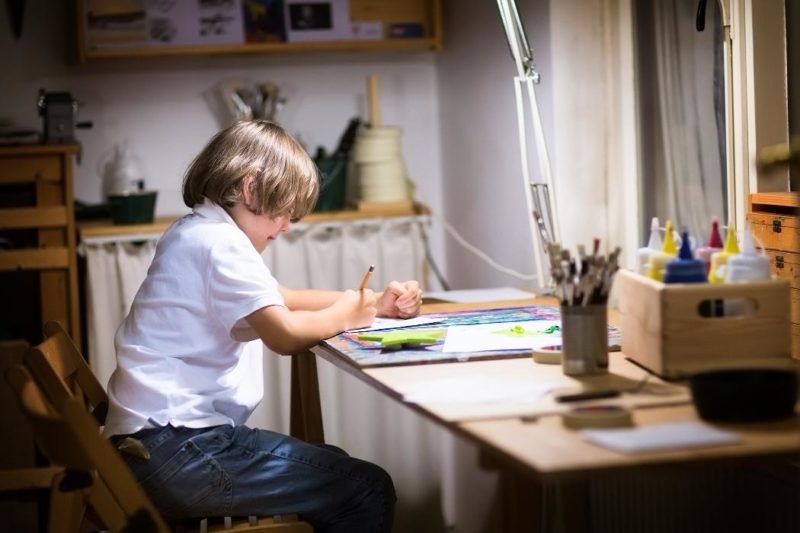
Today, even a preschooler can have a computer on his desk. The light from the lamp should not create glare from the monitor. For proper placement, you need to take into account the angle of incidence of light and the height of the child's eyes when he looks at the screen. The "working" hand also plays a role. For a left-handed child, it is advised to put a table light on the right, for a right-hander - on the left.
Idea. If there is an overhanging shelf right above the table, a lamp can be built into its lower base - this will give even more light.
It is equally important to put a small night light next to the bed, ideally with adjustable brightness. So the baby will fall asleep calmly, and adults will walk without the threat of flying into the furniture in the dark. Usually, floor lamps for a nursery are made in the form of fairy-tale heroes or animals to please the children.
It will be useful to read: Furniture design for a children's room
Multilevel zoning
In general, different methods are used to divide the children's room into separate zones. Auxiliary elements are:
- Stationary partitions made of plasterboard or wood. Allows you to divide the room into several parts.
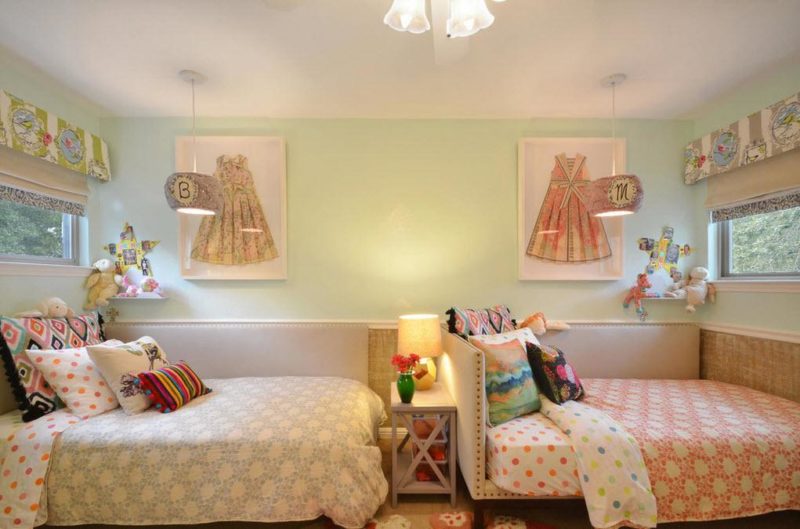
- Screens. This is a good solution for a room where two children live.
- Furniture.A bookcase, shelving and other pieces of furniture can serve as a good divider for a nursery into separate zones. The main thing is that they should not be very high, otherwise it will create difficulties with daylight.
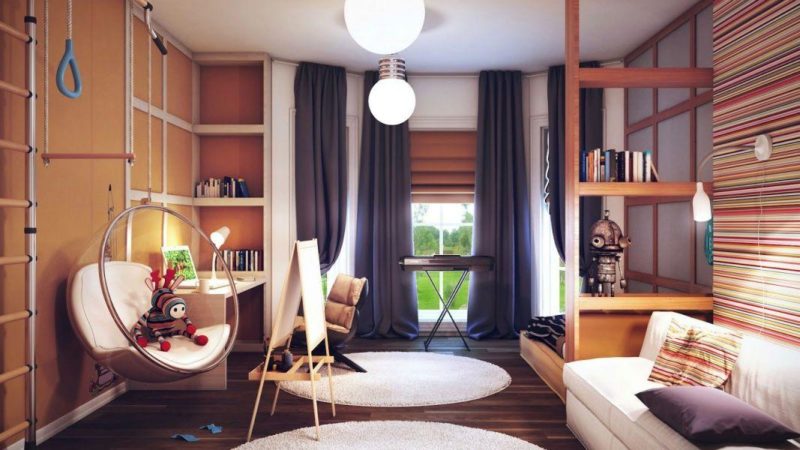
If the room has high ceilings, there is a reason for installing a bunk space. Children are very fond of impromptu attics, and the high false ceiling just allows you to do this.
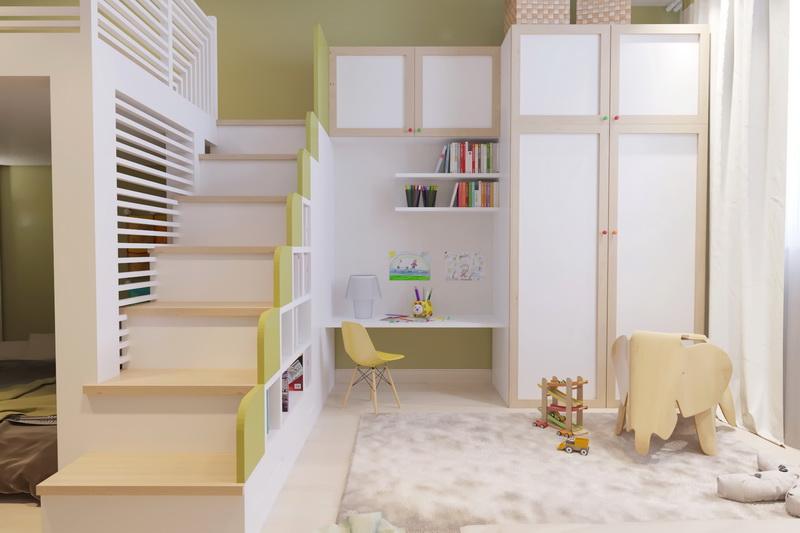
So that the child confidently descends and ascends to his secluded place, stairs should be well lit. On the second tier, the light should be made minimalistic and unobtrusive.
The sections of the floor raised several levels higher will look just as impressive. This is usually done in the form of a small podium. With the help of built-in lighting, such zones can be saturated with light of any nature - from calm to fabulous.
It is better to use different materials for different floor levels.
The main thing in multi-level zoning is a competent balance. It is not necessary to fence everything to the heap, it is necessary to clearly understand what and why to do.
The video tells the main trends in the lighting of the nursery.
Benefits of a tensile structure
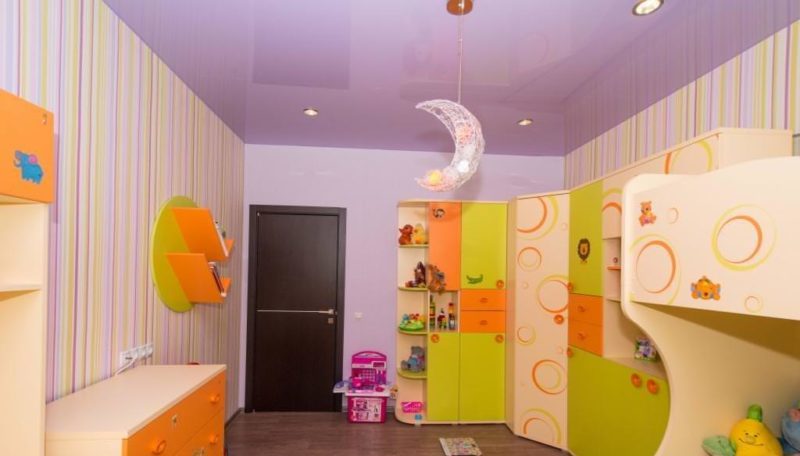
If possible, it is better to install a stretch or suspended ceiling in the children's room from the very beginning. In addition to the options with the creation of the second tier, stretch ceilings provide a number of other advantages. The luminaires will be mounted in the ceiling space and will not be hit by a flying ball. In addition, all wiring will be securely hidden.
Any color of the suspended surface can enhance the visual effect of zoning. Even more this will help different types of fixtures. So it will be possible to achieve a genuine extravaganza of flowers.
Stretch ceiling with a glossy surface "kills another rabbit". The sun's rays, reflected in the gloss, more saturate the room with natural light, reach the farthest corners. Yes, and artificial lighting from the gloss will only benefit.

Requirements for lamps and light for a children's room
Best to choose LED lamp. This type is less harmful to the eyes of the child than others, it does not create as much emotional stress as, for example, incandescent lamps. In addition, LED lamps consume less energy, have a long life, they can not be broken just like that.
The optimal light for the main and local lighting in the children's room is neutral white. It does not hurt the eyes, softens the perception. But for floor lamps-night lights you need a warm yellow light. Nothing will help you sleep better.
Important. The power of all the light in the room should be directly proportional to the age of the child. The older it is, the more power you need to set. The main thing is not to overdo it.
Examples of lighting in the nursery for a boy and a girl
The children's room where the boy lives will be different from a similar room for a little lady. First of all, this is expressed in the main shades (gray, blue, purple, brown), then bright ones prevail in the girlish one:
- yellow;
- Orange;
- pink;
- red;
- light green.
The light in the nursery should competently emphasize the advantages of the overall color palette, but not conflict with it.If two children of different sexes live in one nursery, it is worth zoning for each of them. Roughly speaking, in one room you need to fit the design of two.
The main rule is that between the zones for a boy and a girl there should be something in common, uniting. For example, the same models of chairs or cabinets. Let them be painted in different colors, but the external sameness will be thereby common.
The basic principles for the location of fixtures are unchanged. The main lighting is a matter of a chandelier or lanterns built into the ceiling. The table and the playing place should be accentuated with table lamps and local lighting. Next to the bed you need to put a floor lamp.
These photos show light design options for two types of children's rooms: