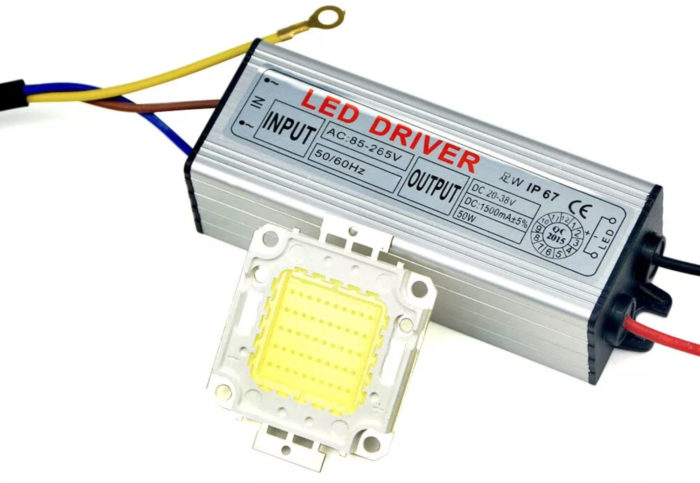
Description of the LED driver
LEDs are versatile and economical lighting sources that have entered every home. With the help of modern LED lamps organize the lighting of apartments, houses, offices, public buildings and streets. The most important element of any LED device is the driver. The component has a number of features that are important to consider when using electrical appliances.
LED driver - what is it
The direct translation of the word "driver" means "driver". Thus, the driver of any LED lamp performs the function of controlling the voltage supplied to the device and adjusts the lighting parameters.
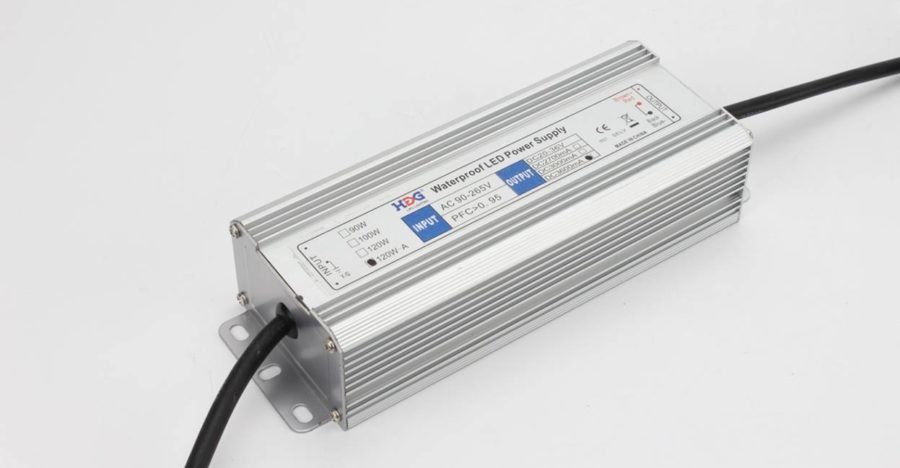
LEDs These are electrical devices capable of emitting light in a certain spectrum. For the device to work correctly, it is necessary to apply exclusively constant voltage to it with minimal ripple. The condition is especially true for high-power LEDs.Even minimal voltage drops can damage the device. A slight decrease in the input voltage will instantly affect the light output parameters. Exceeding the set value leads to overheating of the crystal and its burnout without the possibility of recovery.
The driver performs the function of an input voltage stabilizer. It is this component that is responsible for maintaining the required current values \u200b\u200band the correct operation of the light source. The use of high-quality drivers guarantees a long and safe use of the device.
How the driver works
The LED driver is a constant current source that creates a voltage at the output. Ideally, it should not depend on the load applied to the driver. The AC network is characterized by instability and often significant differences in parameters are observed in it. The stabilizer should smooth out the drops and prevent their negative impact.
For example, by connecting a 40 ohm resistor to a 12 V voltage source, you can get a stable current of 300 mA.
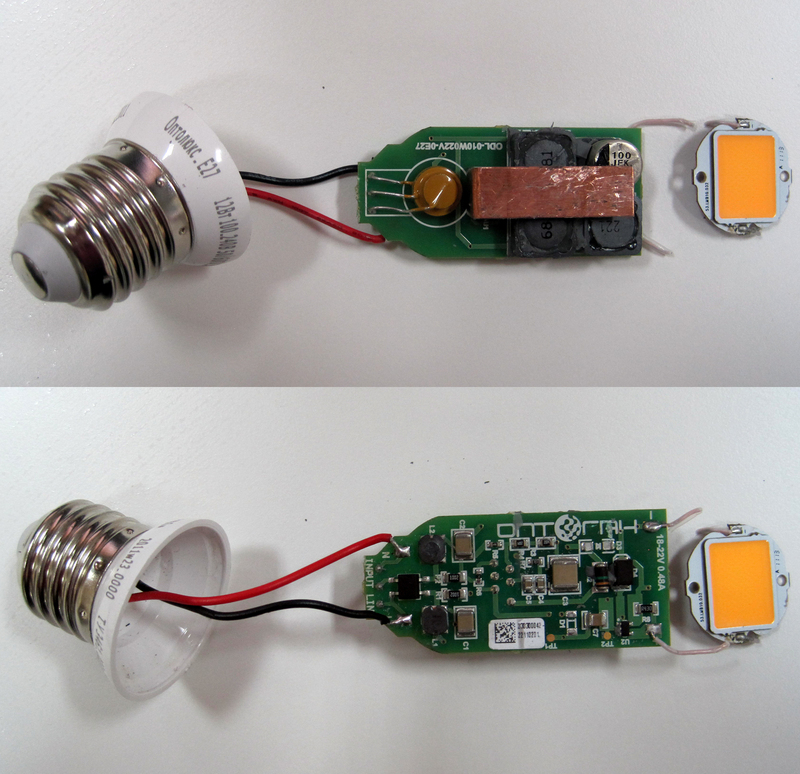
If you connect two identical 40 ohm resistors in parallel, the output current will already be 600 mA. Such a scheme is quite simple and typical for the cheapest electrical appliances. It is not able to automatically maintain the desired current strength and withstand voltage ripples to the fullest.
Kinds
Power drivers for LEDs are divided into two large groups: linear and pulsed, according to the principle of operation.
Pulse stabilization
Pulse stabilization is reliable and efficient when working with diodes of almost any power.
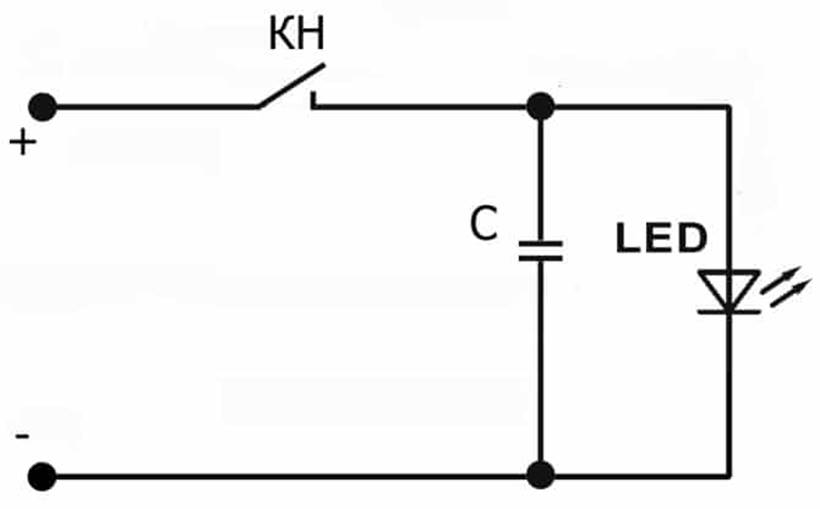
The control element is a button, the circuit is supplemented with a storage capacitor. After applying voltage, a button is pressed, causing the capacitor to store energy. Then the button opens, and a constant voltage from the capacitor is supplied to the lighting equipment. As soon as the capacitor is discharged, the procedure is repeated.
Increasing the voltage reduces the charging time of the capacitor. The voltage supply is triggered by a special transistor or thyristor.
Everything happens automatically at a speed of about hundreds of thousands of circuits per second. The efficiency in this case often reaches an impressive figure of 95%. The circuit is effective even when using high-power LEDs, since energy losses during operation are negligible.

Linear stabilizer
The linear principle of current regulation is different. The simplest diagram of such a circuit is shown in the figure below.
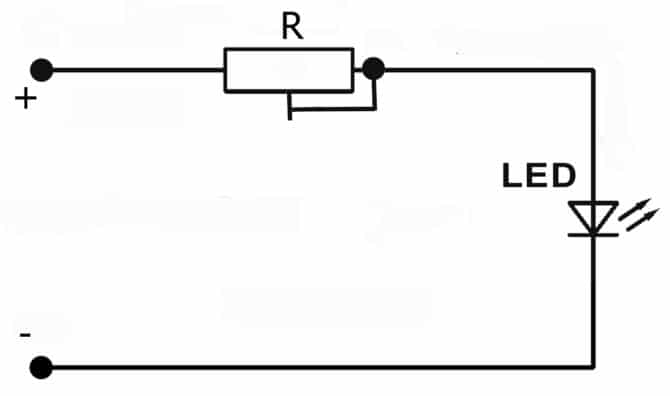
A current limiting resistor is installed in the circuit. If the supply voltage changes, changing the resistance of the resistor will allow you to set the desired current value again. The linear regulator automatically monitors the current passing through the LED and, if necessary, regulates it using a resistor switch. The process is extremely fast and helps to quickly respond to the slightest fluctuations in the network.
Such a scheme is simple and effective, but there is a drawback - useless power dissipation of the current passing through the regulating element. For this reason, the option is optimal when used with a small operating current. The use of high power diodes may cause the control element to consume more power than the lamp itself.
How to choose
To select an LED driver, it is necessary to consider the complex characteristics of the device:
- input and output voltage;
- output current;
- power;
- level of protection against harmful influences.
First, determine the power source. Uses standard AC power, battery, power supply and more. The main thing is that the input voltage is in the range indicated in the device passport. The current must also match the input network and the connected load.
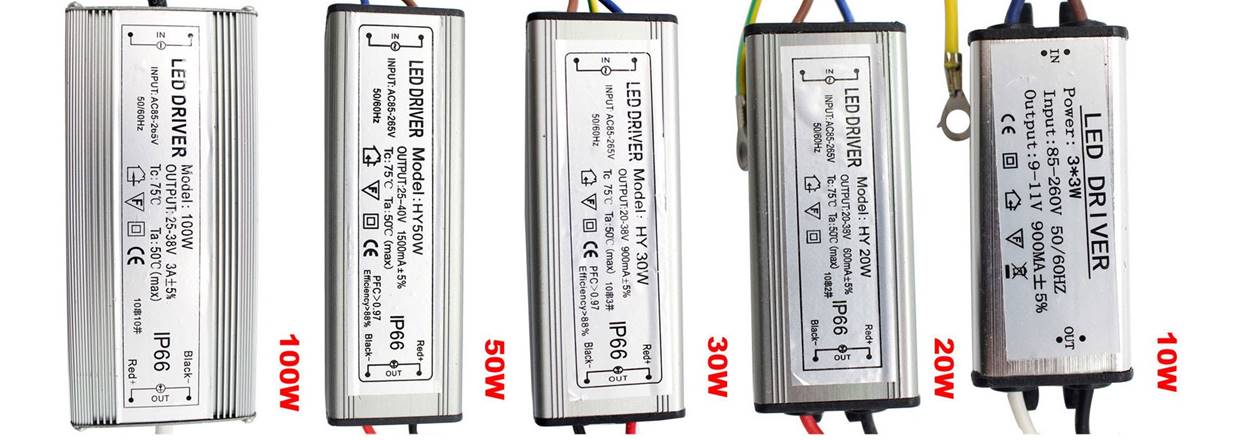
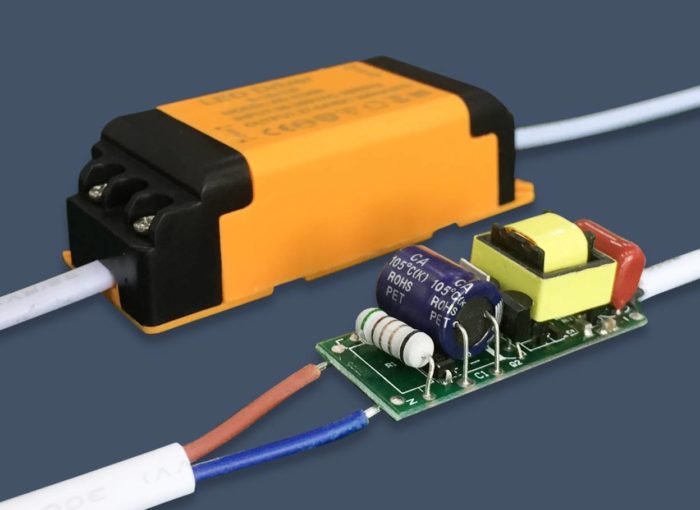
Manufacturers produce devices with or without cases. Cases effectively protect against moisture, dust and negative environmental influences. However, for embedding the device directly into the lamp, the housing is not a necessary component.
How to calculate
For the correct organization of the electrical circuit, it is important to calculate the output parameters. Based on the data obtained, a specific model is selected.
Thematic video: How to choose a driver for an LED lamp.
The calculation starts by looking at the LEDs given their voltage and current. Specifications can be seen in the documents. For example, 3.3 V diodes with a current of 300 mA are used. It is necessary to create a lamp in which three LEDs are located one after the other in series. The voltage drop in the circuit is calculated: 3.3 * 3 = 9.9 V. The current in this case remains constant. This means that the user will need a driver with an output voltage of 9.9 V and a current of 300 mA.
Specifically, such a block cannot be found, since modern devices are designed for use in a certain range. The current of the device may be slightly less, the lamp will be less bright. It is forbidden to exceed the current, since such an approach can disable the device.
Now you need to determine the power of the device. It is good if it exceeds the desired indicator by 10-20%. The power is calculated according to the formula, multiplying the operating voltage by the current: 9.9 * 0.3 = 2.97 W.
How to connect to LEDs
You can connect the driver to the LEDs even without special skills. Contacts and connectors are marked on the case.
INPUT marks the input current contacts, OUTPUT indicates the output. It is important to observe the polarity. If the connected voltage is constant, then the “+” contact must be connected to the positive pole of the battery.
When using alternating voltage, the marking of the input wires is taken into account. Phase is applied to “L”, zero is applied to “N”. The phase can be found with an indicator screwdriver.
If the markings "~", "AC" are present or there are no symbols, polarity is not necessary.
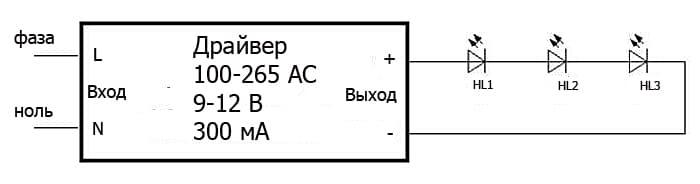
At connecting LEDs to the output polarity is important to observe in any case. In this case, the "plus" from the driver is connected to the anode of the first LED in the circuit, and the "minus" to the cathode of the last.
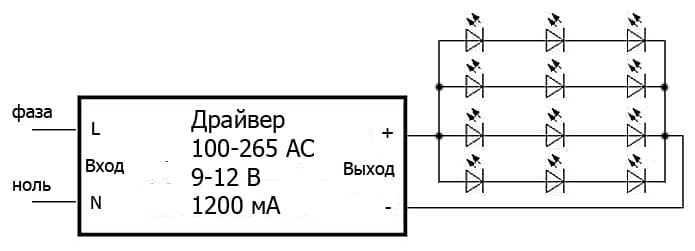
The presence of a large number of LEDs in the circuit may make it necessary to split them into several groups connected in parallel. The power will be the sum of the powers of all groups, while the operating voltage will be equal to that of one group in the circuit.The currents in this case also add up.
How to check the LED lamp driver
You can check the operation of the LED driver by connecting the lamp to the network. It is only necessary to make sure that the lighting device is in good condition and that there are no ripples.
There is a way to check the driver without the LED. 220 V is supplied to it and the output indicators are measured. The indicator should be constant, slightly more than that indicated on the block. For example, the values \u200b\u200bof 28-38 V indicated on the block indicate an output voltage without load of about 40 V.
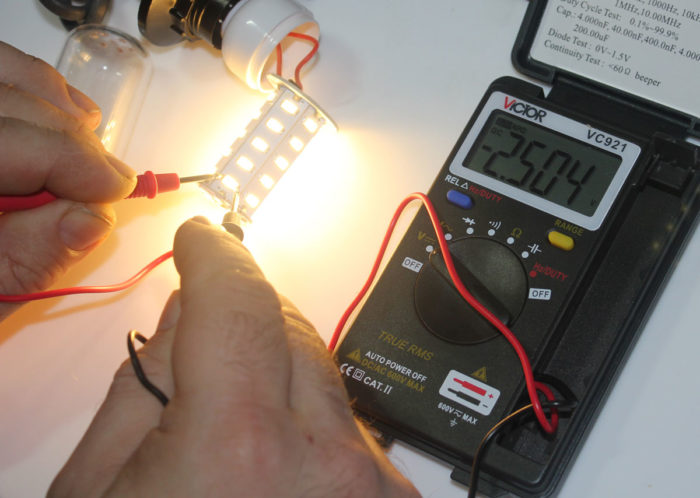
The described method of verification does not give a complete picture of the health of the driver. Often you have to deal with serviceable units that do not turn on idle or work unstable without load. The output is the connection to the device of a special load resistor. Choose resistor resistance it is possible according to Ohm's law, taking into account the indicators indicated on the block.
If, after connecting the resistor, the output voltage is as indicated, the driver is working.
Life time
Drivers have their own resource. More often than not, manufacturers guarantee 30,000 hours of driver operation during intensive use.
The service life will also be affected by voltage drops in the network, temperature, humidity.
Insufficient workload can significantly reduce the life of the device. If a driver is rated at 200 watts and is operating at 90 watts, most of the free power causes network congestion. There are failures, flickering, the lamp may burn out within a year.
It will also be interesting: Checking the LED lamp for operability with a multimeter.