Staircase lighting in a private house
Illumination of the stairs is done wherever the premises are at different levels and a flight of stairs is used for movement. To ensure safety and make a reliable system, you need to follow a few simple guidelines when planning and installing lighting elements.
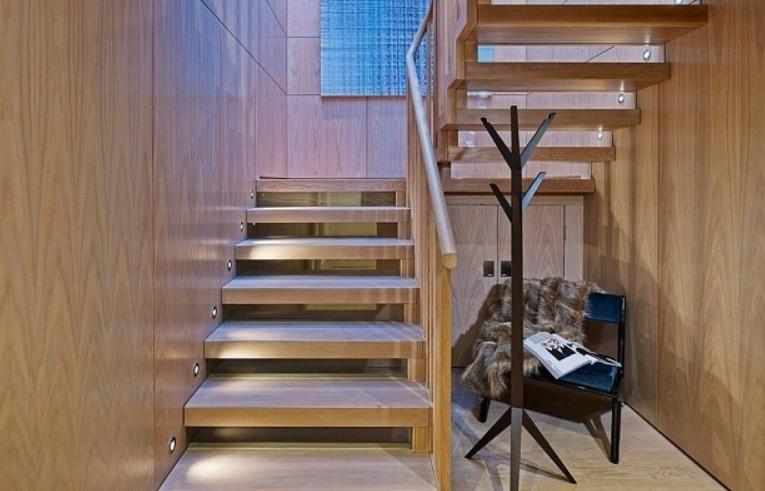
What is backlighting for?
Stair lighting should be developed separately, as it differs from conventional options due to such features:
- The main purpose of the backlight is the safety of people when moving up the flight of stairs. It is important for a person to move calmly without the risk of stumbling, falling, etc. Therefore, the light should highlight at least the steps well, so that even people with poor eyesight can see where to step.
- The second function is decorative. Due to the lighting, you can make the staircase design an element of interior design that attracts attention. With the help of lighting, you can focus on the features of the stairs and give it a more modern look.
![design looks much better]() Due to the beautiful backlight, the design looks much more attractive in the dark.
Due to the beautiful backlight, the design looks much more attractive in the dark. - The light does not have to be on all the time (except for decorative LED lighting, which consumes little electricity). Therefore it is worth think over in advance the system of its inclusion and deactivationto make the process convenient. Now there are many options that allow you not to install standard switches.
- If the luminaires are in the access zone of a person or pets, then they should not get very hot to eliminate the risk of burns. Fire safety requirements are high. It is better to use lamps that heat up minimally and do not overheat even if they fail.
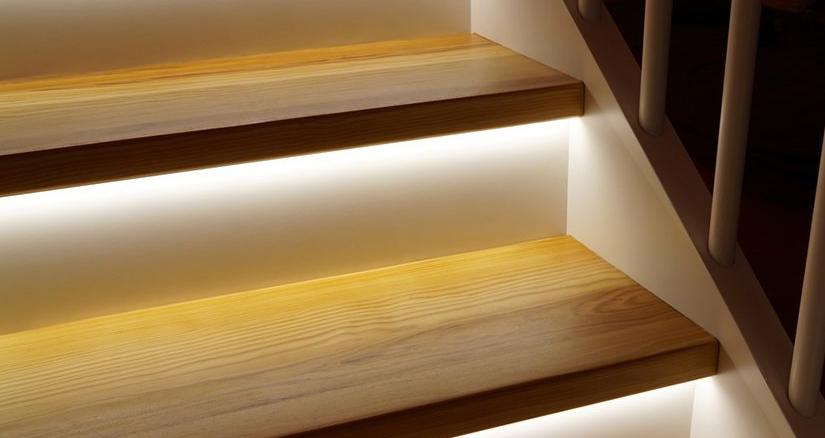
You can use both special lamps for stairs, and any others, if they fit better.
How to organize the lighting of flights of stairs
Before equipping staircase lighting in the house, it is necessary to take into account a number of recommendations that will allow you to get a safe system and avoid common mistakes:
- To choose economical lamps, because the backlight works frequently, and if it consumes a lot of electricity, the costs will increase. It is best to calculate the total consumption in order to understand how much electricity is needed for the normal operation of the system.
- The configuration of flights of stairs and the total length of the structure are taken into account.The longer the staircase, the higher the requirements for its lighting and the more fixtures will need to be installed. When planning the location of equipment, remember that the minimum illumination rate is 20 lux, and this indicator should be taken as a starting point.
- Light flow must be distributed evenly to eliminate glare and discomfort to the eyes anywhere on the stairs. Therefore, they prefer shades with soft, diffused light, comfortable for the eyes and at the same time effectively illuminating the space.
- You should think over the power supply system of the lamps in advance, since it can be difficult to go down in case of power outages. Often, stand-alone equipment is installed that runs on 12 V, and when the power is cut off, it switches to a battery that is placed nearby so that the lighting works for at least an hour even without electricity.
- Lighting elements must clearly convey the outlines of objects and not distort their contours, as this affects safety. It is worth considering in advance how the light will be distributed and whether there will be zones that will not be well lit.
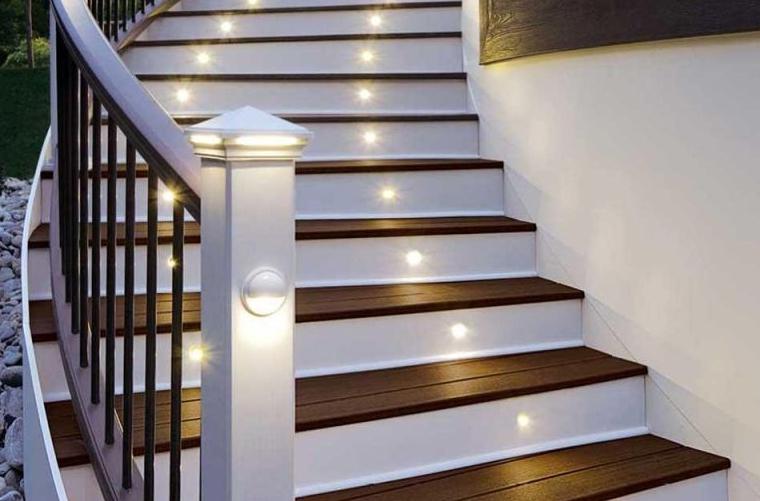
When determining light temperature it is better to choose options that do not distort the colors of objects.
Types of backlight
Step lighting can be implemented in different ways. The location of the light source differs, so it is easiest to classify options on this basis. Various types of equipment can be used.
Upper
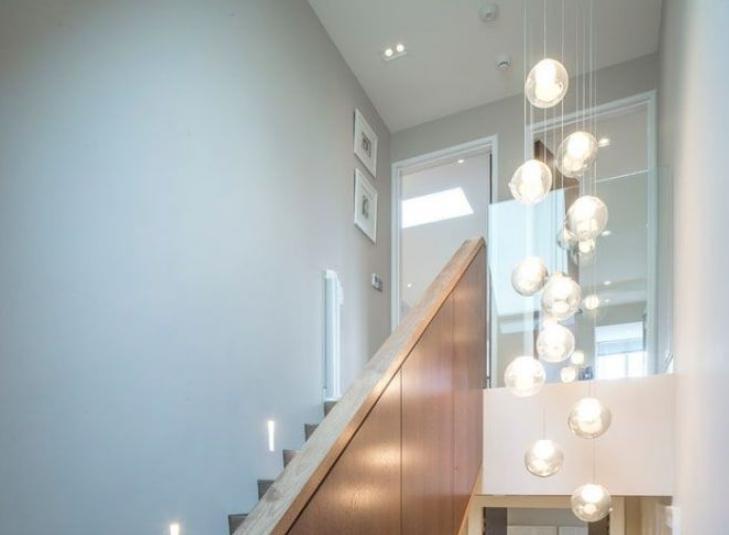
The light comes from above, as usual, and illuminates the flight of stairs completely.The system is simple and does not require alterations in the room, but is more suitable for single-span structures that can be normally lit by a common chandelier. If the staircase is of complex shape or spiral, then it will not be possible to provide normal lighting with one source.
The second option is Spotlights or track systems. They can be installed in any suitable place both on the ceiling and on the bottom of the upper span, if there are several of them. Due to the adjustment, you can direct the light flux where you want or move the shades if there is a track tire.
Lateral top
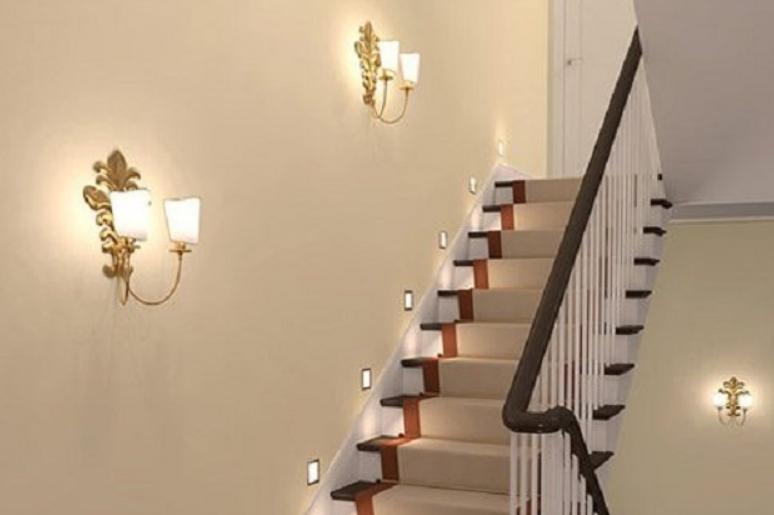
The luminaires are fixed to the wall at a level above the average height of a person, so as not to cling to the equipment with their heads. You can use different models - from classic sconce up to modern with a directional flow of light, it all depends on the design of the stairs.
You can use overhead or partially embedded options, they are suitable for small width structures where you do not need a lot of light. Often, wall systems are used with diffusing shades or reflected light that gently floods the space. The main thing is that the steps are evenly lit, without dark and poorly lit areas.
Side lighting
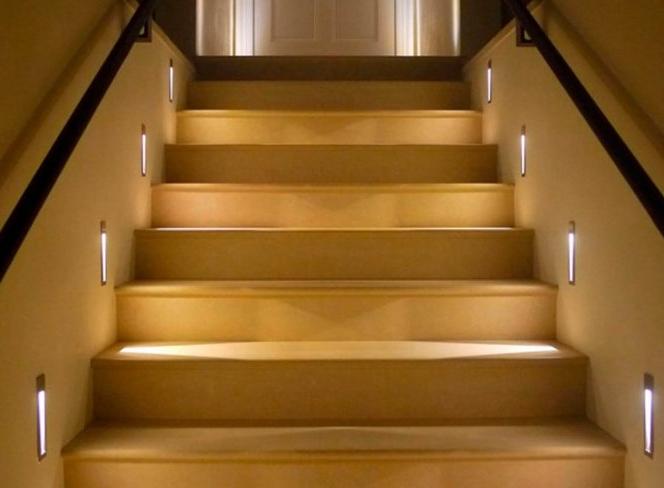
This option differs from the previous one in that the lighting is built into the wall at a height of no more than 25 cm from the surface above each step or through one. Using directional light fixtures, you can provide good illumination of the space.
But if there are children or elderly people in the family, then when descending, there may be problems with orientation in space.It is best to complement side recessed lighting with general lighting to eliminate problems and ensure good visibility.
Step lighting
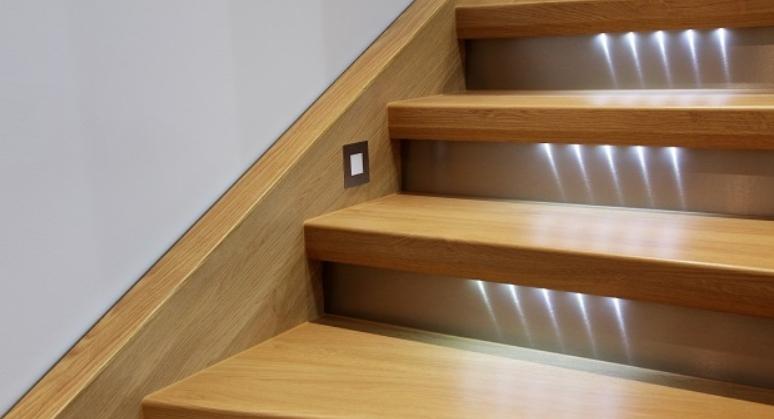
This method is suitable for different designs and can be implemented by various equipment. Previously, the process was complicated due to the fact that it was necessary to cut in the fixtures and conduct wiring from the inside. It required a lot of space and compliance with safety regulations during installation.
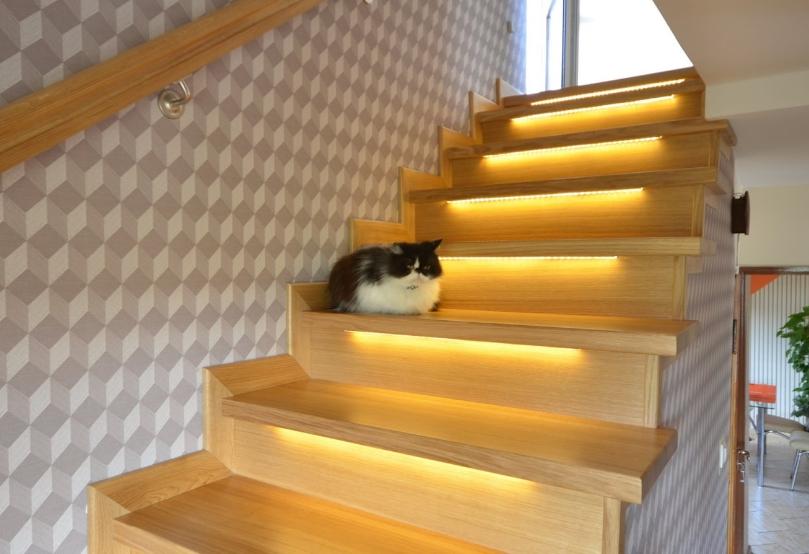
It is much easier to use LED strip, it can provide good quality light. The element is glued to the ledges of the steps with a width of only 2 cm. It is not difficult to connect, any person who has at least the skill of soldering wires can handle the job.
The LED strip is powered by 12V, so the backlight is safe.
railing lighting
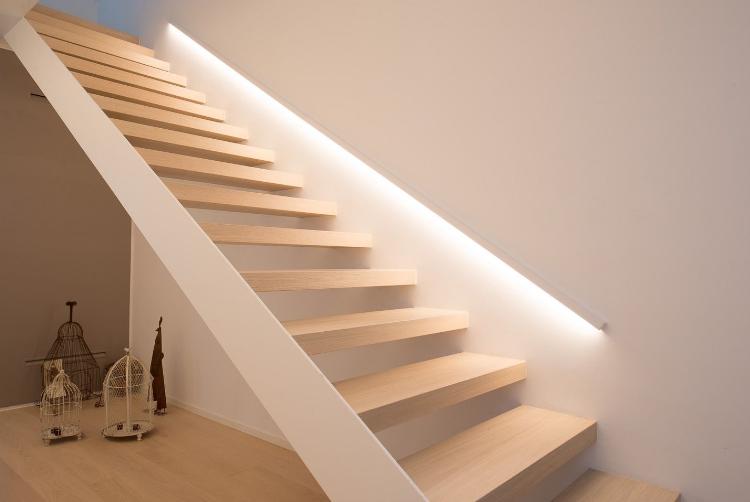
Another solution that allows you to well illuminate the flight of stairs. Most often, an LED strip is used, which is glued to the back or bottom of the railing and illuminates the steps along the entire length. At the same time, connection and installation will not cause any particular difficulties, you will not have to redo anything, even if the ladder is already assembled.
The option is not suitable in cases where the railing is small and their length is not enough for normal lighting of the entire span. It is not very good for large width structures, where the light from under the railing will not be enough to properly illuminate the span. You can combine it with other types of lighting.
Window sill lighting
Suitable only for stairs, near which one or more windows are placed.To emphasize the openings and at the same time improve the illumination of the stairs, a backlight from the LED strip is attached to the lower part of the window sill. It is difficult to achieve uniform lighting here, since it all depends on the location and size of the window openings.
This option is used for decorative purposes, but it can improve lighting if step lighting is used, which cannot give the desired effect. When installing, it is worth choosing the position so as to prevent accidental damage to the LED strip.
Lighting schemes for different types of stairs
Depending on the design of the stairs and the material of its manufacture, different lighting options can be used. It is better to deal with this aspect in advance in order to immediately select those solutions that are suitable.
First you need to determine the type of stairs, there are three main options:
- screw occupy a minimum of space, look original, but require high-quality installation and good lighting. When using step lighting, you need to illuminate each element. Either built-in options or LED strip are best suited. You can use general lighting from the ceiling or walls, if you do not want to deal with lighting steps.
- marching consist of one or more spans, which can be either straight or complex shapes. Here you can use any solutions, it all depends on the design and the angle of inclination - the larger it is, the higher the lighting requirements for safety. Schemes should be selected individually, based on the characteristics of the house or cottage and the available lighting.
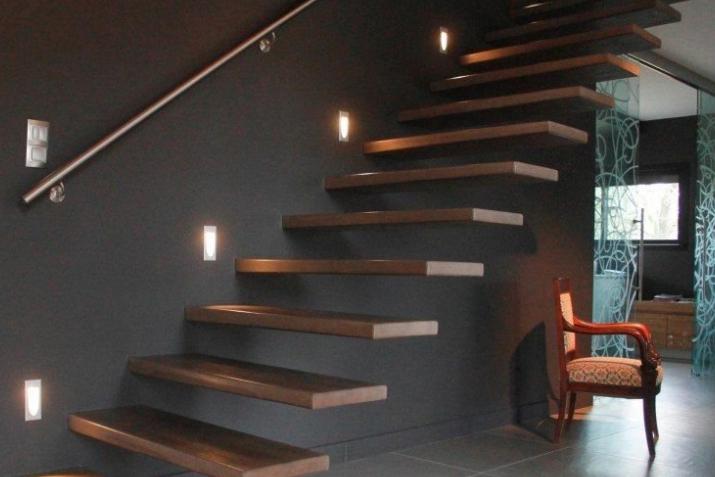
- soaring steps are a new word in stair structures, they are mounted on special brackets and seem to hang in the air.For this option, it is worth using high-quality lighting of a local or general type. But it is better to combine different options for security.
![floating structures]() Soaring designs are original and require high-quality lighting.
Soaring designs are original and require high-quality lighting.
The material from which the stairs are made also matters. The features of installation and the possibility of fastening to a particular surface depend on this. It is worth considering the following recommendations:
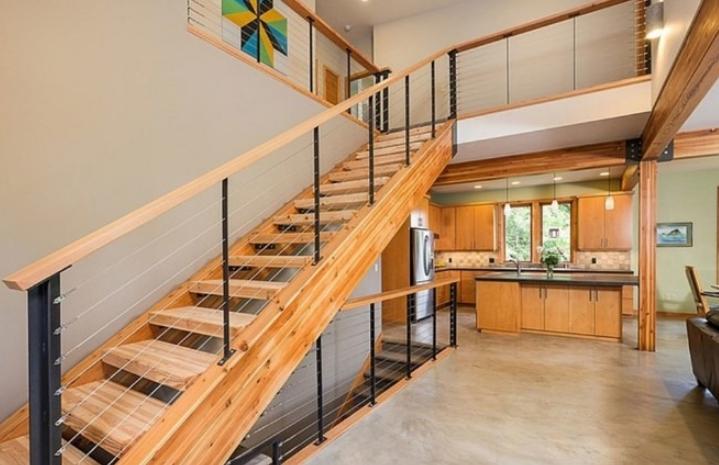
- Wooden stairs are used most often because of the availability and ease of processing the material. In this case, the wiring must be packed in a non-combustible corrugation, which is attached in any suitable place. Attaching lights or embedding recessed options is easy, as there are accessories and fasteners of any type. It is better to choose equipment that does not heat up during operation.
![Wood is a traditional material for making stairs.]() Wood is a traditional material for making stairs.
Wood is a traditional material for making stairs. - Metal structures are strong and durable, but it is difficult to attach lamps or wiring to them. Most often, LED strip is used, as it simply sticks to the metal and holds normally. In this case, lighting from the walls or ceiling is often used, since this does not require special preparation.
- For acrylic and glass elements, it is most important to provide diffused light, so special screens are often used or an LED strip is placed at the ends. Since the material is transparent, it is very important to carefully lay the wiring, and the backlight can even be placed under the stairs, it will give normal light, since most of the structure passes it without problems.
- Concrete options are durable and easy to implement, but at the same time it is difficult to mount lamps on them, and wiring will not work.In this case, most often the structure is sheathed with wood or other material, and the lighting equipment is placed on the walls or ceiling, which is the easiest and most convenient way.
There may be different combinations of materials, there are no restrictions, the main thing is the reliability and safety of the structure.
How to make your own step lights
Let's figure out how to independently make the illumination of the flight of stairs leading to the upper floor. The work is not difficult and depends on the type of equipment used. Two main options can be distinguished and considered separately.
Built-in lights
This type was used most often until a few years ago. Now it is used less often, but in some situations it will fit perfectly. When carrying out work, follow a few tips:
- To begin with, the installation location of the fixtures, their position and number are determined. It is necessary to proceed from the power of the equipment, the required level of illumination and design features. You can build the case into the steps or put them into the wall if it is made of drywall.
![Built-in options are most convenient to put in drywall walls.]() Built-in options are most convenient to put in drywall walls.
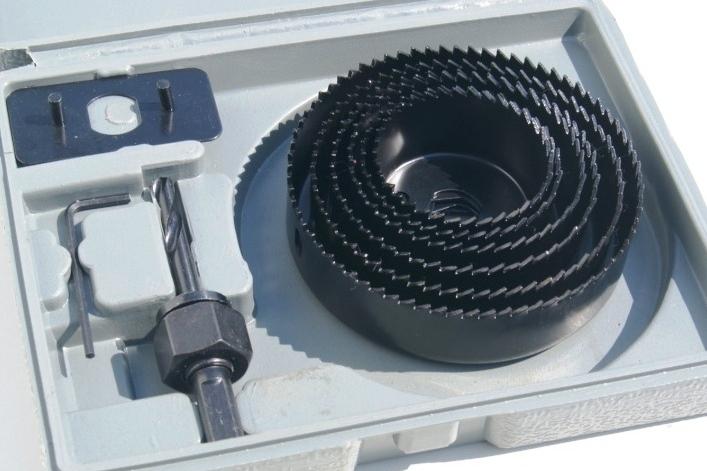
Built-in options are most convenient to put in drywall walls. - When using side lighting, you should lay the wiring even at the stage of installing drywall sheets, this will greatly simplify the work in the future. It is also better to purchase crowns for drywall in advance according to the size of the fixtures. Marking the location of the equipment is done in advance so that the holes are symmetrical, at the same distance, and everything looks perfect.
![Staircase lighting in a private house]() Crowns for wood or drywall are also suitable for plastic.
Crowns for wood or drywall are also suitable for plastic. - It is best to connect the fixtures with the help of blocks, do not twist, as this does not provide the necessary reliability and durability. Leave the wire with a margin, it should not be stretched or twisted.
- If the fixtures will be built into risers or steps, holes are made using a special wood crown. Moreover, the work can be carried out even before the installation of the stairs, on the removed elements it is much easier.
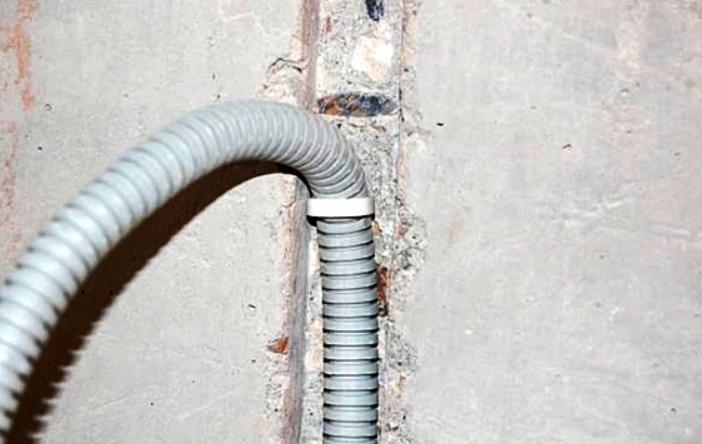
- When laying wiring under steps, place it in corrugations or take it out of the wall, if possible. Pay attention to safety, securely protect contacts to prevent electric shock to people and pets.
![corrugated sleeve]() Corrugated sleeve is best suited for wiring.
Corrugated sleeve is best suited for wiring. - Choose fixtures with impact-resistant shades, as they can be damaged by feet.
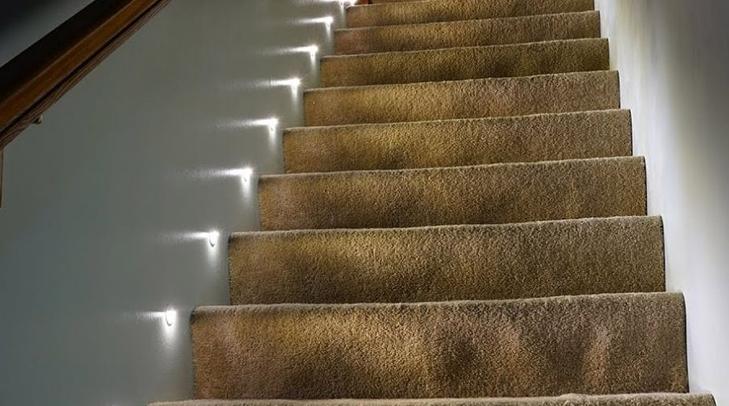
It is better to choose fluorescent or LED options, as they do not heat up as much as halogen or incandescent lamps. In addition, the energy consumption of the former is much less.
LED Strip Light
The simplest and safest solution that can be installed without electrical experience. If you choose a quality tape, it will well illuminate a space of any size and configuration. The work is done like this:
- Ribbon is selected with suitable brightness values. They depend on the number of LEDs per linear meter, which can vary from 30 to 120 pieces. At the same time, it is possible to choose the light temperature, which is also important. Most often, options are used that are close to natural light, which convey colors correctly.
- Tape is the easiest paste on the bottom of the steps or any other elements, these can be ledges on the walls, railings, window sills, etc. It is worthwhile to measure the length in advance and select the size of the tape in accordance with the cut lines, they are located at the same distance. Cut scissors with sharp blades.
![Installing the LED strip is easy.]() You can install the LED strip on the back side under the ledge.
You can install the LED strip on the back side under the ledge. - Wires can be connected connectors or solder and cover the attachment point with heat shrink tubing. Use a cable with copper conductors in flexible insulation.
- Determine the location of the power supply in advance. It is better to hide it, but it is important to place the node not in a closed space, as it must be cooled during operation.
- Before gluing the tape, the surface must be cleaned and degreased. If the substrate is highly absorbent, it is best to reinforce it with a penetrating primer. If the adhesive layer is fragile, you should additionally use double-sided tape, which is cut into narrow strips.
If using battery power, find a place to place it in advance.
Staircase lighting with motion sensor
If you do not want to install standard switches to illuminate the stairs, you can make the light on the stairs with a motion sensor. Then it will turn on only when necessary, which will save energy. You can use one of the following options:
- Install sensors in the upper and lower parts that react to movement in a certain segment and turn on the light. The most important thing is to choose a good place to place them so that the backlight starts at the right time. Most often, the equipment is located on the approach, so that when a person steps onto the flight of stairs, the light is already on.
![Sensors need to be installed correctly]() Sensors must be installed correctly so that they work at the right time.
Sensors must be installed correctly so that they work at the right time. - You can use acoustic sensors that respond to clap or the sound of a voice. They are located in the places indicated in the installation instructions, there may be several options, it is better to follow the manufacturer's recommendations.
- Another option is a load sensor, it is attached to the first steps so that the lighting turns on when a person steps on the surface.
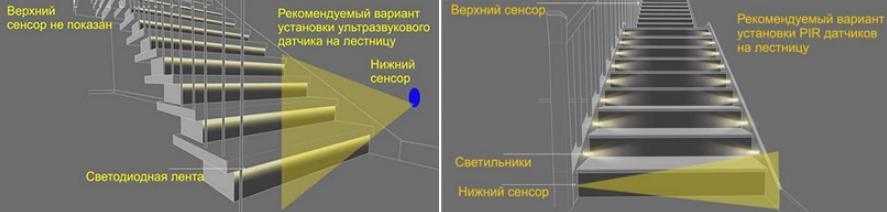
It is not uncommon to combine the two auto-on options to ensure good efficiency and prevent failures.
During installation, follow the instructions in the manual and observe wiring diagram. Usually the system is almost the same as the options with a conventional switch, the main thing is to correctly position the sensors so that they work on time.
Read also: How to adjust motion sensor for lighting
In conclusion, we advise you to look: 3 ways to turn on the light on the stairs.
Step-by-step video instructions for installing lighting on a concrete staircase lined with wood.
It is very important to provide staircase lighting in a private house or a two-level apartment, as safety and ease of movement depend on it. When choosing, you should give preference to safe options with low power consumption, it is better to use what you can install on your own.