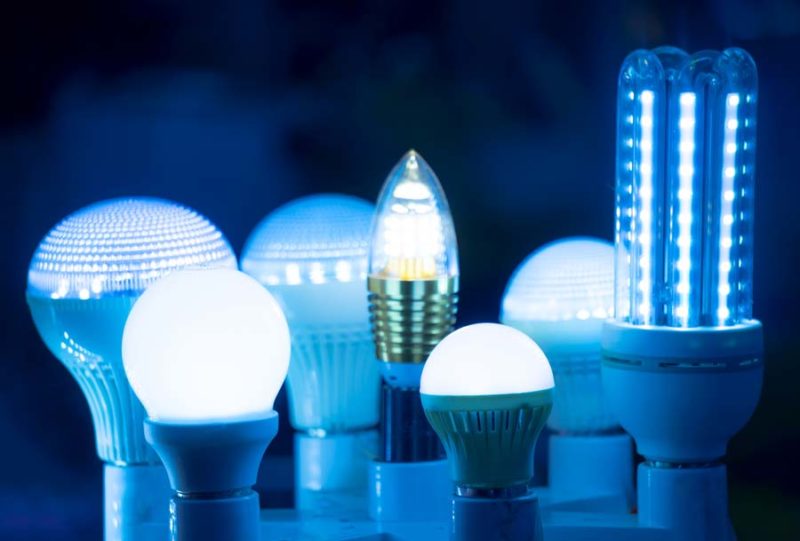
Parameters and characteristics of LED lamps
LED lamps are rapidly gaining popularity in recent years. This is due to their cost-effectiveness and improved manufacturing method. Statistics show that this light source works 20 times longer than other analogues. To purchase high-quality LED products, you should know the parameters of LED lamps: power, size, color temperature, dispersion angle and service life.
Power
The power consumption of a lighting element is one of the main factors affecting the energy consumption of a device for 1 hour. The optimal performance of 6-13 W corresponds to the power of 50-100 W for incandescent lamps. The total power consumption also takes into account the power of the drivers that work in conjunction with the LEDs. They consume about 10-15% of the total power of the device.
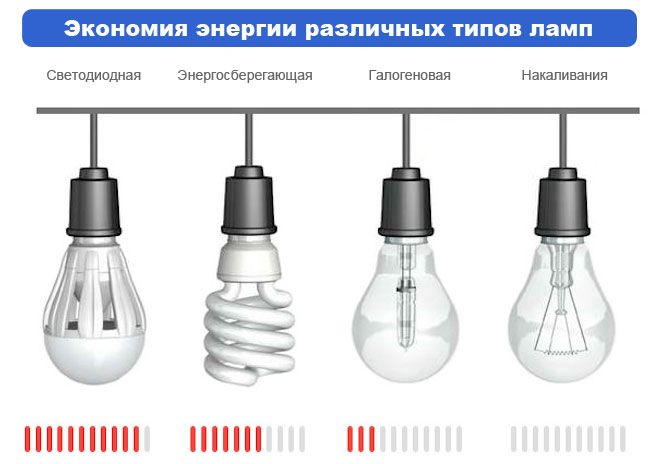
Plinth type
You need to know the dimensions of the base before buying in order for the light bulb to fit the socket in the lamp. Most often, LED lamps are produced with a threaded base E14 and E27.They are considered standard and are used in wall and ceiling lighting elements. On sale there are lamps with a different base thread:
- E40. It is installed in lighting elements with high power. For example, in lamps for street lighting.
- G4, GU10. Socles in LED equipment that completely replaces halogen lamps.
- GX53. This type of base thread is found in recessed fixtures that are installed on the ceiling / wall covering.
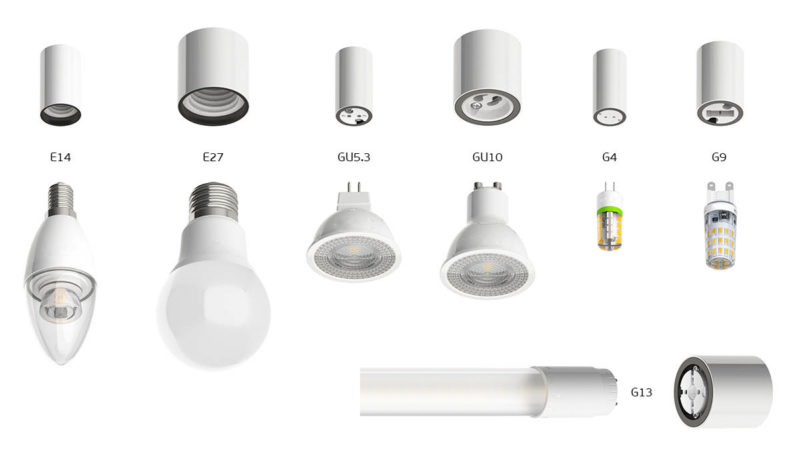
On sale there are LED lighting elements with a G13 base, which is used in tubular luminaires.
Dimensions of LED lamps
The size of LED lamps depends on their shape.
- Form A. This category includes household lighting equipment. The standard diameter of products is 60 mm. Lamps can have a diameter of 50 to 65 mm.
- Form B. Luminaires with a more elongated body. Most often used to create decorative lighting. The standard size is 55-60 mm.
- Form C. Inserted into wall lamps and chandeliers. They have an elongated shape with a pointed end. The lamps use an E14 base thread. The standard diameter is 37 mm.
- SA form. Devices with warm light, which resembles candle lighting. The standard size is 35-37 mm.
- Form G. Decorative LED lighting elements of spherical shape. They have an E14 or E27 base. The sizes are different: lamps with a diameter of 30 mm for decorative lighting, with a diameter of 100 m high powerb. The standard diameter is 45 mm.
- Form T. LED tubes, used for lighting commercial facilities. The standard diameter is 28 mm. Length - 60-120 mm.
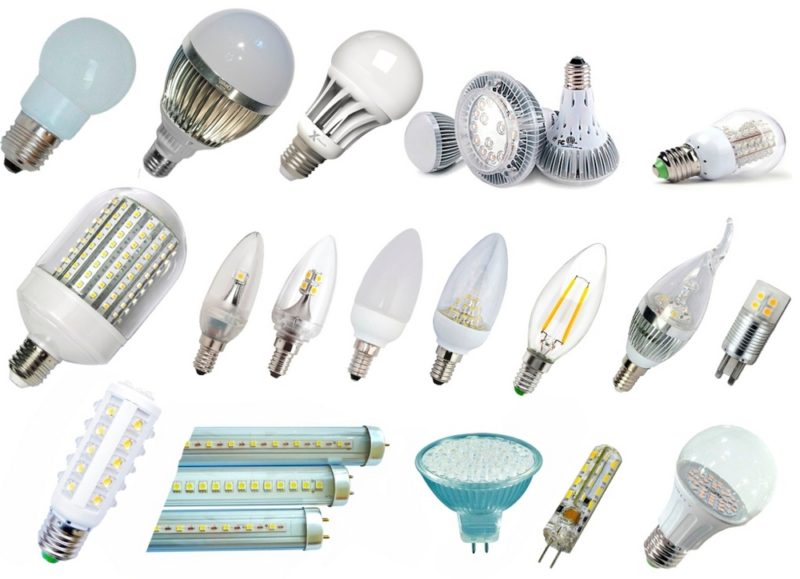
In stores, there are LED lamps of different diameters: from 30 mm to 120 mm.The choice depends on the purpose and installation location.
LED Bulb Weight
Unlike standard lamps, LED lamps have additional elements - drivers and other additions that increase weight. Therefore, when choosing a light source, it is necessary to take into account the mass of the LED structure so as not to weigh down the body of the lamps and chandeliers in which it will be installed. Large weight has advantages - reliability, increased strength, long service life.
Light flow
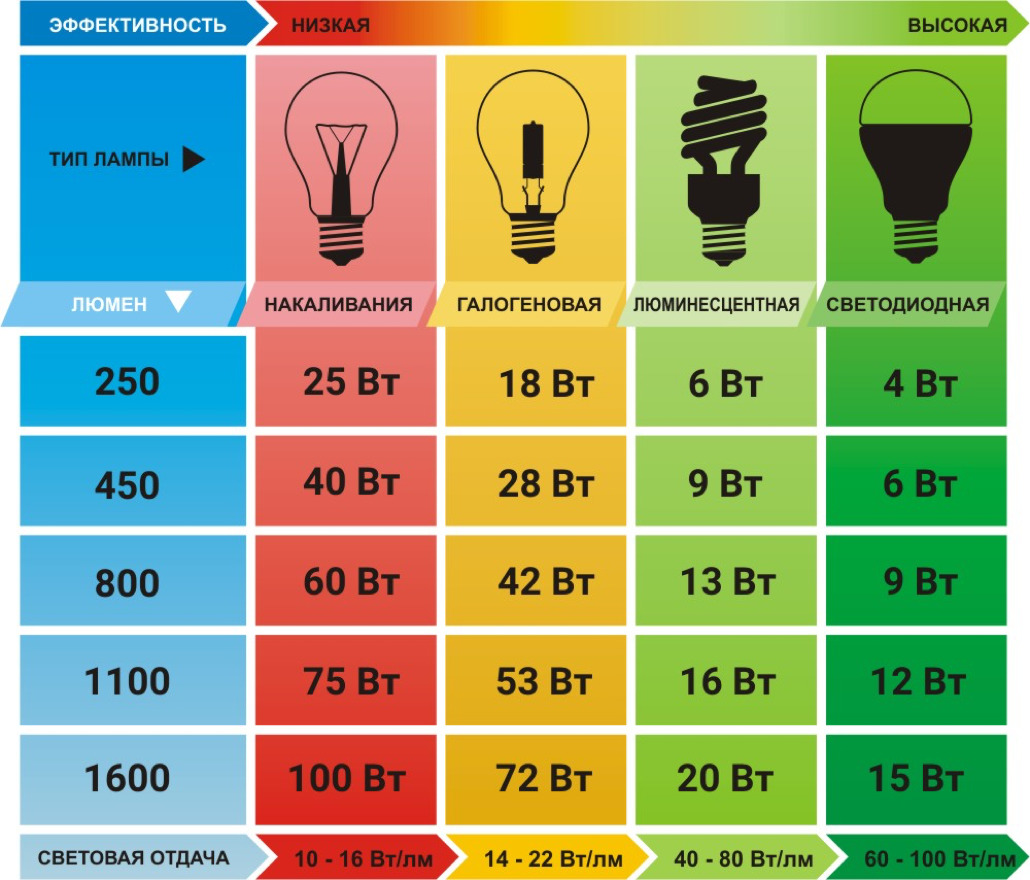
The luminous flux is the amount of energy that a lighting element gives off. Knowing the parameter, you can quickly find a replacement for a burned-out light bulb in lighting equipment. Light output is measured in lumens. The second parameter is efficiency. It determines the ratio of the power of the luminous flux to the power of the consumed electricity. These figures indicate the cost-effectiveness of LED devices. For example, a standard incandescent lamp has a power of 20 watts. Its luminous flux is equivalent to 250 lumens. The same indicators of the light flux are observed in LED-light bulbs with a power of 2-3 watts.
Scattering angle
The scattering angle of LED devices is the angle at which the light stream diverges from the light source. Indicators are measured in degrees. Values range from 15-360 degrees. Ordinary incandescent lamps have a standard dispersion angle of 360 degrees, LED devices have more advanced features. According to the scattering angle, they can be divided into three groups:
- Narrow angle (up to 60 degrees). Light elements with such indicators give concentrated illumination of objects and are used for local illumination.For example, to illuminate a specific area in the house (mirrors, shelves, TVs).
- Wide angle (90-360 degrees). LED-devices with such indicators create uniform illumination over the entire area of \u200b\u200bthe room.
There is an intermediate option - lighting equipment with a scattering angle of 60-90 degrees. These are standard lamps that can be used for both local and general lighting.
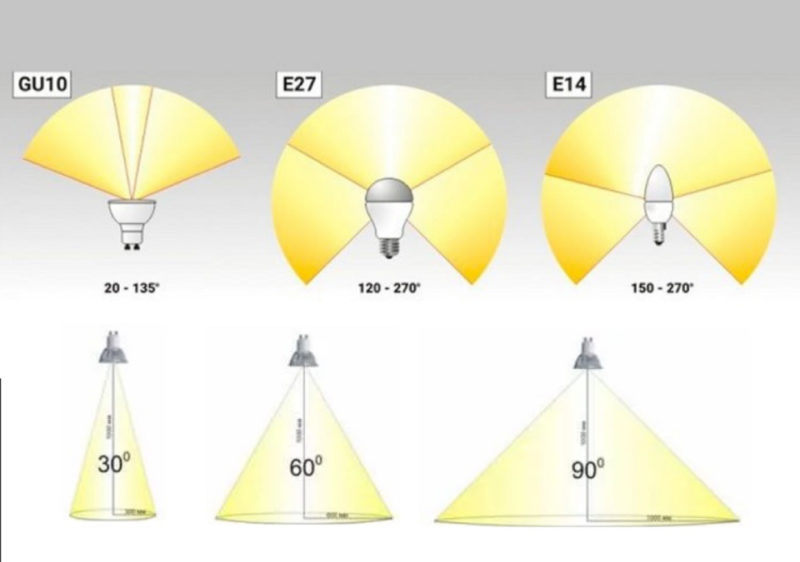
When buying luminaires with an intermediate dispersion angle, it is better to choose models with a swivel option. It allows you to change the color direction. The standard is 210 degrees. It is enough to fully illuminate residential buildings. For commercial and design purposes, lamps with a beam angle of 110-120 degrees are used to highlight small details.
Colorful temperature
Color temperature is an indicator that indicates the shade of the emitted light flux. Conventionally, all lamps are divided into three types:
- With warm color temperature.
- With neutral color rendering.
- With cold light.

When choosing lighting fixtures, consider the place in which they will be used. If this is a bedroom, it is better to give preference to warm or white lighting (up to 3000 K). In the kitchen and bathroom, it is better to use lamps with neutral lighting (3500 K). If commercial facilities are illuminated, then it is advisable to opt for cold lighting. Equipment that creates the effect of daylight (more than 5300 K) in residential areas is not used, only for specific work. Also lamps with cold light are used as elements for emergency lighting. Comparison table:
| Parameters of LED lamps, type of lighting, created atmosphere in the room | |||||
| Temperature | Warm light (2700 K) | White lighting (3000K) | Neutral lighting (3500K) | Cold light (4100 K) | Daylight (6000K) |
| Atmosphere | Warm and cozy atmosphere | Brighter light that creates a pleasant atmosphere with good visibility | Nice atmosphere with excellent visibility | Bright and clean atmosphere | Emphasizing colors and too bright atmosphere |
| Where applicable | Residential premises, cafes and restaurants, boutiques | Shops, offices, libraries | Office space, showrooms, supermarkets, shops | Offices, hospitals and hospitals, large supermarkets, shopping malls, classrooms in schools | Galleries, exhibitions, jewelry outlets, medical offices that are used for examinations |
Life time
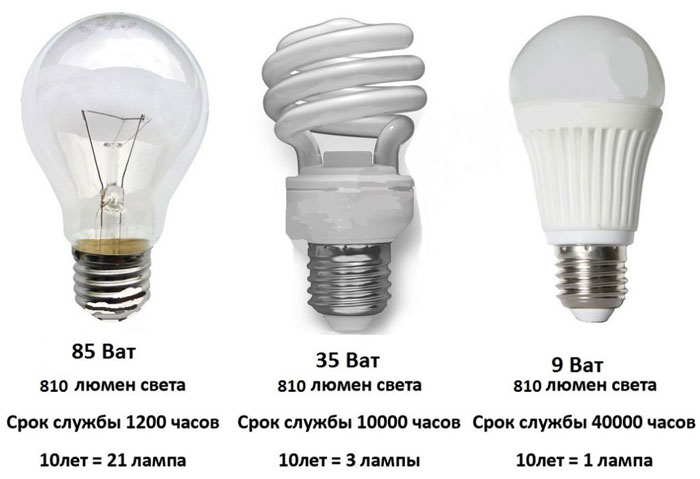
When choosing LED lamps, you should also take into account their service life, which manufacturers indicate on the packaging. However, these figures are very relative. Even if the manufacturer indicates 30 thousand hours of operation on the box, the LED lamp can fail much earlier. The overall service life depends on other parts of the equipment. Also, this indicator is affected by the assembly quality of the lamp, the soldering of radio elements. Since LED elements have a long life, no manufacturer can test the run time. Therefore, all pointers on the packages can be considered conditional.
Adjustable LED lamps
LED devices allow you to adjust the brightness of the lighting. This happens with the help of a control device - a dimmer. The regulator helps to get the most suitable light that will not strain your eyesight.The dimmer works by generating pulses. Their frequency affects the brightness of the lighting. Not all LED systems can be adjusted with a dimmer. Its functions can be performed by a driver that is built into the lamps. In this case, the functionality will be somewhat limited.
If the buyer needs dimmable equipment, you should carefully study the packaging of the products. All manufacturers write about the possibility of adjusting the lighting on the boxes.
Advantages and disadvantages of LED lamps
The advantages of LED lamps include:
- Lifetime. Light sources operate from 50,000 to 100,000 hours without interruption.
- Economical energy consumption. LEDs are classified as light sources with an efficiency 10 times higher than their counterparts.
- Thermal stability. LED lamps are resistant to atmospheric changes, do not deteriorate with a sharp change in temperature.
- Environmental friendliness. They are made on the basis of safe materials that do not harm health.
Cons of LED lamps:
- Price. Lighting elements are more expensive than their main counterparts.
- The size. High power lamps are large. This is not always convenient for rooms with a small area.
- LED driver. For stable operation of the LED system, you need a special power supply, which also has a high cost.
Another disadvantage is the difficulty in replacing diodes in case they burn out. Sometimes this is not possible.
The difference between LED lamps and other light sources lies in the transformation of light into any shade.
Conclusion
LED lamps are a worthy alternative to standard incandescent lamps. Devices work more economically, differ in the increased service life, multifunctionality.Using LED devices, you can adjust the brightness of the lighting, highlight certain objects, create the most favorable atmosphere for the eyes in the room. Various LED lamps are on sale, which differ in their shape, characteristics, size, power level, color rendering, dispersion angle. The choice of equipment depends on the location in which it will be used, as well as on the additional functions that need to be performed.