How to make kitchen lighting - the location of the lamps
Lighting in the kitchen must be organized correctly to ensure the functionality and attractive appearance of the room. It is important to follow all the recommendations and select the optimal types of equipment. In addition, functional areas are thought out in advance, as they need to be illuminated additionally.
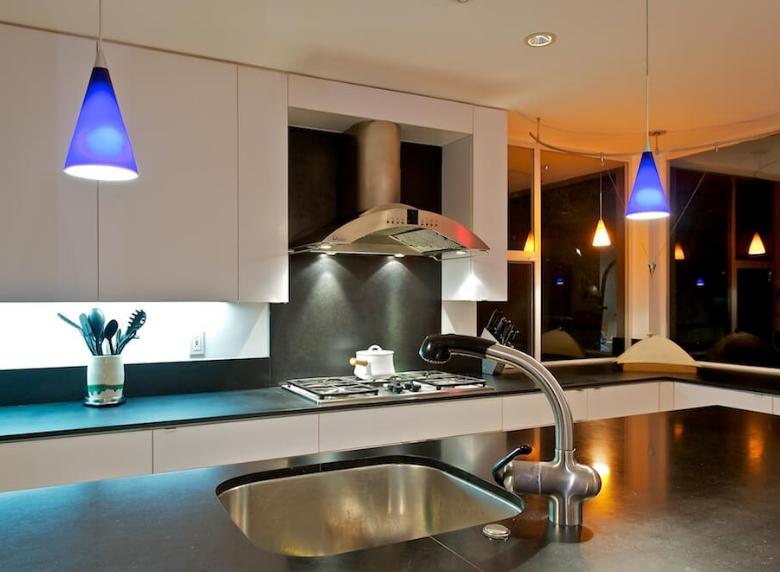
Norms and requirements
There are a number of sanitary and hygienic requirements, which contain all the necessary information on the organization of lighting. The main regulation is SNiP 23-05-2010 "Natural and artificial lighting", as well as the set of rules 52.13330.2011 with the same name. According to the documentation, the illumination in the kitchen should be from 150 to 200 lux per square meter.
It is not difficult to calculate the total power, you need to multiply the area of \u200b\u200bthe kitchen in squares by 200. The result obtained will be a guideline.Many light bulbs do not have lux ratings, only watts. For simplicity, the data is collected in a table, it will not be difficult to find the best options for it.
| Luminous flux in lumens | Incandescent lamp, W | Luminescent, W | LED, W |
| 250 | 20 | 5-7 | 2-3 |
| 400 | 40 | 10-13 | 4-5 |
| 700 | 60 | 15-16 | 8-10 |
| 900 | 75 | 18-20 | 10-12 |
| 1200 | 100 | 25-30 | 12-15 |
| 1800 | 150 | 40-50 | 18-20 |
| 2500 | 200 | 60-80 | 25-30 |
These are average figures and may vary from lamp to lamp. Especially often there is a difference in LED equipment, since the lighting characteristics there depend on the type of diodes used, on the number and location.
Based on the data, you can calculate the required number of light bulbs for the kitchen. Use as many light sources as possible. Three 30W bulbs will provide better illumination than one 100W element. There are also requirements for the uniformity of light, so it is worth choosing equipment so that there are no dark places in the room.
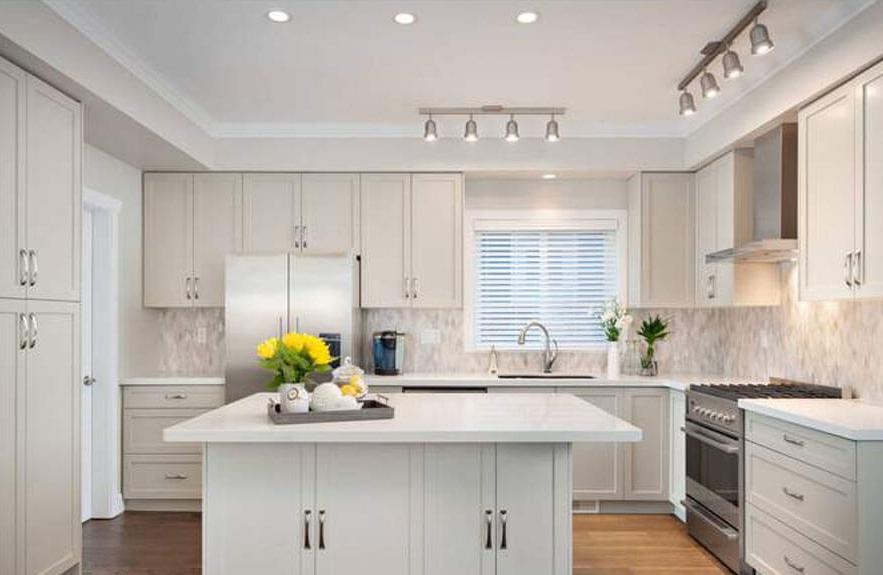
It is also worth considering the pulsation of lighting. This indicator should not exceed 10%, otherwise the eyes will get tired during a long stay in the room. The data must be on the package with the lamp. It is worth checking the luminescent species the most carefully, as they have the highest indicator of invisible flicker.
Colorful temperature affects the perception of the room and the emotional state of people. For the kitchen, the best solution would be a warm yellowish hue that sets you up for relaxation and soothes. Can be used natural light, as it is neutral and creates a comfortable environment. As for the cold shade, it only suitable for work area.
Color rendering index (Ra) indicates how natural colors are rendered under artificial lighting. It is measured on a scale from 0 to 100. For the kitchen, you should choose options with an indicator of 80 or higher so that the colors are not distorted.
Features of the general light in the kitchen
The general light in the kitchen is the main one, most often it works regardless of whether the person is cooking or sitting at the dining table. Therefore, high requirements are placed on it, it is worth choosing reliable equipment that evenly distributes light over the entire area. There are several aspects to keep in mind here:
- It is better to install a chandelier with three bulbs than with one. The light should spread in all directions for the best effect. The second option is to choose a model with a diffused ceiling or a modern LED panel of suitable power. Options with dense shades do not fit very well, as the light spreads over a limited area. How to choose a chandelier for the kitchen is described in detail here.
- When using spotlights as the main lighting, you need calculate their number and evenly place them over the entire illuminated area. These solutions are best suited for tension and plasterboard structures, since it is necessary that there is a void between the ceiling and the partition.
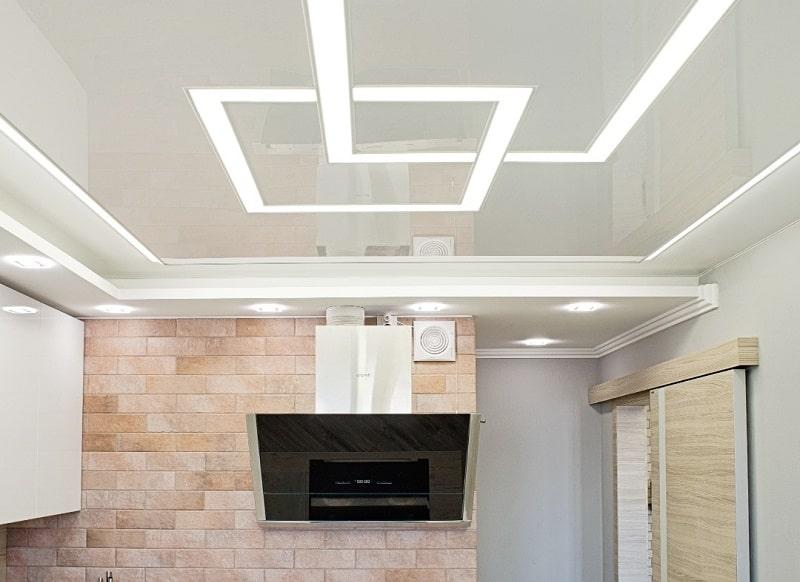
![can replace the traditional chandelier.]() Lines of light look great with spot lighting.
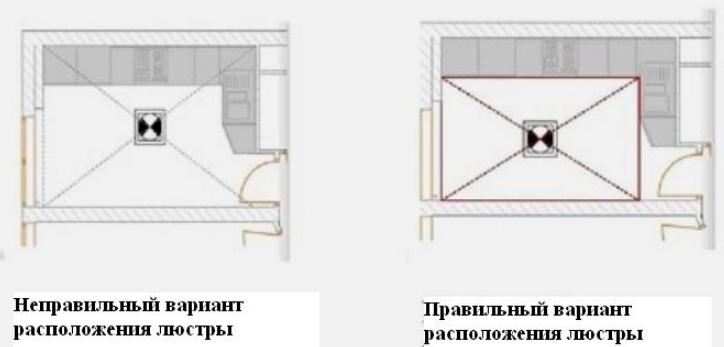
Lines of light look great with spot lighting. - The chandelier should be placed in the center of the space. Moreover, space is not the entire area of the kitchen, but free space without taking into account the kitchen set. That is, the center must be shifted so that the light is evenly distributed where it is needed.
![How to make kitchen lighting - the location of the lamps]() It is necessary to choose the actual, and not the geometric center of space.
It is necessary to choose the actual, and not the geometric center of space. - The size of the kitchen is taken into account.If it is small, one chandelier is enough. The main thing is that it evenly distributes light in all directions. You can use both diffused and reflected light, when the flow is reflected from the ceiling. But in this case, it is necessary to select lamps of higher power, since the brightness will be lower.
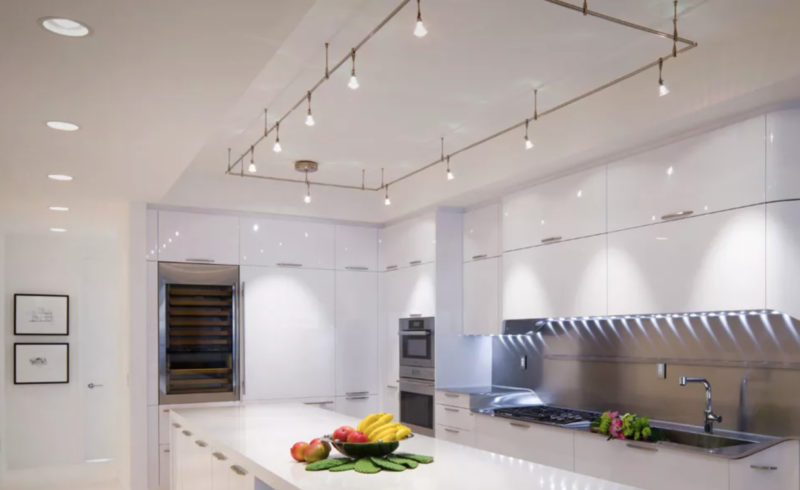
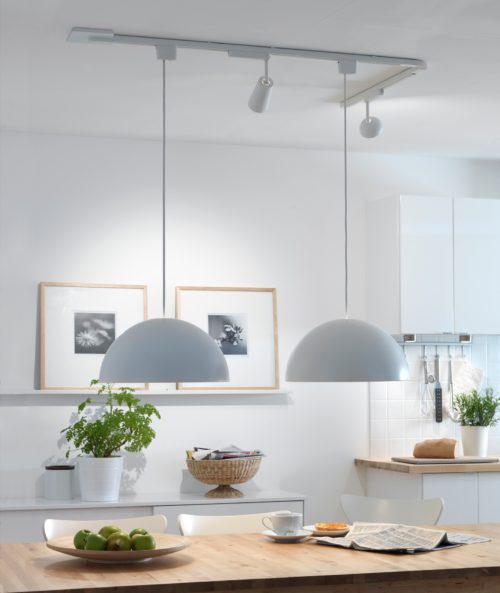
- For a large kitchen, one chandelier is usually not enough. If the room is elongated, you can hang 2-3 identical chandeliers at an equal distance, it is fashionable and functional. You can also use track systems when several ceiling lights are installed on the bus, which can be directed in any direction.
- It is worth looking at the possibility of adjusting the light. For this, set dimmers, which can change the brightness to achieve the optimal effect depending on the time of day.
The kitchen must have adequate natural light. Therefore, do not hang blackout curtains on the windows and limit the ingress of daylight into the room.
The video discusses the most popular types of lighting.
Organization of local and spot lighting
One general lighting is not enough to ensure normal conditions in a modern kitchen. It is necessary to organize the light in such a way that in each functional area it meets all the requirements and provides comfort. The following types of equipment are used here:
- Spotlights They are used most often in the kitchen. Usually they put built-in models, they will fit under the stretch ceiling and plasterboard structures. If there is no void above the ceiling, overhead solutions are placed. Designs are both stationary and adjustable, which is very convenient.
![How to make kitchen lighting - the location of the lamps]() Unusual solution for the kitchen.
Unusual solution for the kitchen. - Modules of several spotlights, if you need to qualitatively illuminate a small area.They give intense bright light, due to the rotary shades it can be adjusted to distribute the flow over a certain area.
- Track systems – a convenient solution for additional light. The current-carrying tire fastens to a ceiling or a wall. You can put lamps on it anywhere and direct it as you like. If necessary, elements can be moved or additional ones can be added.
![How to make kitchen lighting - the location of the lamps]() Track lights can be used as the main light.
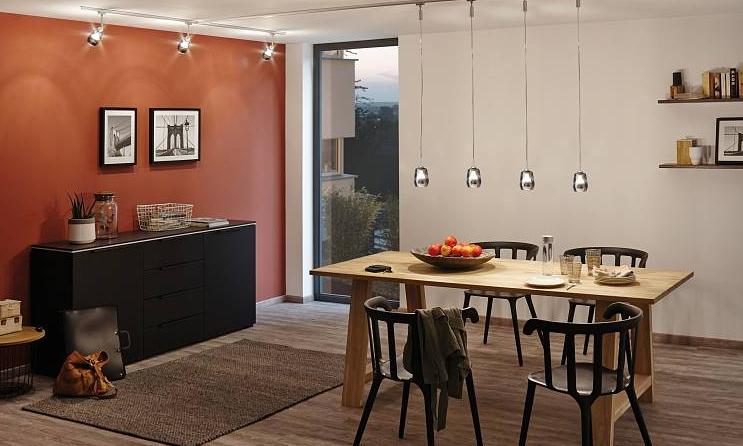
Track lights can be used as the main light. - Suspended lampshades on a long wire are a convenient solution for different kitchens. The main thing is to think over their location and design style so that the lamps fit the environment.
![You can put on the busbar]() Suspended ceiling lamps can be mounted on the bus duct.
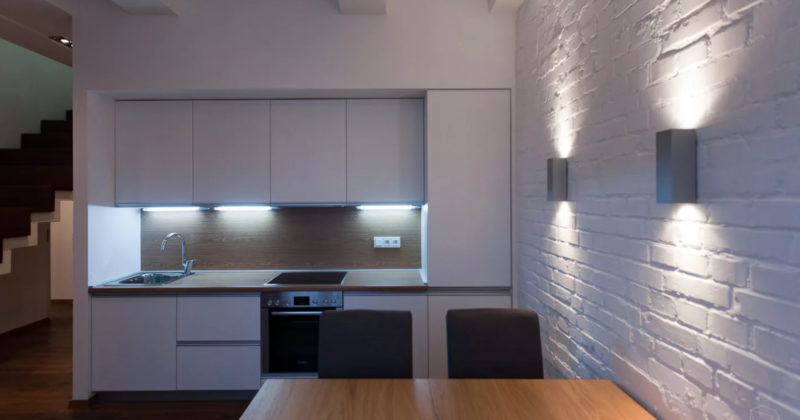
Suspended ceiling lamps can be mounted on the bus duct. - Wall-mounted are suitable for a limited area, they allocate a small space well. You can also use an adjustable option to change the luminous flux.
![How to make kitchen lighting - the location of the lamps]() Decorative wall lamps are always cozy.
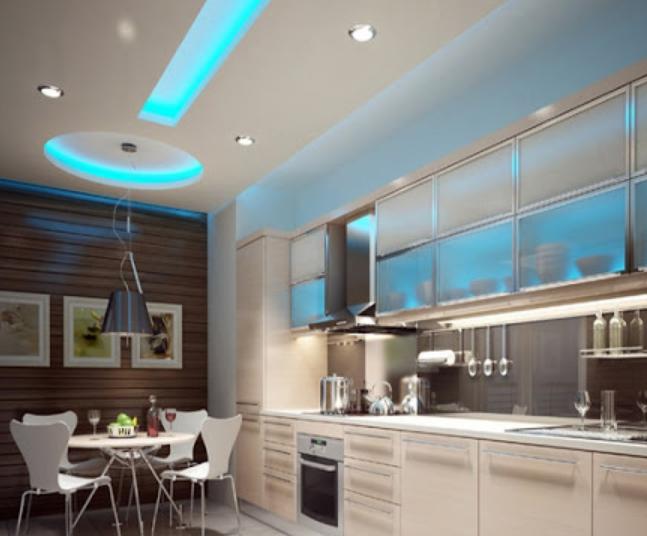
Decorative wall lamps are always cozy. - LED Strip Light will work well if you choose and position it correctly. Monochromatic options are best, as they give better light than multi-color tapes.
![How to make kitchen lighting - the location of the lamps]() LED strip in silicone coating is ideal for the kitchen.
LED strip in silicone coating is ideal for the kitchen.
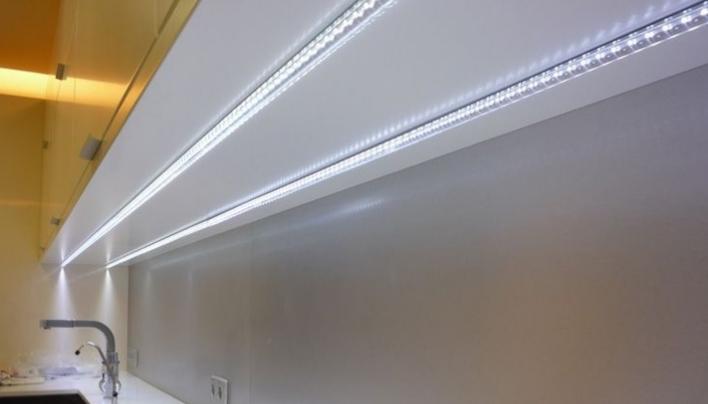
At choice of fixtures for places where there is a danger of water ingress, it is better to buy models with increased resistance to moisture.
How to properly illuminate the dining area
Ideally, position the dining area near a window to let in as much natural light as possible. In the evening, lighting is used above the kitchen table, it should be installed separately, as this area requires special attention. The only exceptions are small kitchens, where the chandelier normally illuminates the countertop. In other cases, the following solutions are suitable:
- A single chandelier above a square or round table.It should be made in the same style as the main one. In this case, the size is most often smaller, since only a small area needs to be illuminated.
![How to make kitchen lighting - the location of the lamps]() The kitchen table is recommended to be illuminated with warm tones.
The kitchen table is recommended to be illuminated with warm tones. - Two or more shades on a long cord. The option is often used as lighting for the dining area. These lamps look stylish and provide high-quality light where it is needed.
![How to make kitchen lighting - the location of the lamps]() Lighting the dining area in the kitchen.
Lighting the dining area in the kitchen. - Wall lights. A good solution for both small kitchens and more spacious ones, in which the table is pushed up to the wall. It can be both classic sconces and modern options with a directional stream of light.
![How to make kitchen lighting - the location of the lamps]() Wall lamps are suitable for both modern and classic interiors.
Wall lamps are suitable for both modern and classic interiors. - Point light sources. You can simply arrange their location so that the light falls on the dining area. For this section, it is better to use a separate switch.
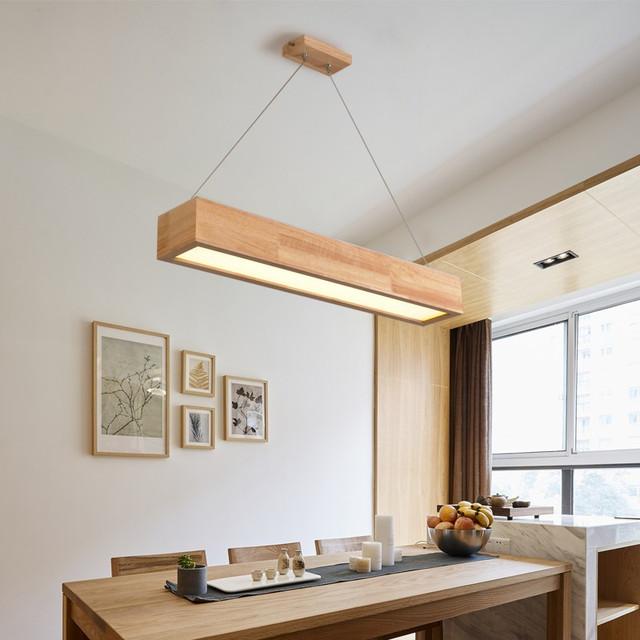
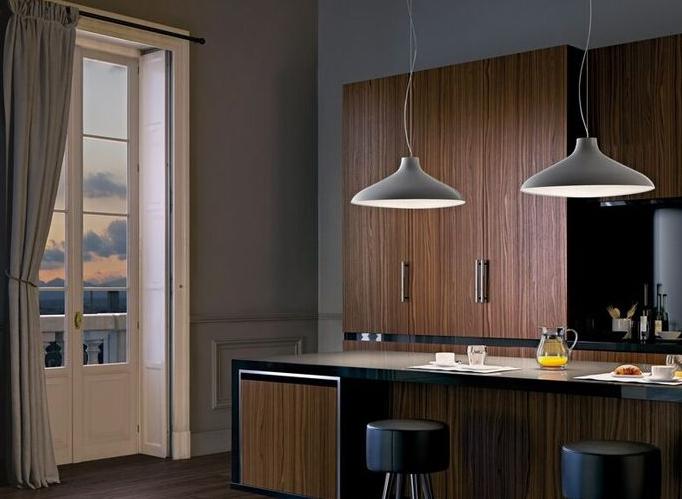
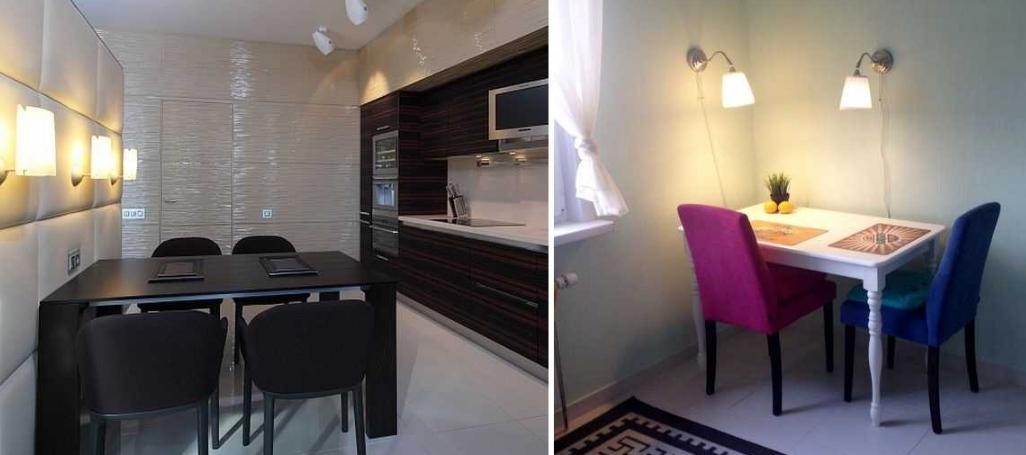
Five options for decorating the dining area.
Light above the work area
This is an important part of any kitchen, which is worth paying attention to if the owners often cook. You can arrange lighting in different ways:
- Consider the location of spotlights in the kitchen so that one of the rows falls exactly on the work surface. At the same time, it is sometimes difficult to provide good light, as wall cabinets interfere.
- Spotlights or LED strip are placed on the bottom of the hanging cabinets. The second option is considered the simplest and most convenient for today.
- To illuminate the stove, you must choose a hood with a built-in lamp. This is the most rational solution.
If the light source is located near the sink, it must be waterproof.
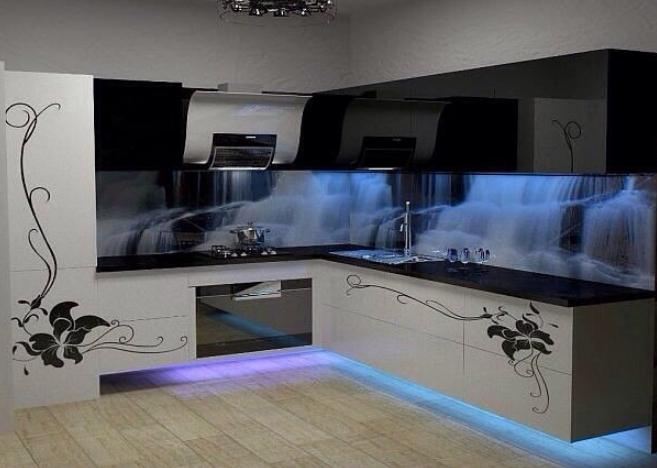
Decorative kitchen lighting
To give the interior a finished look, you can emphasize or highlight individual elements with light. Decorative lighting serves not only to decorate, but also to smooth out the imperfections of the kitchen. The following methods are used:
- LED lights along the perimeter, located under the plinth, visually expands the space and makes the ceiling higher. The light is directed both to the interfloor ceiling and to the wall.
- You can install the tape along the bottom edge of the floor cabinets. Plinth lighting not only gives the furniture a soaring look, but also makes the room more spacious.
![How to make kitchen lighting - the location of the lamps]() Decorative lighting transforms the kitchen.
Decorative lighting transforms the kitchen. - To create original effects, use a multi-color LED strip. Using the remote control, it is easy to fine-tune the shade and change it from time to time to freshen up the environment.
- If there are paintings hanging in the kitchen or there are other objects that you can focus on, directional light is used. It can come from both the ceiling and the walls.
![How to make kitchen lighting - the location of the lamps]() One track system can illuminate 3 areas: a dining table, paintings and a niche above kitchen cabinets.
One track system can illuminate 3 areas: a dining table, paintings and a niche above kitchen cabinets. - Wall sconces also contribute to the visual expansion of the kitchen. They should not be too bright, so as not to create visual discomfort. Most often, such elements are arranged symmetrically according to the chosen scheme.
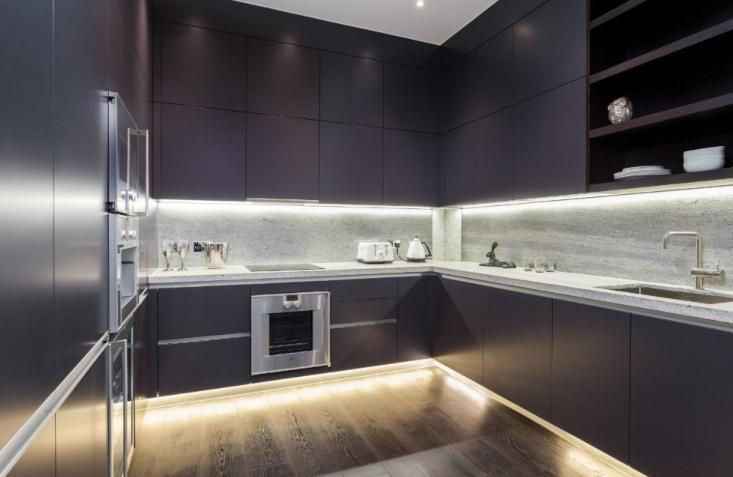
If cabinets with glass doors are installed in the kitchen, their illumination from the inside will be a very effective decorative technique.
Thematic video: Detailed installation of work area lighting.
To organize functional and attractive lighting in the kitchen, you must follow simple rules. Calculate the total power of the fixtures, choose specific options based on the size and shape of the room, and consider the optimal location on the ceiling or walls.