What is an LED - a detailed description of the characteristics and types
LEDs are everywhere: in houses, cars, phones. With their help, bright illumination of gadget screens is provided, economical sources of lighting are produced. Now they are indispensable sources of light. Consider the device and technical characteristics of the main types of LEDs.
What is an LED
An LED (from the English Light Emitting Diode, or LED) is a solid-state electrical source of artificial light made from p- and n-conductivity semiconductor materials. Using several technologies - sputtering through masks, etching, epitaxial deposition, etc., a p-n junction is obtained.
In a p-type semiconductor material, current carriers are "holes" - atoms of a semiconductor crystal, in which, by doping with special metals, they create a shortage of electrons. In n-materials, the carriers are excess electrons in the crystal.
The "hole" is virtually motionless. It has a positive charge equal to the charge of an electron. The electron, "jumping" from the outer orbit of one atom to the outer orbit of the neighboring one, moves the "hole" in the opposite direction.
The principle of operation or what glows in the LED
By connecting a constant voltage of a certain magnitude and polarity to the p-n junction, they cause an electric current in the junction in the form of a counter flow of electric charge carriers - “holes” - positive “particles” and electrons - negative. When these streams meet in a p-n junction, they recombine or merge. A free electron with increased energy enters the “hole”, and it disappears.
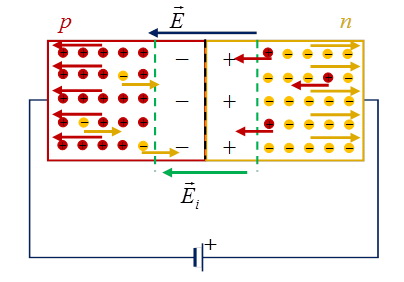
On the right is the n-semiconductor part of the crystal, "enriched" with free electrons, on the left is the p-semiconductor part with positive "particles" - "holes".
Energy is released in the form of light quanta. They are emitted, i.e. emitted from the end of the crystal. The flux of quanta hits the reflector. Its polished surface reflects light in the right direction. A special surface configuration forms the required directional pattern of the light flux.
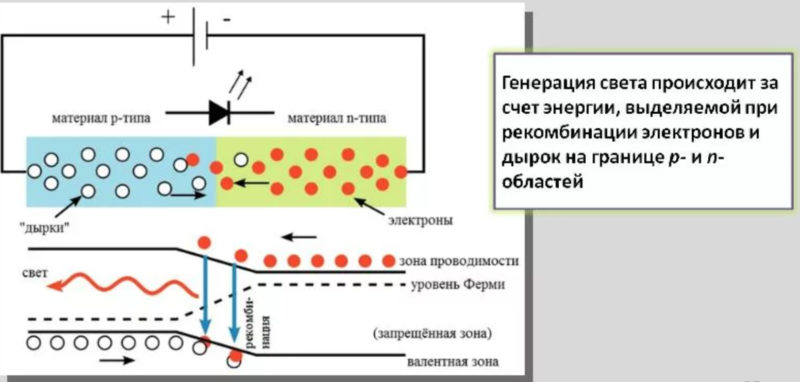
The voltage to power the transition is applied "+" - to the anode of the diode, and "-" - to the cathode.
Design
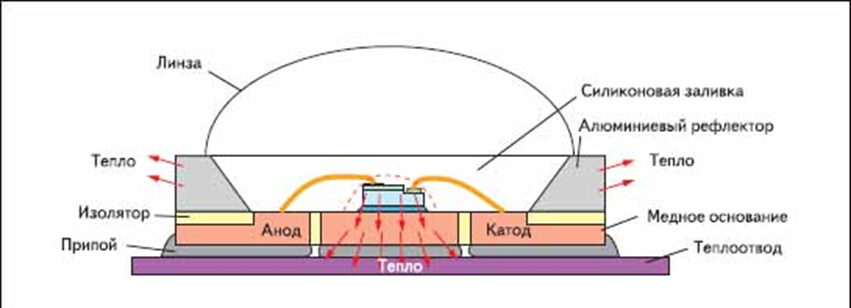
The heat-removing substrate is depicted in lilac. Gray trapeziums are cross-sections of a light-reflecting reflector-reflector of an annular configuration made of aluminum.In the blue center is an LED chip-crystal with connected gold or silver wires soldered to the anode and cathode terminals.
Types of LEDs
LEDs are quite "young" devices. Their final classification has not yet developed. Therefore, many well-known manufacturers use their own subdivision systems.
According to one of them, the LEDs are grouped according to their purpose as follows:
- Indicator.
- Lighting.
Indicators in their group are divided into the following types.
DIP diodes
The abbreviation is derived from Dual In-line Package or "double in-line placement". Usually the cases are cylinders, but there are also parallelepipeds. On the lower end there are wire axial leads parallel to the main axis of symmetry of the body. The output of the cathode is shorter than the anode.
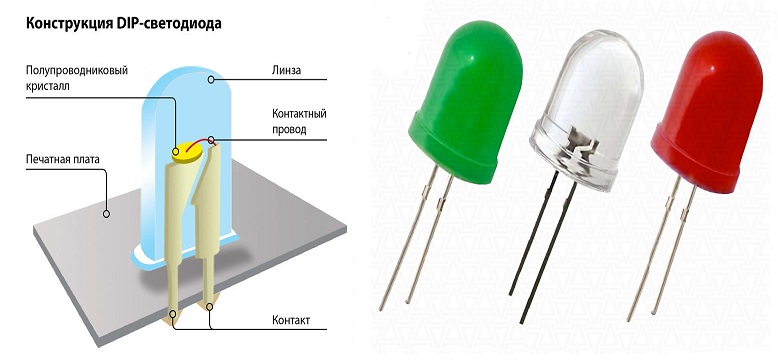
The division into types - according to the diameter of the case and the lens on the upper end. Diameters from 2-3 to 20 mm and more. Glow color - any, several shades of white.
One of the types - flashing in 2 colors, has 3 outputs.
Straw Hat
The literal translation is a straw hat or bryl. Applying to LEDs – the body is like a hat with a rounded top.
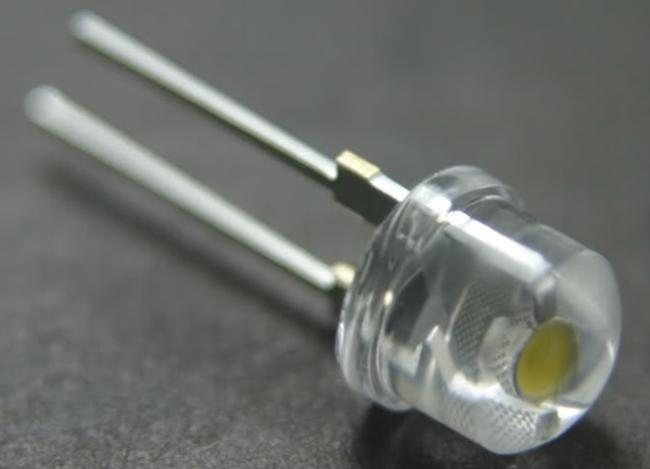
Leads of different lengths are visible, the short one is the cathode. Installation height limiters are also visible. Under the lens is a crystal with a yellow phosphor.
Super Flux Piranha
Direct translation - superflow. Piranha - translation into Russian - piranha. The name of the LED was due to the peculiarities of the metal leads in the form of narrow strips. To simplify installation in the holes of the printed circuit board, the corners were cut off at the ends of the pins during stamping. This is how the sharp “teeth” of a predatory fish turned out.
On the output, “shoulders” are stamped - limiters that set the height of the case above the board. So the case was opened for air cooling from below. Crystals for passive cooling were placed on the upper ends of the leads.
By placing 2 or 3 chips in the case, they increased the flow of light. And the diode fell into the group of super-bright ones.
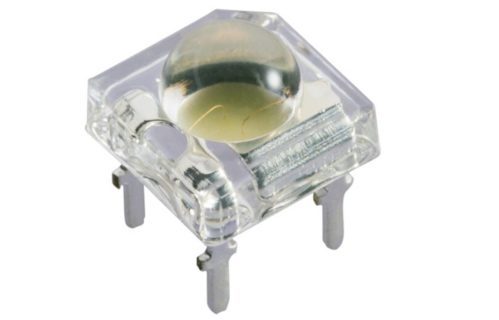
One can see a crystal “covered” by a lens and narrowed leads-shapers of the installation height.
smd
Abbreviation for Surface Mounted Device, translated from English - a device installed on the surface. They look like rectangular cases made of plastic or ceramics. Conclusions - from below and on the side of the case in the form of pads.
Most often - lighting, but at low power they can also be indicator. Powers from mW (milliwatt) to W. Glow is any color or shade of white light.
Read also: Characteristics of SMD LEDs
OLED
In addition to solid-state LEDs based on semiconductor metals - silicon, germanium, gallium arsenide, etc., there is a group of LEDs on films of organic compounds. They are called organic or OLED LEDs - Organic Light Emitting Diode.
They also, like semiconductor diodes, emit light, but not with a solid structure, but with thin films. While the main application is found in the development of single-color displays. The existing disadvantages of color OLED films are the different operating times for films of different glow colors. At a minimum, this is about 12-15 thousand hours.
After improvement, such LEDs will be widely used in cell phones, car and ship GPS navigators, in night sights and devices for night hunting and shooting, etc.
Video review: comparison of QLED, OLED and LCD (IPS).
Filament
In 2012-2013unusual LEDs appeared, which they called Filament. In fact, these are COB matrices in the form of long cylinders with a diameter of 2-3 and a length of 15-30 mm. 28-30 blue crystals interspersed with a few red ones are pasted onto a glass or sapphire cylinder. They are connected in series chains, and after checking the serviceability, they are filled with a yellow phosphor.
This technology for manufacturing filament modules is called Chip-On-Glass or COG.
Ready-made COG-matrices are placed on the fittings of conventional incandescent lamps, installed in the base and placed in a glass or plastic flask. To cool the LEDs, the flask is filled with helium.
Lamp power - from 2-3 to 10-12 watts. The luminous flux corresponds to the luminous efficiency of conventional LEDs of 80-100 lm/W.
The result is an LED retrofit incandescent lamp. The lamp is often incorrectly referred to as an LED incandescent lamp.
The term retrofit comes from the English. retrofit - modernization or modification. These are new light sources in housings with traditional dimensions.
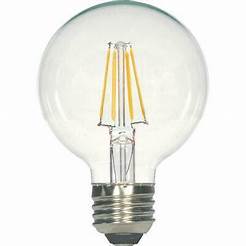
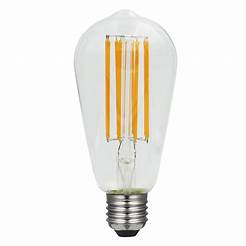
The figures above are different in power and manufacturers filament LED lamps. In a glass flask with an E27 base, filament COL modules are fixed to the fittings for the filaments.
Kind of PCB Star
The abbreviation for LEDs of this type is derived from the English phrase Printed Circuit Board. His translation is printed circuit board.
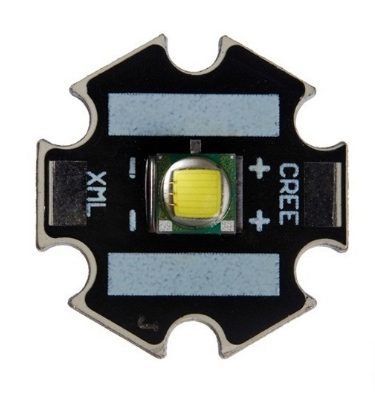
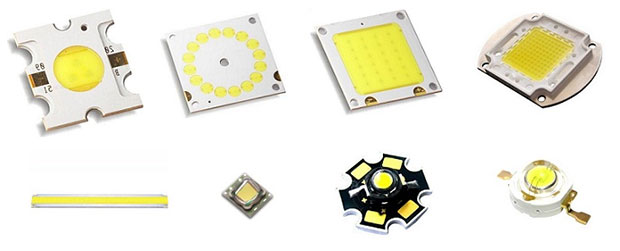
PCB Star type diode board. The manufacturer is the American company CREE, XML diode model. The yellow rectangle is the power diode COB matrix.
The board is made of a metal that conducts heat well, such as aluminum. The board configuration is a 6-ray star.The COB LED array is factory mounted in the center of the star board. The board is painted black to enhance the passive heat dissipation that a powerful working light emitting device generates.
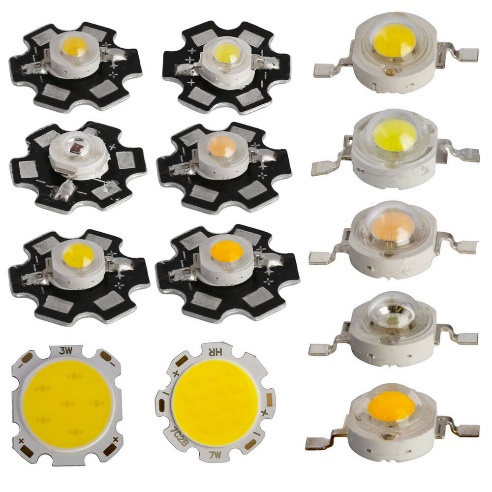
6 "stars" on the left - diodes of different power and shades of white light. The bottom two are more powerful elements with large circles of yellow phosphor. On the right is a column of 4 pieces. – diodes for planar mounting on the surface of pads on a printed circuit board.
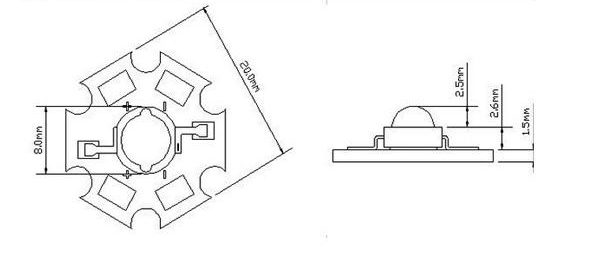
Dimensional drawing of a powerful planar LED on a star board. The height of the structure is 6.6 mm, the diameter of the body of the diode with planar leads is 8 mm, the size of the Star board is 22 mm.
LED COB Matrix
If several tens of blue semiconductor crystals are glued with dielectric glue on a heat-conducting substrate made of an artificial sapphire or silicon crystal, connected by conductors into series-parallel groups and filled with a yellow phosphor on top, we get an LED module. it COB matrix. The abbreviation is derived from the English phrase Chip-On-Board. It is translated as "crystals on the board."
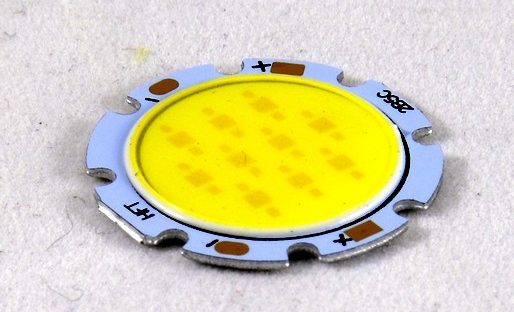
COB matrices use packageless LED chip chips without substrates. The accommodation is extremely tight. This technology produces a significant part of high-power LEDs, including hundreds of crystals. A good fan-cooled heat sink, sometimes using heat pipes, allows you to achieve power of 150-200 W or more in one case.The matrix provides a directional flow with a scattering angle of 100-150 degrees at a level of 0.7 from the radiation maximum.
Type classification
The types of LEDs include:
- single LEDs on a single high-power chip (COB-matrix);
- pair of LEDs in one package - indicator diodes flashing alternately in two colors, for example, red and yellow;
- triplets or triads of emitters of three primary colors - red, green and blue or RGB: Red - Red, Green - Green, Blue - Blue.
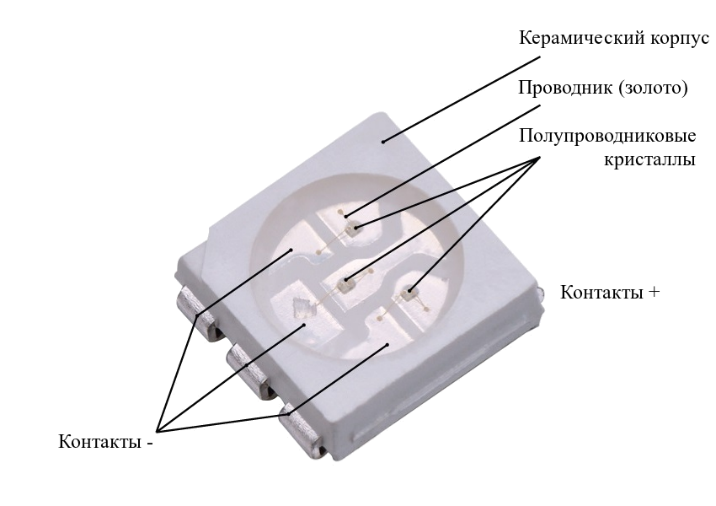
If in a three-crystal LED there are crystals of the same glow color, we have a super-bright LED. With different colors of crystal light, we get an RGB triad or a multicolor controlled light emitting device.
SMD is an abbreviation of the English phrase Surface Mounted Device, a surface mount device. Used to automate the placement and soldering of electronic components on printed circuit boards, incl. and LEDs. Used in tapes, rulers, modules and conventional printed circuit boards.
The main colors also include a pair of YB colors - Yellow, yellow and Blue, blue. There are other combinations of colors that give white when mixed.
Powerful COB LEDs
Large models have mounting holes in the corners of the case. Smaller models are soldered onto the printed circuit board.
In addition to the usual characteristics of LEDs, powerful models add several additional parameters:
- rated power, W;
- chip size, mm;
- rated operating current of the crystal or matrix;
- service life associated with standards L 70, L80, etc.
Low Power LEDs
In terms of power consumption, these are LEDs from 0.05 to 0.5 W, operating current - 20-60 mA (average power - 0.5-3 W, current 0.1-0.7 A, large - more than 3 W , current 1 A and more).
Structurally, low-power LEDs include several groups of LED light emitters:
- LEDs in SMD cases are ordinary and super-bright;
- DIP diodes in cylindrical cases - for mounting in holes in printed circuit boards;
- in piranha-type cases - for mounting in holes.
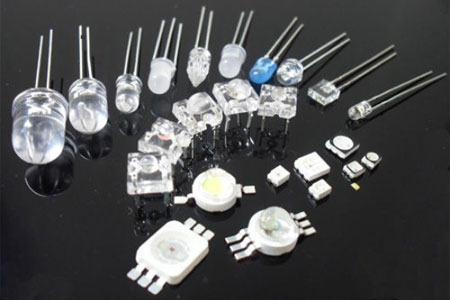
In the picture, the LEDs from top to bottom:
- In cylindrical DIP packages - with flexible wire leads for soldering into the board holes.
- In piranha-type cases, they are also Superflux, soldering through the holes.
- In cases with planar leads for mounting on contact pads of one- and two-sided printed circuit boards or in "wells" of multilayer boards.
Characteristics of LEDs
LEDs are described by many parameters. The most important of them:
- light intensity and energy efficiency - Lm and Lm / W;
- the angle of divergence of the light flux at levels of 0.5 or 0.7, degrees - for ordinary ones from 120 to 140 degrees, for indicator models - from 15 to 45 degrees;
- power consumed during operation, W - small - up to 0.5, medium - 0.5-3, large - more than 3;
- operating current through the diode, mA or A;
- color or shade of white light Colorful temperature, degrees Kelvin, K - from 2000-2500 K - warm white and up to 6500-9500 K - cold white.
There are other characteristics, but they are used less often. For example, the current-voltage characteristic, I-V characteristic of an LED is a curve of current through a junction versus the operating voltage applied to it. It is used in electrical calculations of the LED operation mode.
Dimensions
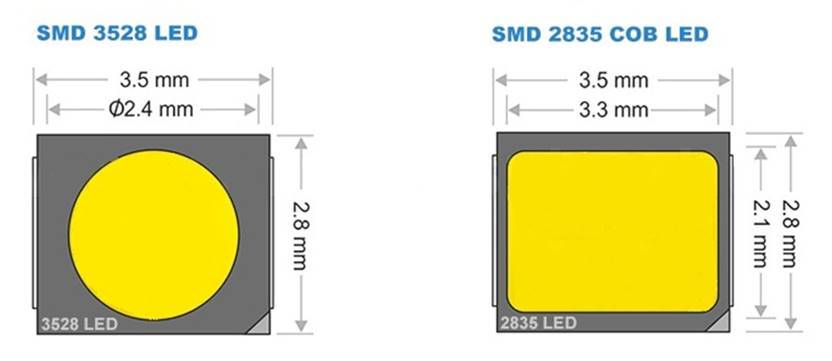
The dimensions of the LED are determined by the dimensions of its body.For SMD cases - length, width, thickness. The first two values are embedded in the designation, for example, SMD2835, where two pairs of numbers are 2.8 mm - width and 3.5 mm - length. The thickness of the case must be taken from the description or passport for the diode.
For cylindrical DIP diodes, important characteristics are the case diameter and its height with a lens. In this case, it is necessary to take into account the length of the wire leads and the manufacturer's recommendations for bending them before installation.
Wavelength
Such a characteristic of LEDs as wavelength is used very rarely. Often called the color of the glow.
| Color shade | Wavelength, nm |
|---|---|
| infrared (invisible) | 760-880 |
| red | 620-760 |
| Orange | 585-620 |
| yellow | 575-585 |
| yellow-green | 555-575 |
| green | 510-555 |
| blue | 480-510 |
| blue | 450-480 |
| violet | 390-450 |
| UV (invisible) | 10-390 |
The wavelength of the glow of the diode is measured in nanometers - nm. It is not always indicated in the passport data of the product.
Designation and color marking
Each manufacturer has its own marking of LEDs. For example, in the designation of the LED - LED-WW-SMD5050, its alphabetic and numeric elements are decoded:
- LED - LED;
- WW - glow color Warm White - warm white 2700-3500 K;
- SMD - surface mount package;
- 5050 - body dimensions in tenths of a millimeter - 5.0 × 5.0.
Variants of abbreviations for shades of white light:
- DW - Day White - white day (4000-5000 K);
- W - White, pure white (6000-8000 K);
- CW or WC - Cool White - cold white (8000-10 000 K);
- WSC - White Super Cool - super cold white, color temperature 15,000 K with a characteristic bluish tint;
- NW - Neutral White - neutral white - 5000 K.
There are other designations for LEDs and colors, the system has not yet been fully standardized, so manufacturers use different numerical values \u200b\u200band names for shades of white light.
Graphic and alphabetic image on the diagram
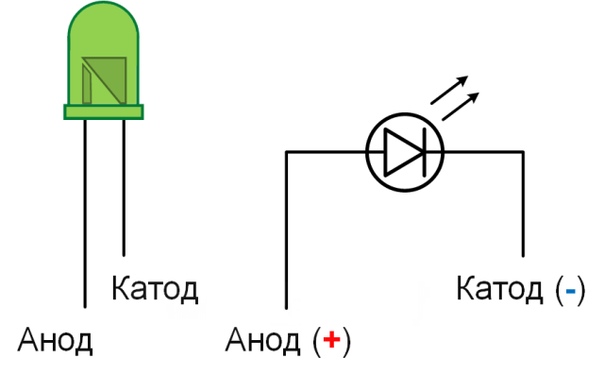
The anode, also known as the plus of the LED, is shown as a triangle on the electrical circuits. Cathode (minus) - a transverse dash.
LED voltage table
In order for the LED to provide during operation all the characteristics specified by its design and manufacturing technology, it needs to be provided with a calculated power supply. For example, apply a voltage to its anode and cathode, which will be slightly more than the direct voltage of the p-n junction. Excess voltage should be "quenched" in series included resistor. The resistor is called a current limiting resistor. It serves to prevent excess current through the p-n junction.
The LED has two contact leads - the anode and the cathode, the cathode is shorter than the anode. If the length is the same, then define You can use them with a finger battery. If there is light, then you have an anode in front of you.
Table. Forward voltage of the p-n junction of the colored LED.
| Glow color | Operating voltage, direct, V |
|---|---|
| white | 3,5 |
| red | 1,63–2,03 |
| Orange | 2,03–2,1 |
| yellow | 2,1–2,18 |
| green | 1,9–4,0 |
| blue | 2,48–3,7 |
| violet | 2,76–4 |
| infrared | up to 1.9 |
| UV | 3,1–4,4 |
Read also: How to find out how many volts an LED
Application of LEDs
The scope of LEDs is constantly expanding. Initially, they were used as light indicators in circuits for switching on or operating electronic equipment.For example, turning on the transmitter, switching to increased or reduced power, etc. They could fix automatic activation, for example, when a call signal appears or to attract attention. Flashing or single-color LEDs were used - red, yellow, green, blue.
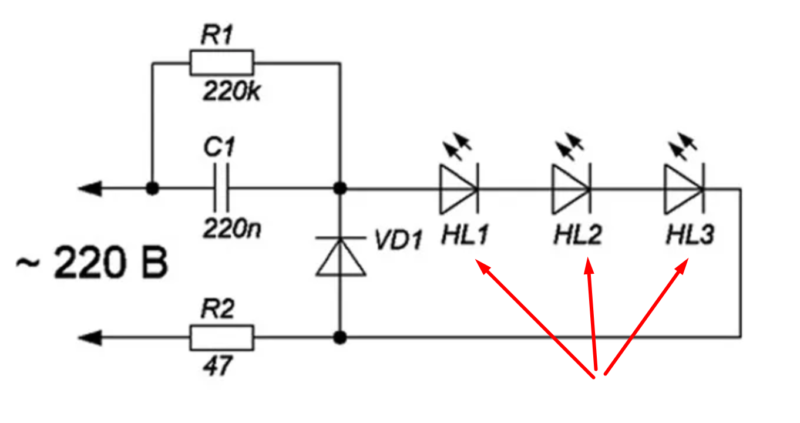
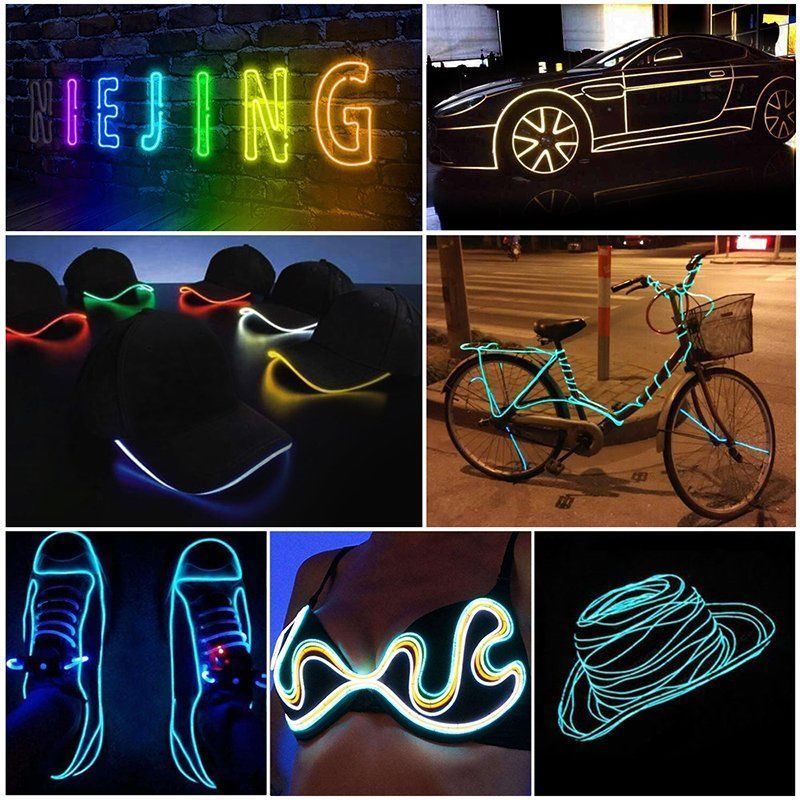
Small-sized super-bright DIP LEDs were connected in series-parallel chains and fed directly from a 220 V network. By placing such series groups of diodes in a transparent flexible PVC tube and filling them with a transparent sealant, we got "flexible neon"- a luminous" tourniquet. It can be laid along the side of the pool, the curb of the path, decorate the roof of the house or a tree in the garden.
The advent of flexible multi-layer boards and SMD packages for surface mounting has led to the creation of flexible LED strips.
Initially, these were means of decorative interior decoration. An increase in the power of SMD diodes and the density of their placement on the board made it possible to start using LED strips, first for auxiliary, and then for main lighting. An increase in the degree of dust and moisture protection of the tapes led to their use for decorative lighting, and then for the main lighting in street conditions.
At the same time, LED lamps were being developed to replace incandescent lamps in lamps - sconces, chandeliers, and table lamps. Retrofit lamps appeared - complete analogues of incandescent lamps and fluorescent tubes in terms of shape, bulb size, and supply voltage. The gradual replacement of incandescent lamps with LED retrofits has begun. At the same time, the production of LN was stopped - at first 100 W or more, then 75, 60, etc.
The development of powerful single LEDs, especially in the Emitter or PCB Star package, has contributed to the emergence of flashlights with a built-in battery. The brightness and duration of the glow after one charge cycle was several times higher than previous models.
Excellent controllability of LEDs by electronic means - controllers and dimmers - dimmers, allowed the use of powerful spotlights in the light-dynamic illumination of streets and squares of cities and towns in any region of the country.
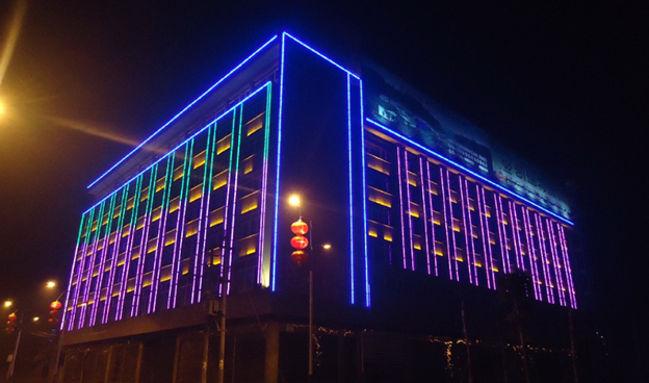
LED strip type RGB, RGBW and RGBWW made it possible not only to obtain powerful streams of white light, but also to change its white hue over a wide range from yellowish warm to bluish and blue cold.
The controllability of new light sources makes it possible to widely use them in illuminated advertising - "creeping lines", light displays, information screens, etc. Use these bright colored and white light sources in facade advertising and on rooftops - flat and three-dimensional letters and drawings, brand names, trademark images and much more.
And all these designs work much longer than their counterparts on conventional lamps, requiring almost no maintenance and consuming many times less electricity. The technical characteristics of LEDs and lighting equipment are constantly growing. The cost of LEDs is decreasing, and the application is expanding.