Dimmable switch for LED lamp
Since the advent of electric lighting, engineers have tried to solve the problem of dimming lamps. At the dawn of electrical engineering, only two methods were available - rheostats and adjustable transformers. These devices are bulky and inconvenient for everyday use, they have other disadvantages. Therefore, only with the development of solid-state power electronics and the development of powerful, but compact electronic switches, modern devices called dimmers were created.
What is dimming and how it works
Dimming is the regulation of the brightness of the glow of lamps of various designs from maximum to decreasing. The term comes from the English verb to dim - to darken.Dimmers are used to create comfortable lighting, as well as to create various lighting effects (for this, modern devices controlled by controllers are used).
The task of reducing the brightness of the glow at different stages of the development of electrical engineering was solved in different ways. Initially, curtains were used for this purpose, which could partially block the light flux. Further, the developers have covered a long-term path from potentiometers and adjustable transformers to modern compact devices. Their basis is a power key that cuts out part of the sinusoid supplied to the lighting device.
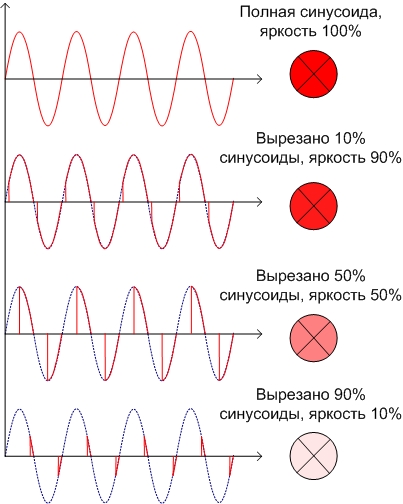
At a certain moment, after passing the sine through zero, the key opens. The later the opening occurs, the less time the load is energized, the lower the average current. Consequently, the average brightness of the glow is also less.
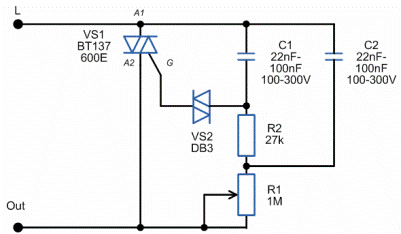
In this circuit, the triac serves as the key, and the opening moment is controlled by the potentiometer. Such a device is suitable for dimming lamps. incandescent and halogen lamps. LED devices have their own specifics.
What light bulbs can be used with a dimmer
Although the glow of incandescent lamps and LEDs are based on different principles, they have one thing in common - the intensity of the glow depends on the average current flowing through the element. The problem of dimming most LED lamps is that they are connected to the network not directly, but through a current stabilizer (driver). Its task is to maintain the brightness of the glow, regardless of changes in the parameters of the supply voltage. In other words, such a device is designed to resist the processes accompanying dimming.Therefore, it is impossible to regulate the intensity of the glow with conventional devices.
There are special lamps, the driver input circuits of which are supplemented with a special circuit. It monitors the average value of the input voltage and, in accordance with it, changes the current of the LEDs, adjusting the luminous flux. Such light bulbs are marked with the inscription Dimmable or the corresponding icon.
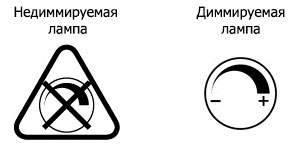
Such lighting fixtures are more expensive, but the possibilities of their use are wider.
There are inexpensive LED lamps that do not have a driver in the form of an electronic circuit, its role is played by a quenching resistor. It is undesirable to connect such lamps directly to the alternating voltage network, even if they pass through the parameters. They are not designed for the high reverse voltage applied during the negative half cycle. This can lead to their rapid failure. Therefore, they must be connected to a network of any alternating voltage through a rectifier (preferably a full-wave one) or used at a constant voltage. In the first case, they are dimmed in the usual way, but they must be turned on according to the “dimmer - rectifier - lamp” scheme. In the second, it is necessary to use special dimmers that control the glow using the pulse-width modulation method. Such devices are usually made on the basis of controllers and the control possibilities are limited only by the imagination of the developers.
For the convenience of assessing the compatibility of lamps and dimmers for LEDs, the data are summarized in a table.
Dimmer type | Lamp type | ||
| Non-dimmable with driver | Dimmable with special driver | LED strip or lamp with quenching resistor | |
| Ordinary | Incompatible | Compatible | Compatible when using a rectifier |
| LED with DC output | Incompatible | Incompatible | Compatible |
Important! All led strip belong to the class of dimmable - non-dimmable LED strips do not exist in principle. Dimmable inscriptions on such devices are pure marketing ploy.
Constant voltage LED dimming
If the LED lamp is running on constant voltage, its brightness can also be adjusted. The easiest way is to enable successively with variable resistor LED. By changing its resistance, the current in the circuit changes.
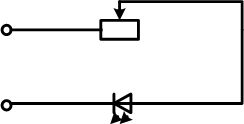
This method has long been recognized as a failure due to energy inefficiency. The resistor dissipates a lot of power uselessly. It is much more rational to distribute energy over time. At the same time, to reduce the intensity of the glow, the key is periodically closed, and the illumination level is averaged by the inertia of human vision.
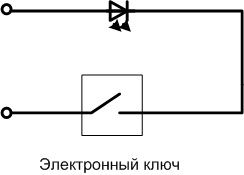
In practice, this is done using the PWM method. The LED is powered by rectangular pulses of constant amplitude and frequency, but of different duration.
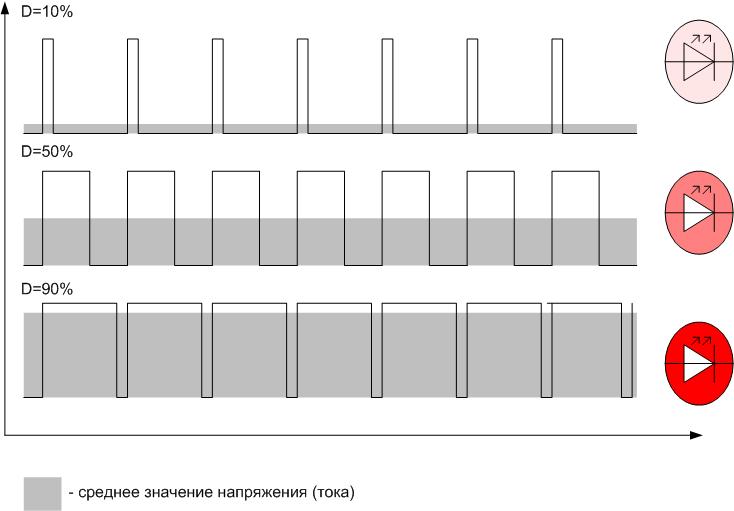
Depending on the pulse length, the average current through the LED changes, which is perceived by the human eye as a change in brightness.
Pulse width modulation is conveniently implemented using processor technology. Therefore, various devices are made on the controllers to create lighting effects.
Advantages and disadvantages
The advantages of the ability to adjust the level of glow include:
- obtaining comfortable illumination of the room;
- saving electricity;
- the ability to focus on details (in the case of decorative lighting);
- reduction of heat emission by lamps;
- possibility of remote and automatic control;
- extending the life of the LED.
Another advantage of LED lamps is that they do not change in the process of changing the brightness. Colorful temperature.
The disadvantages include the noticeable flicker LED emitters at low brightness levels. This leads to increased eye fatigue, as well as to the occurrence of a harmful strobe effect. Getting rid of flicker when powered by direct current is problematic, and when powered by variables - impossible. Another problem is that after installing a dimmer of a certain type, the ability to install lamps of an arbitrary type is lost. They must be compatible with the regulator.
Do dimmers save energy
This simple question causes heated discussions on the Internet. In fact, a lot depends on the design of the dimmer. Dimmers of old designs, made in the form of potentiometers or adjustable transformers, did not give any savings. All the saved power was uselessly dissipated in the ballast. Now such devices are practically not produced.
Dimmers built on electronic keys distribute electricity over time. To reduce the brightness, they close the control element completely for a given period of time, there is practically no current through the load and the key. Everything happens during one half-cycle of a sinusoidal voltage, so the human eye does not notice such interference. The reduction in consumption with this method is obvious, but not everything is so simple:
- The contribution of lighting to the total electricity consumption in a home or office is not so great, powerful electrical appliances consume much more. Therefore, a small reduction in energy consumption due to dimming will be noticeable, but not significant. Due to the global transition to LED lighting, the share of lighting costs is reduced even more, and the effect of dimming becomes even smaller.
- The dimmer itself for LED lamps has an efficiency different from 100%. For good appliances, this figure exceeds 90%, but this is still energy consumption.
- The cost of devices for dimming is higher than that of conventional switches. Even with savings, they have a payback period of at least a couple of years.
- Many manufacturers inflate the economic effect for marketing purposes, this leads to a discrepancy between the expectations from the use of dimmers.
It should be taken into account that the decrease in the average current increases the resource of LEDs. This contributes positively to the overall economics of lighting operation. Anyway don't expect more than 10% savings.
Effect of dimming on luminaire life
It is known that the supply of reduced current at the moment of switching on increases the life of incandescent lamps. LEDs are not prone to failure at the moment of switching on, but dimming is also has a beneficial effect on the extension of the service life LED. The fact is that the service life of the emitters depends on the average operating temperature, which, in turn, is determined by the current. The higher the heating, the faster the degradation of light emitting diodes, the greater the likelihood of a complete failure.
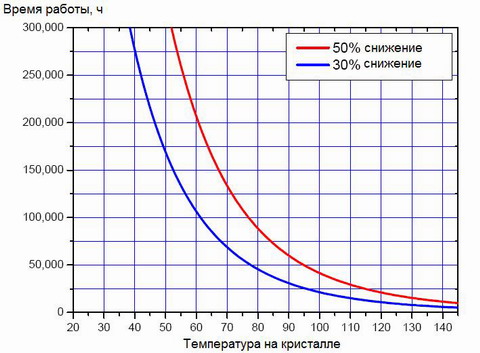
When using dimmers for LEDs, the average current becomes noticeably less than the maximum, so the life of the LED is significantly increased.
In this regard, the graphs and figures should be treated with some skepticism - it is unlikely that manufacturers arranged full-fledged resource tests. Yes, and there is no point in them - by the end of the tests, the technologies will be updated, and you will have to start the tests again. Therefore, the declared figures are obtained by calculation, and there is a hefty advertising component in them.
Types of modern dimmers
A huge number of LED light intensity controls are available on the market. In addition to the differences considered, they are also classified according to other parameters that determine the scope of the devices.
By type of installation
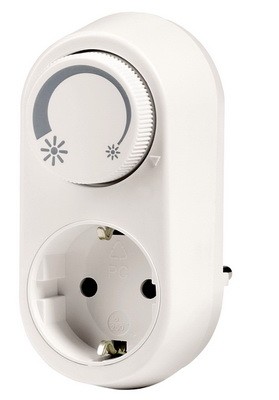
According to the type of installation, devices can be:
- wall-mounted - mounted like a conventional light switch;
- modular - installed in an electrical panel on a DIN rail;
- suspended - built into the structural elements of suspended lamps;
- portable - such a device can be plugged into any outlet, then a floor lamp or table lamp is connected to it;
- built-in - they are hidden behind interior elements.
The last category of devices is similar to wall-mounted ones, but has a less aesthetically designed case.
By execution
Devices can have different contact groups:
- conventional opening-closing;
- changeover.
In the second case, the dimmer is called a pass-through and serves to organize a dual light control circuit - from two points regardless.
By way of adjustment
According to this criterion, devices can be:
- rotary - the brightness is adjusted by turning the wheel, the light is completely turned off by turning it all the way;
- rotary-push - the glow is adjusted by the rotary wheel, turning off is done by pressing the wheel in any position;
- push-button - adjustment is made by pressing the + or - buttons.
- touch - the principle is similar to push-buttons, but instead of pressing it is enough to touch in the sensitive area;
- remotely controlled - the light is controlled by a remote control;
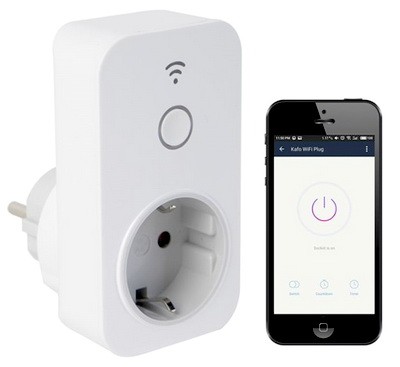
- controlled via WiFi - you can control the lighting from your mobile device;
- acoustic - controlled by a sound signal.
The latter type of devices is not widely used due to low resistance to acoustic interference.
How to connect an LED illuminator through a dimmer
Led dimmer is connected to the lighting network like a normal one. switch (often it also carries this function) - into the break of the phase wire. Therefore, it is often possible take off standard switch and execute dimmer connection in the same way. Do not forget about the maximum load power that can be connected to the regulator. He must withstand it with a margin of 15-20%. Subject to this rule, the dimmer will do its job for a long time.
Video: Connecting and setting up a dimmer with Aliexpress.