How to determine the cathode and anode of an LED
Like any semiconductor device with one-way conduction, the LED is critical to the correct inclusion in the DC circuit. For normal operation, the anode and cathode of the LED must be connected to the corresponding poles of the voltage source according to the circuit diagram. There are several ways to determine the pinout of a light emitting element.
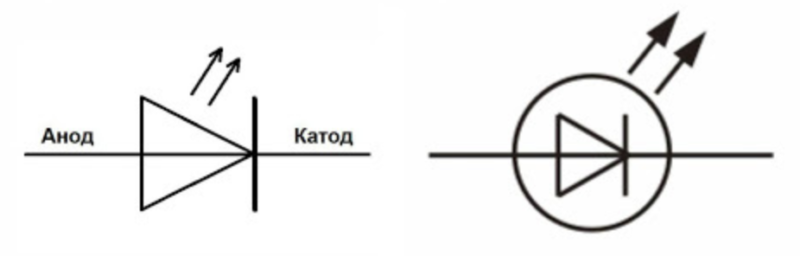
Definition with a multimeter
Like any diode based on a p-n junction, a light emitting diode can be checked with a multimeter, using the ability to conduct current in only one direction. Modern digital testers have a special diode test mode, in which the measuring voltage is optimal for this procedure.
To determine the location of the LED pins, you need to arbitrarily connect its legs to the multimeter probes and determine the result from the display readings.

If the element is connected incorrectly, then the result of the measurement will be an overshoot of the resistance value (OL - overload, overload). It is necessary to swap the clamps of the multimeter.
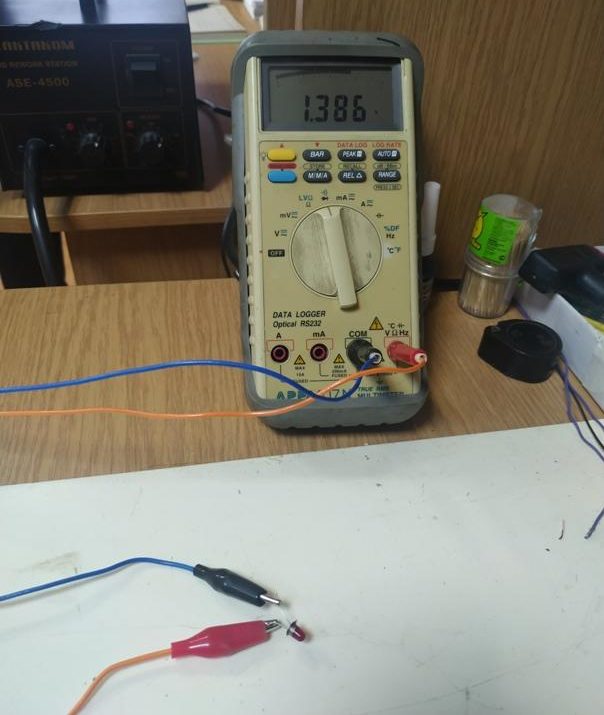
If the LED is working and connected correctly, then some resistance will be displayed (the specific value depends on type radiating element). In this case, the anode will be the output connected to the plus of the multimeter (red wire), and the cathode to the minus (black wire).
Some testers in the diode test mode produce a voltage sufficient to ignite the light emitting element. In this case, the correct connection can be controlled by the glow.
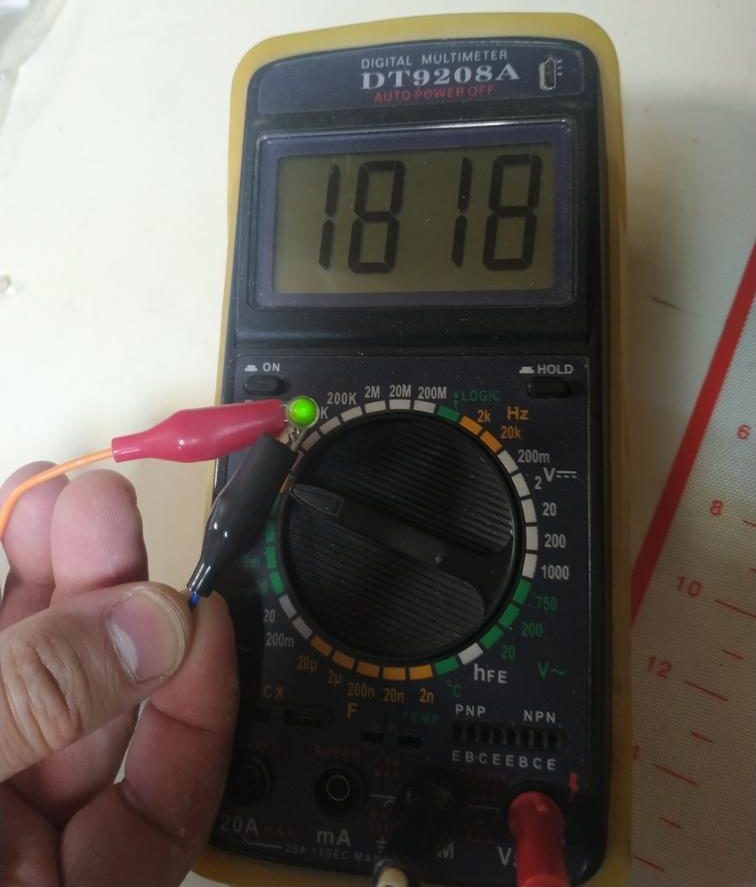
If overload is indicated on the display in both connection options, this may mean:
- LED failure;
- the measuring voltage is not enough to open the p-n junction (the tester is designed for "dialing" of silicon diodes, and most light-emitting elements are made on the basis of gallium arsenide).
In the first case, the semiconductor device can be disposed of. Secondly, try another way.
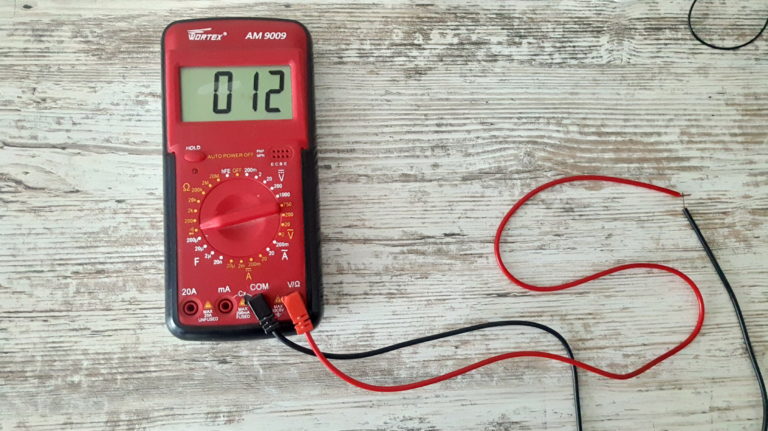
Pinning an LED by applying power
The advantage of this method is that it can be used for light emitting diodes with any parameters (voltage drop and current rating). For such a check, it is better to use a power source with a current limit setting, or at least with its indication for control. Otherwise, the sensitive semiconductor device may be damaged.
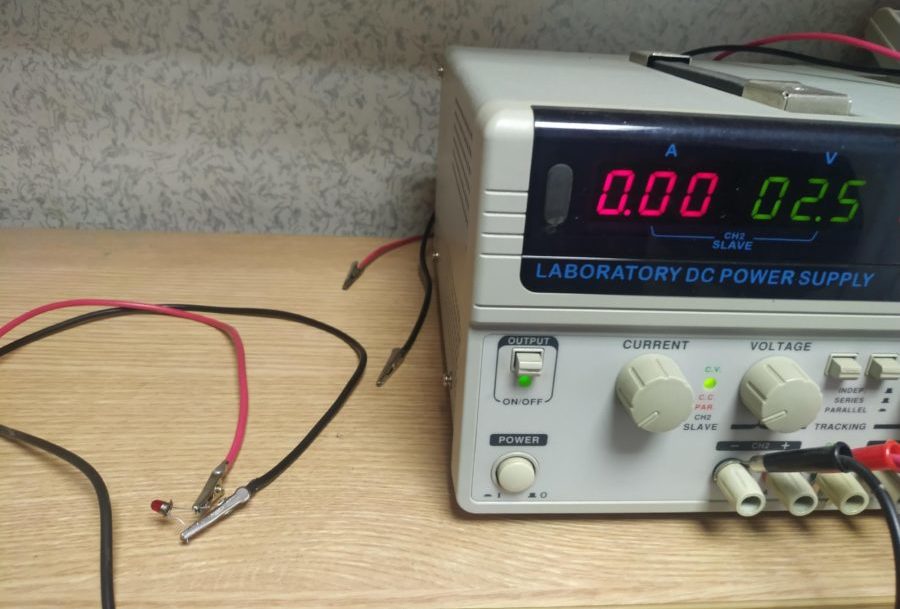
If there is an adjustable source, it is necessary to randomly connect the LED to its output and apply voltage, gradually increasing it from zero. Above 2-3 V, the power should not be raised so that the element does not burn out. If it does not ignite, it is necessary to remove the voltage and switch the conclusions in the opposite way.
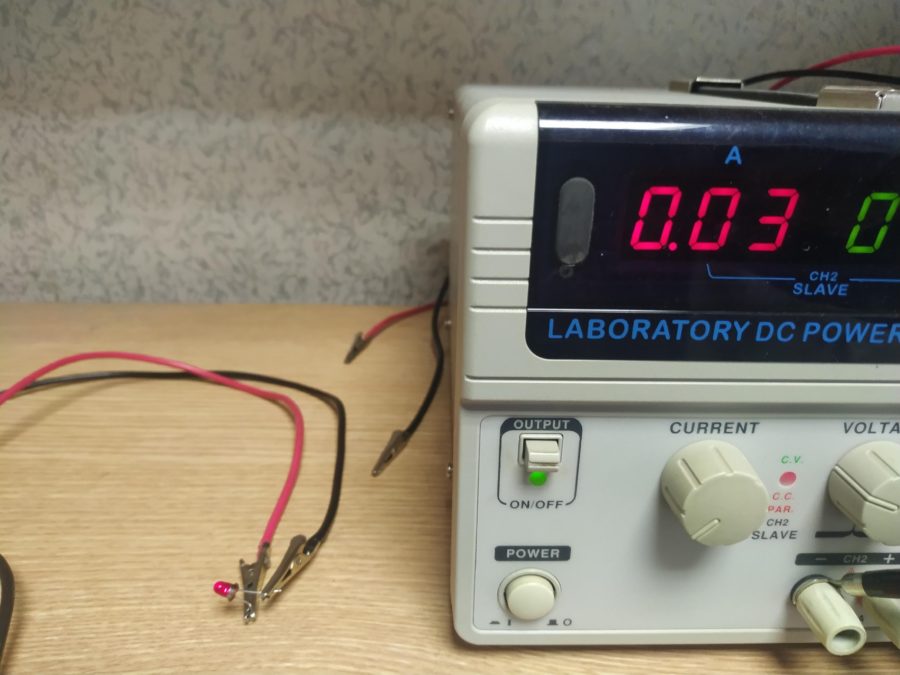
Gradually raising the voltage, you can visually determine the moment of ignition of the LED. In this case, the positive output of the source is connected to the anode, and the negative output is connected to the anode of the radiating element.
If there is no regulated source, then you can try to use an unregulated power supply with a voltage obviously higher than the LED supply voltage. In this case, tests should be carried out only through a 1-3 kΩ resistor connected in series with the semiconductor device.
If in both cases the LED does not light up, you can try to test with increased voltage. If the element is faulty, this will not bring harm to it, and if it is designed for increased voltage, then it will be possible to find out the correct pinout.
Recommended: How to find out how many volts an LED
With battery
If there is no power source, you can try to determine the location of the terminals from the galvanic cell, but you should keep in mind the features of such a check:
- the battery can produce a voltage insufficient to open the p-n junction.
- household galvanic cells have a small power, and the output load current is small - it depends on the initial power of the battery and on the residual charge.
The table shows the parameters of some domestic LEDs.Obviously, the common one and a half volt chemical current sources will not be able to ignite any device from the list.
| Device type | Forward voltage drop, V | Operating current, mA |
|---|---|---|
| AL102A | 2,8 | 5 |
| AL307A | 2 | 10 |
| AL307V | 2,8 | 20 |
To increase the voltage, you can connect batteries successively. To increase power - in parallel (only for elements of the same voltage!). The result may be a cumbersome design that does not guarantee the final result. Therefore, it is better to use this method in cases where there are no other ways.
By appearance
Sometimes you can determine the polarity by appearance. Some types of LEDs have a key on the body - a ledge or a label. To determine which output is marked with a key, it is better to read the reference materials.
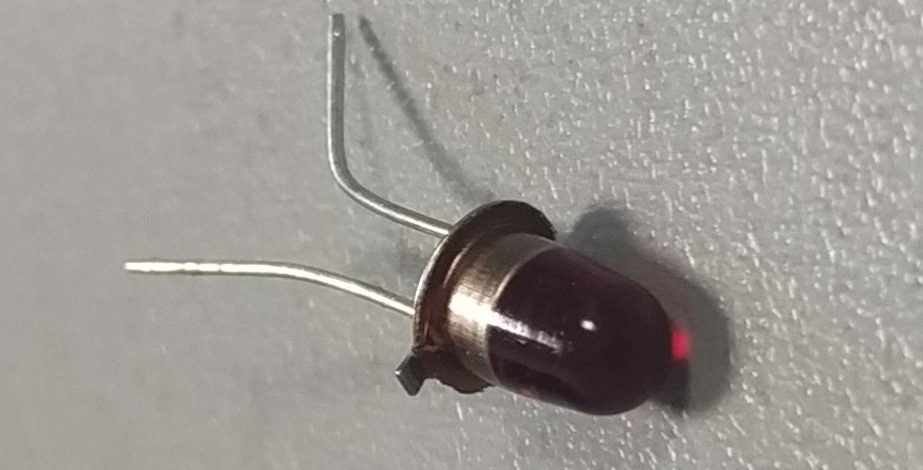
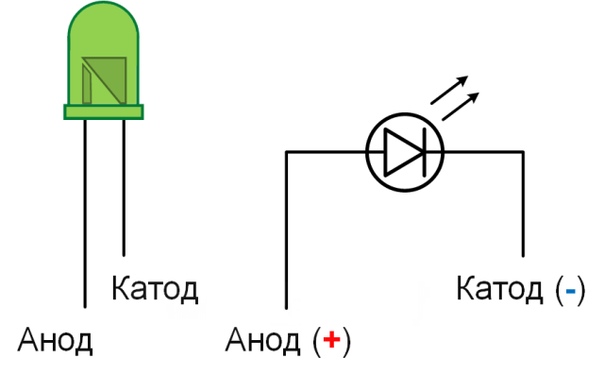
For unpackaged LEDs manufactured in the USSR, you can find out the pinout by looking at the internal structure of the device through the compound layer. The cathode terminal has a large area and is made in the form of a flag. This principle could become a standard, but now manufacturers do not strictly comply with it, so this method is unreliable, especially for elements from an unknown manufacturer. Therefore, such a definition of conclusions can only be used for preliminary orientation.
The pinout of domestic LEDs can be recognized by the length of the legs - the anode output is made shorter. But this is true only for elements that were not in use - when installed in place, the leads can be cut off arbitrarily.
For clarity, we recommend watching the video.
With technical documentation
Other ways to determine the conclusions can be searched in the technical documentation for the elements - in reference books or online sources. To do this, at least you need to know the type of LED or its manufacturer. The documentation may contain information about the dimensions and pinout of the device.
But even if this information is not found in the specification, efforts will not be wasted. Technical documentation can become a source of information about the limiting parameters of an electronic device. This knowledge will help you choose the correct mode of operation, as well as prevent the LED from failing when checking the pinout.
SMD LED Polarity
At the moment, leadless elements for direct mounting on the board are becoming more and more popular (smd – surface mounted device). Such radio elements, unlike conventional ones, have the following advantages:
- in the process of manufacturing a printed circuit board, it is not necessary to drill holes - the technology becomes cheaper and faster;
- electronic devices are smaller;
- simplifies the design of RF devices - the absence of leads minimizes spurious interference.
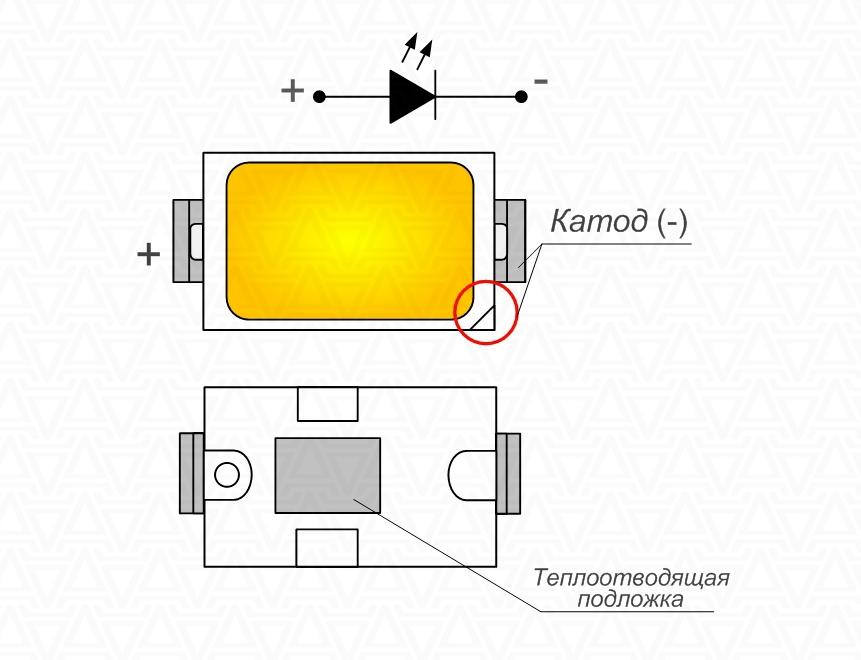
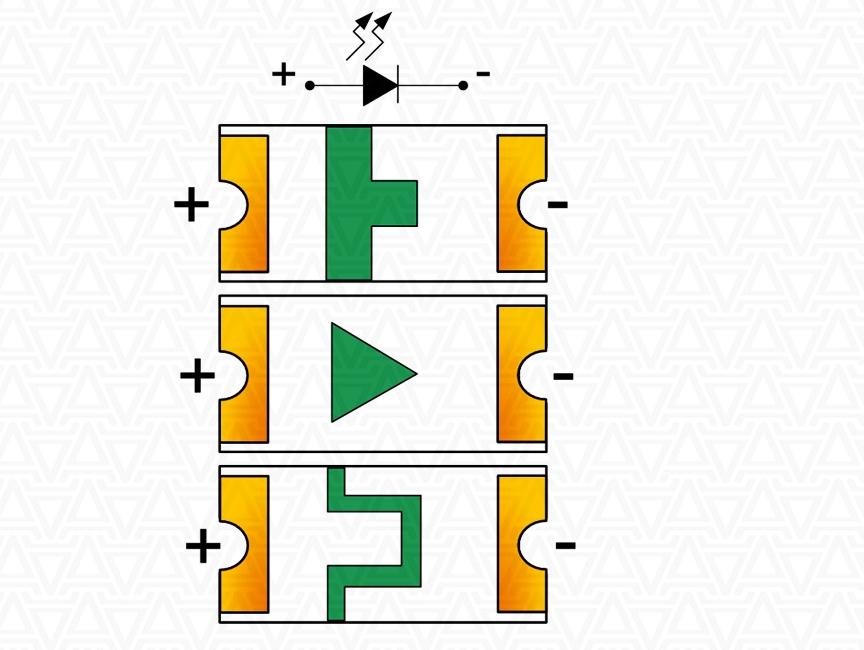
But the desire for miniaturization has a downside - it is more difficult to determine the conclusions of an SMD LED. It is difficult to connect the probes of the tester or power source to it. Therefore, it is important to apply clear markings directly on the element body to avoid errors during installation. Such a designation is made in the form of a mark on the body (bevel or recess) or in the form of a mnemonic pattern.
And the simplest case is the inclusion of a light emitting diode in an alternating current circuit. In this embodiment, the polarity of the LED does not matter.