Characteristics and types of luminous intensity curve
The luminous intensity curve is one of the mandatory criteria that manufacturers indicate on the packaging of fixtures. Moreover, for different types of equipment, the designations differ. Therefore, it is worth understanding the main features in order to understand what is meant by the term and what this or that marking means.
What is a luminous intensity curve
There are several definitions related to the topic. It is necessary to disassemble them all so that there are no questions when choosing equipment and determining the features of its operation:
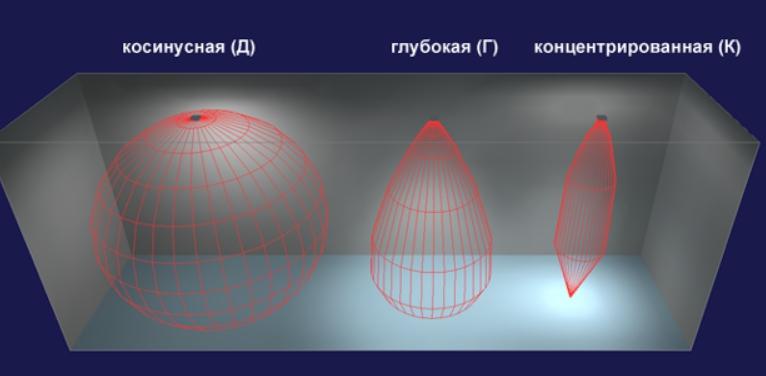
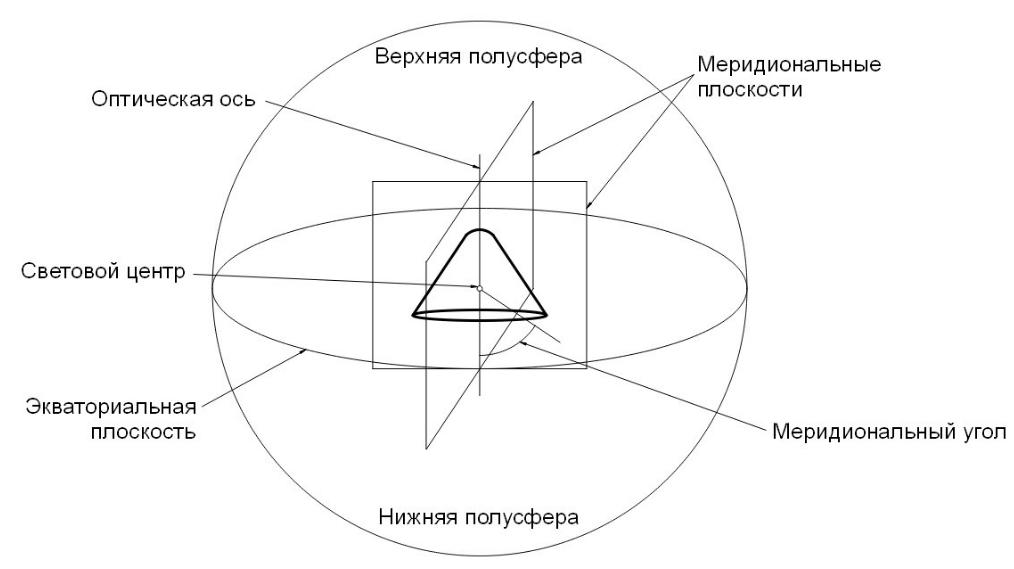
- The light intensity curve is a graph that shows the dependence of light intensity on meridional angles. The image is obtained by dividing the photometric body by a surface or a plane. Essentially, the image shows how the light will spread depending on its direction.
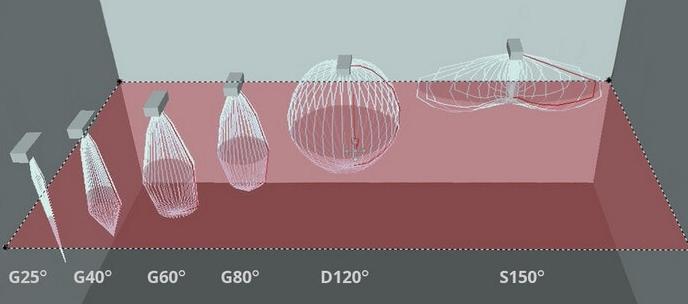
![Characteristics and types of luminous intensity curve]() Visual comparison of different types of KSS.
Visual comparison of different types of KSS. - The light distribution of equipment shows how light will spread on a given surface.This moment is important for the reason that any lamp distributes light unevenly, therefore its design is developed in such a way as to direct the maximum flow to a given area. This is done by configuring the dome, reflector, lamp type and position.
- The optical axis passes through the center of the luminaire or other equipment and serves as the starting point for all calculations. It can be located in different ways, it all depends on the ceiling and the specifics of the light distribution.
![Characteristics and types of luminous intensity curve]() Criteria for evaluating luminaires used by specialists.
Criteria for evaluating luminaires used by specialists. - The shape factor of the luminous intensity curve reflects the ratio of the maximum illumination in a certain plane to the average.
There are other definitions related to the topic under consideration, but it makes no sense to understand them. The main thing is to always study the graph on the package to understand how the light will spread over the surface.
Light intensity curve types
Depending on distribution luminous flux there are several main options. Moreover, each type of luminous intensity curve is suitable for certain conditions, as it has its own light distribution. For clarity, below is a graph with seven main types of KSS, for simplicity they are denoted by letters.
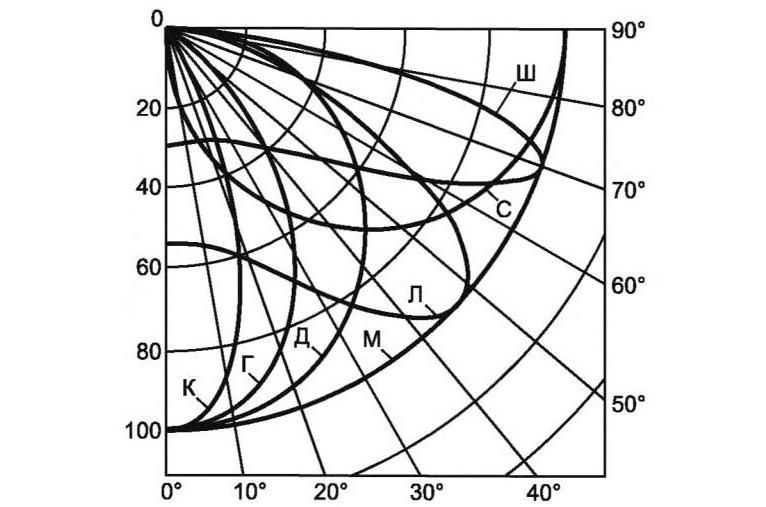
All data are presented in the form of a table with deciphering of designations and diagrams of light propagation.
| Marking | What does | Light propagation angle (degrees) | Diagram |
|---|---|---|---|
| To | Concentrated | 30 | 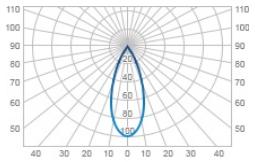 |
| G | deep | 60 | 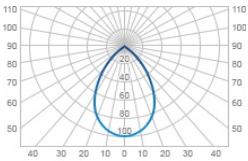 |
| D | cosine | 120 | 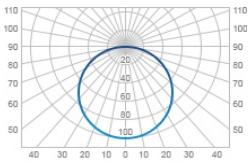 |
| L | Semi-wide | 140 | 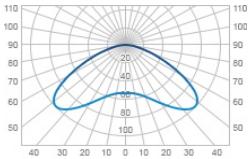 |
| W | Wide | 160 | 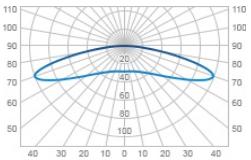 |
| M | Uniform | 180 | 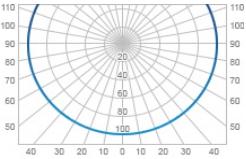 |
| FROM | Sinus | 90 | 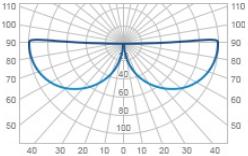 |
There may be other options, but they are most often used for specific objects with special lighting requirements.
Lighting characteristics of lamps
In addition to the KSS, each lamp has a number of equally important characteristics that you should pay attention to when choosing. The main ones are the following:
- The power of light. This is the ratio of the luminous flux to the angle of its propagation, measured in candela.
- Energy efficiency of the light source. The ratio of electricity consumed to the luminous flux that the lamp provides. It is best to use LED and fluorescent equipment, and traditional incandescent lamps spend most of their electricity not on light, but on heating the coil and generating heat.
- illumination. One of the most important indicators showing what luminous flux falls on a square meter of area. Using this criterion, choose the power and location of fixtures indoors is easy. Measured in lux.
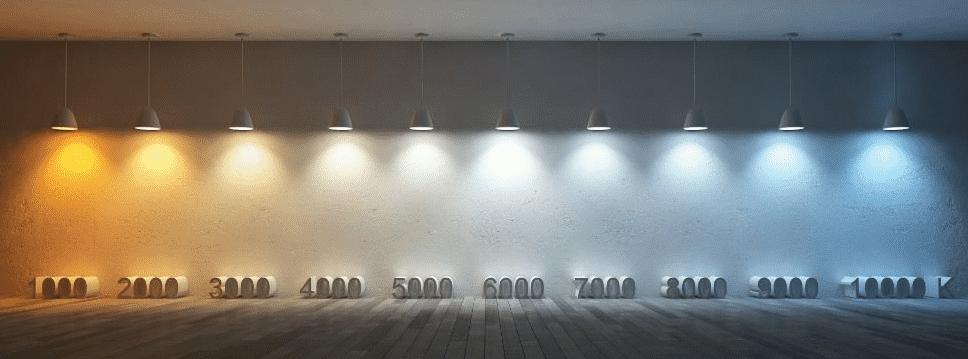
- Colorful temperature shows what spectrum the lamp emits. Daylight corresponds to indicators from 5500 to 6500 K. Variants with a lower color temperature give a yellowish light, with a higher one - bluish. For a person it is best to use a neutral option or warm white light, as it contributes to normal life and creates a minimal burden on vision.
![Characteristics and types of luminous intensity curve]() The perception of the room depends on the color temperature.
The perception of the room depends on the color temperature. - Color rendering index (Ra) is measured on a scale of 0 to 100 and tells you how natural colors are when lighting is used. An ideal color rendition corresponds to an indicator of 100.For rooms, it is worth choosing options from 80 and above to ensure a normal perception of the situation.
- Light ripple factor. Shows changes in light intensity due to uneven AC supply in the network. Pulsation can be both noticeable and indistinguishable to the human eye. For normal work and rest, the ripple should not exceed 15%, and for certain categories of equipment - 5%.
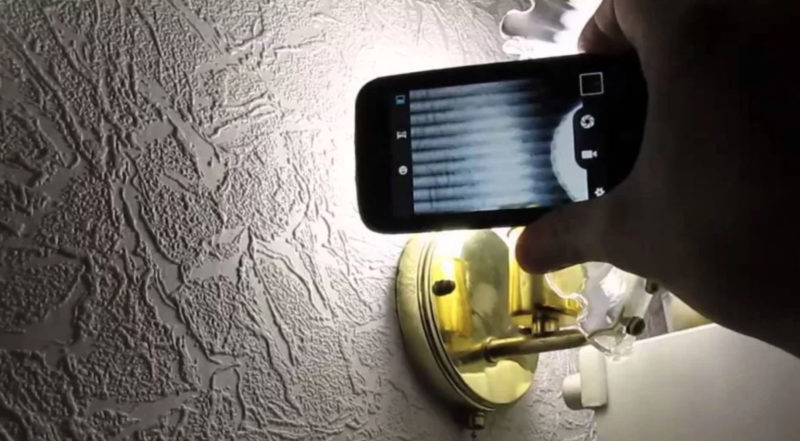
The camera is turned on and the lens is aimed at the light bulb. If stripes are visible on the screen, it is better to replace the light source.
How to choose a KSS
In order not to calculate the optimal indicators of the light intensity curve for a particular room or street, you can use general recommendations from experts. It is important to remember the following:
- AT living quarters, as well as wherever it is necessary to create a calm environment conducive to relaxation, it is better to install lamps with a sinus KSS. Moreover, you should choose an option with a matte diffuser or a ceiling that gives reflected light.
- In administrative buildings, public places, offices and workrooms, it is worth using the cosine view with a propagation angle of 120 °. There are no special requirements here, the main thing is to choose an option that provides normal illumination (there are minimum standards in GOST).
![Characteristics and types of luminous intensity curve]() The larger the angle, the better the light spreads.
The larger the angle, the better the light spreads. - In industrial workshops, production sites, as well as on other similar objects, different solutions can be used depending on the specifics of the work. The most commonly used options are "D", "G" or "K".
- As additional lighting, as well as for decorative highlighting of individual zones, a deep KSS will be the best solution. The main thing is to correctly adjust the direction of the light flux.
- If you need to highlight a separate object, provide lighting for a sculpture, shelving or showcase in store, it is worth using lamps with concentrated KSS. She will direct the light flux to the right place and thus will attract attention.
- For highways, sidewalks and pedestrian areas use lamps with a half-wide or wide KSS. Due to this, the surface is illuminated evenly without blackouts and poorly lit areas. In this case, it is very important to choose the optimal height and the angle of the plafonds.
- In entrances, pantries, utility rooms and other small rooms equipped with wall shades, it is worth using options with a uniform KSS.
If necessary, in one room, you can combine different options. For example, general lighting in the production hall and additional lamps at each workplace.
The video explains in detail about the KSS and related concepts.
Selecting the optimal luminous intensity curve is no less important than ensuring good illumination and the correct placement of luminaires. Therefore, it is necessary to determine in advance the appropriate marking in order to buy exactly what you need.