What is illumination rationing and what documents regulate it
Lighting standards are established for all types of premises and must be observed in order to ensure comfortable conditions for a person to stay. All important aspects are collected in separate regulatory documents, which allows you to quickly find the information you need.
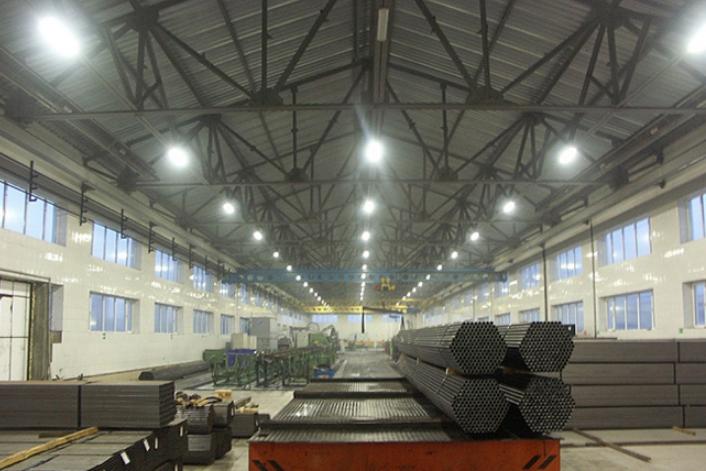
Normative documents regulating illumination standards
Documentation is constantly being improved, as new types of lighting equipment appear. In addition, working conditions in factories are changing, in offices and other places. Some light standards have been established for a long time, since a number of indicators remain unchanged regardless of the type of equipment and its installation location.
SNiP 23-05-95
This act is called "Natural and artificial lighting" and regulates all significant points on this topic. It is developed taking into account all regulatory documents and combines the main indicators. Included in the "Complex 23", it has all the documentation on the regulation and design of lighting.
AT SNiP 23-05-95 there are norms for natural, artificial, as well as combined lighting of structures and buildings. It also contains recommendations for street lightingconcerning production sites, warehouse complexes and other important areas.
The document regulates issues related to the design of light in buildings for various purposes and in adjacent areas. Natural and artificial light are described in separate chapters, so it will not be difficult to figure it out.
The norms established for a particular object should be used as a guideline that shows the minimum allowable illumination. Excess may occur, but indicators below the established values are unacceptable.
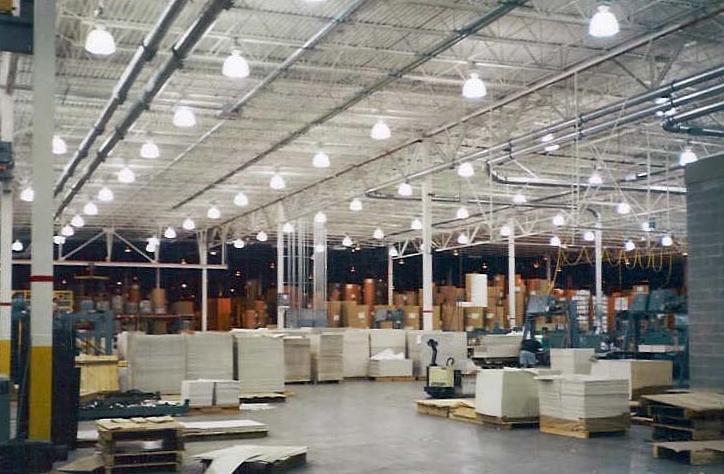
There is an updated version - SNiP 23-05-2010, which has been in force since 2011 and is an amended version of the main regulatory act. Many changes have been made to it, so it is necessary to clarify the data in this document in order to prevent errors and inaccuracies.
SP 52.13330.2011
The set of rules is also called "Natural and artificial lighting". It is partially harmonized with European standards, but there are also a number of differences, since the requirements in our country do not coincide with many of the standards established in Europe.On the basis of this document, it is possible to develop standards for organizations regarding lighting, if there are features that need to be regulated separately.
The set indicators are checked at the level of the working surface, this is the normalized minimum illumination. There is a separate table for each option, which simplifies the use of the document and allows you to quickly find the necessary data.
The set of rules contains links to documents that set specific values for different objects. When designing, they should be checked to ensure that the information is up to date and has not changed from what is specified in the SP.
What is the minimum and average normalized illumination
These are important indicators, which are most often repelled when designing light, or checking an already installed system. It is important to understand the difference between the terms in order to eliminate any errors and inaccuracies. It's simple:
- Normalized minimum illumination - this is the lowest indicator in a room, at a workplace, in a separate sector or in an open area. Shows what the smallest value in the set zone can be. It is impossible to violate it; in production and in offices, supervisory authorities can issue a fine. A decrease in indicators below the permissible limit has a bad effect on vision.
- Average normalized illumination determined by checking in several places. Based on the results, a value is displayed that should correspond to a certain indicator. This is the guideline that should be followed when designing the system. It is important that the differences in illumination within the space are not too large.
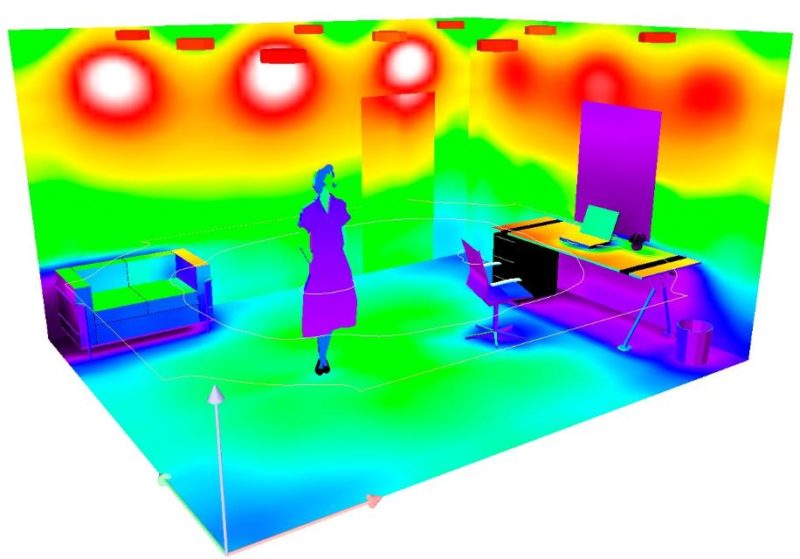
Illumination standards for different types of premises
For simplicity, the information is collected in the form of tables and grouped depending on the type of room. The data is up-to-date and can be used when designing, planning the installation of luminaires or checking the operation of the system. The standards are not set in watts, but in lux, it is important to remember this.
By the way! You need to control the readings with a luxmeter. Moreover, the device must be verified in the prescribed manner, only then the data can be considered correct.
Lighting standards in the office
People most often work at a computer or with papers. Therefore, it is very important to ensure the correct visibility so that the eyesight does not get tired and the employees work effectively throughout the working hours. The room illumination standards in the table are grouped in accordance with their classification in SNiP.
| Type of office space | Illumination level, lx | Ultimate Glare (UGR) |
| Archives and documentation rooms | 200 | 25 |
| Locations for copying work, office space | 300 | 19 |
| Reception | 300 | 22 |
| Meeting rooms and conference rooms | 300 | 19 |
| Places for data processing, reading, printing or manual filling of documents | 600 | 19 |
| Premises for design and drawing | 750 | 16 |
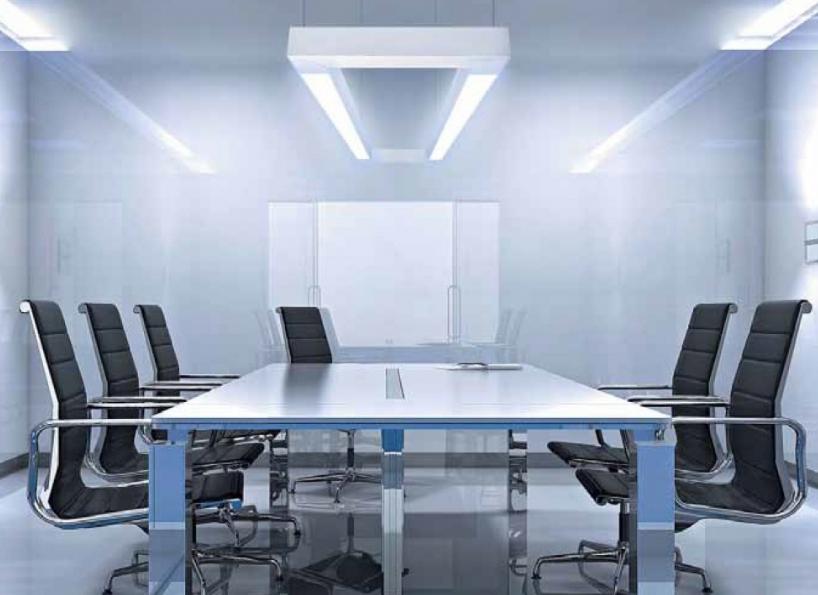
SanPiN standards may specify special lighting conditions for some workers places. Also of great importance color rendering (Ra) which shows how correct artificial lighting conveys shades. For all administrative premises, the minimum the norm is 80, it can be much more, it is not prohibited.
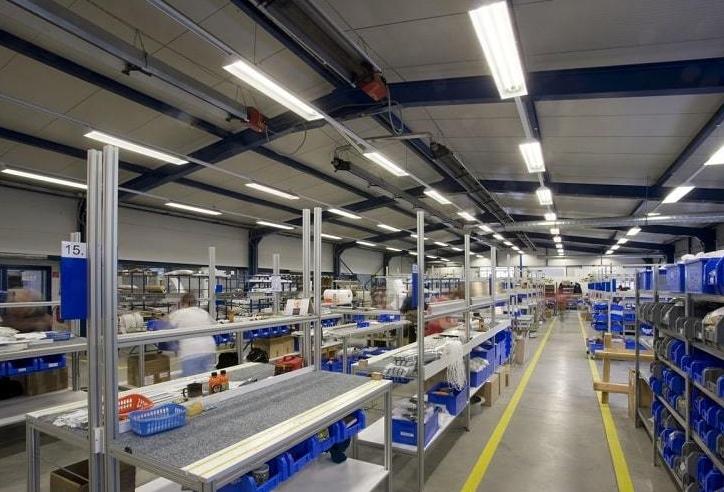
Norms of illumination of industrial premises
There is no listing of specific options, since it would take more than one book. All work areas are divided into categories in accordance with what eye strain is required for the normal performance of duties.
| Discharge of visual work | Characteristic | Combined illumination | General lighting |
| 1 | Highest Accuracy | From 1500 to 5000 | 400 to 1250 |
| 2 | Very high accuracy | 1000 to 4000 | 300 to 750 |
| 3 | High accuracy | 400 to 2000 | 200 to 500 |
| 4 | Average accuracy | 400 to 750 | 200 to 300 |
| 5 | Low precision | 400 | 200 to 300 |
| 6 | rough work | 200 | |
| 7 | Production process monitoring | 20 to 200 |
Norms of illumination of technical and auxiliary premises
Technical rooms are used to support the work process, equipment can be installed in them or spare parts are stored, etc. Auxiliary rooms help to carry out the work normally, so they also need to be given attention.
| Room type | Illumination rate in Lux |
| Attics | 20 |
| engine rooms | 30 |
| corridors | 20 to 50 |
| Main passages and corridors | 100 |
| Stairwells | 20 to 50 |
| Vestibules and cloakrooms | 75 to 150 |
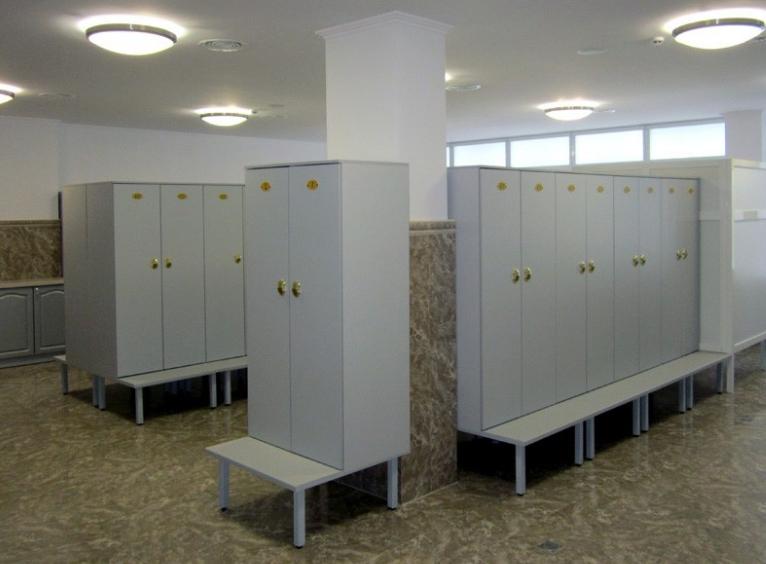
| Showers, changing rooms, heating rooms | 50 |
| Washrooms, bathrooms, smoking areas | 75 |
School lighting standards
There can be many options, but there are three main indicators, they are most often guided by when designing.
| Room type | Illumination rate, lx |
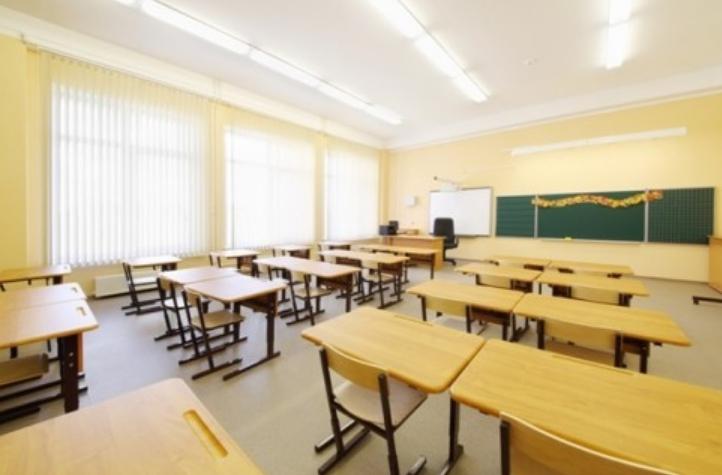
| Training classes | 200 to 750 |
| Reading rooms and libraries | From 50 to 1500 |
| Sport halls | 100 to 300 |
There are separate norms for all types of institutions, so it is necessary to select indicators that are suitable for a particular educational institution.
European lighting standards and their comparison with Russian ones
Most often, the norms in Europe are much higher than in Russia.
| Room type | Norm in Russia (Lk) | Norm in Europe (Lk) |
| Archive | 75 | 200 |
| stairs | 50-100 | 150 |
| Rooms for working with documents and at the computer | 300 | 500 |
| Open plan offices | 400 | 750 |
| Design and drawing rooms | 500 | 1500 |
Video lecture: Lighting rationing.
Illumination standards are mandatory both at work or in the office, and at home. All of them are selected to provide maximum visual comfort when performing certain tasks.