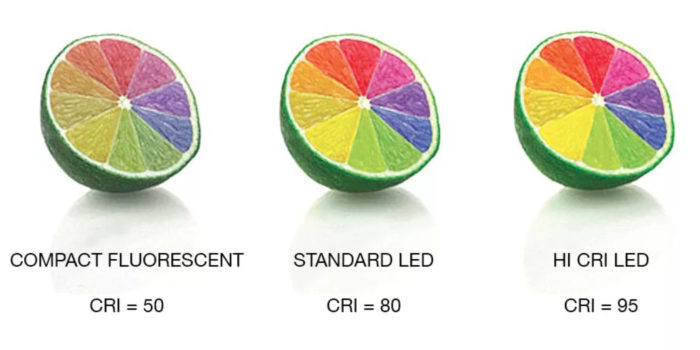
Color rendering of LED lamps
When using various lighting devices, you can notice that one light makes the surrounding objects bright and expressive, while the other seems to eat up part of the color. This phenomenon is responsible for a special parameter of lamps, which is called color rendering (CRI). Color rendition characterizes the correspondence of the visual perception of color to the spectrum of the lighting device.
What is CRI
The color rendering index is referred to as CRI (Colour Rendering Index). The term appeared in the 1960s. The parameter is determined by the eight main desaturated and six secondary saturated colors. These colors are called test shades.
The indicator has the dimension Ra and varies from 0 to 100 Ra. The upper limit of 100 Ra is the accepted color rendering index of sunlight. The parameter is rather arbitrary, since weather conditions, the time of day and the hemisphere on which the light falls affect the color rendering.
In the course of measuring the color rendering parameter of a particular device, it illuminates the established test colors.At the same time, these colors are illuminated by a reference light source whose CRI is as close as possible to 100 Ra. Then a comparison of the saturation of the shades is carried out and, based on the difference obtained, a conclusion is made about the color rendering index of the tested product.
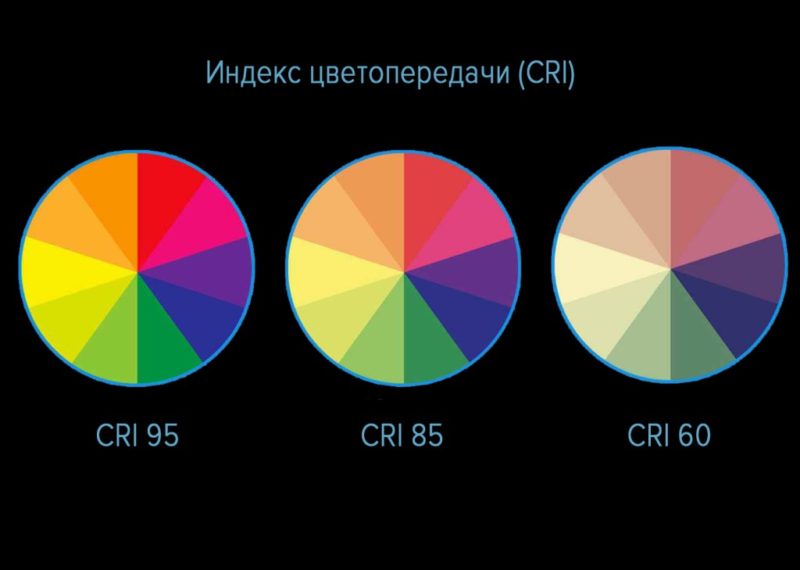
In simple terms, the color rendering index shows how natural all the colors and shades appear to a person, illuminated by a particular lamp. The human eye is tuned to perceive colors in sunlight, so it is taken as a standard. Moreover, human eyes are able to adjust the display of colors depending on specific weather conditions or time of day. A similar setting occurs when objects are illuminated with hot elements in incandescent lamps and halogen devices.
LED lamps operate on a different principle, which means that there is no automatic color correction by vision. According to observations, shades of red are displayed worst of all in such lighting. In particular, a person's face when illuminated by low-quality LEDs will appear gray. Using good LED fixtures will make the color warmer by just a couple of shades. But also does not fully convey the blush.
The most comfortable models with a color rendering index of at least 80 Ra. For workplaces and areas with high lighting requirements, it is better to achieve a figure of 90 or even 100 Ra.
This must be seen: Green skin or the era of disgusting light. CRI Index
How to measure color rendering index
When measuring the color rendering index, the deviation of apparent light from natural light is taken as the basis. The smaller it is, the better the performance of the light source.
The table below shows the values of the CRI coefficients and their respective lighting characteristics.
| Characteristic | Degree | CRI ratio |
|---|---|---|
| Low | 4 | |
| Sufficient | 3 | 40-59 |
| Good | 2B | 60-69 |
| Good | 2A | 70-79 |
| Very good | 1B | 80-89 |
| Very good | 1A | > 90 |
To evaluate the color rendering, there are systems of mathematical algorithms. They compare the changes in radiation in the spectral scale of the instrument with those of a reference light source. The values obtained are subtracted from 100 and the CRI index is obtained.
If the difference between the colors is insignificant, the source is assigned a value of 100 Ra.
Color rendering index
Consider the color rendering indexes of the most popular fixtures. The indicator depends on the design of the lighting device, the principle of operation and the quality of the elements used.
Sodium lamps
Sodium lamps are a specific light source that is rarely used in rooms with working people. The limitations are due to the features:
- during operation, the throttle buzzes loudly;
- flares up for a long time;
- low color rendering index of about 40 Ra.
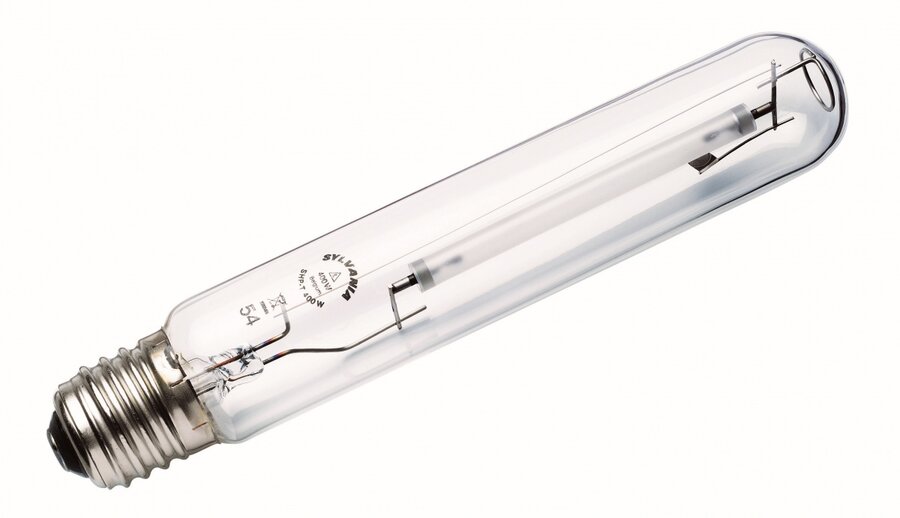
High pressure sodium lamps are widely used in street lamps and spotlights. They boast an impressive luminous flux about 150 lm/W and a work resource of 25 thousand hours.
These are gas-discharge light sources with a flat spectrum and a predominance of red-orange hues. This spectrum allows the use of devices as a source of illumination for plants in greenhouses.
Halogen lamps
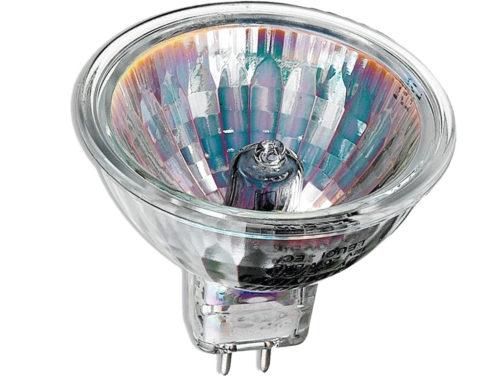
Halogen light sources are characterized by high flux, impressive power consumption and high color rendering. Here the indicator is very close to the daylight indicator and is often taken for 100 Ra.
Incandescent lamps
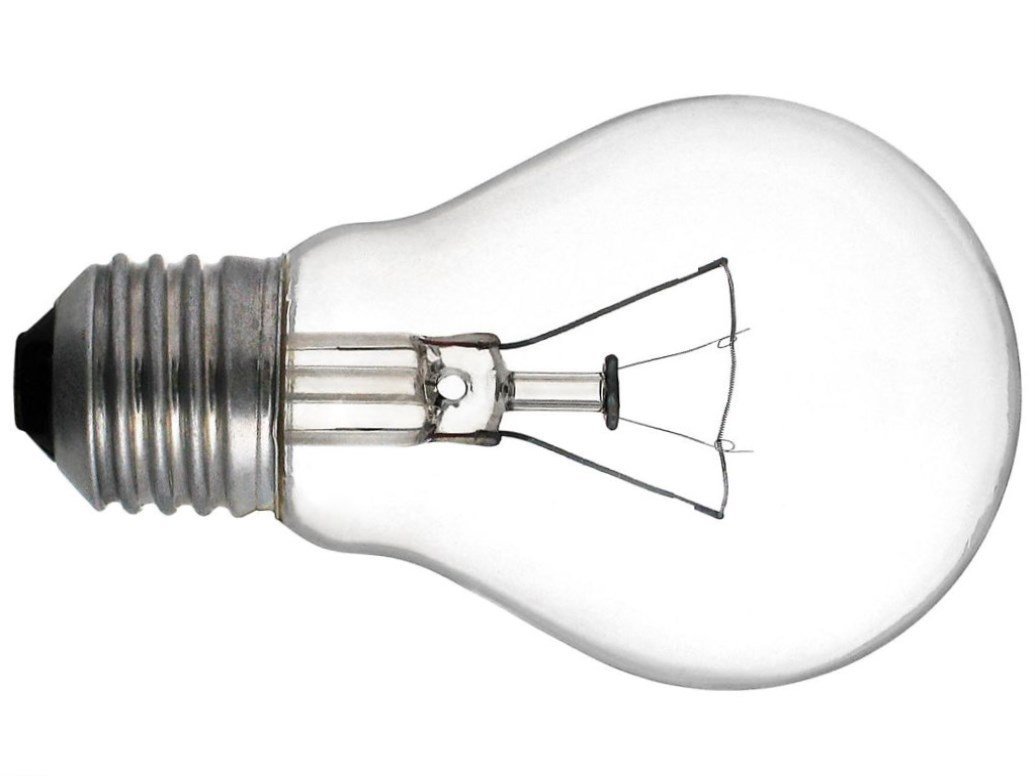
Traditional incandescent lamps are gradually disappearing from store shelves due to low efficiency. However, they have one indisputable advantage: close to sunlight color rendering at 100 Ra. At the same time, there is a significant shift towards warm shades of the infrared range.
Fluorescent lamps
For a long time, fluorescent lamps have been in demand due to energy efficiency and safety. However, the emergence of a large number of affordable LED fixtures has somewhat reduced demand and pushed fluorescent light sources into the background.
The devices are characterized by a torn spectrum, clearly shifted to the region of cold shades. They cannot function stably without special ballasts.
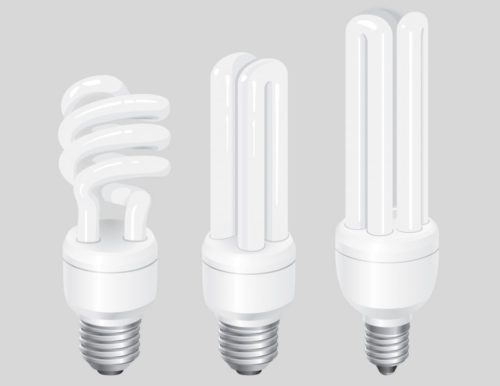
The color rendering index depends on the phosphor used in the lamp, from 60 Ra to 90 Ra. High values are typical for five-component phosphors.
LED lamp
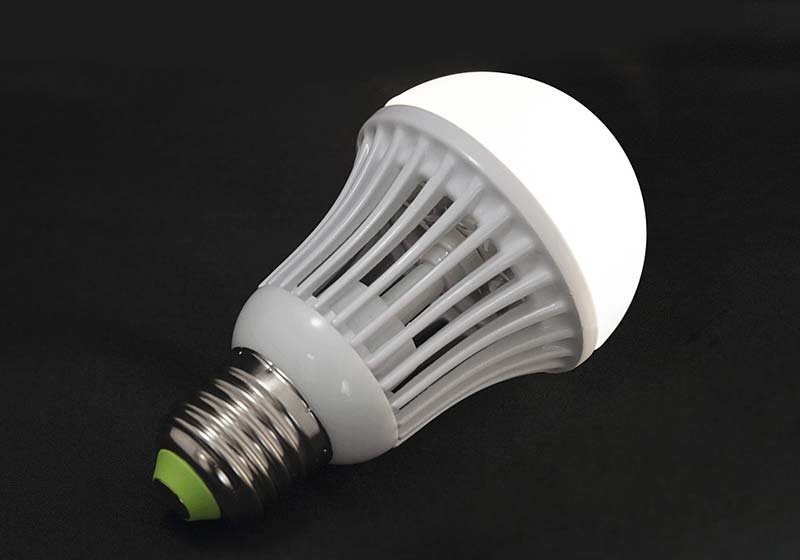
LED lamps also use a phosphor. It covers the LED crystals and affects the color rendering parameters. Color rendering index of modern LED lamps starts at 80 Ra. The optimal value seems to be 90 Ra, but more can be found. Lamps are actively used in rooms of any type without any restrictions.
DRL
Arc mercury lamps (DRL) are quite powerful light sources, similar in their characteristics and purpose to sodium lamps. The devices are capable of stably serving for 10 thousand hours and providing luminous flux is about 95 Lm/W. The color rendering index is low, rarely exceeding 40 Ra. The spectrum shows a significant shift towards blue and ultraviolet.