Homemade flashlight do it yourself
Flashlights are very handy devices that are used to solve a large number of tasks. In the household, a flashlight is an irreplaceable and extremely important thing. But far from always the user has a ready-made device available, so knowledge on how to make a flashlight with your own hands will come to the rescue.
Stages of assembling a flashlight on a bright LED
The most effective are homemade flashlights on super-bright LEDs. They are distinguished by reliability, convenience and low power requirements. To make a homemade flashlight work for a long time, we recommend that you follow the assembly steps.
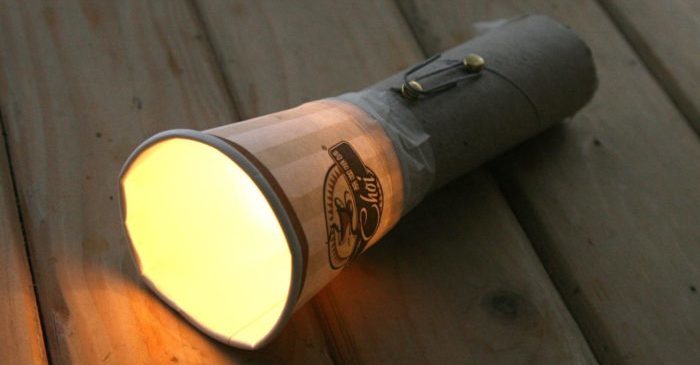
Drawing and diagram
Conventional flashlight circuits with lamps are energy-consuming and inconvenient. They are not able to provide the desired luminous flux and do not have a large resource. Circuits for diode lighting sources will help get rid of the shortcomings.
When designing a flashlight circuit with an ultra-bright LED, keep in mind that it is powered by two AA batteries or rechargeable batteries.The DFL-OSPW5111P LED with high brightness, white tint and 80 mA operating current is best suited.
To stabilize the voltage and prevent flickering, a ready-made ADP1110 chip is built into the circuit, capable of operating on batteries with a voltage of 2-12 V. It has three voltage outputs: 12 V, 5.5 V, 3.3 V.
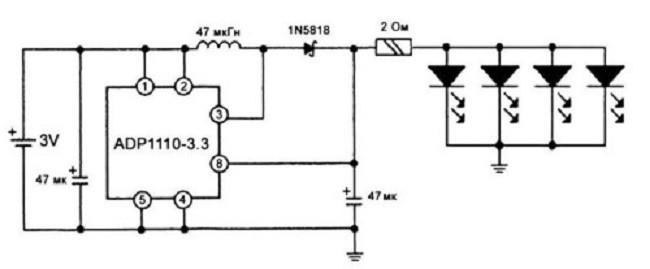
From batteries or accumulators, the current is supplied to the high-capacity capacitor and the ADP1110 chip plates. Coin-cell batteries can be used as power sources.
The ripple is limited by an inductor and a Schottky diode. The diode creates a barrier effect at the transition from metal to conductor. The direct resistance in this case is very small, which increases the speed.
Selection of tools and material
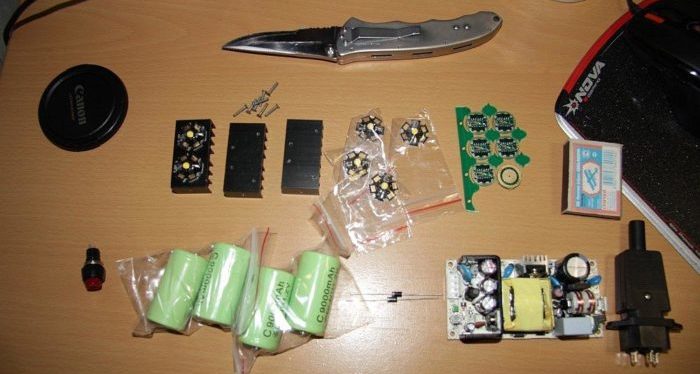
To make your own flashlight with LED sources, you will need:
- Batteries. These can be flat "tablets", AA blocks or other power sources.
- "Pocket" for installing batteries. When working with "tablets", a "pocket" dismantled from an old computer motherboard is best suited.
- Bright LEDs. Quantity and size will depend on specific requirements.
- Lenses for LED, for light dispersion or focusing into one beam.
- Flashlight body. It can be a plastic container, an old syringe, or any other safety item.
- A switch with which the turn-on voltage will be applied to the diode.
- Voltage regulator. It can be a ready-made module from other electrical appliances or a kit of parts for self-assembly.
- Glue.Liquid nails, epoxy, or standard superglue can be used as a bonding agent.
- Wires for connecting structural elements in a circuit. It is better to select copper cables with the best conductivity values.
- Knife or scissors for cutting wires.
To make it convenient to apply glue, you can use a syringe or a special gun for dosing viscous substances.
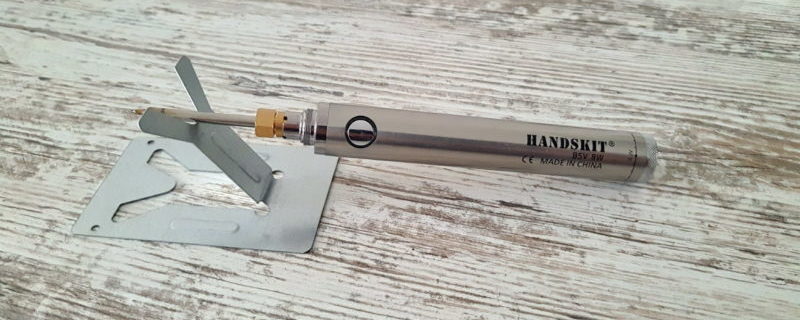
Assembling a homemade flashlight involves working with electrical circuits, you will need a soldering iron and solder.
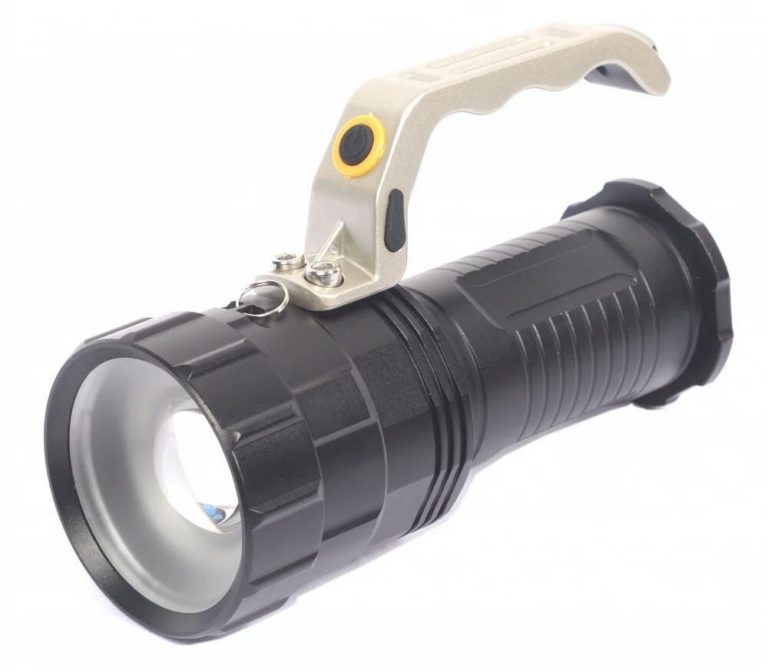
Assembling the flashlight
Assembly steps:
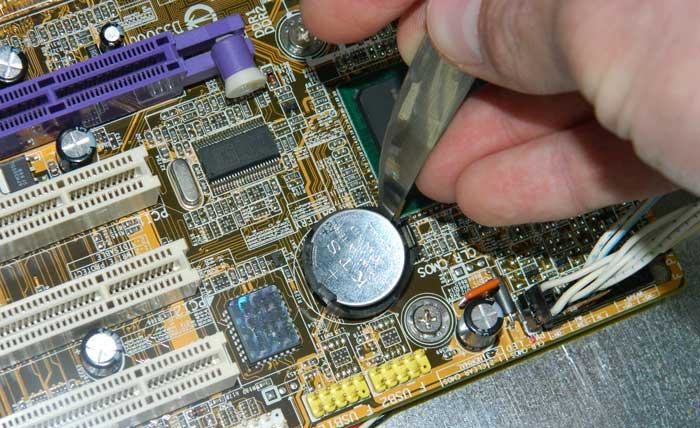
- From the old computer motherboard, you need to remove the battery pocket, carefully disconnecting all the contacts from the microcircuit with a soldering iron. Too much force can damage the contacts and make it difficult to assembly designs. When choosing other power sources, the installation pocket must be removed from the corresponding devices.
![Figure 4. Removing the "pocket" for the battery from the motherboard.]() Removing the "pocket" for the battery from the motherboard.
Removing the "pocket" for the battery from the motherboard. - Solder the power button to the positive contact of the pocket. Copper wires are used for connection.
- The leg of the LED is also soldered to the second contact of the switch.
- The second leg of the LED is connected to the negative pole of the pocket.
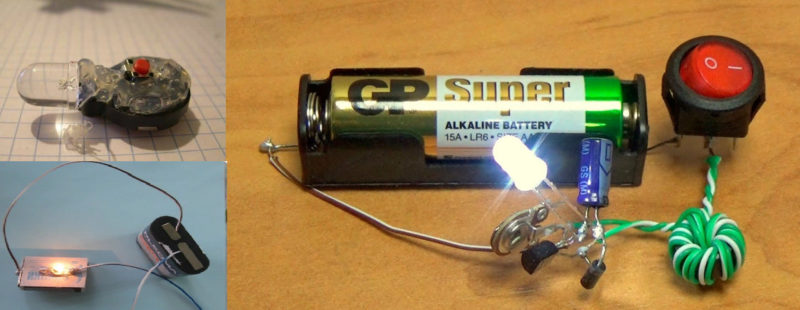
As a result, we get an electrical circuit that will be closed when the switch button is pressed. To test the operation of the circuit, insert the battery into your pocket and press the switch. The LED should light up.
To make the chain strong enough, it is recommended to fill the joints with hot glue. Now you need to assemble the structure by placing all the elements in the case and fixing them in the right places.The case can be the shell of an old flashlight or a plastic container. The lamp assembled in this way does not take up much space and does its job perfectly.
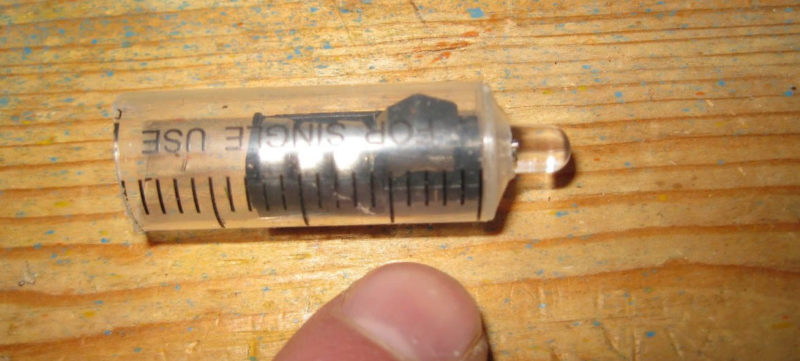
To avoid problems with overheating, it is recommended to install a small aluminum heatsink on the LED.
For a uniform glow without ripples, you will need to integrate a voltage regulator into the circuit. It is better to use ready-made microcircuits, successively connecting to them the appropriate wires from the power source and diodes. Sometimes it is enough to install an additional resistor or capacitor to stabilize.
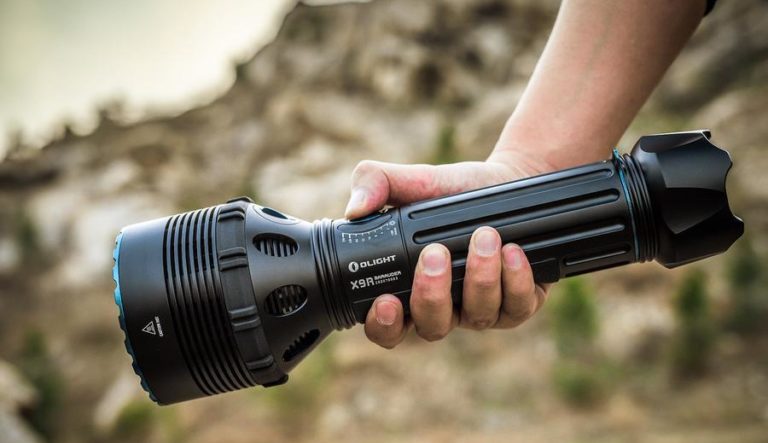
How can I use a homemade lantern
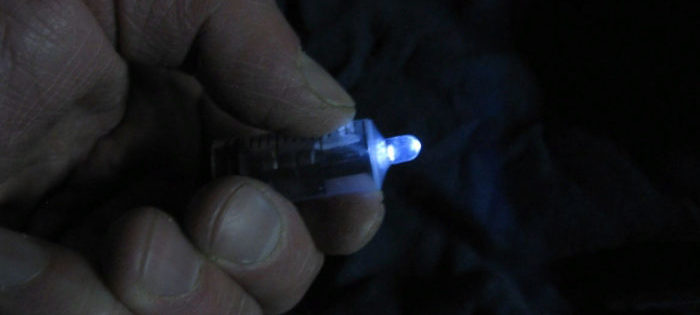
A homemade flashlight can be used for a variety of purposes. It all depends on its size, design and power. A portable flashlight helps to illuminate the desired area in the event that the inclusion of stationary light sources is not possible.
Household flashlights are widely used in work on garden plots, when illuminating closets, basements or other rooms with a complete lack of light. They are also actively used when inspecting a car from a viewing hole.
You can independently make not only a portable, but also a powerful stationary LED flashlight, which is easy to install in a suitable place. In this case, it is desirable to take into account the possibility of connecting to the device power supply from a common power supply.
Video: Sturdy, Reliable Underwater Light with Powerful Beam
When working with LEDs, it is important to consider them peculiarities. Due to the uneven current-voltage characteristics and unstable voltage, users often opt for traditional fixtures. However, the stabilizer eliminates the disadvantage.
It is better to assemble devices that can operate on one or two popular types of batteries. Too fast consumption of batteries will indicate assembly errors. LEDs are energy efficient, which means that the batteries should last for a long time.
Making your own flashlight is not as difficult as it seems. All tools and materials are available, and assembly does not require specific skills. It is enough to have an idea about the operation of electronic circuits and have soldering skills.
