What is the norm of illumination of a dwelling
Illumination standards for residential premises are specified in SNiP 23-05-95 "Natural and artificial lighting". There is also information in other documents, for example, in specialized sets of rules. To ensure a comfortable stay in a particular room, you need to choose the right light mode. It differs for different conditions, so you need to understand the topic well.
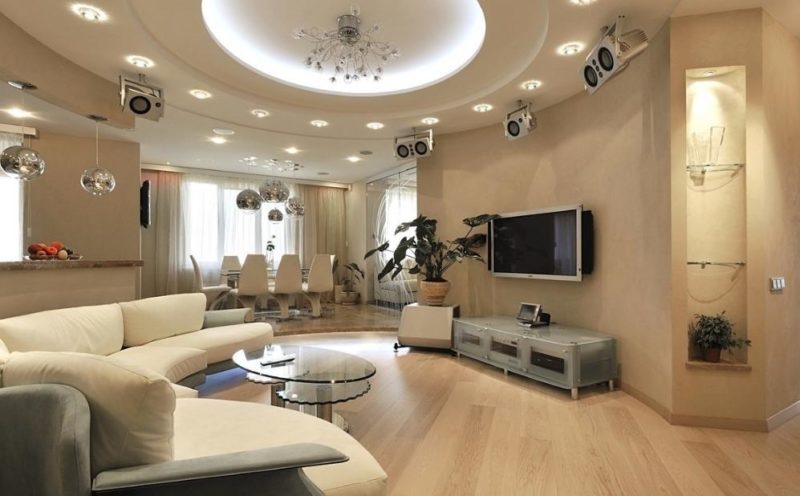
Lighting standards for residential premises for various purposes
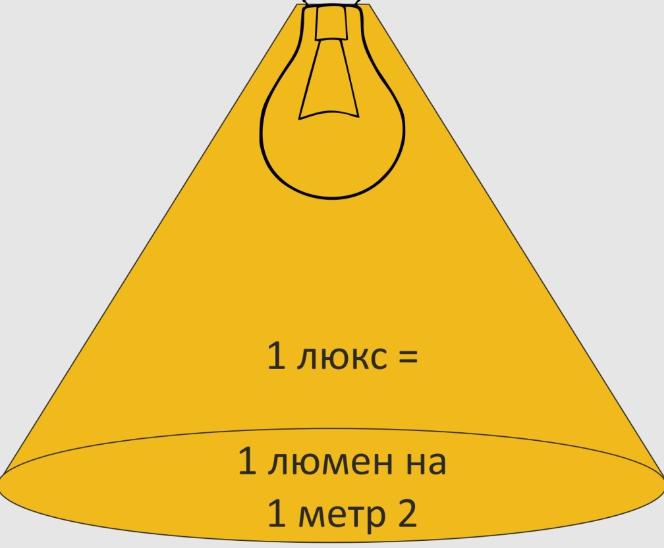
In regulatory documents, indicators are usually indicated in suites. 1 lux is an illumination output of 1 lumen (Lm) per square meter. The easiest way to choose the norms of illumination in an apartment or a private house is according to the table.
| Room type | Illumination rate in lux |
| Hallways without natural light | 60 |
| Corridors in apartments | 50 |
| Storerooms and utility rooms | 60 |
| Stair flights and landings | 30 |
| bathrooms | 50 |
| Basements and attics | 60 |
| Bedrooms | 120 |
| Kitchens and dining rooms | 150 |
| Bathrooms and work areas in kitchens | 250 |
| Children's rooms | 200 |
| Living rooms, living quarters | 150 |
| workrooms | 300 |
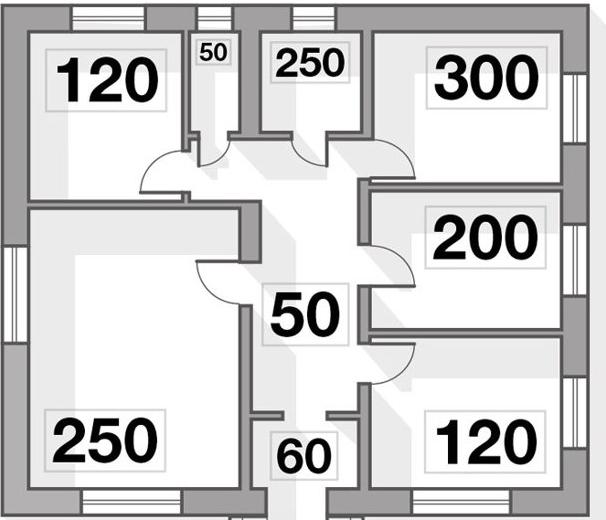
By the way! If you need to select a separate zone in the room, use combined lighting. Additional light sources must be switched on separately.
Norm of illumination of a residential area: W per m2
When only incandescent lamps were used, power was calculated in watts. But with the spread of fluorescent and LED lamps, this option has become not very convenient. Power to luminous flux different models are different, so it's easier to use the indicators in lumens and convert them to W, based on the type of light bulb indicated in the table.
| Luminous flux, Lm | Incandescent lamp (power in watts) | Fluorescent (power in W) | LED (power in W) |
| 250 | 20 | 5-7 | 2-3 |
| 400 | 40 | 10-13 | 4-5 |
| 700 | 60 | 15-16 | 8-10 |
| 900 | 75 | 18-20 | 10-12 |
| 1200 | 100 | 25-30 | 12-15 |
| 1800 | 150 | 40-50 | 18-20 |
| 2500 | 200 | 60-80 | 25-30 |
These are standard figures, actual figures may vary. Therefore, when choosing or buying light bulbs, you need to check the data, if necessary, adjust their number or power to obtain the desired level of illumination. It is especially important to do this when purchasing LED equipment, since the indicators there depend on the manufacturer and the diodes used in the lamp.
Is the type of lighting and surface characteristics important?
You need to choose light bulbs not only by their power and luminous flux, but also by the features of light. Here are some important tips to keep in mind:
- Incandescent lamps give a yellowish light, as close as possible in the spectrum to sunlight. They are comfortable to look at, but they have many disadvantages.The main disadvantages are a small resource, high power consumption and strong heating during operation.
![What is the norm of illumination of a dwelling]() Incandescent lamps are not suitable for all chandeliers.
Incandescent lamps are not suitable for all chandeliers. - Fluorescent options give a very bright light, it is important to choose the optimal color temperature. They have a large resource, consume little electricity. The biggest disadvantage is the presence of mercury vapor in the flask, which requires disposal only in specially designed containers.
- LED light bulbs can give warm, neutral and cold light. For residential premises, only the first two varieties are suitable. Warm shades are ideal for bedrooms and lounges, while neutrals are used in kitchens, offices and other places where bright light is needed.
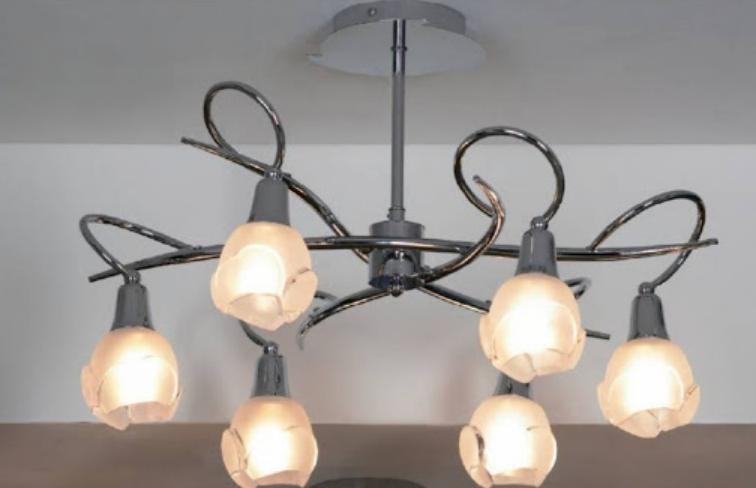
The level of illumination depends on the texture and color of the walls. In residential premises, you can not use complex calculation methods. But keep in mind that light, even surfaces reflect light much better than textured and dark ones. Therefore, it is worth considering the decoration of walls, ceiling and floor. The more dark areas, the higher the power of the fixtures should be.
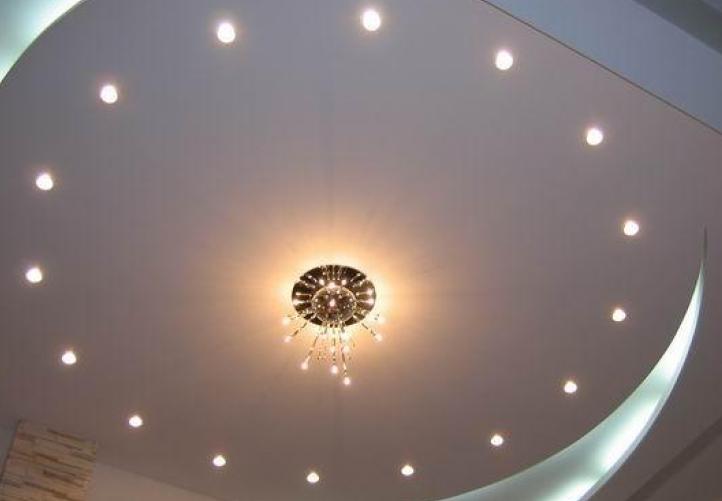
Illumination calculation
The level of illumination can be defined in different ways. Even if mistakes are made, you can put more lamp power or add local lighting. But it is better to do everything right initially in order to create optimal conditions. Artificial light is selected without taking into account daylight, since it is mainly turned on at night. When calculating, you should adhere to the following recommendations:
- According to the table of recommended illumination, the optimal power for a particular room is selected.If dark shades predominate in the finish, the rate is increased by 30-40%. A small supply will not create any special problems.
- The indicator of illumination per square meter in lux is multiplied by the area of \u200b\u200bthe room. The result obtained will tell you what the total power of the lamps should be to ensure normal conditions.
- It is also necessary to take into account the height of the ceiling, and depending on it, a correction factor is selected. For height up to 270 cm - 1.0; from 270 to 300 - 1.2; 300-350 - 1.5 and 350-400 cm - 2.0. It is necessary to multiply the result by a suitable indicator. The location of the fixtures is selected based on the shape of the room, if a chandelier in the middle is enough for a square one, then for an elongated one it is better to use 2-3 light sources.
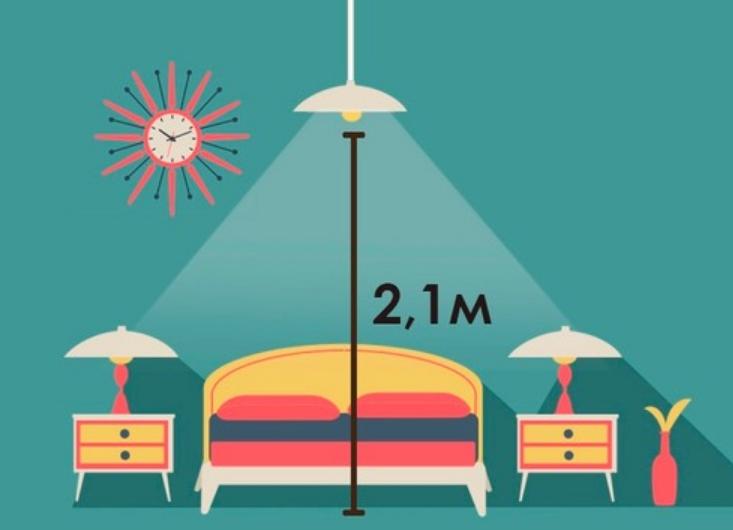
If lighting is selected for the workplace, the light should be concentrated on the surface of the table. Best to use adjustable lamps.
How to calculate the illumination of standard lamps
By standard means traditional incandescent lamps. This option is inferior in efficiency to analogues, but is still popular due to its low price and availability. In this case, the calculations are also the easiest to carry out. The standard is the option when there are 20 watts of power per square meter. That is, one 100 W light bulb is enough for full lighting of 5 sq.m.
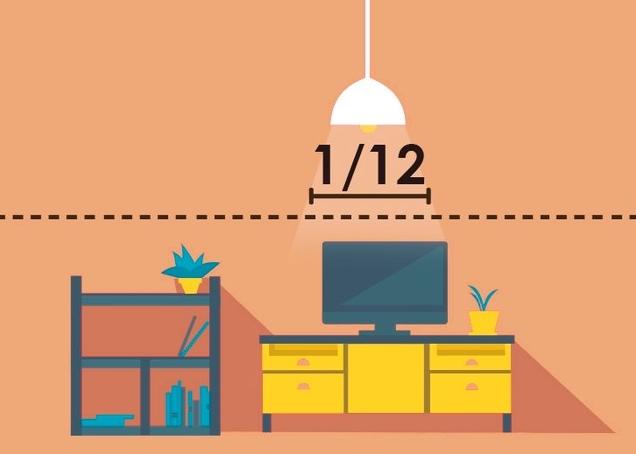
For bedrooms it is better to use a chandelier with at least two modes so that you can turn on standard or subdued light. As for the offices or living rooms, there you can add a margin of 20-30% to ensure good visibility. Do not forget about the correction factors depending on the color of the floor and walls, as well as the height of the lamp.
If you use a chandelier with reflected light or a diffuser, you need to add 20-30% margin, as the illumination will deteriorate.
Video: how lighting standards were formed for various objects and tasks.
Dealing with lighting standards for residential premises is easy. The main thing is to have a table with indicators for different rooms at hand and use correction factors if necessary.