Lighting requirements for office space
The lighting in the office is different from other rooms, as in it a person is engaged in work that requires eye strain for a long time. All indicators are regulated by sanitary and hygienic standards, violations are not allowed. If the light does not meet the requirements, employees will get tired much faster, productivity will decrease.
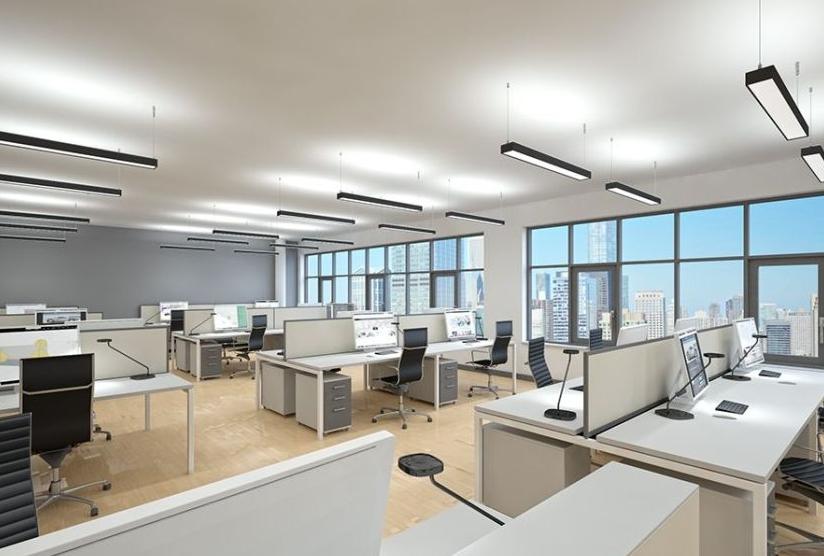
Features of office lighting
Based on the regulations, different solutions can be used for lighting in the office. But the main ones are always unchanged and are used almost everywhere:
- General lighting. Can be implemented with ceiling or wall lamps, it is allowed to combine the two options in one room. The equipment should give a uniform bright light, which is distributed throughout the room so that all segments where employees are located are illuminated.Very often this is enough to provide the desired indicators.
- Local or local lighting - an additional option used in addition to the main one, its cannot be used as the only. Most often installed at each workplace and is a desktop or attached to the edge countertop lamp, although there may be a wall-mounted option. For right-handers it is better to place the light source on the left, and for left-handers it is vice versa.
![Lighting requirements for office space]() If the general lighting is good, you do not need to put lamps on the tables.
If the general lighting is good, you do not need to put lamps on the tables. - Zonal lighting is needed to highlight individual parts of the room. For example, this option is often used in recreation areas, meeting rooms and other places where you need to create special conditions. Often, such solutions are more of a decorative function, emphasizing the corporate identity of the company or creating an area where you can relax and unwind.
- Do not lose sight of other mandatory types of lighting. The office may need duty lighting during non-working hours, security to protect against intruders, and evacuation, which turns on during a power outage and allows employees to leave the office safely.
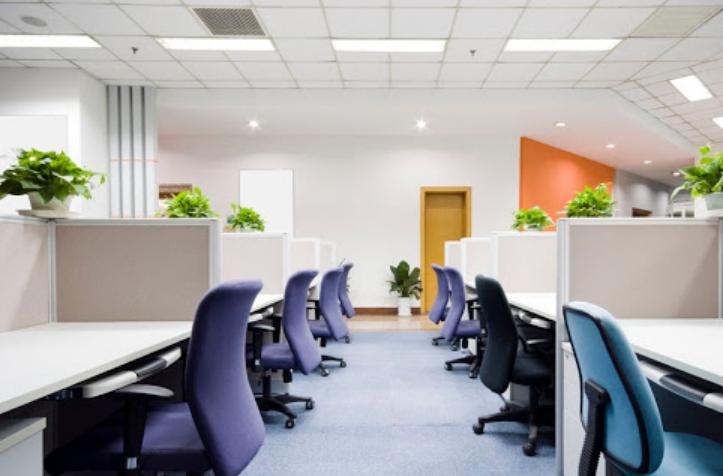
Do not forget about the lighting of corridors and auxiliary rooms, it must also comply with the standards.
Illumination standards
To select the optimal indicators, you should use SP 52.13330.2016 "Natural and artificial lighting", this document has all the data, the main ones are as follows:
- For rooms with computers, the illumination norm should be from 200 to 300 lx.
- Large offices with a large number of employees require lighting not less than 400 lux.
- If the department is working with drawings, the rate rises up to 500 lx.
- For meeting and conference rooms, the minimum values should not be lower than 200 Lux.
- In pantries and ancillary rooms, the norm is 50 suites.
- Lighting required in halls and corridors from 50 to 75 Lux.
- For archives and other places of storage of documentation, it is necessary to provide illumination 75 Lk.
- If the building has stairs and escalators, then in these areas the lighting rate should be from 50 to 100 lux.
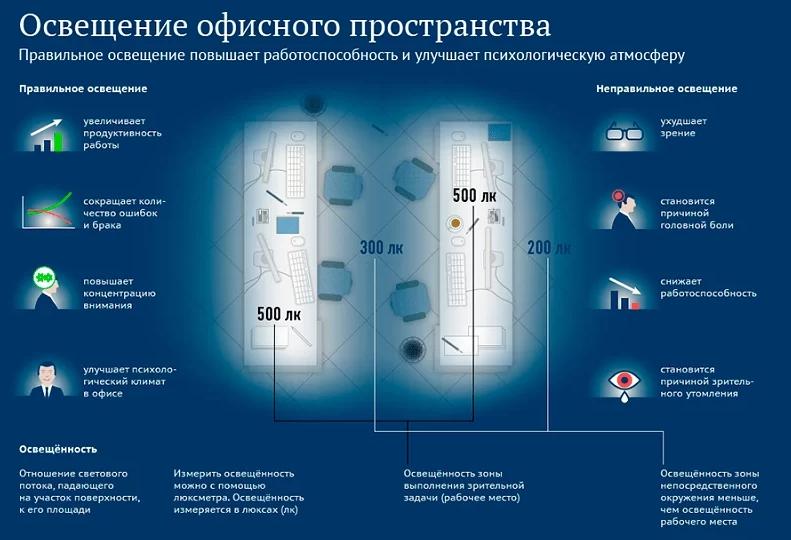
Lighting for office space is checked at a height of 80 to 100 cm, which corresponds to the level of the desktop. In this case, the established indicators should be within a radius of 50 cm from the workplace. If high-precision work is carried out in the office or constant eye strain is required, the illumination standards can be even higher, they are established by industry acts.
What to consider when calculating the illumination of the workplace
The easiest way to calculate the required indicator is with the help of a special program in which you need to enter all the data. But you can do it yourself if you follow a simple instruction:
- To begin with, choose the illumination rate for the workplace and multiply it by the office area in square meters. Next, you need to clarify the safety factor, which shows the deterioration of light from lamps over time due to their dusting or clouding (for LEDs, the indicator is 1). Another indicator is a correction factor if there are special lighting requirements. All numbers are multiplied.
- You will also need a usage indicator luminous flux indoors, which takes into account the reflectance of the surfaces.It must be multiplied by the number of lamps and the number of lamps in each of them. Then divide the result of the first item by the number of the second.
You can involve specialists in the calculations to eliminate any errors and inaccuracies. If the work is carried out independently, it is worth considering the reflection coefficient of the surfaces, it affects both the overall illumination and the creation of a comfortable environment in the room. For the floor, it should be 0.1-0.4, for walls - from 0.3 to 0.5, for ceilings - from 0.6 to 0.8, and work surfaces should reflect light in the range from 0.2 to 0.7.
Natural lighting in office space
This option is the most preferred, as it provides ideal office lighting - daylight can be enough for most of the day and it is completely free. To determine the indicators, KEO is used - the coefficient of natural illumination, which shows the amount of light in the office compared to the illumination in the open air.
The coefficient of natural light directly depends on the number of window openings and their size. The larger they are, the better the light penetrates, but the heat loss in winter also increases. Therefore, calculations are always made in order to select the optimal ratio of window openings to the total area of \u200b\u200bthe walls.
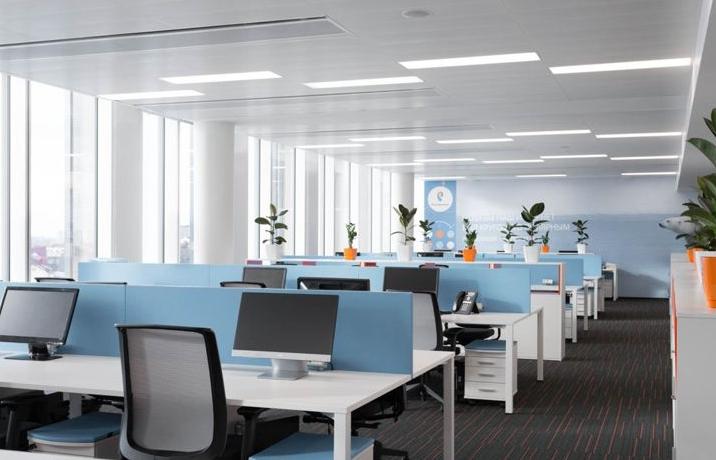
With lateral natural light KEO should be 1.0, and if the windows are in the ceiling, then the indicator increases to 3.0. If combined lighting is used, then the minimum side illumination indicator is 0.6, and the top one is 1.8.
KEO indicators differ in different regions.So, if in the middle and northern latitudes a coefficient of 1.0 is used, then in the south it must be increased to 1.2.
The choice of fixtures and their placement
There are several basic types of lamps that can be placed in the office, each with its own characteristics. It is necessary to select equipment according to power and quantity only after making calculations.
Types of lamps used
Today, different types are used, but the last of the considered options is best suited, it is worth paying the main attention to it. Features are:
- Incandescent lamps are the least efficient solution, consuming the most electricity, while the service life is only 1000 hours, so you need to change the elements often. The filament gives a yellowish light of low brightness, to ensure high-quality lighting, you need to put a lot of light bulbs, and this is a big cost for electricity.
- Halogen bulbs are distinguished by the quality of light, which provide comfortable work. But at the same time, the elements also get very hot and consume a lot of electricity. The service life is not very long, so the option is not suitable for task lighting.
- Discharge lamps used to be used often, but now they have lost their relevance due to the high consumption of electricity. They also give off a flickering light, which causes vision to get tired over time and work efficiency decreases.
- LED light bulbs have the largest resource - 50,000 hours or more. At the same time, they can give light of any intensity, and the flicker rate is less than 1%. This is the best solution for the office today, which is used most often.
![LED lights]() LED lamps not only give good light, but also look modern.
LED lamps not only give good light, but also look modern. - Fluorescent options consume energy economically and do not heat up during operation, they also have the disadvantage of flickering. In general, they fit better than any of the above types.
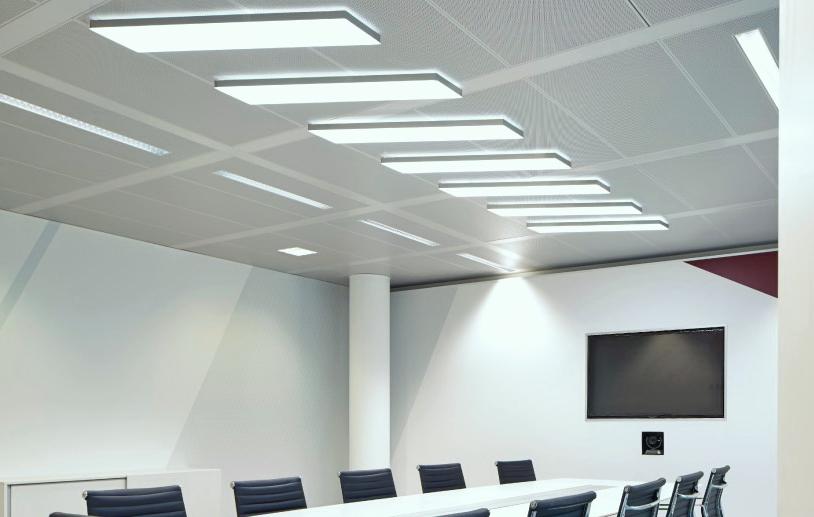
It is better to use equipment of the same type in the office.
Lighting Requirements
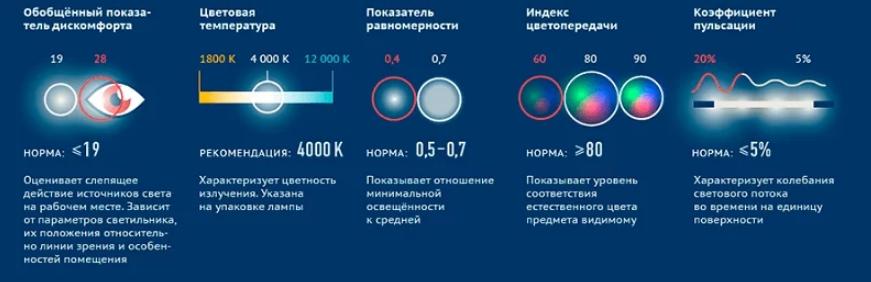
First of all, you should choose a color temperature according to SNiP and sanitary standards. It makes no sense to go into details, you can remember a simple recommendation - lighting should be as close to natural as possible, this is the best option for work.
As for the location of the lamps, they are placed in rows parallel to the wall with windows. It is desirable that the desktops are located between the rows, then good visibility will be provided. The light should be diffused or directed, so it does not create discomfort for the eyesight.
Thematic video:
If you understand the standards, then it is not difficult to choose lighting for the office in compliance with all sanitary standards. LED lamps are best suited, as they consume little electricity and do not flicker when working.
