Description of the main types of light bulbs
It is impossible to imagine modern life without bright electric light. It is visual comfort and excellent well-being. Lamps are used in everyday life, in production, underground, under water and in space. Over 100 years of development, different types of light bulbs have appeared that work on many physical effects.
Incandescent lamps
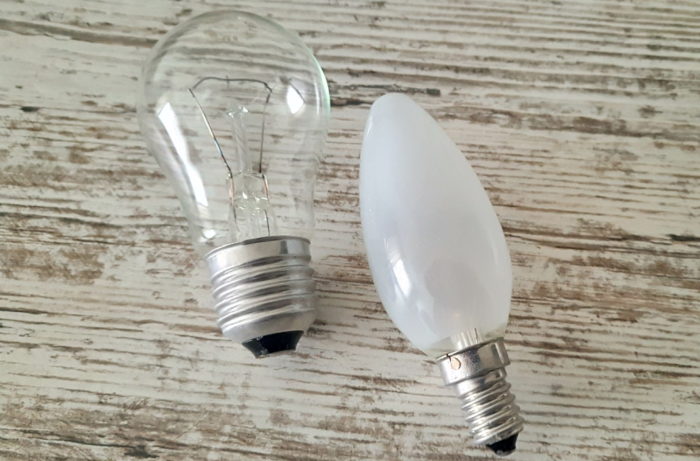
The advantages of modern incandescent lamps (LON) include:
- simplicity of design and low price of the materials used, which ensure their low cost in mass production;
- the ability to create products for different operating voltages - from a few volts to hundreds of volts;
- a continuous spectrum of luminescence, similar to the spectrum of the Sun - this is the spectrum of thermal and visible radiation of a metal heated to a glow, the name of incandescent lamps is associated with this;
- gas-filled,hours and halogen incandescent lamps have a service life of 2-3 thousand to tens of thousands of hours;
- brightness adjustment, i.e. dimming, is carried out by fairly simple means - rheostats, thyristor and triac dimmers.
The nominal service life of 1,000 hours for LON - general purpose light bulbs, was established in 1930 by agreement of the main world manufacturers of that period. Violators of this term were punished and continue to be punished by international sanctions.
Protozoa classification of incandescent lamps:
- LON - general purpose lamps, used everywhere in everyday life and at work;
- halogen incandescent lamps - halogen substances are added to the inert gas;
- incandescent local lighting bulbs are characterized by a safe low operating voltage of 12, 24, 36 or 48 V, a short filament and resistance to mechanical stress.
From the video you will learn how incandescent lamps are made
Over a century old the history of the development of incandescent lamps showed that they can be used in any field of human activity - from household to special lighting:
- in transport - in cars, trains, ships, airplanes;
- in production - for lighting rooms, for obtaining absolutely pure heat without pollutants - in medicine, the industry for the production of semiconductor devices, in animal husbandry and poultry farming - for heating young animals and many others. others
Halogen devices
These sources of artificial light include gas-filled incandescent lamps. In them, halogen substances - iodine, bromine, chlorine, etc. - are added to the inert gas that fills the flask. Metal evaporates from the hot filament and settles on the walls of the flask. Wherein:
- the thickness of the thread decreases;
- the metal on the glass of the bulb reduces its transparency - the light flux falls.
The evaporated metal atoms of the halogen substance are bound into "oxides". They, falling on the hot metal of the incandescent body, disintegrate and the metal settles on the surface of the thread. As a result, the life of the device increases by 3-4 times, the shade of the glow “whitens”.
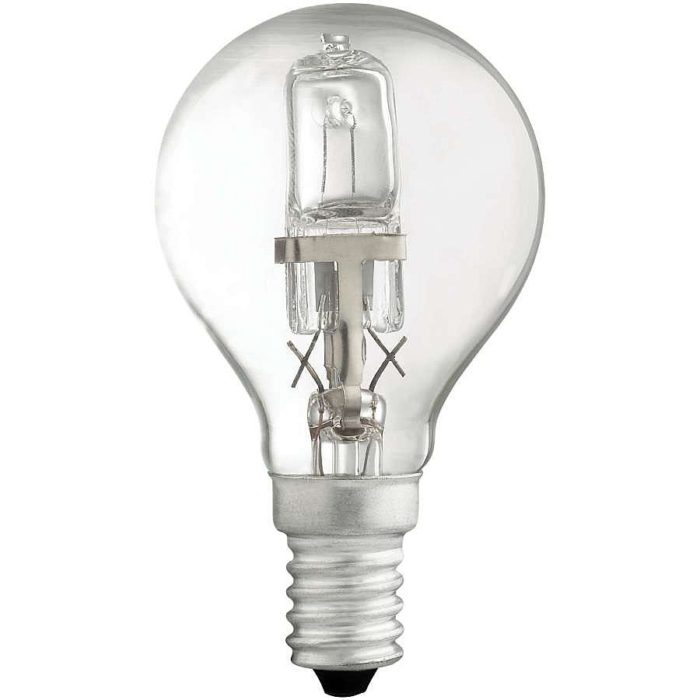
Inside a pear-shaped glass bulb, a capsule halogen small-sized lamp is placed on the armature of a conventional incandescent lamp.
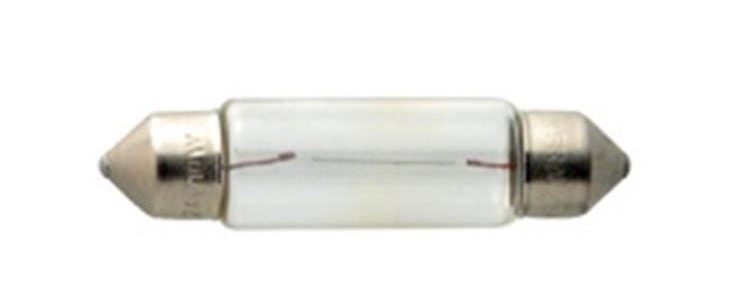
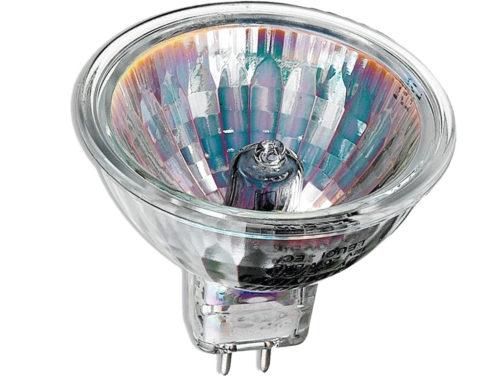
G - glass - translation from English - glass, U - design option of the base, 5.3 - distance between the axes of the pins in millimeters.
Fluorescent lamps
In a thin-walled glass tube with an inert gas and mercury vapor, heated electrodes are placed at the ends, which, after heating, emit electrons that excite gas and mercury atoms. Voltage pulses of several hundred volts applied to the electrodes create an electrical discharge in the gas. Fueled by the energy of the voltage source, the excited atoms of gas and metal vapor begin to emit ultraviolet light. High-energy UV radiation hits the phosphor on the inner surface of the bulb. Under the action of radiation, the atoms of the phosphor receive additional energy and emit light. So in fluorescent lamp invisible UV radiation is converted into visible light.
To obtain such a stream of light, much less energy is required than to heat the metal to the incandescent temperature.
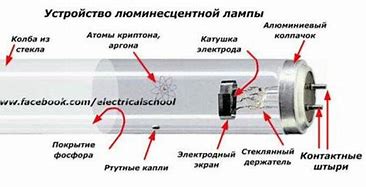
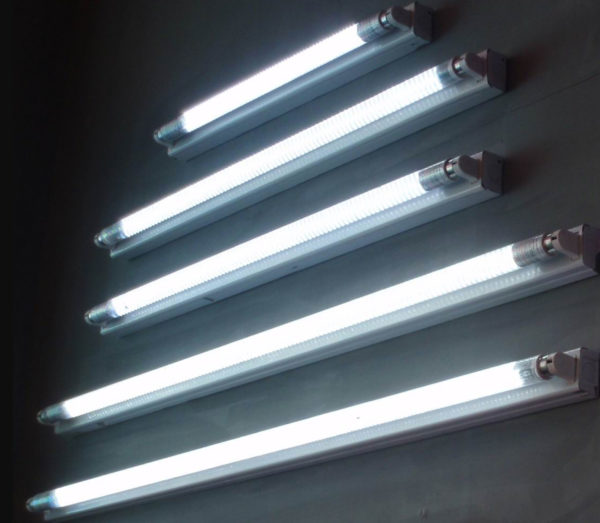
Tubular lamps are marked with the letter T and a number that is equal to 1/8 inch. That is, a T8 type tube is 8/8 inch or 25.4 mm, rounded 25 mm.
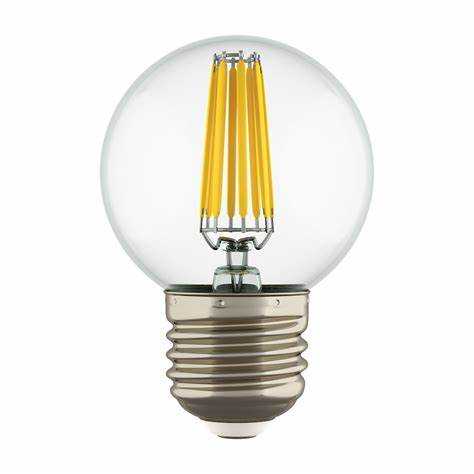
LED lamp
The basis of modern led lamp are superbright LEDs. The light source is the process of recombination of electric charge carriers in p- and n-type semiconductor metals - electrons and "holes".
The color of the glow depends on the semiconductor material and its doping. The white tint is obtained by converting the blue light of an LED into a yellow phosphor, which is coated on the crystal. By changing the thickness of the phosphor and its composition, any shade of white glow is obtained.
Gas-discharge light sources (GRL)
A physical phenomenon that is used to produce light in gas-discharge radiation sources - this is an electric discharge when current passes through a gas of a certain composition. Such a discharge was called smoldering.
The beginning of the discharge is possible only with forced ionization of the gas. To do this, a high voltage is applied to the gas located in the gap between the electrodes. Usually it is a little more than a hundred volts. During the discharge, a breakdown of the interelectrode gap occurs and the current flowing through the gas increases sharply. A luminous plasma cloud is formed. Its color depends on the composition of the gas in the flask.For example, neon glows red, argon glows purple, xenon glows bluish, and helium glows red-orange.
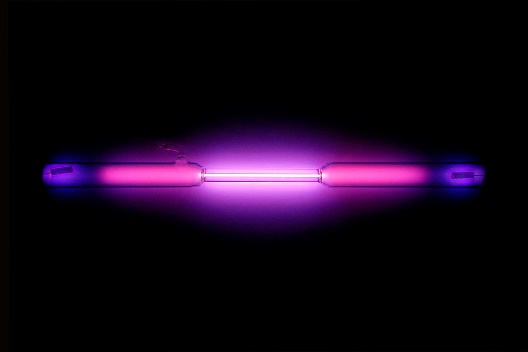
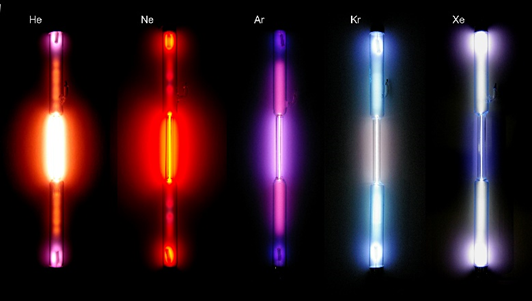
To intensify the glow process, a metal, mercury, is added to the air or an inert gas in the tube, the vapors of which give ultraviolet radiation. It is re-emitted by the phosphor.
Arc mercury (DRL)
On the basis of such a physical phenomenon, lamps of the type DRL, DNAT, MGL. These artificial light sources belong to the large category of gas discharge lamps, a subcategory of arc discharge.
Abbreviations mean:
- DRL – arc mercury fluorescent or arc mercury lamp;
- DNAT – arc sodium tubular;
- MGL - metal halide lamp.
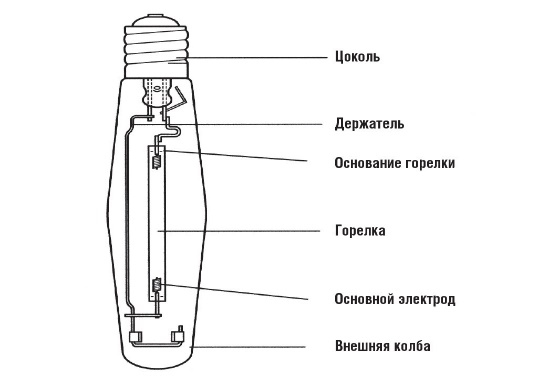
At GRL, a discharge tube is mounted inside the flasks. It's called a burner. The light in the GRL is emitted by a plasma cord or cloud formed during an arc discharge in the burner gas.
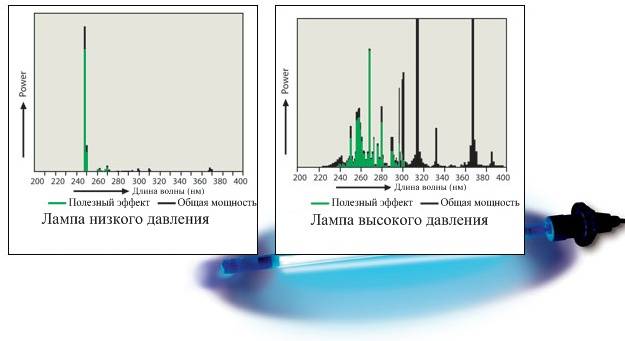
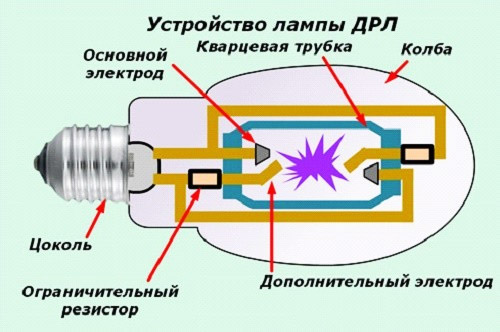
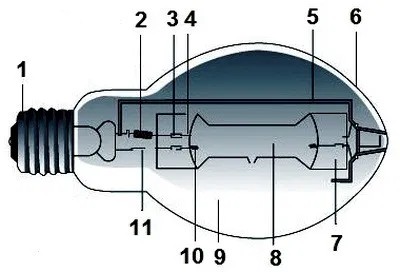
Used to illuminate large spaces. For example, workshops of enterprises, streets, squares, parking lots, etc.
HPS lamps
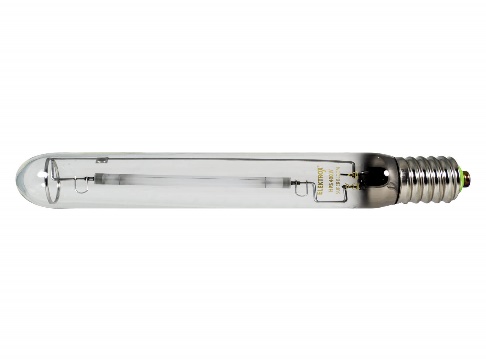
A tubular bulb with an Edison E40 threaded base used in high power lamps.A discharge tube is visible in the flask - a burner. On the glass of the flask, near the base, a minimum of characteristics is printed in indelible text.
In industrial production, paws with a power of 50 to 1,000 W, but some manufacturers produce 2 or even 4 kW.
Main application - street lighting, roads, highways, underpasses, parking lots. That is, places where a person stays for a short time. The reason is the narrow-line spectral composition of the emission of yellow-orange light.. Burner made of quartz glass or transparent ceramic. Outer bowl made of mechanically and thermally resistant borosilicate glass. Flask:
- stabilizes the temperature of the burner, reducing heat loss;
- filters excess UV radiation harmful to the environment and humans.
Metal halide (MHL)
One of the types of gas discharge lamps. They are also called DRI - arc mercury with radiating additives. The design is similar to the DRL. The difference is that sodium, indium, and thallium halides are added to the burner cavity.
MGL are characterized by a high level color reproduction Ra, aka CRI, reaching 90. At the same time, these lamps have increased light output (energy efficiency) to 70-95 Lm / W. Service life not less than 8-10 thousand hours. A variety is DRIZ, which has a mirror layer applied from the inside to part of the flask. This allows, by turning a special cartridge, to direct the flow of light in one direction.
infrared devices
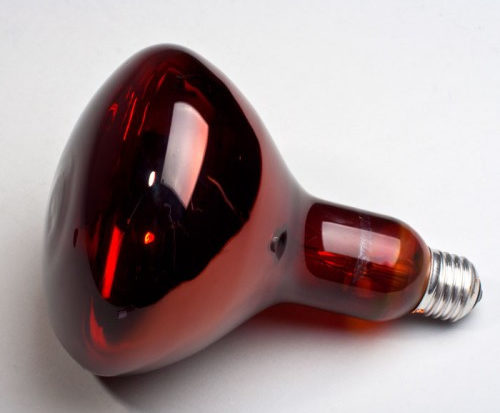
These types lamps are incandescent lamps, in which their main drawback - a high level of thermal radiation, has been turned into a virtue. The current is selected so that the light emission is smaller. In it, the filament is heated to a temperature close to red heat.The main stream of its energy is infrared radiation. It is rightly called thermal. Outwardly, they look like this.
Kerosene
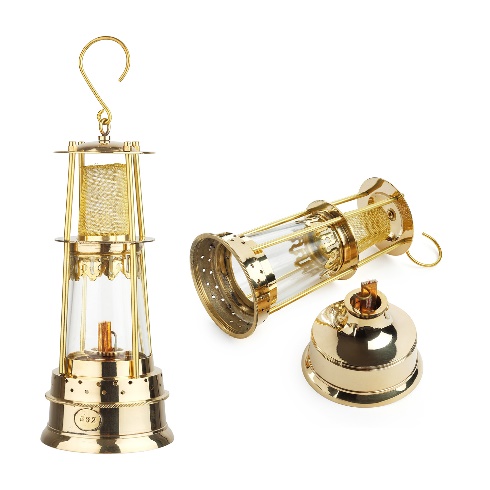
Kerosene lamp. The kerosene tank (right) has a wick immersed in liquid fuel. Protective glass creates a closed volume with elevated air temperature. Cold - sucked in at the bottom, in the area of the round container, hot - comes out in the area of the hook-suspension.
UV Light Sources
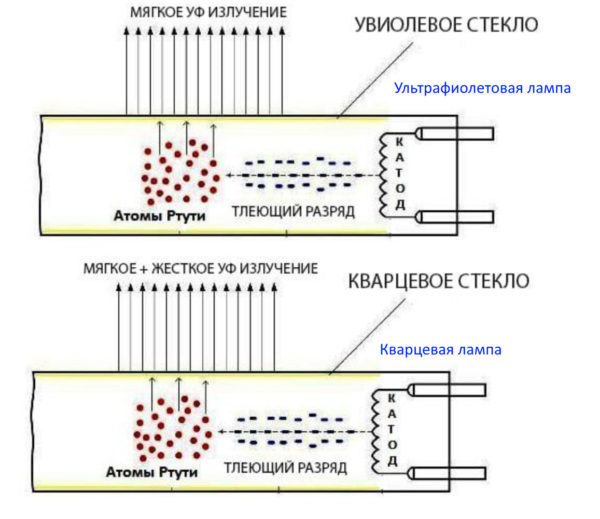
The main physical phenomenon in these The sources of "light" are the electrical discharge in the gas. The resulting ultraviolet radiation is not spent on conversion into light in the phosphor, but is passed through the bulb material, made of special violet glass. Outwardly, such a light bulb looks like a black tube. For medical purposes, they are used to disinfect hospital premises, tools, clothing, as well as apartments and offices.
Lamp characteristics
Comparisons of different types of lamps are provided by comparing their parameters. Characteristics are divided into such large groups:
Electrical parameters
These include operating voltage and power. Operating voltage, unit of measure V (volts) is the nominal voltage at which a working lamp consumes the estimated power from the mains or power source (unit), W (watts). At the same time, the lamp provides a stream of light, Lm (lumen) with design characteristics.
Usually, the nominal (working) voltage and power are indicated by inscriptions on the top of the bulb and on the side surface of the base.
Lighting parameters
Main lighting parameters:
- Light flow. This characteristic is measured in lumens, Lm (lm). The essence of the concept is the number of units of light falling on a unit of illuminated area.
- Light output. Unit Lm/W. The essence of the concept is the amount of light or the luminous flux in Lm, which is obtained from the lamp when it consumes a power of 1 W (watt) from the mains, i.e. Lm / W.
Luminous flux is all the visible and invisible electromagnetic energy emitted by an artificial light source.
Light output is the energy efficiency of a light source or efficiency. - efficiency factor.
Operating parameters
The main parameter of this group is the service life. For lamps of different types, this period is different. Ordinary incandescent lamps have 1,000 hours. And for luminescent ones - from 3-5 to 12-15 thousand hours. The term depends on the manufacturer, type of lamp, its electronic ballast - electronic starting control apparatus and the number of on / off. For conventional fluorescent lamps, the number of switching on approximately corresponds to the number of nominal hours of its operation.
LED bulbs have the longest lifespan. Manufacturers declare them from 15-20 to 100 thousand hours. With 3-6 hours of operation per day, this is several years of operation. Over the years, the lamp will become morally obsolete. Or it degrades with a loss of 30-50% of brightness, and often with a change in the shade of the glow or the emission spectrum.
Plinth type and size
The purpose of the base in the lamp:
- ensure a reliable connection of the light-emitting element of the lamp to the primary power supply circuits, usually this is the primary alternating current network laid in the building;
- hold the design of the lamp in the ceiling of the lamp in a certain position and prevent it from touching the ceiling, for example, sconces or chandeliers;
- guarantee a quick change of a burned-out lamp and its replacement with a new one, etc.
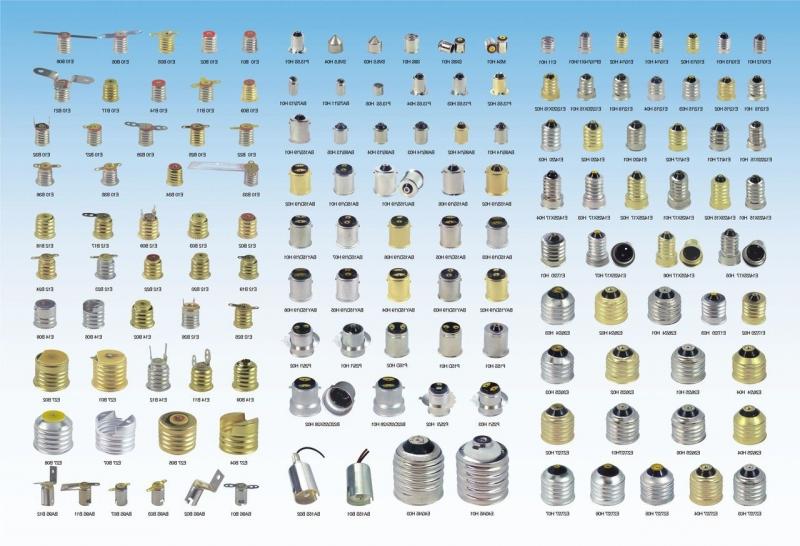
Often used:
- threaded Edison socles, denoted by the letter E and a number showing the outer diameter of the thread in millimeters, it varies from E5 - socles for microminiature light bulbs to E40 - for the most powerful lamps, mainly industrial lighting;
- pin plinths - are denoted by the letter G, from the word glass - glass, since the pins are “welded” directly into the glass of the bulb, the numbers in the plinth marking are the distance in millimeters between the axes of the pins;
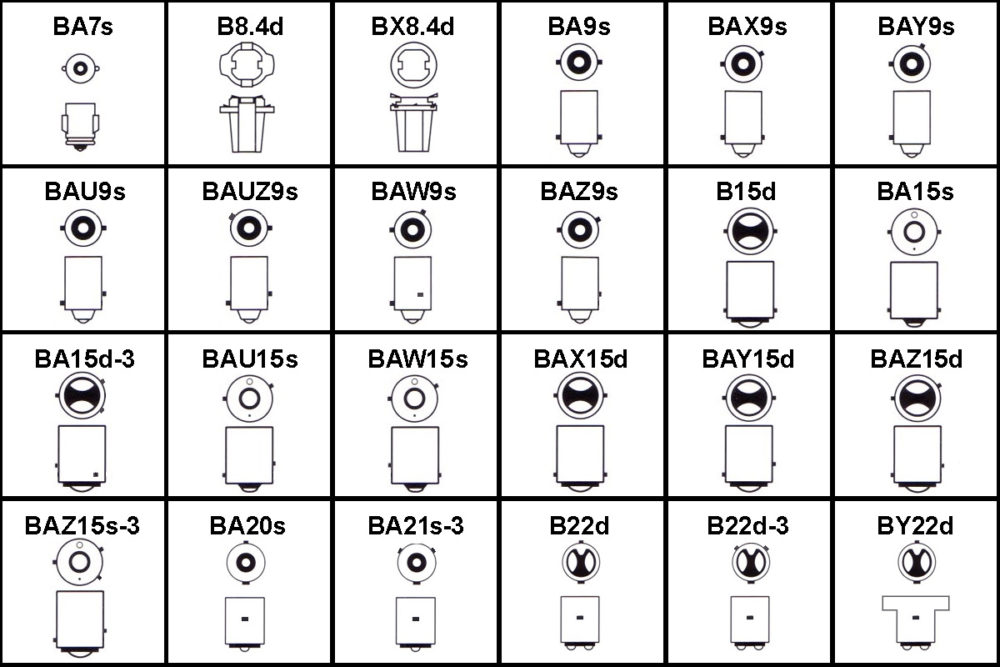
- bayonet or pin - the name comes from the French word "baginet" or bayonet, is characterized by not falling out of the cartridge during vibrations, is used on vehicles - cars, planes, ships and ships, trains and trams, etc. One of the names - Swan base - named after the inventor.
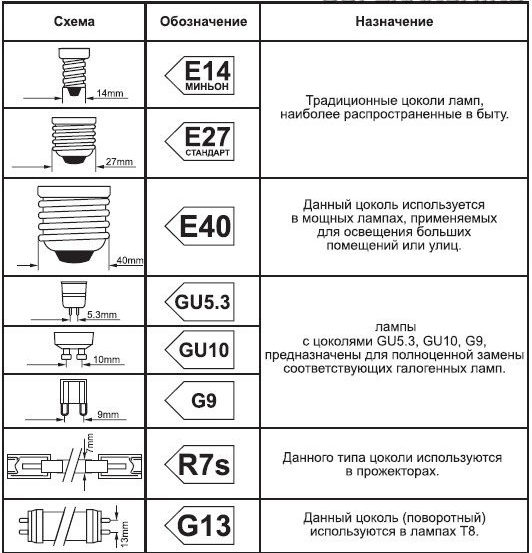
Main types of plinths - Edison, pin, bayonet Swan, they are also pin.
Bayonet bases in the marking have the Latin letter B as the first element.
Flask shape
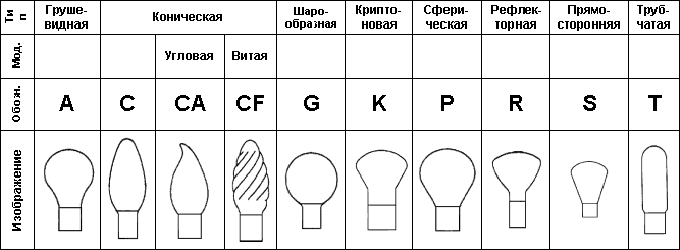
The shape of the flasks of lighting fixtures is determined not only by its technical essence, but is sometimes associated with its origin. For example, flasks BUT, FROM, SA and CF - originated: from a pear, from a candle for a chandelier or sconce. And they got the letter C in the abbreviation, for example, from the Latin word "candela", in translation - "candle". SA - "a candle in the wind", and CF - "twisted candle".
For clarity, we recommend a series of thematic videos.
Modern electric sources of artificial light are striking in their diversity. For any type of fixtures, you can choose several varieties of light bulbs for the price and energy efficiency. For example, for a sconce or chandelier, an LED or LON “candle” or “candle in the wind” is suitable. For retro fixtures, choose an Edison light bulb or a modern LED "corn".