Basics of parallel and serial connection of LEDs
LED technology is the latest achievement in lighting technology, which has made changes in the lighting of housing, streets, public places, and transport. Their application has a number of features according to the types of connection: serial connection of LEDs, parallel or mixed. Each of these types has positive and negative sides. Serial allows connection to a high-voltage network, and the disadvantage is unreliability. Other types also have their pros and cons.
Parallel connection
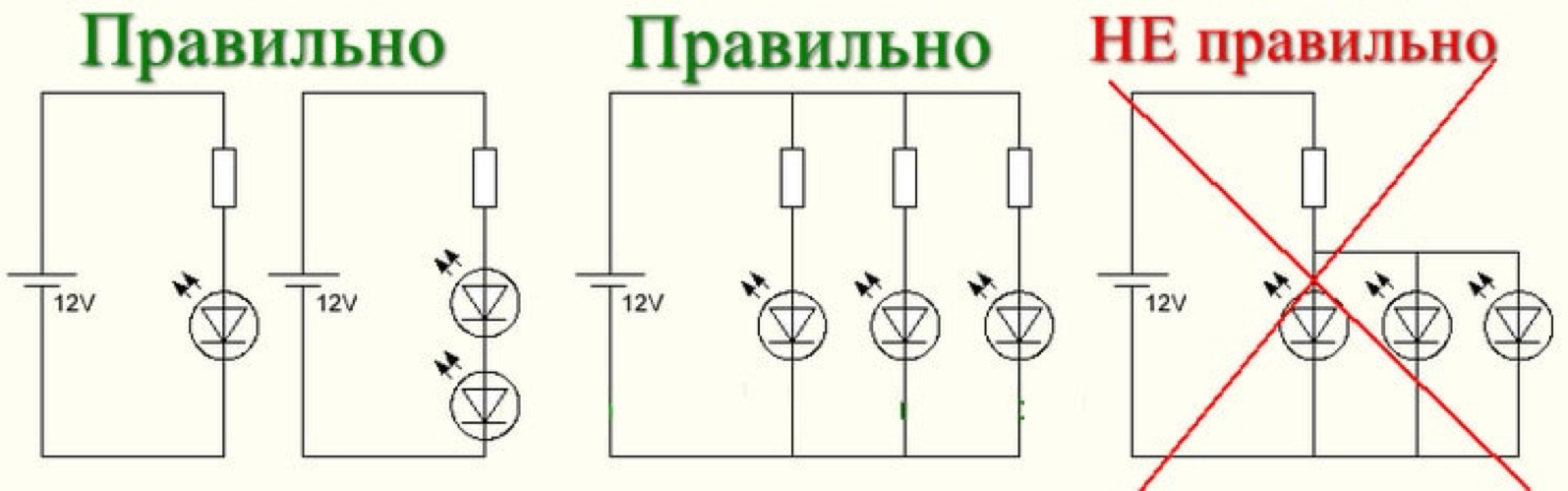
Light-emitting diode (LED, LED) is a microelement, the operation of which depends on many parameters. Errors in microtechnologies lead to the fact that the current-voltage characteristic of each individual LED is different. Therefore, the threshold for operation (“turning on”) of all diodes is simultaneously different. This is allowed by quality standards and must be taken into account when constructing electrical circuits. Parallel connection of LEDs requires exactly this setting for their simultaneous operation.
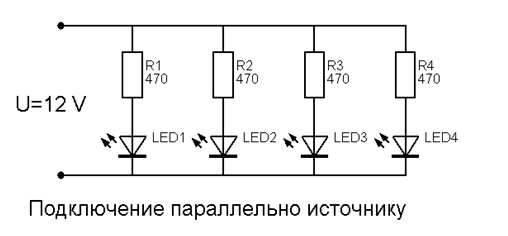
The wiring diagram shows that for each LED, its own resistor is selected. When setting, resistors R1-R6 regulate the operation of the entire system. The threshold for each diode is in the range of 2.5-3.0 Volts, therefore resistors must be selected for each diode.
A positive indicator is the low voltage characteristic. The trigger level of a single LED is up to 3.0 V, so the entire light node can be designed for low voltage.
An essential advantage of parallel connection is the "survivability" of this option. If one LED element fails, the system continues to work and provide illumination.
This quality is used in mini-devices when miniaturization is important and they are assembled on rechargeable "tablets". Such crafts are widely produced by the industry and are intended for small tasks - local illumination, for advertising purposes, etc.
Advantages and disadvantages
Benefits Parallel connection of LEDs are: low voltage circuit supply, which makes it possible to build miniature devices; high "survivability" of the system, since each diode is connected directly to the current source. disadvantages – the need to tune each LED, which leads to an increase in the number of elements (resistors); the need for a separate current source (or driver) when using general-purpose power networks.
Series connection
When LEDs are connected in series in the electrical circuit, individual circuit settings for each LED are excluded. But there are also some peculiarities.
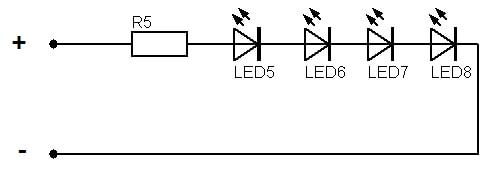
The circuit is configured with one resistor, and all diodes are activated simultaneously.The advantage of this compound is its small component size and simplicity. The disadvantage is the low "survivability": if one SD fails, the entire system is turned off.
The serial way to connect LED-devices allows the use of high-voltage current sources. Usually these are stationary lighting fixtures for various purposes using standard public electrical networks..
12 V LED systems
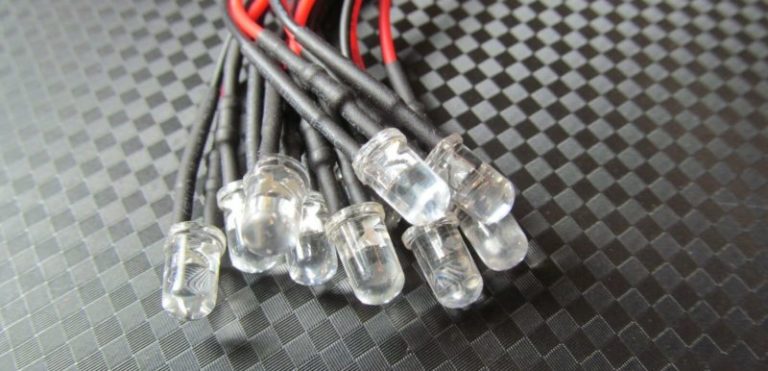
LED-devices, designed for 12 V, usually belong to the class of automotive light. The car network has stabilizers, so there is no need for voltage equalization. LED lighting in cars has become popular - many companies widely use LED lighting in models for road lighting and alarm operation, interior lighting, trunk and dashboard lighting. However, the use of LEDs in cars has led to an increase in the price of lighting elements, especially headlights and signal light blocks. In some premium models, the cost of a block headlight is comparable to the price of an inexpensive car.
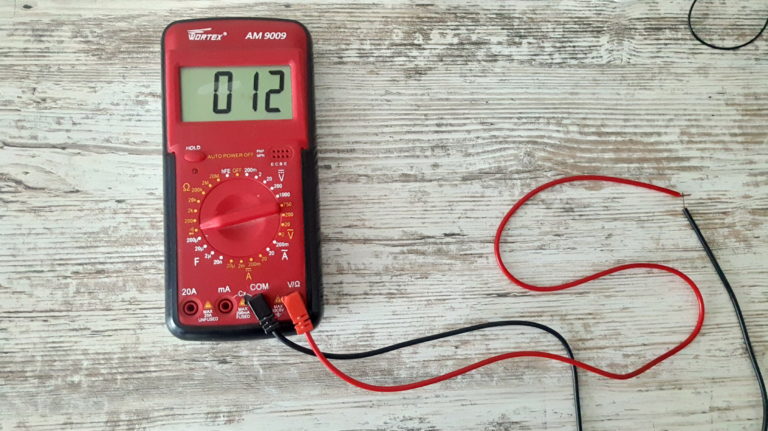
Also, 12-volt LED diodes are used in the construction and decoration of residential premises. Often these are LED strips that not only illuminate the room, but also create light installations. This requires the installation of step-down transformers or drivers connected to the house power supply and ensuring long-term operation of the diodes.
220 V LED systems
Such diode systems are the most common. 220V daisy-chain LEDs are used for lighting large rooms, high power spotlights, street lighting, airport signaling systems, etc.
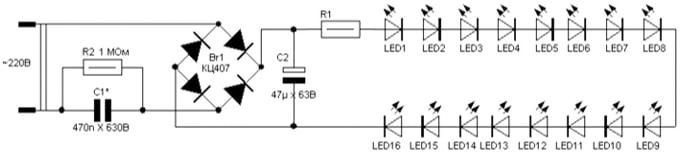
The 220V series connection shown here is the simplest way to connect a string of diodes with a small number of components.
Mixed connection of LEDs
This type of connection takes advantage of the advantages of parallel and series connection of LEDs. Mixed (or hybrid) connection is used in complex LED systems that have a large number of light points and combine powerful narrow luminaires and diffused light.
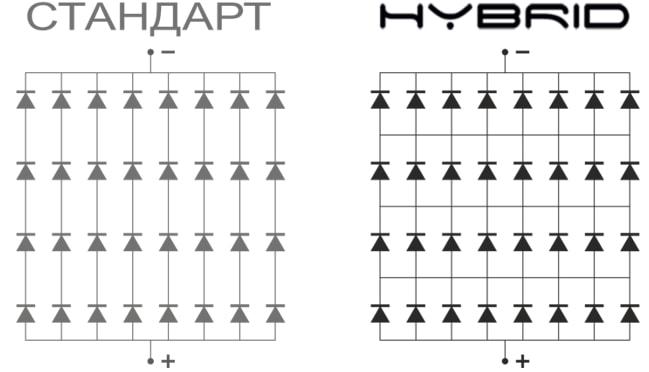
Mixed connections realize the advantages of parallel and series connections to increase the reliability of the entire system: if one of the diodes burns out, then the whole circuit remains operational, while the rest of the LEDs do not experience overvoltage and save their resource.
Common Connection Mistakes
The LED is a current element that "painfully" reacts to increases in the flowing current. This should be taken into account when creating systems that include LEDs, where there are many elements that affect the operation of diodes and their service life. This is a common mistake and applies to battery-powered LED systems: if the battery is not powerful enough, then the flowing current is limited by its internal resistance, which will not allow exceeding the limiting values of the current characteristics of the diodes and will not lead to their failure.
For systems involving diodes, series connection is considered the best. They are easy to design and manufacture, low-element, reliable in operation, provide connection to high-voltage sources without the use of step-down transformers.
Of course, systems with parallel connection have their advantages - the possibility of using in miniature devices.But they require low-voltage current sources.
Stabilizers and drivers are used to increase the reliability and service life of LED systems, which makes it possible to avoid design errors and makes it possible to use all types of connections.
Thematic video: Why diodes are connected in series and in parallel.
Selecting the correct driver
Drivers are electronic power supplies used when connecting LEDs, which are sensitive to excess currents. These devices are mainly built on the principles of pulse width modulation (PWM), which ensures maximum system efficiency and automatic current regulation. When choosing the right drivers for the LED scheme, the following are taken into account:
- input and output voltage;
- output current;
- output power;
- degree of protection from the environment.
The input and output voltages are the requirements of the network parameters: AC or DC (house network 220 V - AC, car network 12 V - DC). The load current is calculated from the number of LEDs and their current data. The output power is determined by the power of the entire circuit. The degree of protection depends on where the lamp is located - outdoors or indoors.