Searchlight selection rules
Lighting of large areas, including outdoors, is planned according to other principles, different from indoor conditions. Firstly, there are far fewer reflective surfaces on the street, so it needs more light output. Secondly, the device is affected by aggressive environmental factors, respectively, the entire structure needs to be protected from moisture, temperature extremes. And thirdly, searchlights are usually located on poles, towers or under the canopy of houses, where the replacement of components is associated with a lot of inconvenience, which places demands on their resource. Based on the totality of all characteristics, the choice for each specific situation is determined.
What are
Since incandescent lamps in street lighting spotlights do not justify themselves in terms of efficiency and durability, new devices have appeared on the lighting engineering market that differ in a different principle of operation.
Halogen
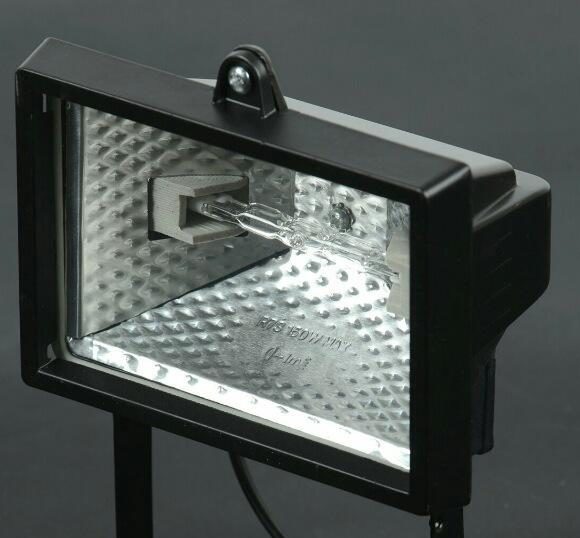
Modification of an incandescent lamp with vapors of halogen gases in a flask. Halogens are inert to chemical and thermal processes, which slows down the oxidation of the tungsten filament and increases its efficiency by 30–40% compared to a conventional vacuum system. The flask is demanding on the absence of moisture and contamination on the glass surface, and the electrical circuit of the device needs a step-down transformer.
Metal halide
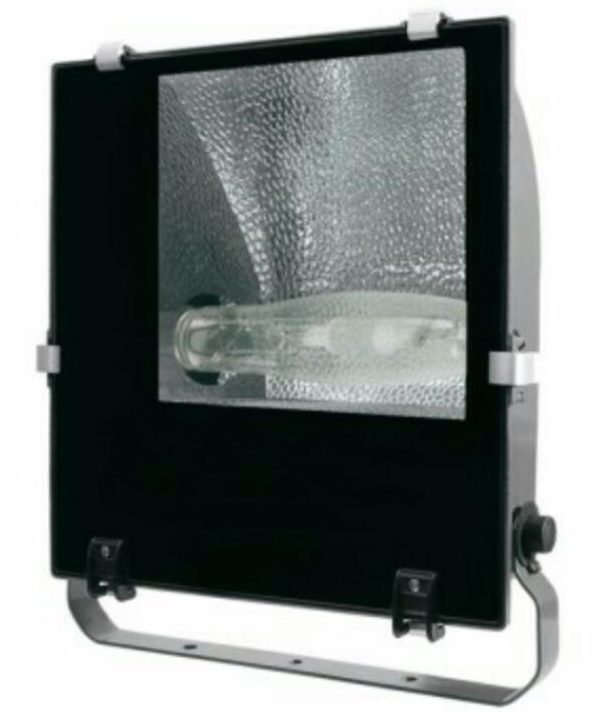
Represent gas discharge mercury lamp in a double glass flask. In the inner shell, in addition to mercury vapor, there are halides of various metals for spectrum correction. The device can only be started from the ignition unit, but the device itself operates from a 220 V network. Metal halide lamps are larger than halogens, the body along with the reflector is more massive, and their energy consumption is greater, with relatively the same light output.
sodium
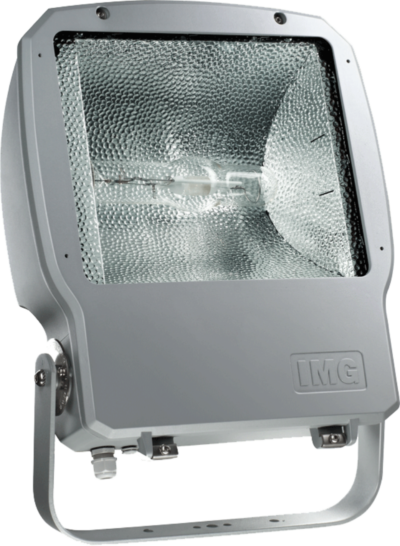
The design, scheme and principle of operation are the same as those of metal halides, but sodium vapor is used as a light source, giving out more light flux with the same power consumption.
LED
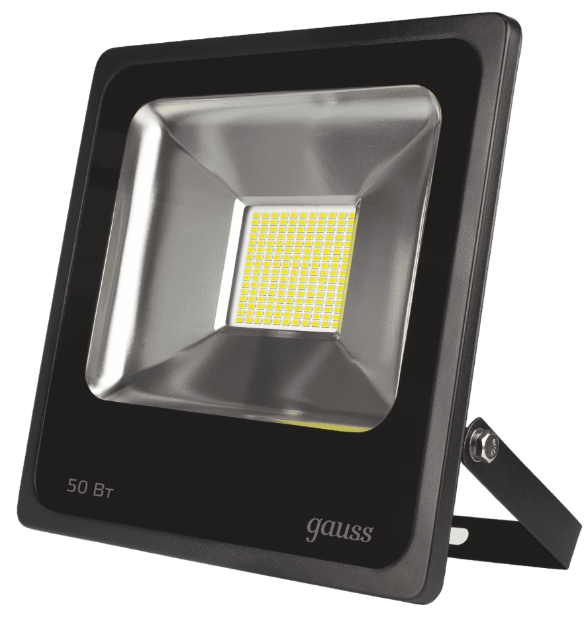
They are LED COB or SMD matrices in a package with a driver or a step-down transformer. They differ from the previous types of lanterns in their smaller weight and dimensions with a longer service life and efficiency.
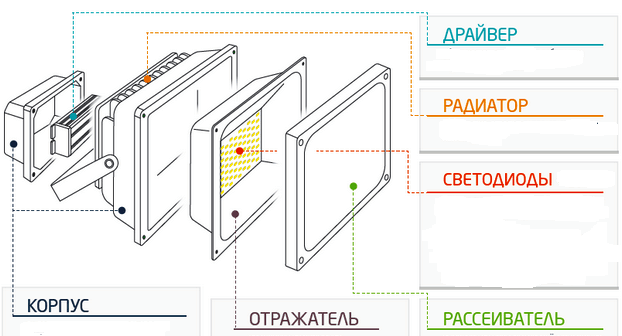
Criteria for selecting spotlights
The choice of a spotlight should come first of all from the task. For example, it makes no sense to overpay for the most powerful spotlight available if you need to illuminate the entrance to the house. There's enough brightness to keep you from tripping and taking your keys out of your purse, and the low-slung, bright lamp will only dazzle you.And vice versa, if the device is faced with the task of working in such a way that a person can read or work with small details without stress, then spotlight more powerful.
Voltage
Most spotlights are powered by 220 V, but gas discharge lamps can only be started through throttle, halogens need step-down transformers, and LEDs work from a network driver designed for direct connection to a 220 V network. In some cases, the driver is not included in the kit and you will have to buy a 12 or 18 volt rectifier to power the LED. As a rule, all additional elements of the circuit are placed in the body of a street lamp and externally a device operating from a 220 or 12 volt network cannot be distinguished, so information about the type of power supply must be clarified.
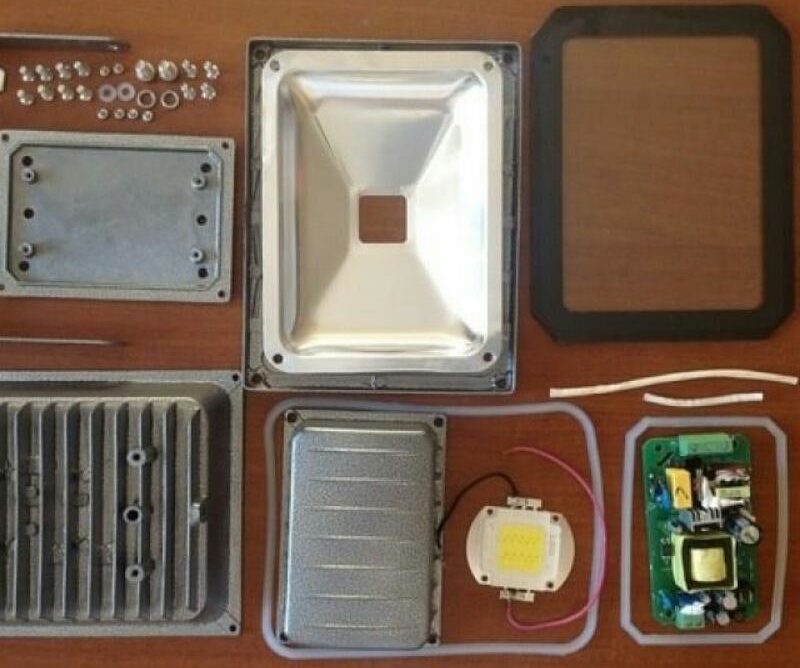
LED elements with a Chinese driver, where a diode bridge plays the role of a rectifier, sometimes start flashing or burn out when the network jumps in the range of 200–250 V. The most unpretentious halogens in this regard, although high-quality driver with a stabilizer ensures the operation of LEDs even in the extreme range of 60–300 V.
Power
Traditionally, the main indicator of efficiency is the power of the matrix - the level of its power consumption, measured in watts. The level of light output to some extent depends on the power. That is, the more powerful, the brighter and farther the device shines. Traditionally, it is by power that the distance and area that the spotlight is able to illuminate is calculated.
| Lamp models | Power, W | Suspension height, m | Light spot height, m | Light spot length, m |
| LED 30 | 30 | 4-5 | 8-10 | 14-17 |
| LED 50 | 50 | 6-8 | 12-16 | 21-28 |
| LED 100 | 100 | 10-12 | 20-24 | 35-42 |
Table for calculating the power of the LED spotlight.
For illumination of a platform of 25 m2 from the height of a five-meter lamppost, a 35–40 W LED spotlight is enough, but it is worth considering that the light output of different LED elements with the same power consumption varies greatly and these figures are subjective.
LED types
For powerful devices, two types of LED lamps are used:
- smd-matrices - consist of a group of LEDs of the same power, summed up to achieve the desired level of light output. The disadvantage of the solution is that if one of the bulbs burns out, then the entire matrix fails, and soldering the jumper leads to an increase in the load on the other LED lamps. As a result, they burn out exponentially.
![SMD matrices.]() The appearance of the SMD matrix.
The appearance of the SMD matrix. - COB - cluster LEDs, which are a solid crystal. Compared to SMD, they give a more uniform light output.. The system is not without flaws. Firstly, such lamps heat up more and need a powerful heat sink. Secondly, their cost is 20-30% higher than that of SMD.
![COB type diodes.]() COB type diodes.
COB type diodes.
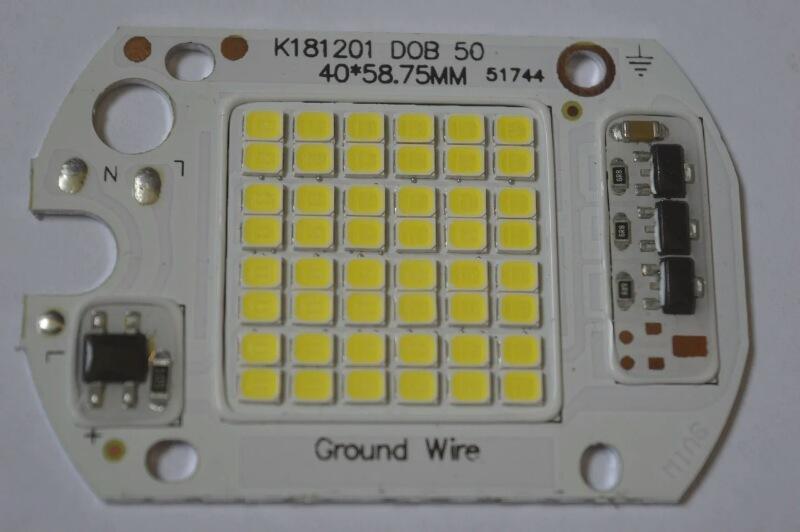
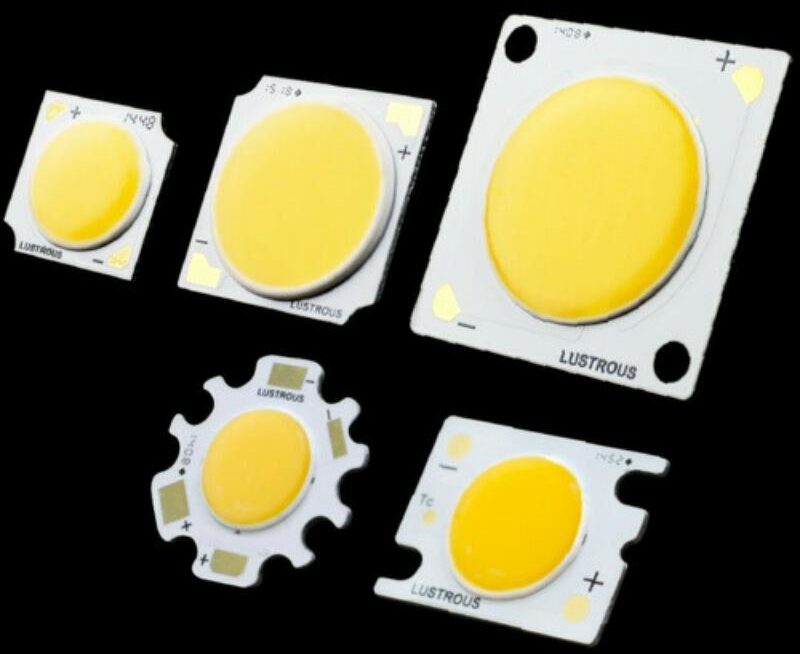
Cluster LED-elements have not received wide distribution due to the cost and the vast majority of lighting devices work on matrix lamps.
Scattering angle
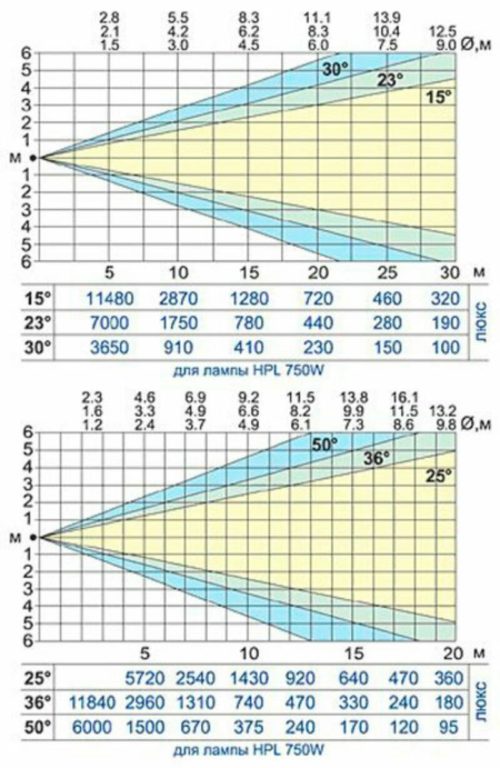
Using the example of two lamps of the same power, you can see that the width of the central spot and side illumination are different. In street lamps, this parameter is not adjustable, since it was initially set by the shape of the reflector. Conventionally, according to the angle of dispersion, spotlights are divided into:
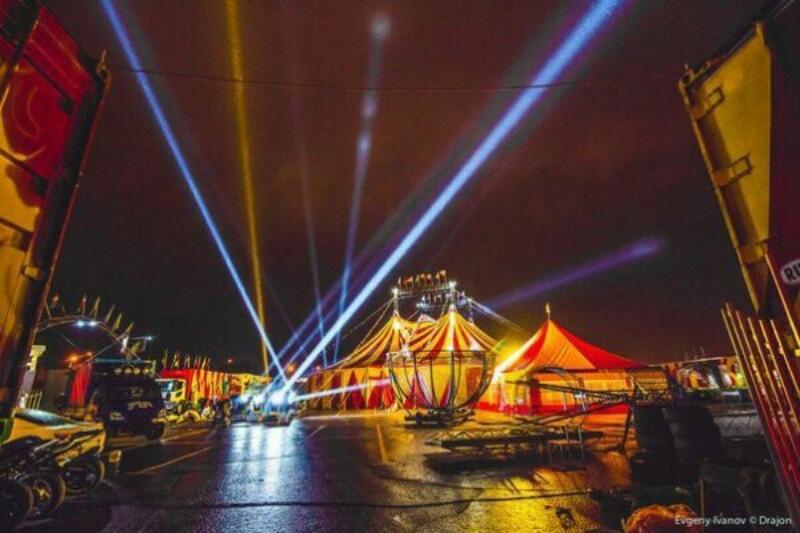
- search - long-range lights with a concentrated beam of light and a minimum of side illumination.Used in watchtowers, Open Air entertainment shows, stage lighting;
![Searchlight selection rules]()
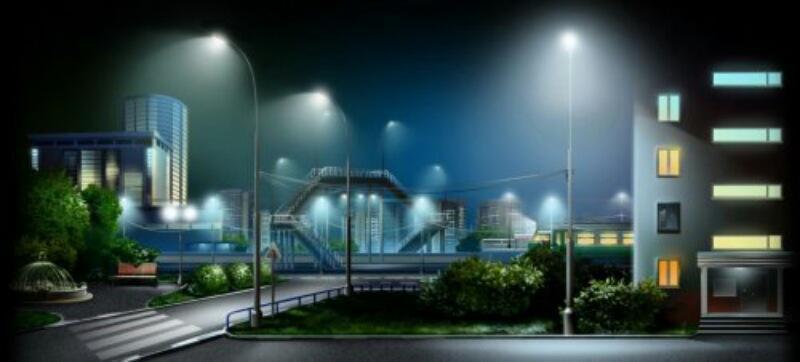
- aspic — with a uniform, wide-angle light required in most outdoor lighting applications.
![Searchlight selection rules]()
IP protection class
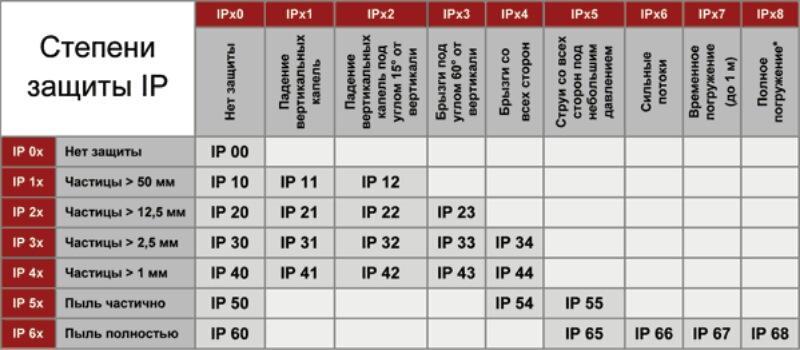
Street lamps require protection from external physical factors with a degree of at least IP54. The first number is dustproof, the second is waterproof.. Maximum degree IP68 implies complete tightness of the structure with the possibility of immersing it under water for a period of more than 1 hour.
Light flow
The main parameter that reflects the actual efficiency of the LED chip and is measured in lumens. However, for lighting calculations for a certain quadrature, a parameter such as lux is used - this is the amount of light energy in a certain area.
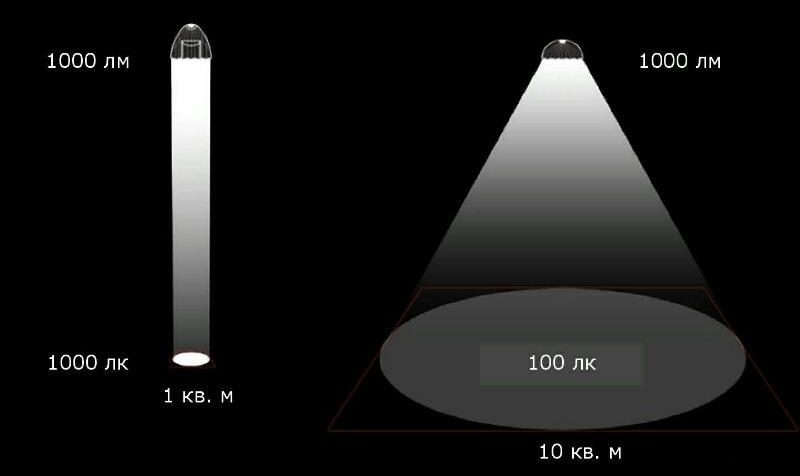
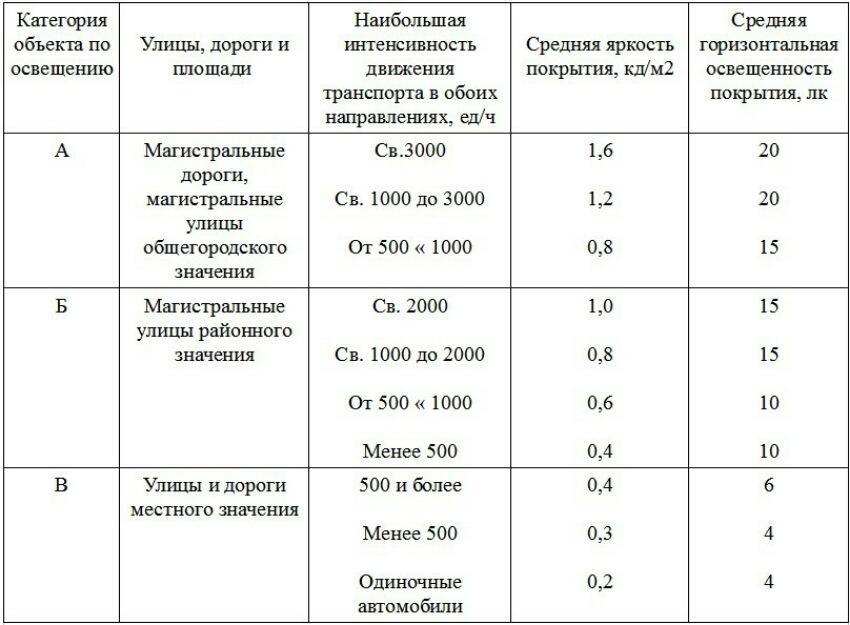
From five meters this parameter will be reduced to 20 lux, which is quite enough to see where to go, but not enough for precise work. The full calculation formulas are quite complex and special programs are used for this purpose, but indicative figures are presented in the lighting table for road lighting.
You can only find out how much lux a particular sample gives out empirically, using a luxmeter. This is done at night, when the device is set to a given height and the light is directed to a light meter located in the center of the light spot.
Features of choice
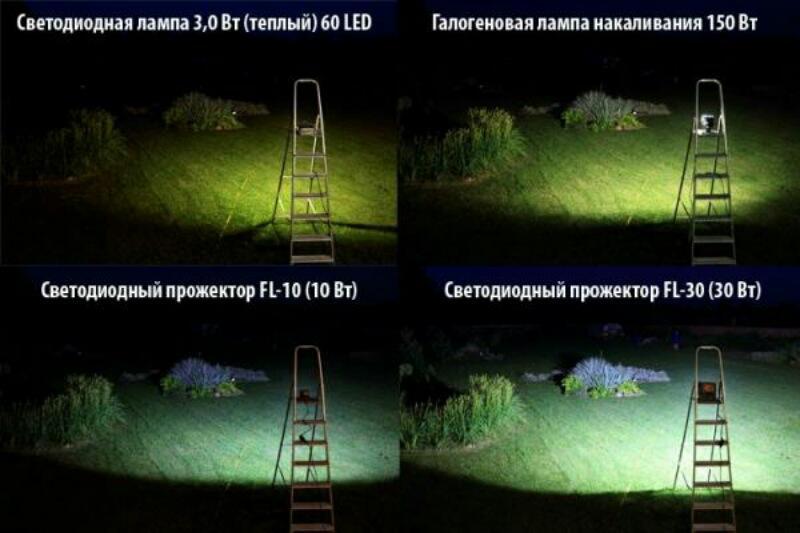
Most buyers and sellers focus primarily on the power of the spotlight.This approach is fundamentally wrong, because at the same power, different lights produce a different amount of light output, depending on the characteristics of the LED chip. For example, to illuminate the entrance to the garage from a height of 3 meters, a 10 W lamp is sufficient, provided that the energy efficiency of the LED is 100 lumens / watt. This is the average efficiency of an LED lamp. That is, in the technical passport of the product, 10 W should account for about 1000 lumens. If this value is less, then the LED will heat up more and shine weaker relative to others., with less power, but the same luminous flux.
According to the law of conservation of energy, the more energy is spent on light, the less is left on heat and vice versa. The best ratio of power to luminous flux 130 lumens/watt, but such lamps are demanding on the quality of the driver, without which they will not last long.
The body of the outdoor spotlight must be made of metal, because plastic does not provide sufficient heat dissipation. In addition, under prolonged exposure to direct sunlight, the plastic becomes brittle, deformed, as a result of which the tightness of the structure is violated.
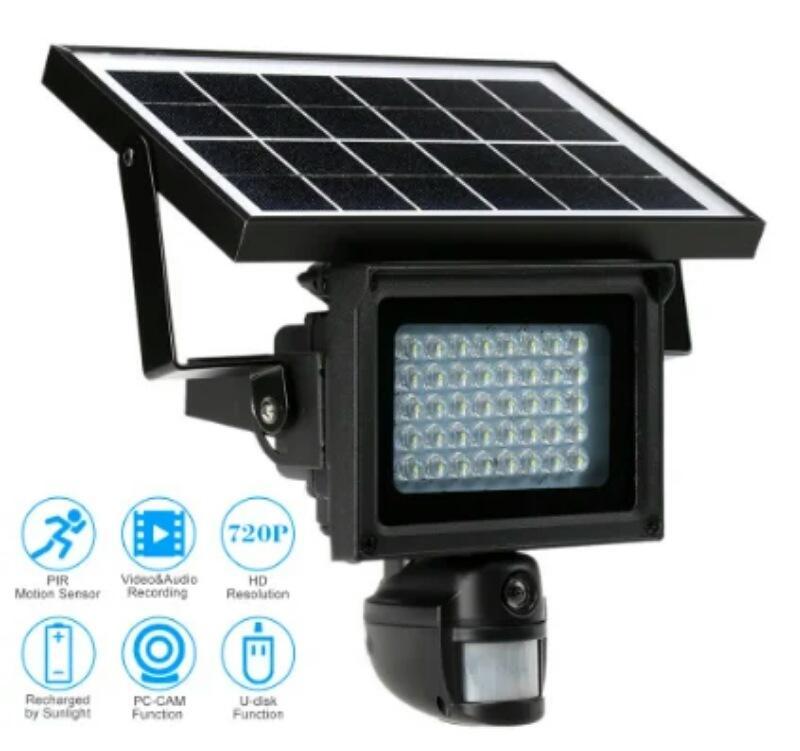
Some flashlights are equipped with motion and light sensors, turning on at nightfall and turning off in the morning or reacting to the approach of moving objects. This saves energy, the resource of the device, and also frees the owner from the need to control the operation of lighting devices. There are completely autonomous systems with solar panels and energy storage. The device charges during the day and uses battery power at night.
The reliability of these spotlights depends on all components, especially on the battery, since after a year of operation, the level of the Chinese drive drops, and in winter it discharges 2-3 times faster. Some autonomous systems are combined with a video recorder, which in combination is security system, which turns on the light and video recording when there is movement within the range of the sensors.
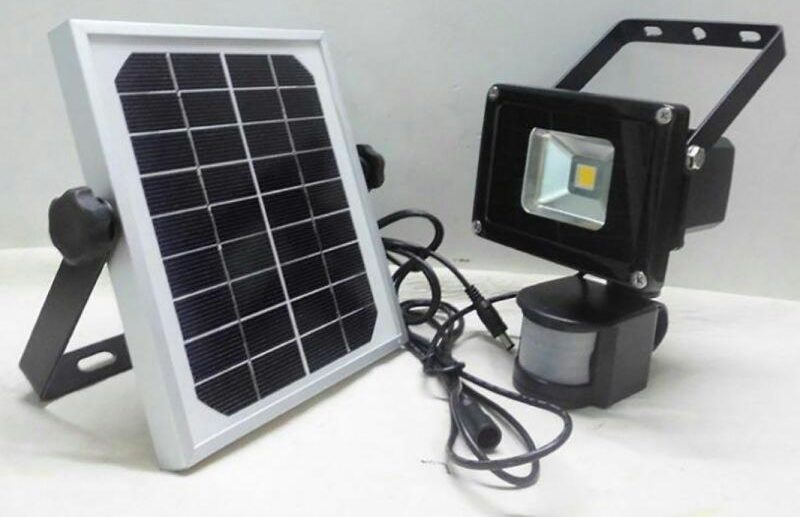
Trying to choose a bright LED spotlight, it is better to pay attention to the warmth of the glow indicated in the product specifications. If the task is illuminate home areas, facades of buildings or a work area, it is better to choose models with a glow heat of up to 4000 K. Warm or natural light does not tire your eyesight and color rendering is not distorted.
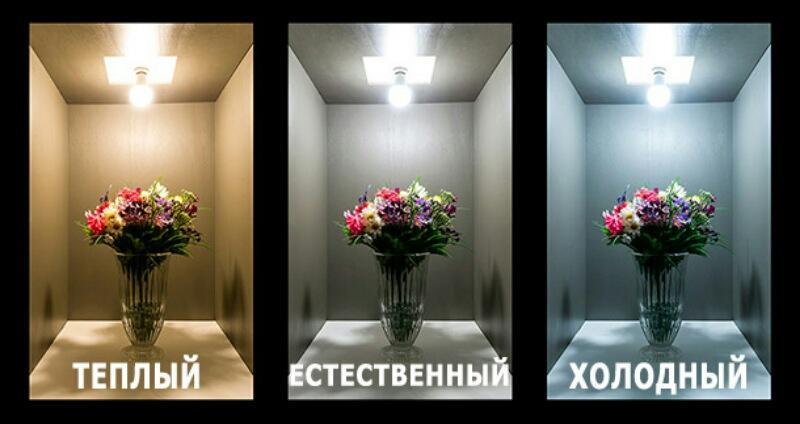
Chinese diodes often do exactly cold glow, as they put out more lumens per watt. For precise work with small details, you will need a light level of at least 40 lux. To illuminate large areas, industrial facilities, parking lots, security zones, bright cold light in the range of 5000–6500 K with illumination from 20 to 40 lux is suitable.
Rating of LED spotlights
5th place Hager EE610
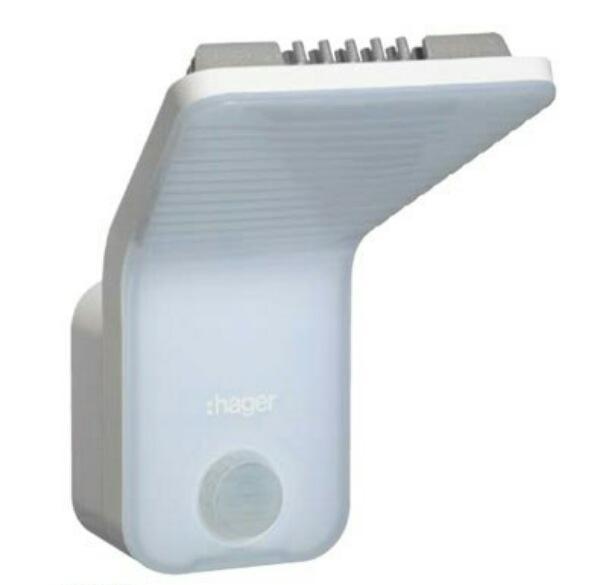
The 5th place in the ranking is occupied by a model from a German high-tech brand. A power of 15 W produces 1100 lumens, which, with a glow heat of 4000 K, is quite enough for adjacent areas and residential areas. The body is made of high quality polycarbonate with IP55 protection. The characteristics at first glance are not the most impressive, but they are indicated with the utmost honesty. The spotlight is equipped with a motion sensor. Fastening is quick-detachable, on the landing platform.Among the shortcomings are the difficulty with adjusting the direction and the price.
4th place Jooby Cobra 60W
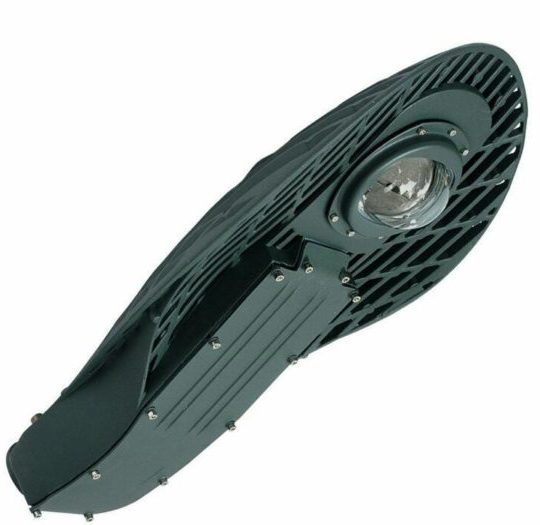
4th place behind a Ukrainian device made of aluminum alloy with Japanese components, including a 50 W Citizen diode that produces 5500 lumens of cold light. It is intended for illumination of park, security zones, squares, adjoining territories. Degree of protection IP65, the voltage stabilizer withstands power surges from 85 to 265 volts. It is noteworthy that the guarantee for the unit is issued for five years, which is a record for a local assembly, but corresponds to the quality of Japanese parts.
3rd place Osram M3 90W
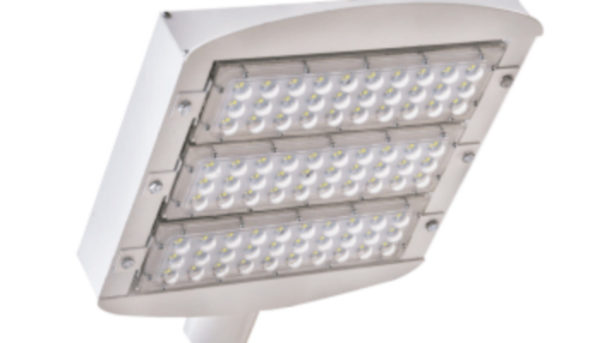
The top three is opened by a Russian-assembled unit with German components and Japanese Nichia LEDs, with a total power of 90 W, producing 11,700 lumens of neutral temperature. Housing made of aluminum with protection class IP66. The claimed service life is 12 years, but the warranty is only for 2 years, which refers to the shortcomings. However, the seemingly unpretentious design is quite reliable and the spotlight does not cause any complaints from consumers. The lantern is mounted on a console with a fixed direction angle.
2nd place Philips BVP176 LED190
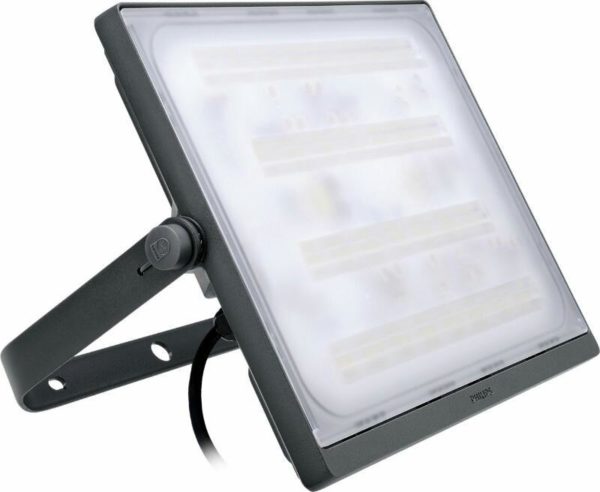
Made in the Netherlands or in China, but under the control of Dutch technologists, the street lamp is one of the best lighting fixtures in its category. The power of 200 V is quite consistent with a luminous flux of 19,000 lumens, while the color of the radiation is warm - 3000K. Die-cast aluminum and polycarbonate lens provide IP65 protection against dust and water jets. The only drawback is the possibility of incorrect operation when the minimum operating temperature is -40 ° C and an overpayment for the brand.
1 place Geniled element 100W
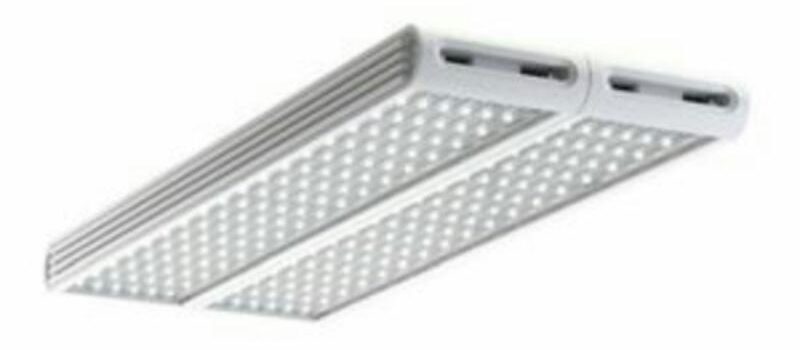
The leader of the top is the Russian manufacturer, one of the most honest in terms of the compliance of the declared parameters with the real numbers during testing. The device produces 100 lumens / watt of cold light at 5000 K. The aluminum case with IP65 protection can be mounted in three versions at once: on a console (pipe), on a swivel arm or on a suspension. The spotlight works stably in the temperature range from +50 to -45°C. Warranty service is provided for 3 years. Among the shortcomings is a relatively cold glow, but, given the local assembly, you can order the device in a configuration with warmer LEDs.