How to connect LED spotlight
LEDs as elements of lighting and indication have practically replaced incandescent lamps from their main scope. Competitive advantages of LED are long service life and economy. Now such lamps are used, among other things, for lighting streets and territories, artistic lighting of buildings, etc.
How a spotlight works
An LED spotlight (in everyday life the incorrect name diode is used - such a term is at least unprofessional to use) is simple. Like a conventional lamp with an incandescent lamp, it contains:
- frame;
- light-emitting element (single powerful LED or a matrix of several less powerful devices);
- terminal for connecting the power cable (terminal block, connector);
- glass covering the compartment with LEDs (diffuser).
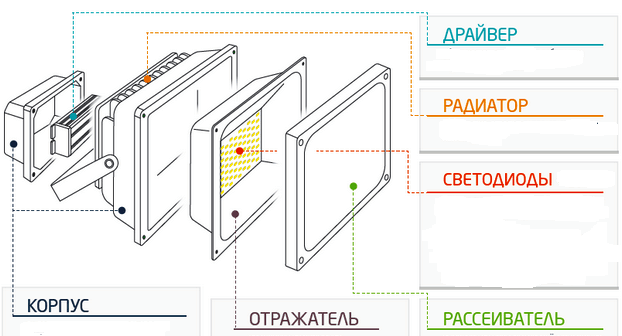
Unlike its predecessor with the "Ilyich's light bulb", the LED spotlight contains one more detail - the driver.In powerful spotlights, it is made in the form of an electronic circuit that stabilizes the current through the light emitting element. For small fixtures, a resistor can be used as a driver. Since the emission of LEDs does not depend on the degree of heating, they are installed on a heat sink to extend the service life.
Electrical connection
To connect most lighting devices to a single-phase 220 V network, they are equipped with three terminals:
- phase (denoted by L);
- neutral conductor (N);
- ground conductor (
![]() ).
).
 ).
).Related video:
Obviously, the electrical network with TNS neutral mode must be used for the connection. The peculiarity of this mode is that it consists of phase conductors, zero (N) and protective (PE). In this case, the connection diagram for an LED spotlight with three wires is simple - phase conductor per phase, zero conductor to zero, ground conductor to PE. The same applies to the TNC-S system. In it, the neutral and protective conductors are separated at a certain point, usually at the entrance to the building. But many networks are made according to the outdated TNC scheme, where the neutral and protective conductors are combined.
In accordance with the rules, lighting devices that do not require grounding must be used in these networks. Such devices include devices with a protection class:
- 0 - protection is provided by one layer of insulation, the least secure option;
- II - devices with double or reinforced insulation, are noticeably more expensive;
- III - devices powered by extra-low safety voltage (below 50 V alternating), they are outside the scope of this article.
Important! You can determine the protection class of an electrical appliance by the passport, technical specification or marking:
- 0 - not marked;
- I - ground icon
![]() or the very presence of a ground terminal;
or the very presence of a ground terminal; - II - double insulation icon
![]() ;
; - III - class III protection badge
![]() .
.
 or the very presence of a ground terminal;
 ;
; .
.In class II devices, safety is ensured by the presence of a protective earth, and their use in a TNC network without earth is against the rules and can lead to sad consequences if the main insulation is broken and voltage appears on the luminaire body. The connection of the ground terminal to the working neutral conductor (N, PEN) also contradicts the PUE.
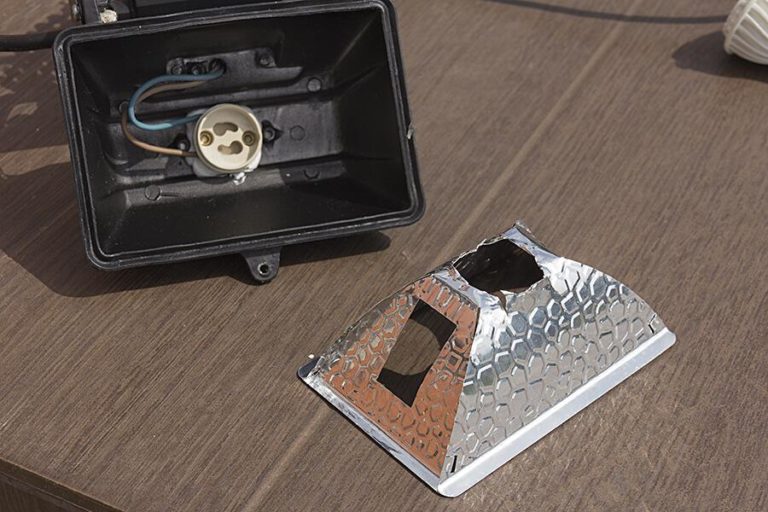
At his own risk, an electrician can connect a device of protection class II without a connection to protective earth. And the spotlight will even work. But he must remember that the consequences will be on his conscience. He may even have to answer to the law.
Important! Grounding by itself does not provide safety. The supply circuit must be equipped with a circuit breaker in order to provide protection against basic insulation failure. Also, if possible, RCDs (or difavtomats) should be used.
Necessary tools and materials
To connect the lamp, you will need a conventional electrical tool:
- wire cutters for cutting power cables;
- fitter's knife for stripping cable sections;
- screwdriver for connecting the wire ends to the terminals.
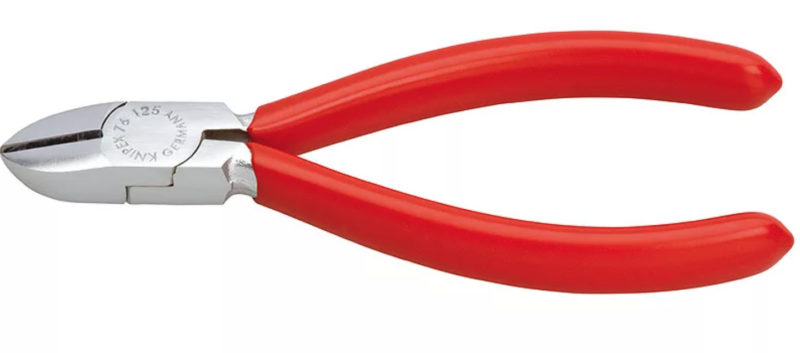
This is enough to complete the connection. But a professional would also advise:
- special insulation stripper;
- lugs for wires of the appropriate diameter and a crimping tool.
If the installation is carried out with a stranded wire, it is good to irradiate the stripped areas - a soldering iron is useful for this.
And, of course, you need an electrical cable of the appropriate section.For voltage 220 V, it can be selected from the table according to the power of the spotlight:
| Conductor cross section, sq. mm | 1 | 1,5 | 2,5 | 4 |
| Load power for copper conductor, W | 3000 | 3300 | 4600 | 5900 |
| Load power for aluminum conductor, W | -- | -- | 3500 | 4600 |
Important! When choosing a cable, it is necessary to take into account the power consumption of the lamp, and not the equivalent (corresponding to the power of the incandescent lamp).
Wiring diagram
Connecting the LED spotlight to the electrical network can be done through a regular socket. To do this, a plug must be installed on the supply end of the cable. If a luminaire of protection class II is used, the socket and plug must have a grounding contact.
Motion sensor circuit
In order to save electricity, lighting devices are connected to work in conjunction with a motion sensor. Power is supplied to the spotlight only when a moving object (person, car) is detected. In this case, the sensor is connected to a break in the phase wire, in series with a conventional switch.
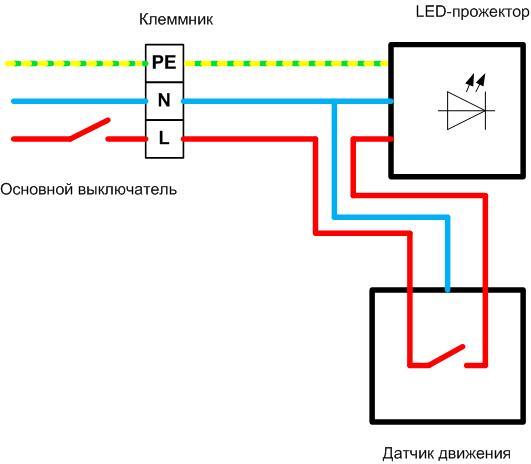
The main power switch turns off the spotlight regardless of the status of the motion sensor. When the power is turned on, the lamp works in automatic mode. The problem with this circuit is that the sensor contacts are not designed for high current, and if the lamp is powerful, they will burn after a while and the sensor will stop working. To avoid this, it is necessary to connect the spotlight through an intermediate relay or a magnetic starter. The sensor will turn on the relay, and the relay will turn on the spotlight.
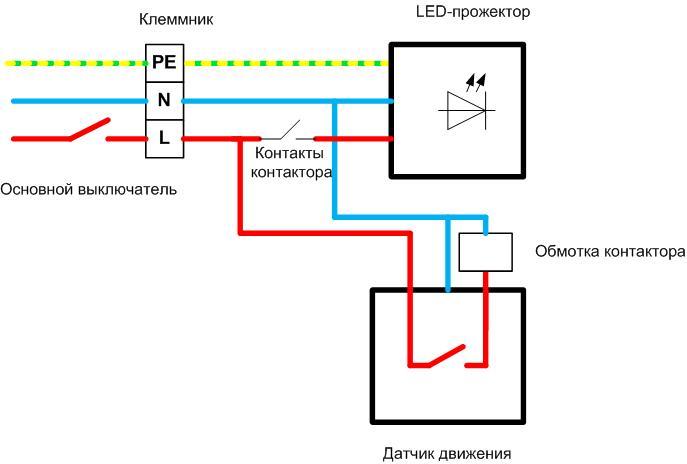
Important! A bad solution would be to turn on two motion sensors in parallel to strengthen the contacts.Due to the spread in the switching level, simultaneous operation cannot be achieved, and both sensors will fail.
How to connect through a switch
A less successful scheme is to connect the motion sensor in parallel with the main switch. In this case, the closure of the switch contacts blocks the automation circuit.
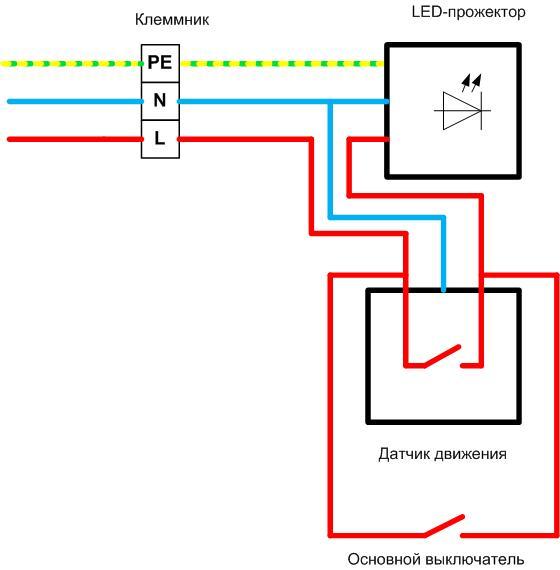
In this option, it will not be possible to remove power from the spotlight in case of a motion sensor malfunction (sticking of contacts).
Mounting Recommendations
When connecting a floodlight, it is advisable to use a cable with standard core insulation colors and follow the connection procedure.
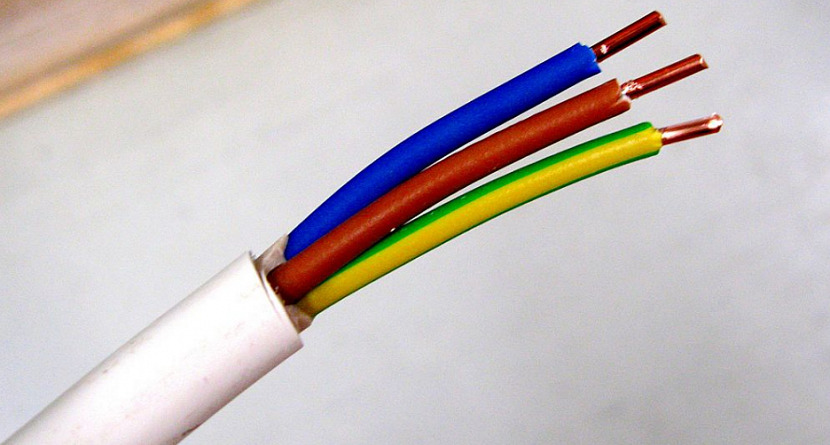
- the red wire is connected to the phase terminal (L);
- blue - to zero (N);
- yellow-green - to ground (PE).
This order must be observed both from the side of the power source and from the side of the consumer (luminaire). Of course, for an electric current, the color of the core does not matter, and if the connection is not made correctly by the color of the insulation, nothing will happen - the spotlight will work just as well. But compliance with the rules speaks of the professionalism of the installer. And in the future, if repair or reconnection is necessary, it will be easier for another master to deal with the circuit.
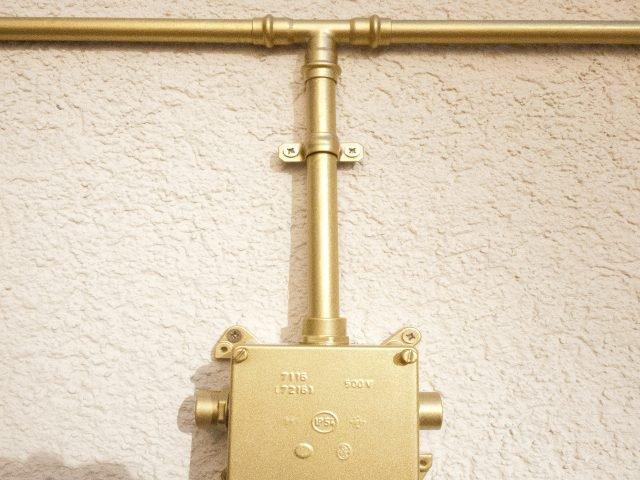
If the wiring runs along the street, in order to ensure anti-vandalism, it makes sense to lay it in pipes. In this case, it must be understood that the conditions for heat removal will be worse than in the version with an open gasket. If, according to calculations, it turns out that the load power is close to the upper limit for the selected section, then the wire diameter must be increased at least by a step. It is even more correct in this case to clarify the parameters of the conductors in the PUE.
Safety measures and operating rules
During any work with electrical installations, the main rule must be observed - all actions must be performed with the power off. The absence of voltage must be checked with a pointer directly at the place of work. The electric tool must be in good working order, without damage to the insulation. Even better, even at home, use protective equipment against electric shock - dielectric gloves, carpets, galoshes. There are not many security measures.
During operation, it is also necessary to monitor the integrity of the insulation of the wiring and switching equipment. In the event of any damage, the luminaire must be taken out of service until the fault is rectified.