How to make a spotlight yourself
LED devices are rapidly conquering the lighting market. Their advantages are low power consumption with increased light output, the ability to select the light spectrum according to personal preferences, and a long service life. A large number of LED lamps are offered on the market, but sometimes it becomes necessary to make such a device with your own hands.
step by step process
The following is a step-by-step instruction on how to create a homemade spotlight yourself. It's easy with minimal skills and tools.
Drawing and diagram
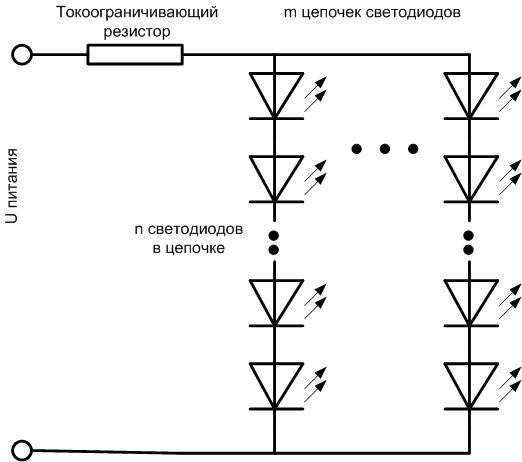
Consider the general scheme for switching on LEDs to create a lamp. Since one radiating element has low power, it is necessary to take several LEDs to create a sufficient luminous flux. The above circuit is typical, in fact it can consist of one chain, the chain can consist of one element, and the whole circuit can consist of one LED. Practical circuits may also have some differences, but fundamentally in common: LEDs are included in a matrix with a current-limiting resistor.The calculation of the searchlight elements will be given below. It is even better to use an electronic current stabilizer instead of resistance - a driver, but this is a topic for separate article.
Important! LEDs can be powered from either AC or DC voltage, but if a driver is used in the circuit, and not resistor, then the voltage must be constant.
Hull selection
There are two approaches to choosing a case:
- Find the case in the first place, and choose everything else according to the dimensions of the case. This path is relevant if the requirements for dimensions, fastening, etc. more important than other parameters.
- If the most important criterion is power and luminous flux, and everything else can be done in place, then the case is selected last, when all other components are available, or their dimensions become known.
Whichever option prevails, the spotlight shell can be selected using one of three methods:
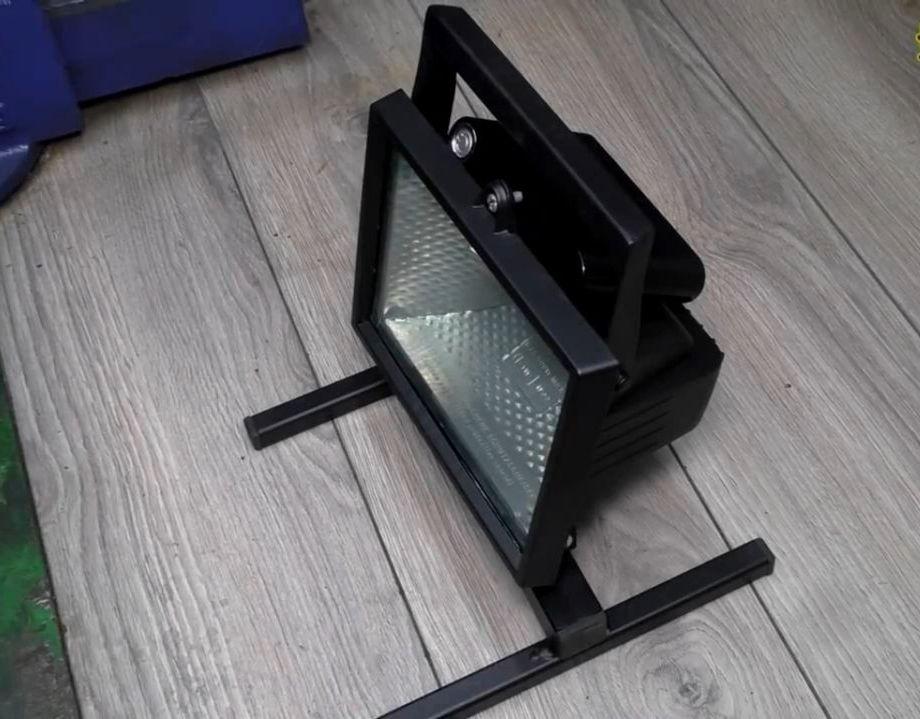
- Take an old spotlight (halogen or incandescent), carefully disassemble it and discard the outdated stuffing (or use it for other purposes).
![New building]() Housing from an old halogen lamp.
Housing from an old halogen lamp. - Buy a case in a lighting store. This method can be costly financially, but technically and aesthetically advantageous.
- Make the body yourself. In the presence of skillful hands, materials and tools, the shell of a homemade lantern can be any. It can be included in any design.
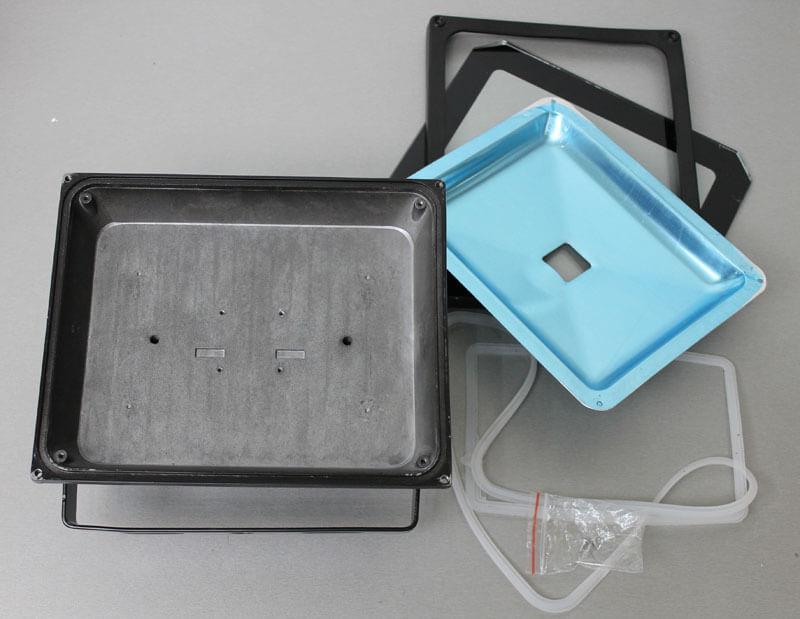
Whichever way the case is chosen, it must be borne in mind that it must simultaneously serve as a radiator to remove heat from the radiating elements. The more powerful the illuminator is supposed to be built, the more important this requirement is.Therefore, for 50+ W spotlights, it is better to make the shell from aluminum (its thermal conductivity is higher) or provide for the installation of the LED block on a separate radiator and heat removal from it.
Lamp selection
We will choose a “lamp” based on two parameters:
- The power of the future spotlight. It is pointless to make it less than 30 W, in practice devices from 50 W will be used, really bright light can be obtained from a source of at least 100 W.
- Voltage. For domestic purposes, it is better to set the voltage to 220 V - there will be no need to look for a power source. But you can calculate a chain of 12 V LEDs if you plan to be powered from the car's on-board network. Or to any other voltage, if you have to power the spotlight from an existing power source.
Wherever the article refers to watts, it refers to "lighting" power - the equivalent of the corresponding incandescent lamp, and not actually consumed.
Next you have to choose LEDsavailable at hand or intended to be purchased. Two parameters required for calculation:
- forward voltage of the LED;
- operating current in normal mode (80-90% of maximum current).
Video: Alteration of the spotlight. We put a 50 W LED.
The parameters of typical elements are given in the table.
| Size LED | Voltage, V (U) | Current, mA (I) |
| 3 mm | 2,1 | 20 |
| 5 mm | 2,3 | 20 |
| 5 mm high brightness | 3,6 | 75 |
| Cree XLamp MX3 (SMD) | 3,7 | 350 |
We determine the circuit based on the number of LEDs. Let there be a matrix of m strings of LEDs connected in parallel, with n elements per string connected in series. We calculate the voltage applied to the circuit according to the formula Utotal=U*n and the current consumption according to the formula Itotal=I*m.Next, we find the value of the resistor R=(Usource-Utotal)/Itotal (in kiloohms!), and its power P=(Usource-Utotal)*Itotal in milliwatts. Since the LEDs have a spread of parameters, after assembling the circuit, it is recommended to measure the actual current and clarify the resistor values.
Searchlight collection
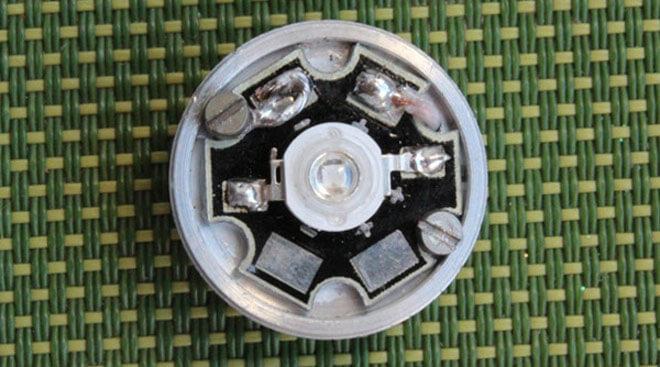
First of all, you need to assemble a matrix of LEDs, not forgetting about the resistor. This can be done on a board made of foil textolite or in a hinged way. But in each case, the design of heat removal must be thought out in advance.
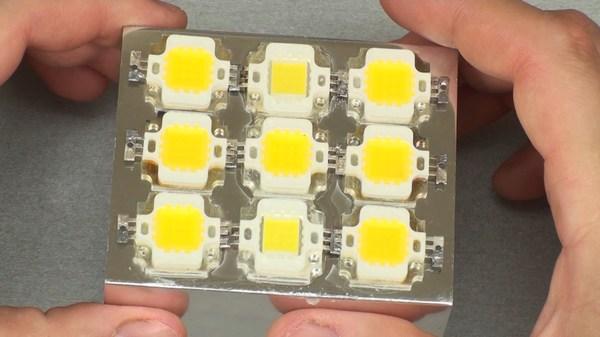
The next step is to make a reflector. To do this, you can paste over the compartment with radiating elements with ordinary foil.
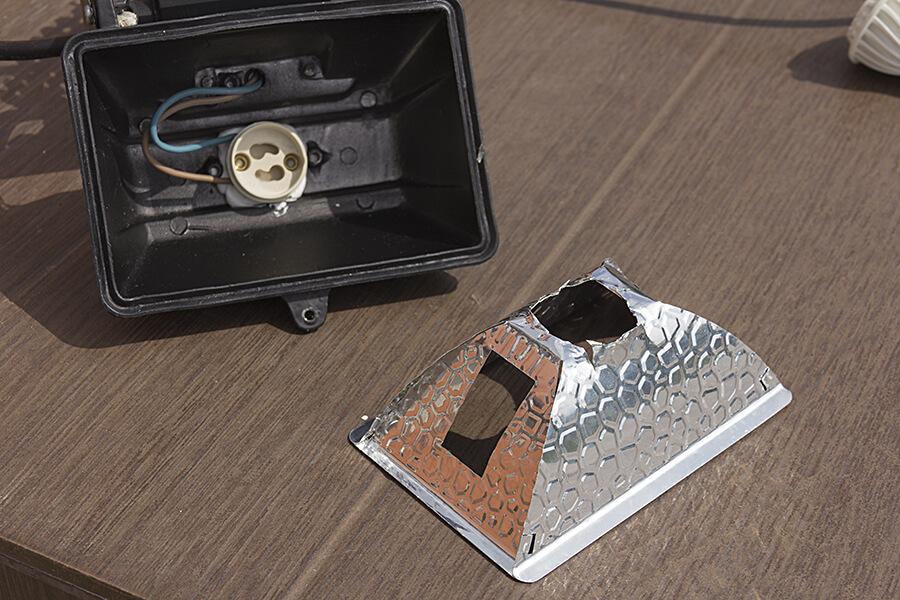
Next, you need to fix the matrix in the case, solder and bring out the power wire. If the calculations turned out to be correct, when turned on, the lighting device will give a bright light.
How can you use the spotlight
The most logical use of a DIY LED spotlight is to illuminate the territory of a house adjoining area, a garage, etc. But the fantasy of a skilled craftsman is not limited to this. You can come up with the design of a portable lighting device and use it for studio shooting of photos and videos.
A small 24V lamp can add to the effectiveness of the car's stock lighting when driving off-road (but do not use homemade devices when driving on public roads!). You can also use a similar spotlight (or several) for aesthetic purposes - for accentuated illumination of buildings. Everything is limited only by the imagination of the master and the skill of his hands.
