What is measured in lumens - how the value is calculated
Illumination in living and working areas is measured in lumens, but not everyone knows what it is and how to make calculations correctly. Understanding the topic is easy, it will help you choose the right light bulbs for any conditions. In addition, if you have the right data at hand, you can convert other units of measurement into lumens if there is no data on the luminous flux on the package.
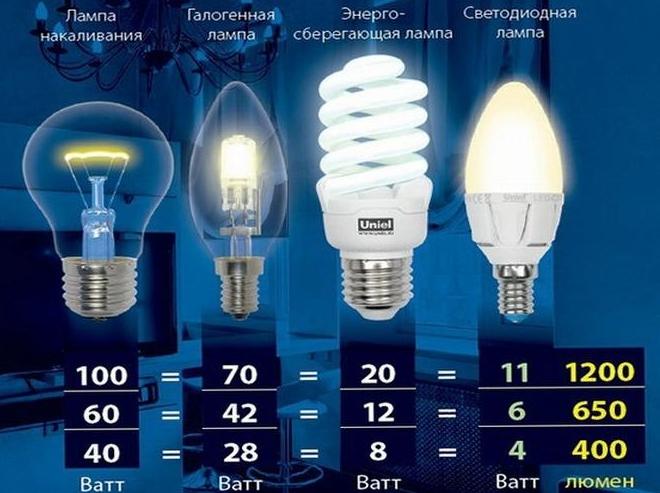
What is Lumen
Lumen is part of the international system of units and denotes power luminous flux, which comes from a specific source. The luminous flux in lumens is denoted Lm or Lm. It is equal to the luminous flux coming from an isotropic source with a luminous intensity of 1 candela.
This indicator is universal and is used for all types of lamps and fixtures, which simplifies calculations. The option when light sources in a house or apartment were selected by watts are long gone. It is much more convenient and accurate to use lumens, as they reflect the strength of the light flux, and not the energy consumed.
By the way! The power of light does not depend on it temperaturemeasured in Kelvin. Lighting can be warm, neutral or cool, but still have the same lumens.
How many lumens in 1 watt light bulb
The easiest way is to use the lumens table for the most common types of lamps and their power options. There are not so many varieties, so you can quickly navigate and choose the optimal value. All data are averages, as values may vary depending on the design and manufacturer.
| Luminous flux in lm | Incandescent (W) | LED options (W) | Fluorescent lamps (W) |
| 200 | 20 | 2-3 | 5-7 |
| 400 | 40 | 4-5 | 10-13 |
| 700 | 60 | 8-10 | 15-16 |
| 900 | 75 | 10-12 | 18-20 |
| 1200 | 100 | 12-15 | 25-30 |
| 1800 | 150 | 18-20 | 40-50 |
| 2500 | 200 | 25-30 | 60-80 |
Over time, the performance of incandescent lamps decreases due to the thinning of the spiral. For fluorescent and LED options, the brightness also decreases, but not as much.
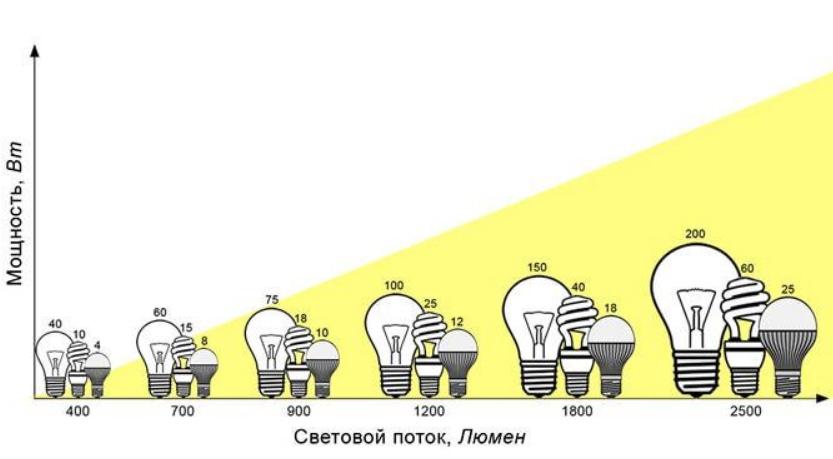
It is best to study the information on the packaging, there is usually accurate data from which you can build on. The ratio is subject to change, as new types of diodes with increased brightness are now appearing, which are much more efficient, but at the same time consume less electricity.
If there is no data on how many lumens are in a 100 W incandescent lamp, which happens often, you can do the calculations yourself. Even if the table is not at hand, it is easy to remember the ratio. In 1 watt of power, there are approximately 12 lumens of luminous flux. Using this information, it will not be difficult to determine indicators for variants of any type. Actual figures may vary, but not significantly. Usually products with filament are taken with a margin of 20-30% brightness to eliminate any problems.
Determine lumens in LED lamps much more difficult. It all depends on the current-voltage characteristics of the diodes used, as well as on the type of diffuser, the location of the elements and the cooling system. Therefore, it is necessary to study the information on the packaging or in the insert, if any. Usually this type of lamp has all the necessary data. But it is important to remember that the actual values \u200b\u200bmay differ from those declared, especially for cheap products. Therefore, it is worth buying products of famous firmswhich have performed well.
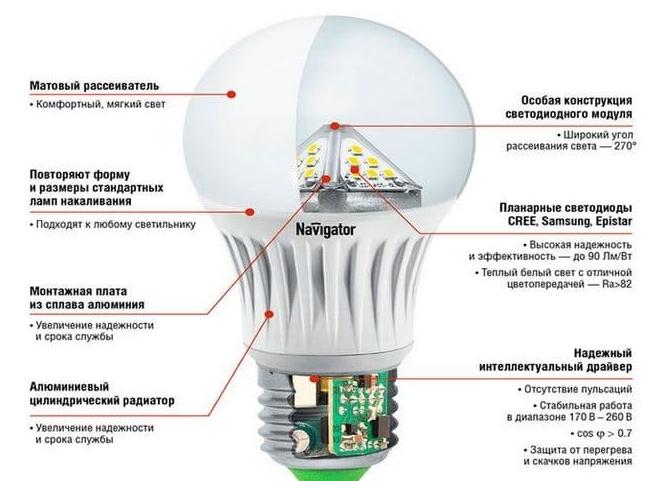
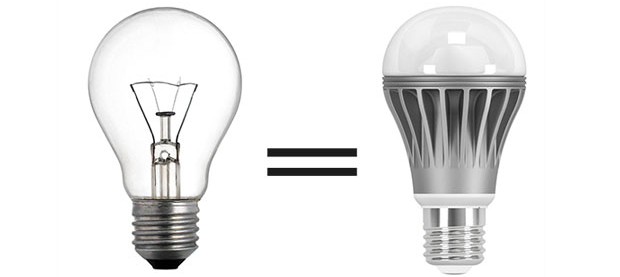
To find out the LM ratio in LED lamps and other types of products, the easiest way is to use the table in this section. With its help, you can quickly navigate in order to understand how much power the LED version needs instead of an incandescent or fluorescent lamp.
It is difficult to determine the indicators by eye, since the brightness can be perceived differently depending on the height of the lamp. Also, the indicators are affected by the color of the walls, floor and ceiling, depending on this it changes light reflection. The easiest way to measure lumens in lamps is with a luxmeter, this is the name of a special device that shows the actual illumination in lux.
Measurements are made in several places in the room, since not only brightness, but also uniformity of illumination is important. For living rooms, you need to check the indicators at floor level, for offices and industries, measurements are taken on work surfaces. In this way, you can quickly check whether the indicated data correspond to the actual figures.
In the video, we tell you what watts, lux and lumens are in the context of LED light.
Converting Lumens to Other Units
Sometimes you need to convert lumens to watts or lux. You can use online calculators for this. And if they are not at hand, then simple recommendations will come in handy that will help you carry out calculations manually, there is nothing complicated in the process. The ratio varies for different types of equipment, so you need to choose the right option before you translate the data:
- The average ratio of power to luminous flux for incandescent lamps is 1:12. But there are features here: if a 100-watt product gives a flow of about 1200 lumens, and a 60-watt option gives 600, then a 40-watt bulb provides only 400 lm. That is, for low power options (up to 40 W), the ratio will be 1:10.
- At arc mercury lamps indicators are stable and almost always amount to 58 lumens per watt of power.
- Lamps DNAT have a different ratio depending on the power. For 70 W models it is 1:66, for 100, 150 and 250 W products it is 1:74, for the most powerful 400 W lamps it is 1:88. Efficiency increases with power.
- energy saving fluorescent options translate at the rate of 60 lm per watt of power. But there is a peculiarity here - over time, the characteristics of the phosphor are reduced and the actual performance will be much lower than that of a new product.
- LED (LED) lamps filament type (with a transparent bulb that does not interfere with the spread of light) give out 100 lm for each watt of power.
- LED light bulbs with a diffusing lamp have a ratio of 80-90 lm per watt. But there may be deviations, since the light transmission of the diffuser may differ.
If you need to take measurements with a luxmeter, you need to keep the light on for one and a half to two hours. This is especially important for LED equipment, as its performance may decrease as it heats up if the cooling system is not made correctly.
Sometimes it becomes necessary to convert lux to lumens. It is important to understand the difference between these terms. If lux refers to the luminous flux emanating in a certain direction, then lumen indicates the luminous intensity of the source.
That is, the indicator in lumens reflects how much light the lamp emits, but at the same time it can be distributed in all directions. The SNiP states that one lux is equal to one lumen of illumination distributed over an area of 1 square meter.
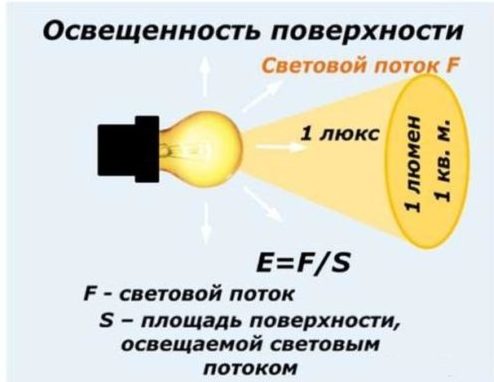
There are no separate values \u200b\u200bfor different types of lamps, in order to convert one indicator to another, a simple formula is required. The number of lux is equal to the number of lumens of light output divided by the area in square meters.
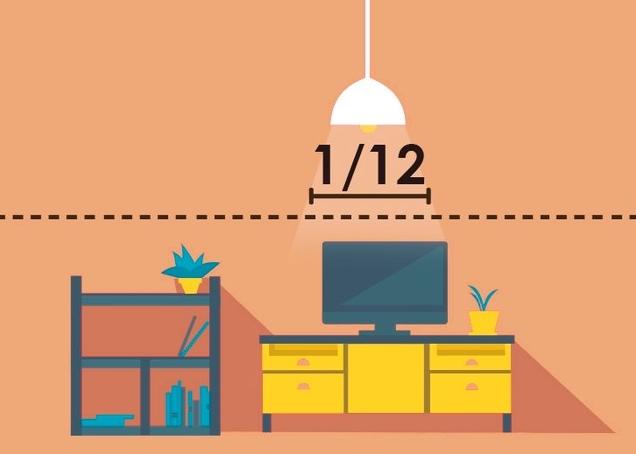
How to choose the right lamps depending on the number of lumens
Calculating the illumination in lumens is not difficult if you use the recommendations from SNiP and remember a few tips:
- Sanitary norms of illumination are established for each room. For bathrooms, bathrooms, utility rooms, corridors and hallways, the indicator is 50 Lx. For living rooms and kitchens, it is equal to 150 Lx. In children's rooms and play areas you need at least 200 Lx. Study rooms, home offices and libraries are lit at a rate of 300 lux.
- The selected norm must be multiplied by the area of \u200b\u200bthe room.The result will show the total illumination that is needed for a particular room. This indicator is worth focusing on.
- The number of light bulbs and their location are thought out. For small rooms, a chandelier in the middle will suffice, evenly distributing light. And if the room is large or elongated, it is better to use more lamps with a lower brightness and arrange them evenly or put 2-3 chandeliers.
It is not difficult to calculate the optimal luminous flux in lumens if you know the ratio of this indicator to the power of the main types of lamps. When choosing equipment, you must remember that you can not greatly exceed the recommended standards.