How to choose an LED lamp
LED lamps are an economical and modern option for home lighting. They are durable, and their variety allows you to choose the right shape, color temperature and a certain angle at which the light will scatter. Properly selected lamps will make lighting in any room comfortable.
Types of LED lamps
LED lighting is being used more and more. Bright LED lamps can significantly save on electricity at home and at work.
Corn
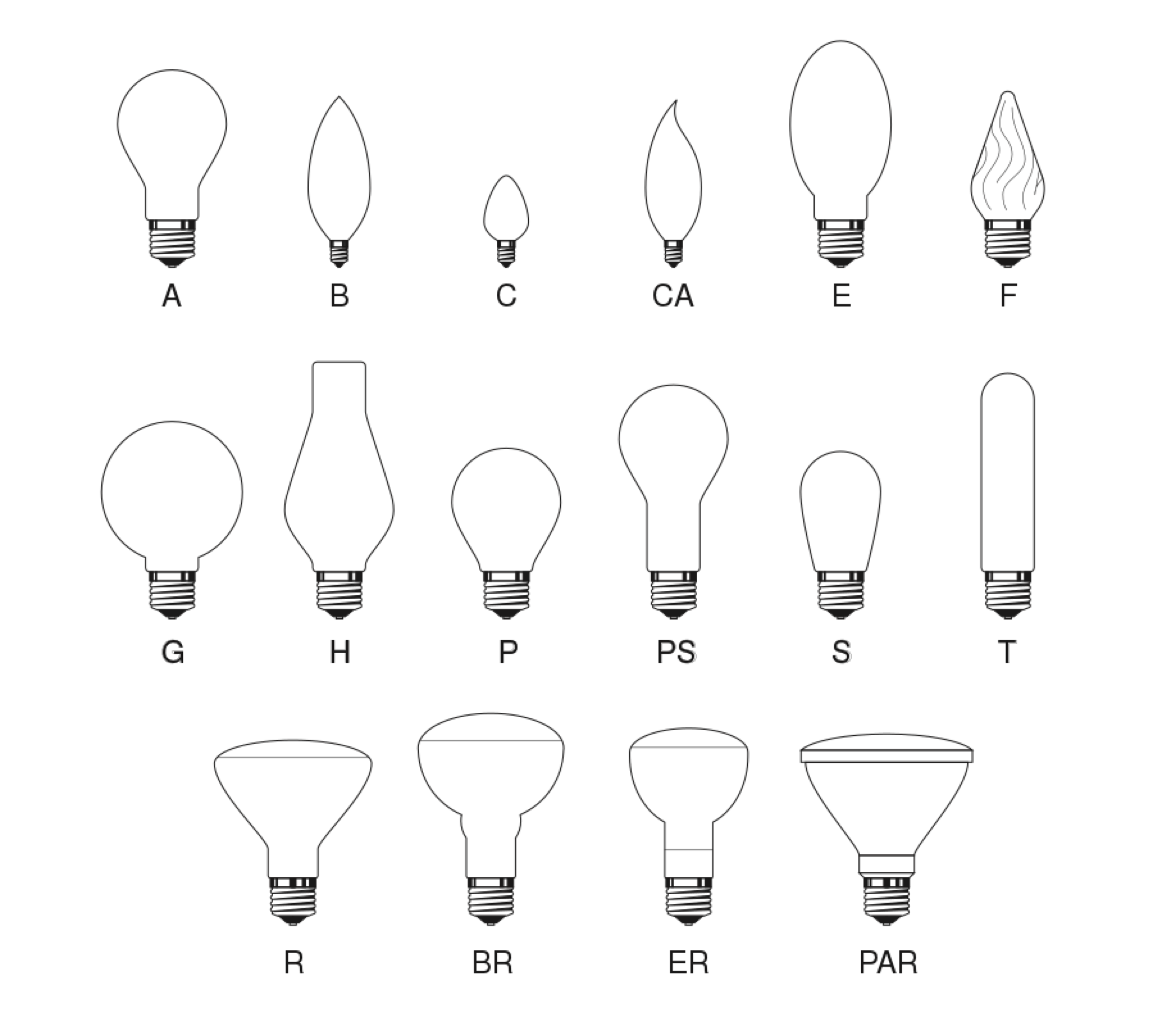
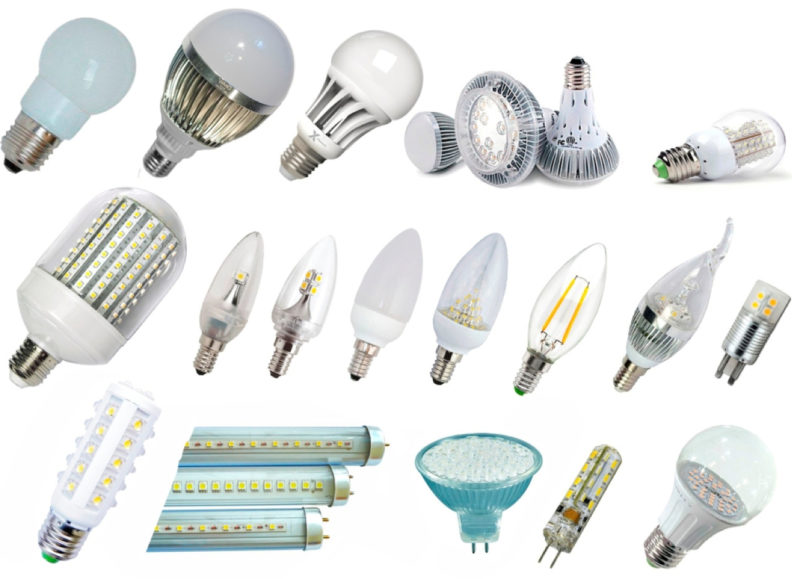
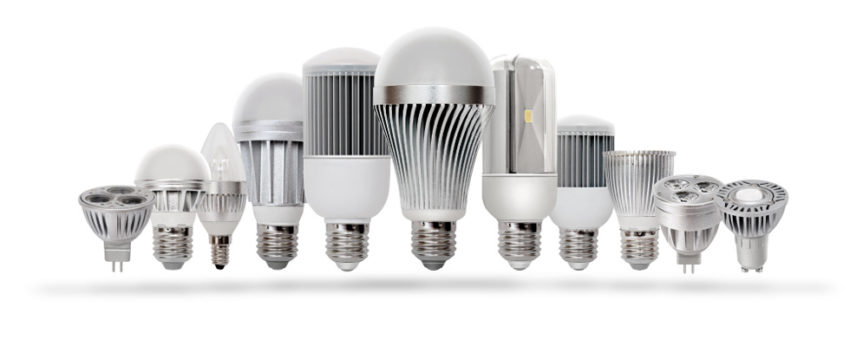
The bulb bulb looks like an ear of corn: an elongated cylinder, the diameter is approximately equal to the base. Yellow diodes are located on substrates similar to a polyhedron. They provide good light dispersion, exceeding an angle of 300°.
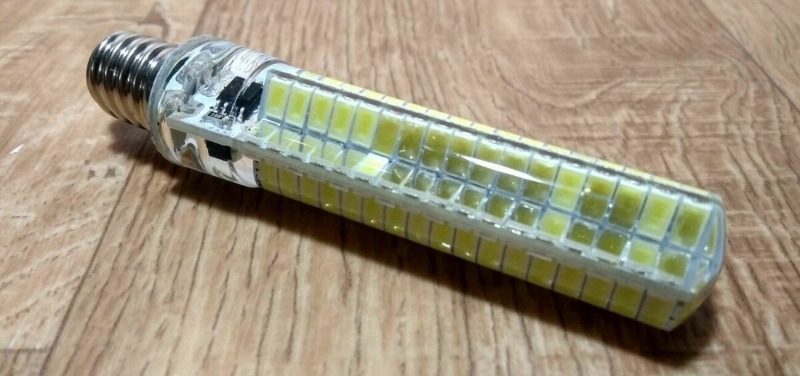
Convenient for horizontal or spot lighting with a shade that has a shading function. Quite rare to find filament type of.
Pear
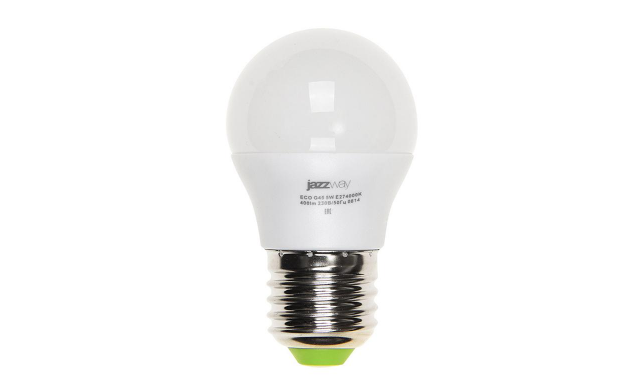
Pear lamp with spot LEDs distributes light at an angle of up to 180°. It is usually chosen for chandeliers with arms that point downwards to illuminate the center of the room. If the cartridges are oriented to the ceiling, then the lower part of the room will not be adequately lit.
Candle
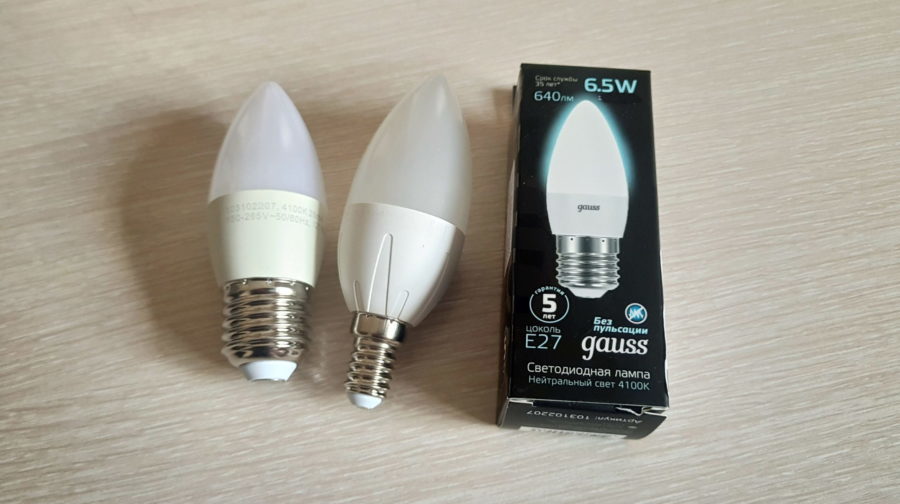
The candle bulb has a limited scattering angle and low power. Mainly applied to night lights and desktop devices.
There are flasks with a variety of shapes: from simple ones to imitation of a candle in the wind.
Instances with a filament design are universal, as they have a large angle of light scattering. They can do home tasks - lighting individual areas in the premises.
Criterias of choice
It is important to correlate your requirements with the characteristics of LED lamps.
Before choosing an ice lamp, you need to consider where it will be used. By location, there are lamps for streets, houses and special-purpose premises. According to the purpose of the lamp - to create general and decorative lighting in the room or spot lighting.
There are LED lamps and the type of installation: ceiling, wall, floor, table, furniture. According to the type of installation, they are built-in, suspended, overhead, on a support.

Among the additional features that may become one of the selection criteria for the buyer are setting the intensity and color of the glow, switching modes, built-in speakers, radio, USB port, etc. Before you buy a lamp, you need to familiarize yourself with the main characteristics.
Power
High lamp power is needed in rooms with high ceilings, in outdoor areas and in landscape design. For comparison, see the table.
| Incandescent lamp power, W | Fluorescent lamp power, W | LED lamp power, W | Luminous flux, Lm |
|---|---|---|---|
| 20 | 5-7 | 2-3 | 250 |
| 40 | 10-13 | 4-5 | 400 |
| 60 | 15-16 | 8-10 | 700 |
| 75 | 18-20 | 10-12 | 900 |
| 100 | 25-30 | 12-15 | 1200 |
| 150 | 40-50 | 18-20 | 1800 |
| 200 | 60-80 | 25-30 | 2500 |
To calculate the required power for a house, you need an indicator of illumination, which is measured in lux. Thus, we calculate the required light flux per 1 m²: 1 lux = 1 lm x 1 m².
Recommended for viewing: Varieties of Sirius lamps
The illumination calculation algorithm makes it possible to divide the room into zones where more intense or moderate light is needed. This method helps to save on utilities.
plinth
LED lamps are now produced with an E40 or E27 base, provided with IP64 protection, which allows them to be used in all weather conditions.
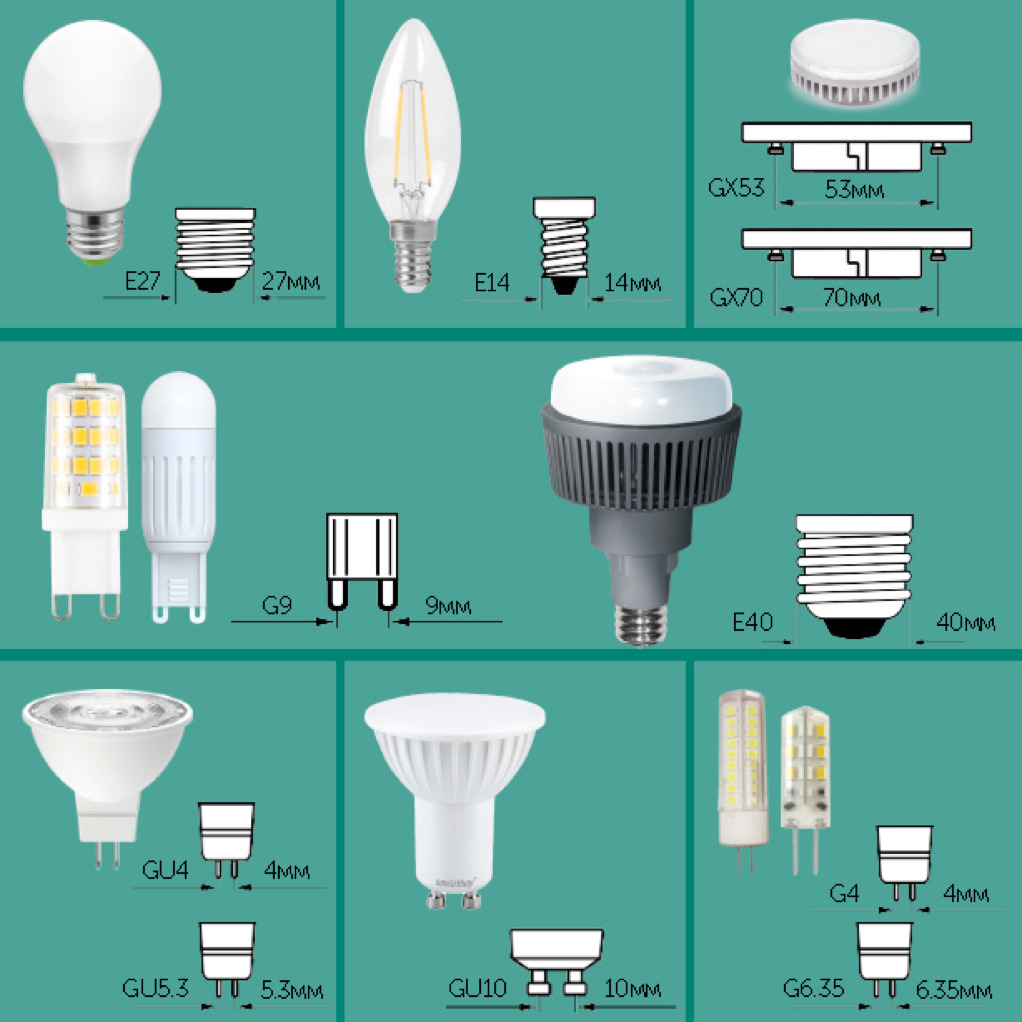
Classify the types of socles by application. Threaded is indicated by the letter "E". This type will easily replace an incandescent light bulb. In houses, diode lamps with a standard E14 or E27 base are used. E14 lamps are called minions.
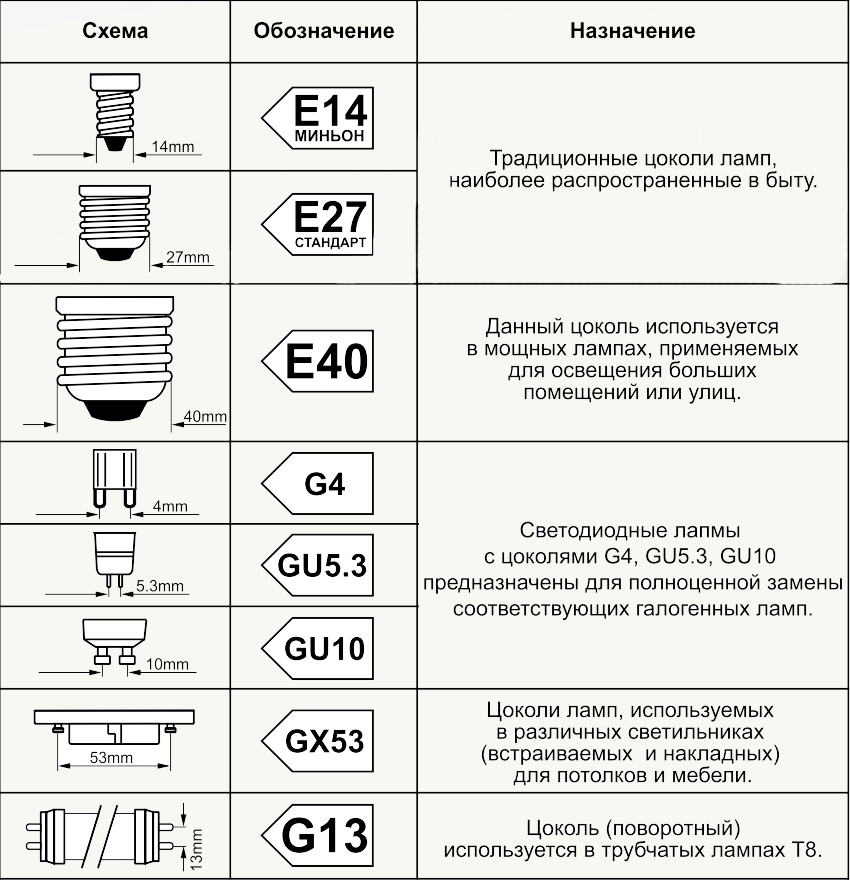
The size of the base depends on the size of the flask. The GU10 connector has 2 pins with thick ends, where G is the pin type, U indicates the presence of thick ends, and the distance between the pins shows the digital value. The design of the base corresponds to the starter connectors, which serve as one of the elements of gas-discharge light sources. The mount in such lamps is swivel.
Electrical safety and ease of installation are the main advantages of the pin base.
Lamps with such a base are used in reflector ceiling lights.
The GU5,3 and GU9 connector is used for suspended ceilings and has the same advantages as GU10.
Tube-shaped LED fixtures have a G13 base. They can replace fluorescent light sources and illuminate large areas and rooms with high ceilings.
The GX53 base is used in recessed lighting fixtures for furniture and ceiling decoration.
It will be useful to read: The main types of plinths
Lamp Warranty
Conscientious manufacturers give a guarantee for LED devices for at least 2 years. Warranty for LED-lamps is on average 6-12 months, for lamps designed for interior - 1-2 years.
Some manufacturers may not provide a warranty period, in which case the store assumes this obligation. If the store does not fulfill the condition, then automatically the warranty period is set to two years.
Having discovered a malfunction before the expiration of the warranty period, the buyer has the right to demand that the store comply with its rights under Article 18 of Law No. 2300-1. If there is no warranty period, the buyer can make a claim within up to two years.
Thematic video: How to extend the life of the LED lamp
The seller has the right to refuse the buyer a refund or other obligations if he can prove that the lighting device does not work:
- due to improper transportation;
- due to an accident;
- due to improper handling;
- due to an attempted repair;
- due to connection to faulty equipment.
Scattering angle
Conventional electrical sources illuminate the largest possible area around them, LEDs direct light only in one direction. A diffuser is used to cover a larger area.
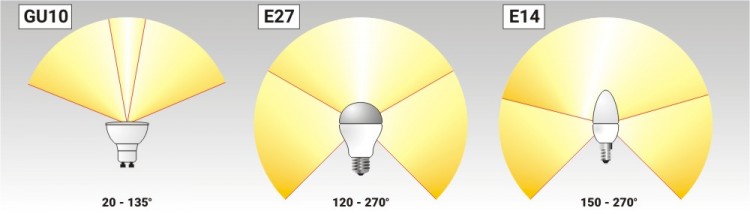
To achieve a uniform distribution of the light flux allows the installation of LEDs in a plane at different angles. LED bulbs can spread light at an angle of 60° or 120°.
Life time
LED lamps differ from conventional lamps in durability, for which buyers fell in love with them. Manufacturers usually overestimate the service life.
So, for example, they often indicate a service life of 5-7 years. However, after 3-4 years, the lamps begin to lose brightness. This may be due to voltage drops, which are not taken into account by the manufacturer when calculating the service life.
May overestimate other characteristics of the lamps. For example, they indicate a power of 5 watts, but in reality - 8 watts. As a result, electricity consumption increases many times, and efficiency decreases. If you do not want to be deceived, purchase light bulbs from trusted manufacturers.
Recommended for viewing: What to consider when choosing LED-lamps.
Colorful temperature
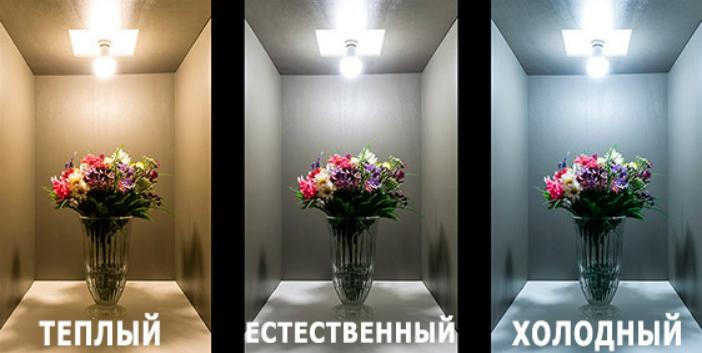
One of the advantages of LED lamps over competitors is the color temperature. Choice color spectrum allows you to create different atmospheres in the premises.
Color temperature is measured in Kelvin. There is a pattern showing what determines the shade of white. If the Kelvin value is lower, the light is warmer. The higher the value, the closer the light is to sunlight with a natural cool tone.
2700 K emits a warm light with a reddish white tint, creates a cozy home and has relaxing properties that ensure relaxation and rest.
3000K creates a warm light with a yellow-white tint. Such indicators have halogen and LED bulbs, suitable for apartments and private houses.
3500 K - daylight white light, which is suitable for offices and public places.
4000 K - cold white light used in medical institutions, in the subway, etc.
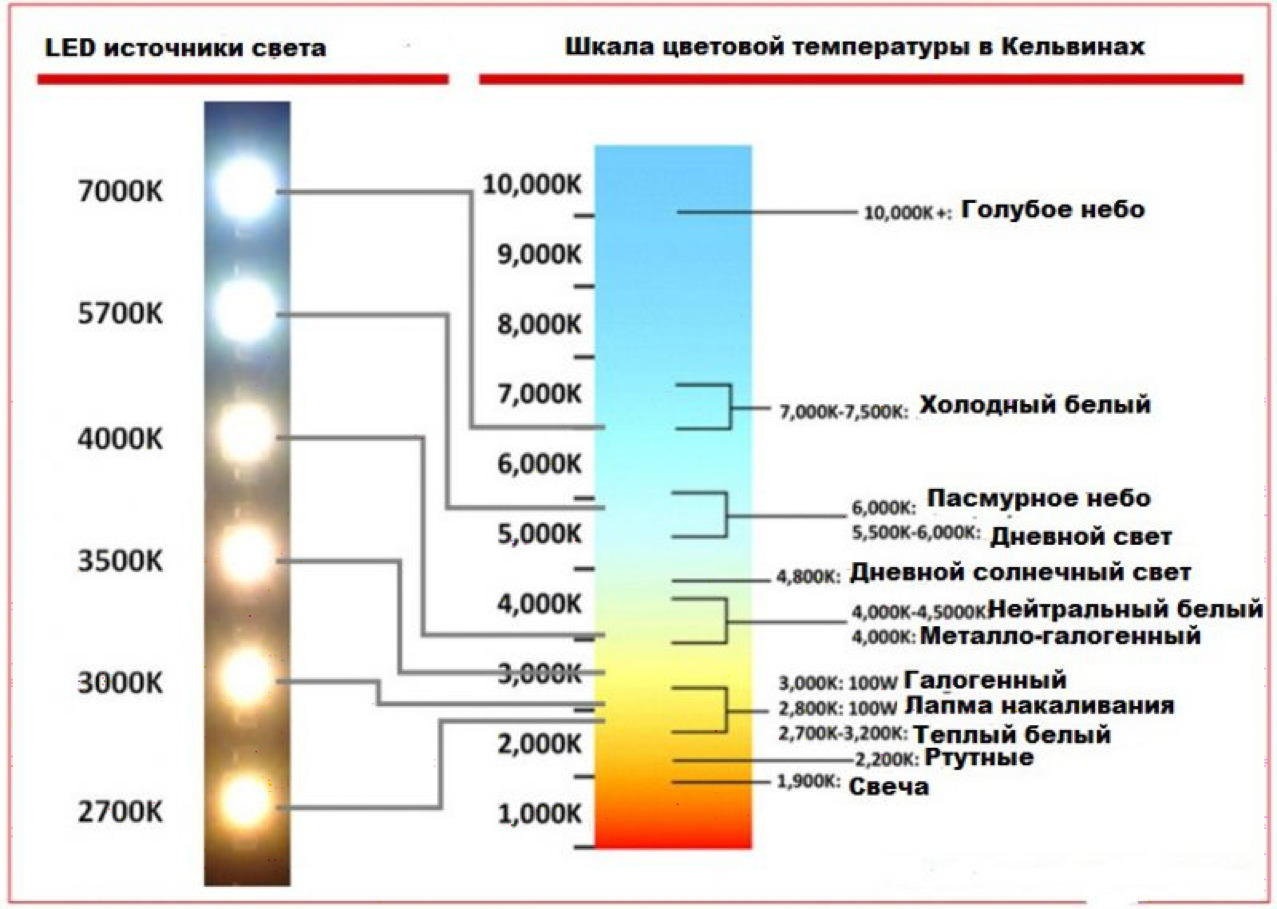
5000-6000 K - daylight with a white-blue tint, well suited for manufacturing organizations, factories, greenhouses, etc.
6500 K - cold daylight with a white-lilac tint. Used in warehouses and industrial establishments, for street lighting.
Which LED lamp to choose for home use depends on individual preferences.
The color temperature indicator can be viewed on the packaging in the list characteristics. Information is duplicated on the base.
If you don’t know how to choose an LED lamp for an apartment or other room, which shade is more suitable, you can refer to regulatory documents, namely SP 52.13330.2011 “Natural and artificial lighting”, where there are recommendations.
The presence of a radiator
The radiator prevents overheating and controls the light output of the diodes. There are aluminum, composite, plastic and ceramic radiators.
The most reliable and with a long service life are considered to be aluminum cooling radiators or ceramic ones in the absence of a dissipating flask.
A plastic radiator is convenient if the light source will be used rarely and for a short time.
Which LED lamp is better for home and apartment
When choosing, take into account:
- the color spectrum of the lamp - from 3000 K to 4000 K;
- optimal voltage - 220 V, 12 W;
- natural color for a lamp with a color rendering index of 80 CRA (Ra);
- the placement affects the choice of the flow of light - diffused or directional;
- flickering is imperceptible for lamps with a pulsation range of 5-15%.
You can opt for RGB with changeable color.This will be an interesting solution for the house.
Be sure to watch: Comparison of LED light bulbs: which is better - for $55 or $4
Top Producers
Recognized on the European market several leaders among manufacturers. Philips (Netherlands) uses new technologies, products are safe for the eyes, have a minimum pulsation coefficient, have passed all laboratory tests, the glow temperature switches in one click. The cost of lamps is $ 500-20. You can buy it at Citylink.
Osram (Germany) has a wide range of LED lamps. Ripple coefficient - no more than 10-15%, color rendering index - 80, minimal eye strain. The price is in the range of $400-16. Can be found on Yandex.Market.
Camelion makes vintage and phyto lamps for growing flowers at home. Despite the recent appearance of this manufacturer, a huge range of products is presented. The operating time of the lamps corresponds to the declared characteristics. Price -4$. You can buy in online stores.
Of the Russian manufacturers, Gauss has proven itself well.
Products have a long warranty period, high brightness up to 900 lm, characteristic design - antique style. The cost is within $20. Rarely seen in regular stores. Can be found at Mirsveta-online, Svetelcom.
