The laws of light reflection and the history of their discovery
The law of reflection of light was discovered through observations and experiments. Of course, it can be derived theoretically, but all the principles that are used now have been defined and substantiated in practice. Knowing the main features of this phenomenon helps with lighting planning and equipment selection. This principle also works in other areas - radio waves, x-rays, etc. behave exactly the same in reflection.
What is the reflection of light and its varieties, mechanism
The law is formulated as follows: the incident and reflected rays lie in the same plane, having a perpendicular to the reflecting surface, which emerges from the point of incidence. The angle of incidence is equal to the angle of reflection.
In essence, reflection is a physical process in which a beam, particles or radiation interact with a plane. The direction of the waves changes at the boundary of two media, as they have different properties.Reflected light always returns to the medium from which it came. Most often during reflection, the phenomenon of refraction of waves is also observed.
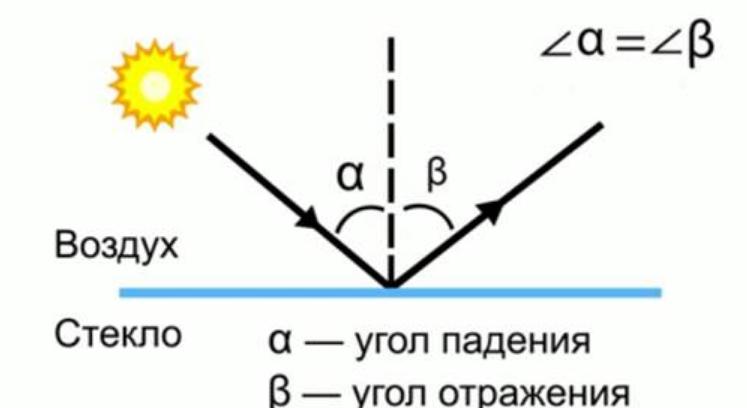
Mirror reflection
In this case, there is a clear relationship between reflected and incident rays, this is the main feature of this variety. There are several main points specific to mirroring:
- The reflected ray is always in a plane that passes through the incident ray and the normal to the reflecting surface, which is reconstructed at the point of incidence.
- The angle of incidence is equal to the angle of reflection of the light beam.
- The characteristics of the reflected beam are proportional to the polarization of the beam beam and its angle of incidence. Also, the indicator is influenced by the characteristics of the two environments.
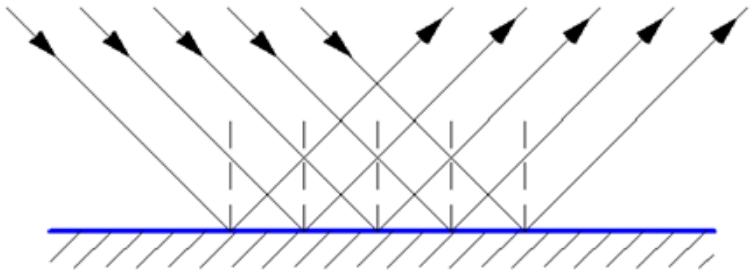
In this case, the refractive indices depend on the properties of the plane and the characteristics of the light. This reflection can be found wherever there are smooth surfaces. But for different environments, the conditions and principles may change.
Total internal reflection
Typical for sound and electromagnetic waves. Occurs at the point where two environments meet. In this case, the waves must fall from a medium in which the propagation velocity is lower. With regard to light, we can say that the refractive indices in this case increase greatly.
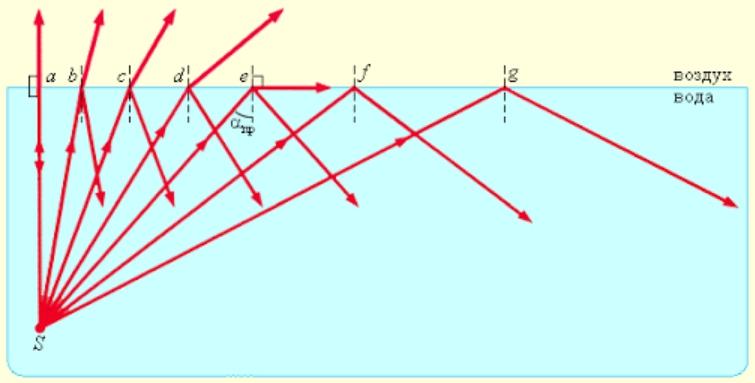
The angle of incidence of a light beam affects the angle of refraction. With an increase in its value, the intensity of the reflected rays increases, and the refracted ones decrease.When a certain critical value is reached, the refractive indices decrease to zero, which leads to the total reflection of the rays.
The critical angle is calculated individually for different media.
Diffuse reflection of light
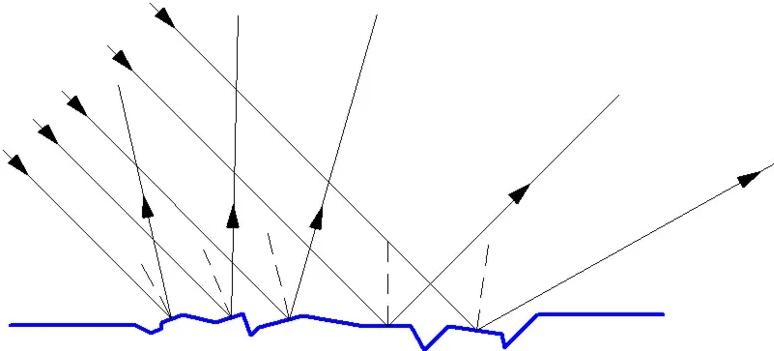
This option is characterized by the fact that when it hits an uneven surface, the rays are reflected in different directions. Reflected light simply scatters and it is because of this that you cannot see your reflection on an uneven or matte surface. The phenomenon of ray diffusion is observed when the irregularities are equal to or greater than the wavelength.
In this case, one and the same plane can be diffusely reflective for light or ultraviolet, but at the same time reflect the infrared spectrum well. It all depends on the characteristics of the waves and the properties of the surface.
Reverse reflection
This phenomenon is observed when rays, waves or other particles are reflected back, that is, towards the source. This property can be used in astronomy, natural science, medicine, photography and other areas. Due to the system of convex lenses in telescopes, it is possible to see the light of stars that are not visible to the naked eye.
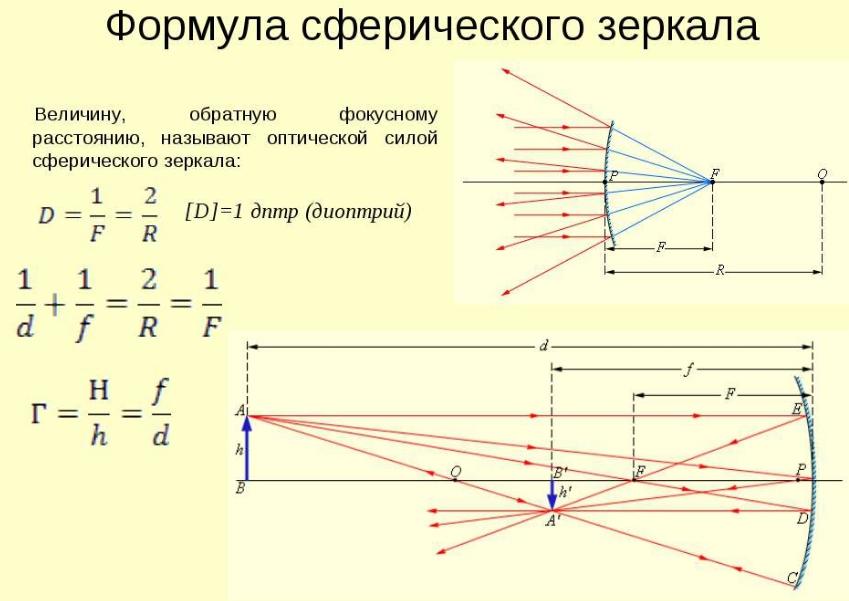
It is important to create certain conditions for the light to return to the source, this is most often achieved through optics and the beam direction of the rays. For example, this principle is used in ultrasound studies, thanks to the reflected ultrasonic waves, an image of the organ under study is displayed on the monitor.
History of the discovery of the laws of reflection
This phenomenon has been known for a long time.For the first time, the reflection of light was mentioned in the work "Katoptrik", which dates back to 200 BC. and written by the ancient Greek scholar Euclid. The first experiments were simple, so no theoretical basis appeared at that time, but it was he who discovered this phenomenon. In this case, Fermat's principle for mirror surfaces was used.
Fresnel formulas
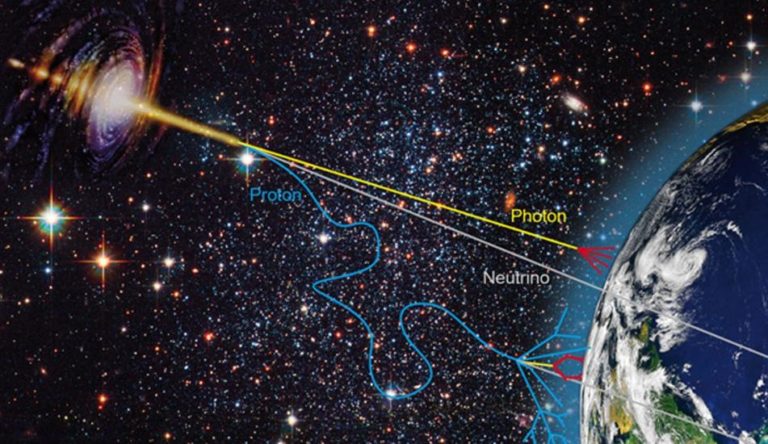
Auguste Fresnel was a French physicist who developed a number of formulas that are widely used to this day. They are used in calculating the intensity and amplitude of reflected and refracted electromagnetic waves. At the same time, they must pass through a clear boundary between two media with different refractive values.
All phenomena that fit the formulas of a French physicist are called Fresnel reflection. But it must be remembered that all the laws derived are valid only when the media are isotropic, and the boundary between them is clear. In this case, the angle of incidence is always equal to the angle of reflection, and the value of refraction is determined by Snell's law.
It is important that when light falls on a flat surface, there can be two types of polarization:
- p-polarization is characterized by the fact that the vector of the electromagnetic field lies in the plane of incidence.
- s-polarization differs from the first type in that the electromagnetic wave intensity vector is located perpendicular to the plane in which both the incident and the reflected beam lie.
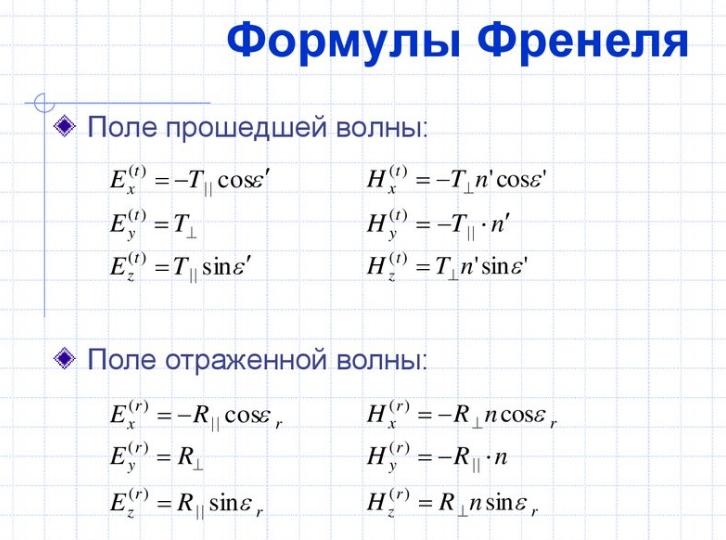
Formulas for situations with different polarizations differ.This is due to the fact that polarization affects the characteristics of the beam and it is reflected in different ways. When light falls at a certain angle, the reflected beam can be completely polarized. This angle is called the Brewster angle, it depends on the refraction characteristics of the media at the interface.
By the way! The reflected beam is always polarized, even if the incident light was unpolarized.
Huygens principle
Huygens is a Dutch physicist who succeeded in deriving principles that make it possible to describe waves of any nature. It is with its help that most often they prove both the law of reflection and law of refraction of light.
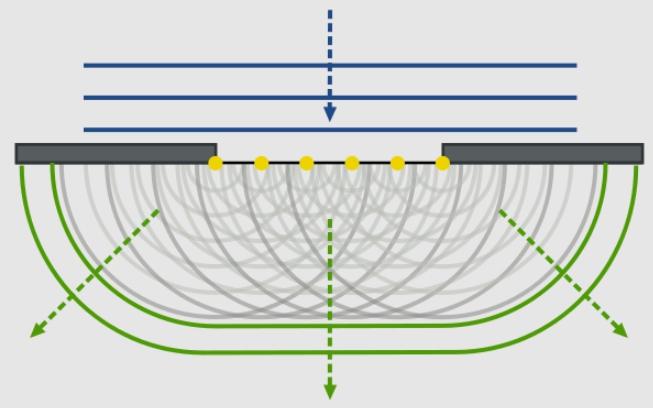
In this case, the light is understood as a wave of a flat shape, that is, all wave surfaces are flat. In this case, the wave surface is a set of points with oscillations in the same phase.
The wording goes like this: any point to which the perturbation has come subsequently becomes a source of spherical waves.
In the video, a law from grade 8 physics is explained in very simple words using graphics and animation.
Fedorov's shift
It is also called the Fedorov-Ember effect. In this case, there is a displacement of the light beam with total internal reflection. In this case, the shift is insignificant, it is always less than the wavelength. Because of this displacement, the reflected beam does not lie in the same plane as the incident one, which goes against the law of light reflection.
The diploma for scientific discovery was awarded to F.I. Fedorov in 1980.
The lateral displacement of the rays was theoretically proved by a Soviet scientist in 1955 thanks to mathematical calculations. As for the experimental confirmation of this effect, a little later the French physicist Amber did it.
Use of the law in practice
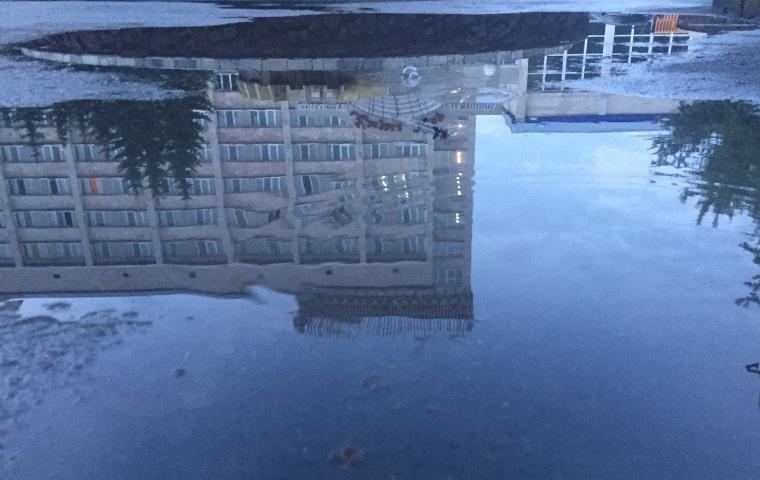
The law in question is much more common than it seems. This principle is widely used in various fields:
- Mirror is the simplest example. It is a smooth surface that reflects light and other types of radiation well. Both flat versions and elements of other shapes are used, for example, spherical surfaces allow objects to be moved away, which makes them indispensable as rear-view mirrors in a car.
- Various optical equipment also works due to the considered principles. This includes everything from glasses, which are found everywhere, to powerful telescopes with convex lenses or microscopes used in medicine and biology.
- Ultrasound devices also use the same principle. Ultrasound equipment allows for accurate examinations. X-rays propagate according to the same principles.
- microwave ovens - Another example of the application of the law in question in practice. It also includes all equipment that operates due to infrared radiation (for example, night vision devices).
- concave mirrors allow flashlights and lamps to increase performance. In this case, the power of the light bulb can be much less than without the use of a mirror element.
By the way! Through the reflection of light, we see the moon and stars.
The law of reflection of light explains many natural phenomena, and knowledge of its features made it possible to create equipment that is widely used in our time.