How to properly test a fluorescent lamp
The daylight fluorescent lamp (LDS) is one of the popular lighting fixtures. With its help, you can organize lighting that can work for a very long time. However, even such devices fail, and it may be necessary to check the fluorescent lamp for serviceability. Consider diagnostic methods.
Why do fluorescent lamps burn out
Considering gas-discharge lamps, one cannot but mention their similarity with traditional incandescent lamps (LN). As in the LN, the glow is created by heating the helical tungsten electrodes. Long and intensive operation leads to overheating, wear of contacts and their failure.
In LDS, the elements are covered with a layer of active alkali metal. This solution allows you to extend the life of the lamp and reduce the negative impact of high temperatures.This stabilizes the discharge between the electrodes, which helps to maintain integrity.
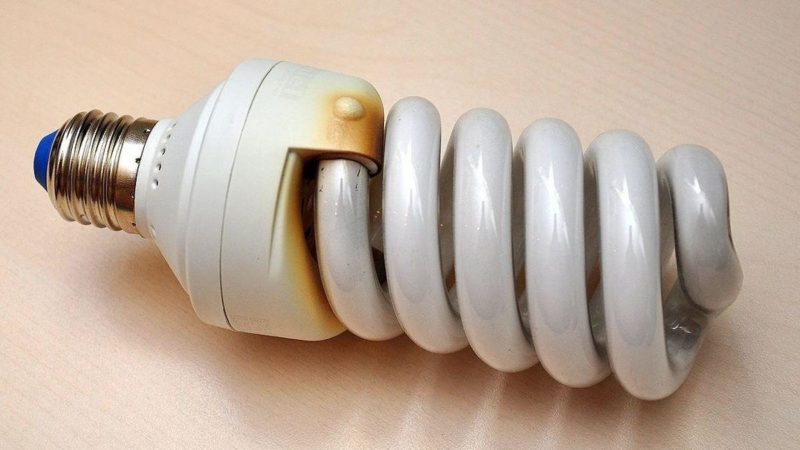
However, the coating is not eternal and is sensitive to frequent switching on and off. Gradually, the metal crumbles, and the tungsten electrodes begin to contact each other. The discharge passing through them heats the material and leads to final burnout. This can be seen on old flasks: small darkened areas of the phosphor next to the contacts.
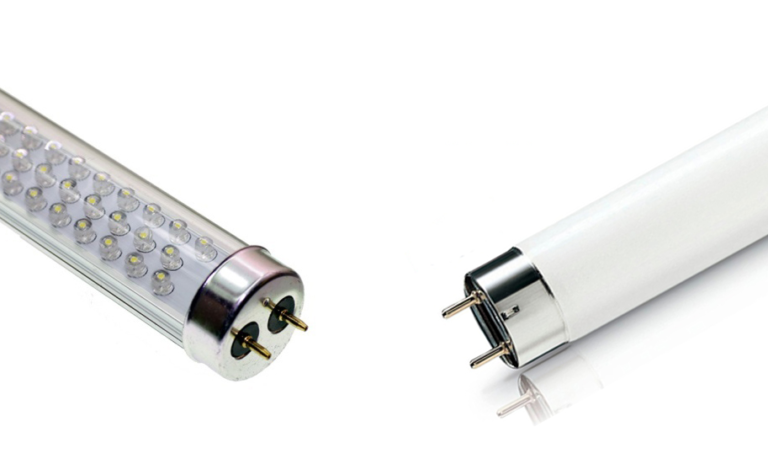
During operation, it is important to monitor the integrity of the flask. If there is damage, burnout will not take long. If an orange glow is observed along the edges of the flask, then air enters through the hole. It is impossible to repair the element, only to change it.
Burnout usually occurs at the moment the lamp is turned on, since it is at this stage that the contacts experience the maximum load.
Troubleshooting
You can determine the burnout of a fluorescent lamp by several factors:
- the lamp does not turn on when voltage is applied;
- at startup, short-term flickering is observed, gradually turning into a uniform glow;
- the device flickers for a long time, but cannot flare up at full strength;
- a strong hum is heard during operation;
- The lamp works, however, during the glow, flickering and pulsations are observed.
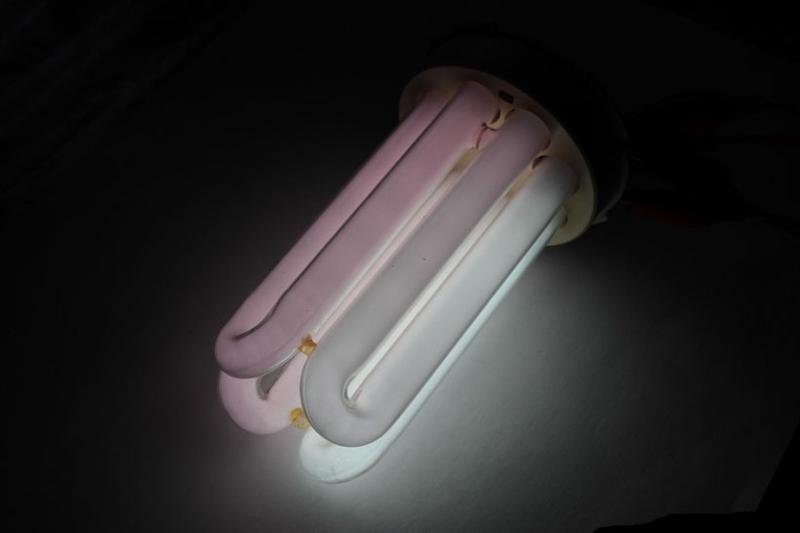
A complete refusal to turn on is a reason to check the device. But with flicker, users put off diagnostics and repairs indefinitely. It is not recommended to do this, because. the pulsating glow is uncomfortable and has a negative effect on vision.
Diagnostics requires a multimeter or tester with the ability to measure the resistance on the contacts.
Before starting the test, make sure that the problem is with the lamp and not with the fixture. To check, connect a known-good flask to the lamp.
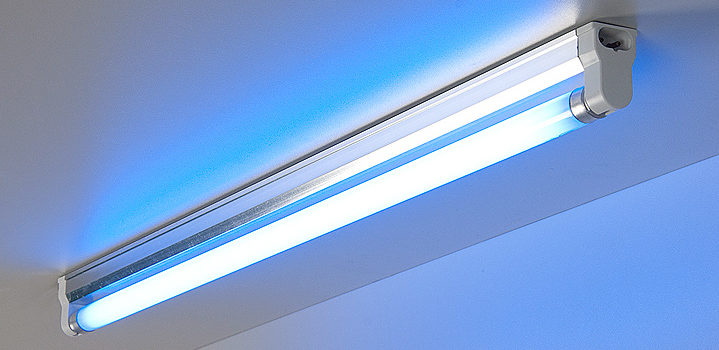
If the case is in the cartridge, clean the contacts with alcohol liquid, clean with sandpaper and, if necessary, change their position relative to the flask. Perhaps the problem is in poor contact between the components of the system.
If the lamp is working, the problem is in the lamp.
Recommended for viewing: How to check a fluorescent lamp
Integrity of electrode spirals
The first stage of checking the bulb is measuring the resistance in the contacts of the system with a multimeter. Set the resistance test mode by selecting the minimum value range. Attach the probes to the lamp contacts on both sides.
Zero resistance indicates a break in the filament between the electrodes in the interior of the bulb. On a working device, the resistance indicator will be in the range from 3 to 16 ohms, depending on the characteristics of the model.
The presence of even one gap is a reason to dispose of the old device and purchase a new lamp.
Malfunctions in the electronic ballast
In modern lighting fixtures, electronic ballasts are used to stabilize the voltage. It is recommended that you first try to replace the ballast with a working one and check the health of the system. If the reason is in it, you can proceed to self-repair the device.
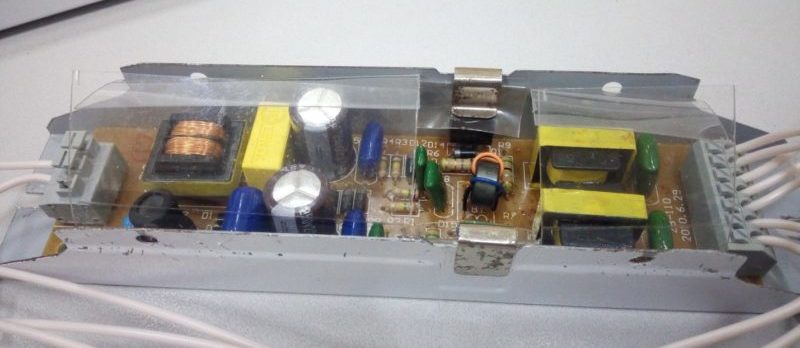
The first step is to change the fuse. A weak glow of the electrodes indicates a broken capacitor. It can be replaced, but it is better to immediately select a capacitor with an operating voltage of 2 kV. This will give a margin of safety, since in the vast majority of cheap electronic ballast capacitors with values not exceeding 400 V are used. Such elements do not tolerate loads well and burn out quickly.
Frequent voltage drops in the network negatively affect transistors. A dial will indicate a component failure.
It is only necessary to check the ballast after repair with the load connected, since idling will quickly lead to breakdown.
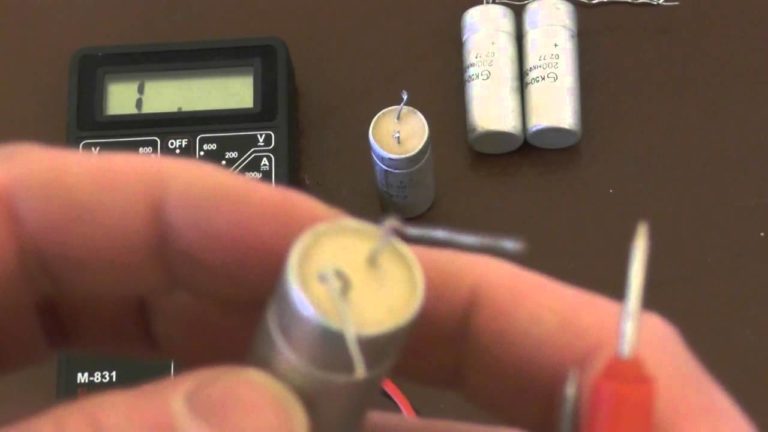
How to check the throttle
Malfunction throttle usually expressed by the buzz of the lamp, darkening the edges of the bulb, overheating, strong flickering during operation. If at least one of these signs takes place, it is necessary to check the resistance element.
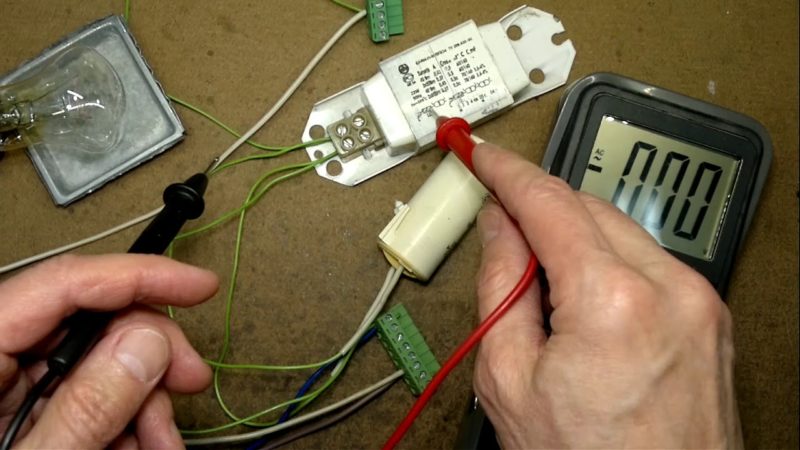
Verification includes the steps:
- The starter is pulled out of the lamp.
- The contacts in the cartridge are short-circuited.
- The flask is pulled out of the groove, the contacts in the cartridges are shorted.
- Turns on the multimeter in resistance measurement mode.
- The probes are connected to the contacts in the lamp socket. Infinite resistance indicates a winding break, a small value in the zero region indicates an interturn circuit.
Often, throttle burnout is accompanied by the smell of burnt metal and dark spots on the stabilizer body.
How to check the starter
If the lamp flickers, but does not light up at full strength, you need to check the starter. Checking is possible only when a 60 W light bulb and a starter are connected in series to the network.
How to check the capacitance of a capacitor with a tester
A capacitor problem can have a significant impact on the entire system, reducing efficiency from 90% to 40%. The capacitor is selected according to the power of a particular lamp. For example, for 40 W, the optimal capacitor is 4.5 microfarads.

The capacity is checked with a multimeter or tester.
Checking with a multimeter
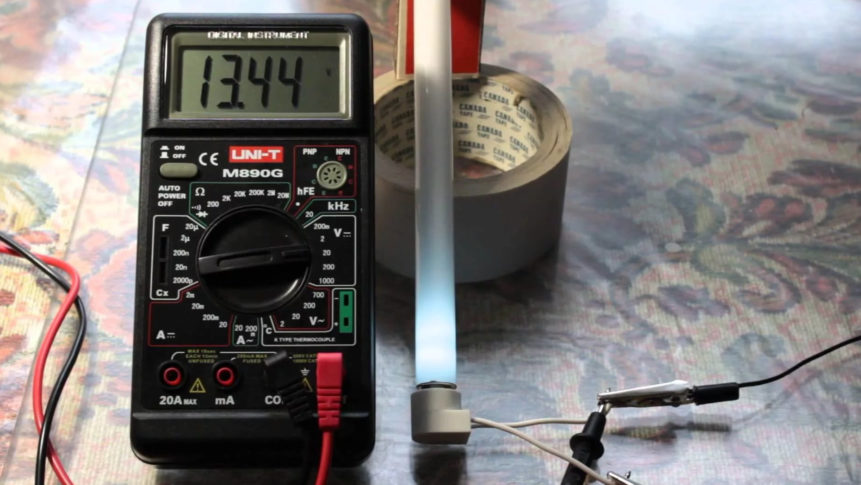
A multimeter is a very useful tool for effectively testing lamp assemblies. Switch it to the continuity mode or measure the resistance in the minimum range.
If, when connecting the probes to the contacts of the bulb, a specific value appears on the multimeter display, the lamp is working. The absence of signals indicates a broken thread. Checking other nodes is carried out in the same way. You just need to familiarize yourself in advance with the nominal values \u200b\u200bof the resistances on the contacts and ring them. Even the smallest deviation can cause damage.
How to turn on a fluorescent lamp without a choke
Fluorescent lamps in some cases, they can be connected in circuits without a starter and a choke. Moreover, this works even for failed devices, the brightness of which has become significantly lower than the nominal.
You can increase the brightness by replacing the contacts and turning the lamp in the cartridge. In this case, power is supplied in the form of a constant voltage from a special source. A full-wave rectifier with the ability to double the voltage is usually used. It is desirable to select all elements in the circuit with an operating voltage of about 900 V, since it is this voltage that is formed at startup.
Wiring diagram for burnt out lamps
Wiring diagram burned out lamps in the figure below. The voltage passing through the circuit is rectified by capacitors, and its value is increased by a doubling circuit.

Disposal
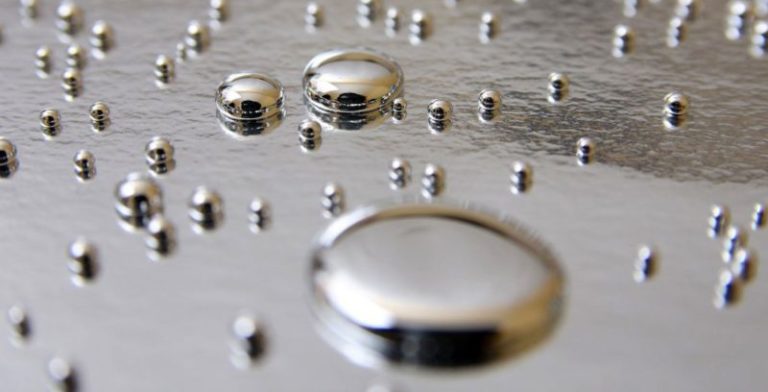
Fluorescent lamps contain mercury vapor, which is extremely harmful to humans and the environment. Therefore, simply throwing away fluorescent lamps is prohibited, since a large number of such elements in a landfill can cause negative consequences.
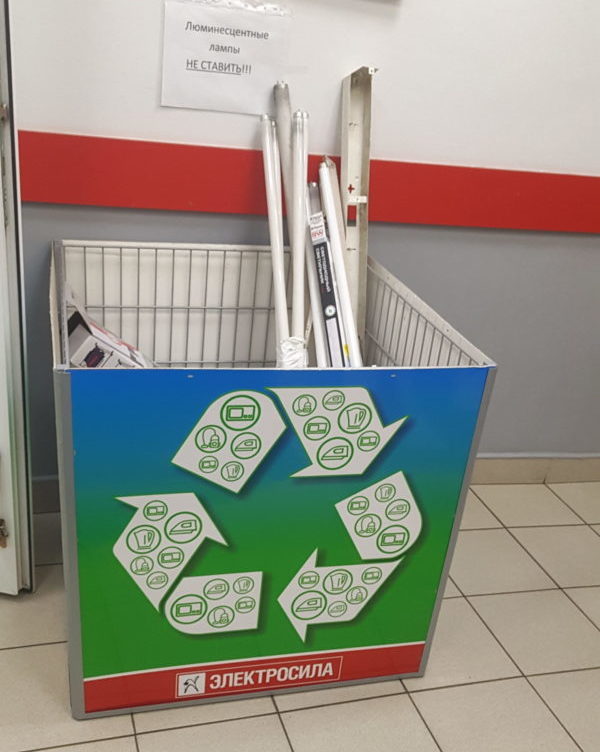
Disposal provided by special companies that, with the help of special equipment, recycle lamps, trap harmful fumes, and use raw materials to create new lighting fixtures.