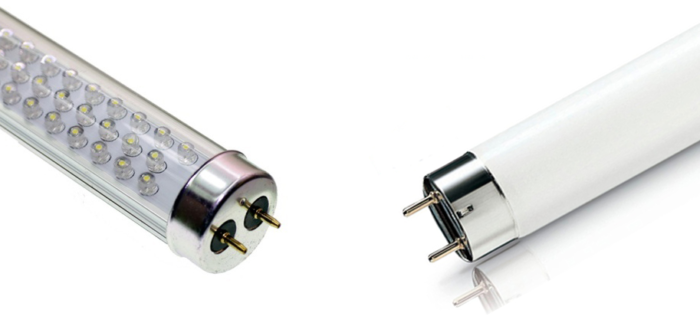
How to convert a daylight lamp to LED
The advent of LED lamps has replaced a significant number of other lighting devices. Even popular fluorescent lamps are gradually losing ground. LEDs have many advantages, encouraging users to replace them as soon as possible.
Is it possible to replace the fluorescent lamp with LED
A fluorescent lamp can indeed be replaced with an LED device of the same power. The user does not need any special skills or tools.
Using LEDs instead fluorescent lamps (LL) gives a serious benefit. Energy consumption is reduced, better stability is provided, and there is no harmful effect of fluorescent circuits.
How to choose the right LED lamps
Choosing an LED lamp, it is necessary to take into account the purpose, design and type of the base. It is better to pay attention to the products of well-known manufacturers Armstrong, Maxus, Philips, etc.
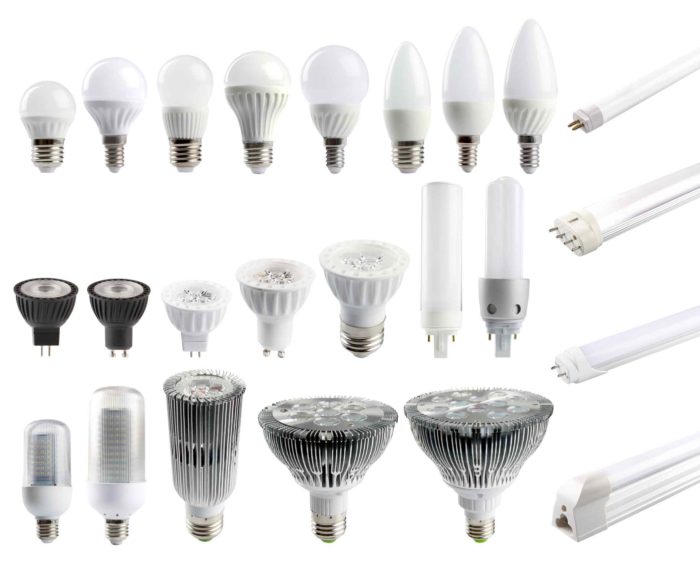
By appointment, the following types are distinguished:
- Household.Used in administrative or warehouse premises.
- Designer. Represented by functional ribbons and used to create spectacular lighting.
- Street. Illuminate roads, pedestrian areas and adjacent areas.
- Projector.
- Decorative. Compact models for installation in small fixtures.
Construction types:
- Traditional. Devices with conventional plinths.
- Directed. Are established in searchlights and street lamps.
- Linear. Replace the usual cylindrical luminescent elements.
- With lenses. Mounted in incandescent devices.
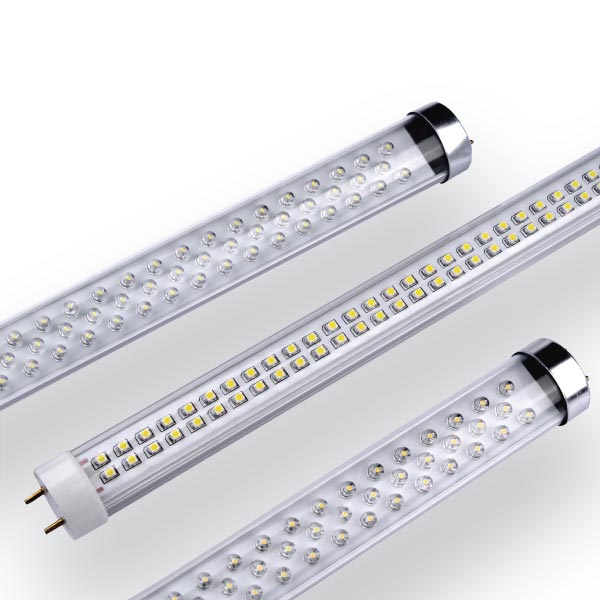
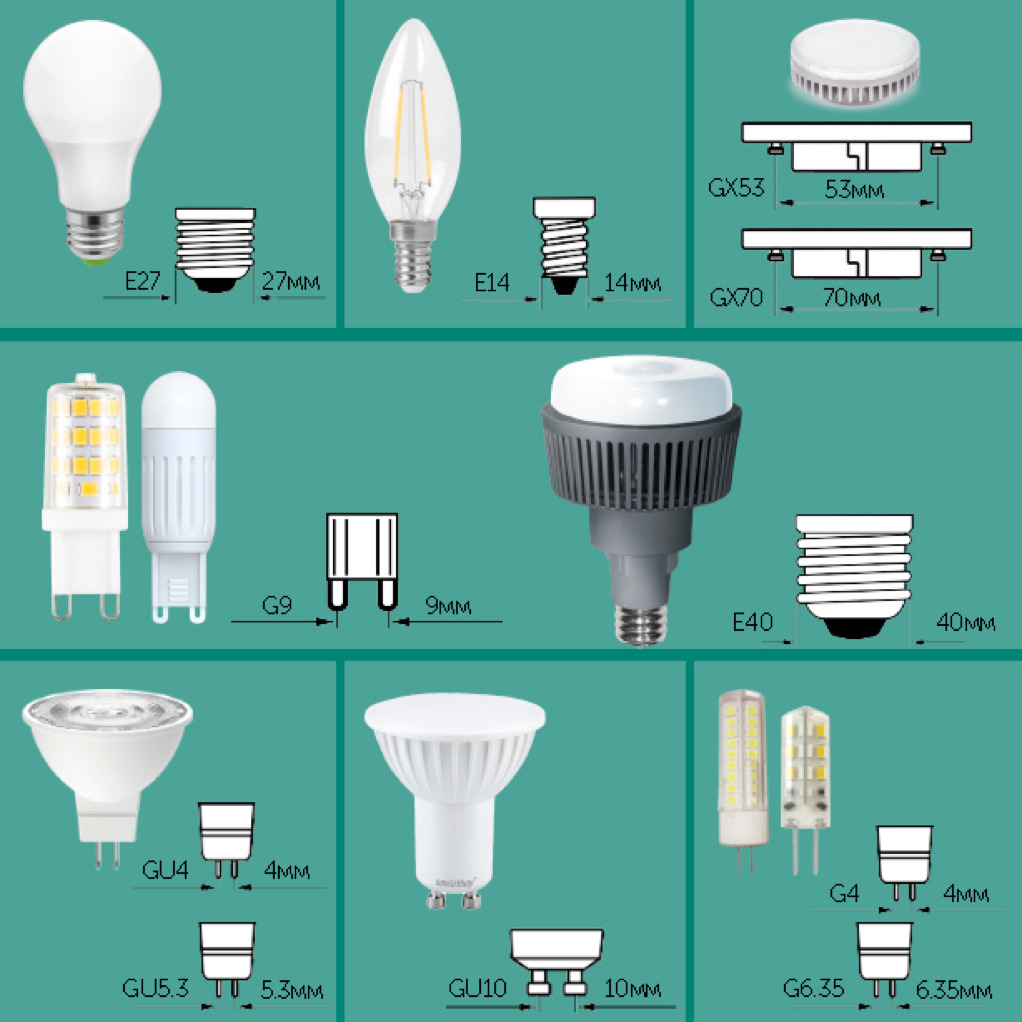
Bases on devices can be any. This parameter practically does not differ from that in other lighting fixtures. Connection to the chuck is possible with standard threads or pins (eg G13).
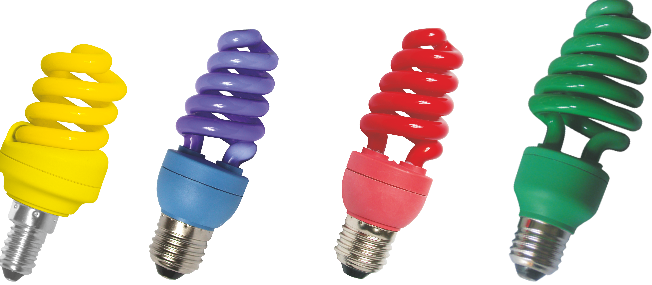
Instructions for replacing fluorescent tubes
Replacing fluorescent fixtures with LEDs consists of the following steps:
- The power supply to the device is turned off. Verify the effectiveness of the action using an indicator screwdriver.
- The cover is removed from the lamp.
- The capacitor, starter and throttle. Sometimes ballasts (electronic ballast) can be combined.
- Separate the wires connected to the cartridge, connect them to the zero and phase cables.
- The remaining wiring is removed or isolated.
- A tube is connected to the corresponding wires.
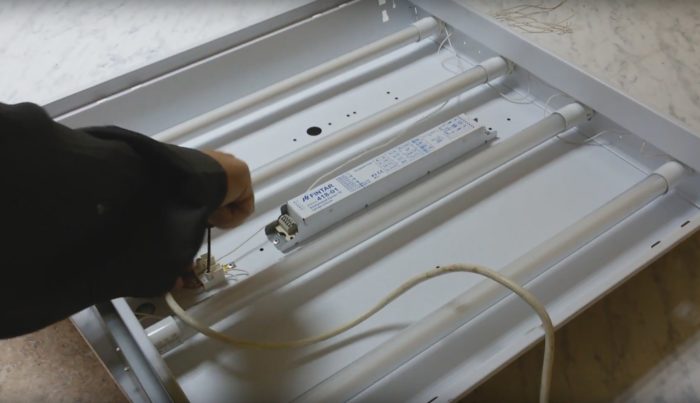
A feature of daylight fluorescent lamps is the uniform distribution of light in all directions. LEDs, on the other hand, are distinguished by a directional glow and require some adjustment.It is best to use swivel plinths that allow you to direct the light in the right direction.
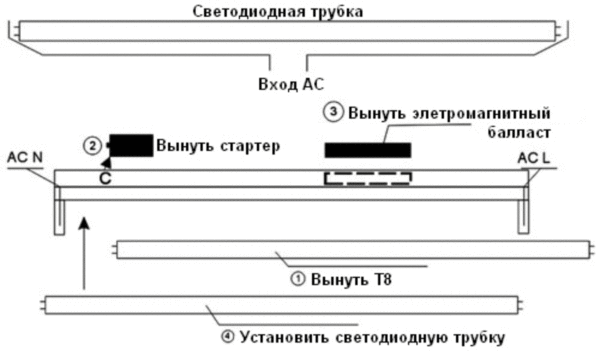
Wiring diagram for LED lamp
Devices consist of several main components:
- printed circuit board with diodes;
- power unit;
- plinth;
- ceiling;
- frame.
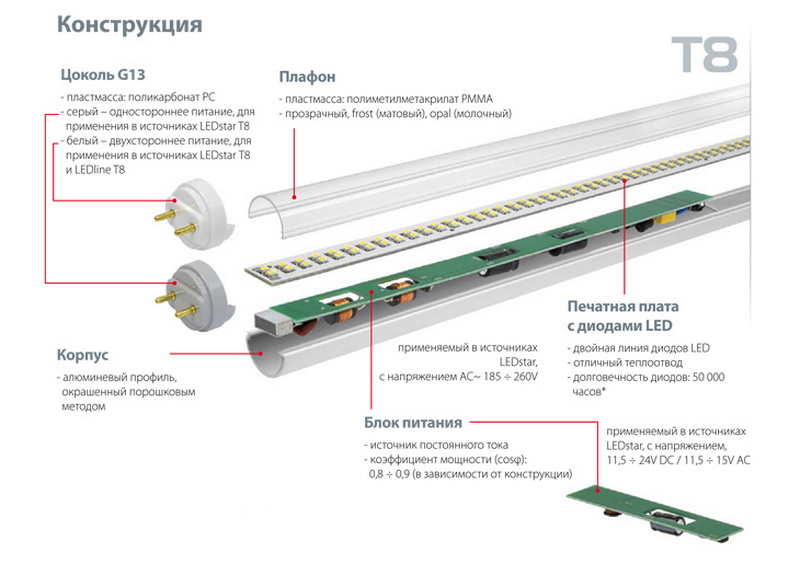
The presence of a built-in power supply provides the ability to connect the device directly to a network with a voltage of 220 volts without additional equipment.
That's why connection diagram has the simplest form shown in the figure below.
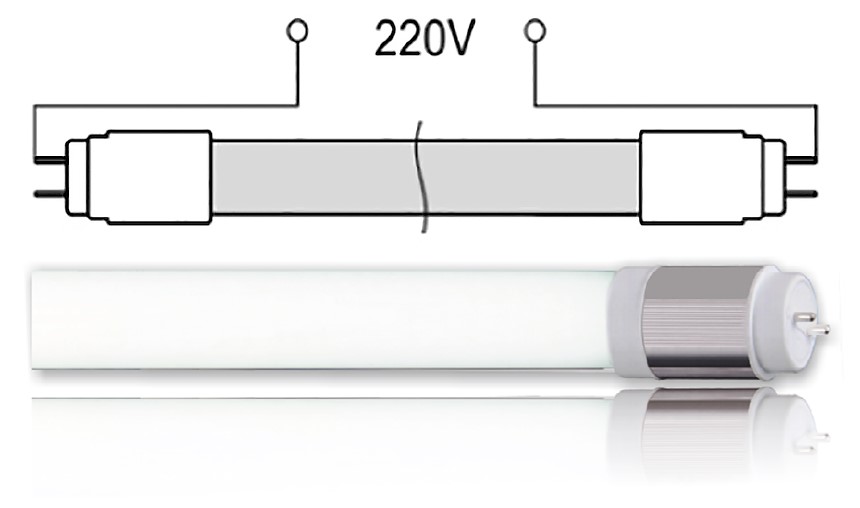
Instead of a conventional lamp, you can use an LED strip. Installation in this case occurs in the same way. However, the tapes do not contain a built-in power supply, so it must be connected to the circuit separately.
Recommended for viewing
Pros and cons of replacement
The conversion of the lamp to an LED lamp instead of a fluorescent lamp has features that are best taken into account at the preparation stage.
The benefits include:
- The conversion process takes a minimum of time.
- LED lamps do not require maintenance. It is enough to clean the ceiling of dust from time to time and occasionally replace the tubes.
- Compared to fluorescent lamps, LEDs consume 60% less electricity. Impressive savings that will quickly pay for the cost of the device.
- LEDs are characterized by an increased resource, which can reach 40,000 hours.
- When using LED tubes, there is no unpleasant flickering or pulsation that has a negative effect on the organs of vision. This is especially important when organizing lighting in schools.
- There are no harmful substances inside the LED lamp and it does not require disposal after a breakdown. The device is absolutely safe for humans and the environment.
- Even with significant voltage drops in the network (up to 110 V), the lamp will continue to function as at 220 V.
- A wide range of color temperatures is available, making it easy to create the right lighting.

At the same time, it is worth considering the disadvantages of LEDs:
- Compared to other lamps, the most expensive.
- Over time, the luminous flux characteristics of LEDs decrease due to the degradation of the crystals.
- LED lamps work narrowly, which is not always convenient. Instead of one fluorescent one, several LED fixtures may be required.
- The color temperature is not always at the right level. Often the light is not enough for comfort.
- During operation, the LEDs get quite hot. The design of the lamp must have a heat sink, which not only complicates the design, but also affects the price.
Recommended reading: Which is better - LED or energy-saving lamp
Almost all of these disadvantages can be smoothed out using a high-quality scheme. It is still recommended to convert the luminaire to LED lamps, since there will be more benefits from such a solution.