Warehouse lighting standards
Lighting in a class A warehouse differs from light in objects of other classes, so you need to select indicators depending on the category. It is important to understand all the nuances even before designing lighting and choosing fixtures, this will eliminate any mistakes and help you do everything right.
Warehouse lighting rules
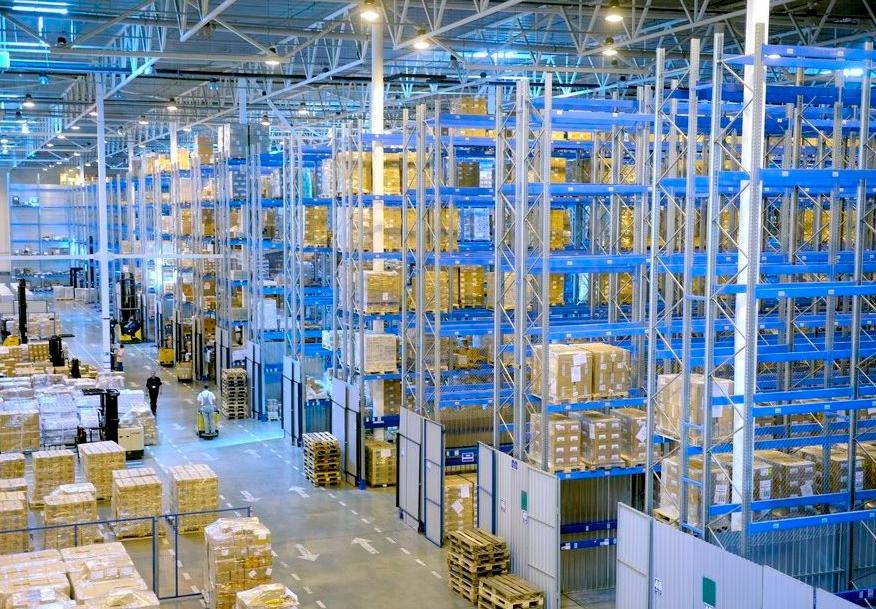
Regardless of the type of warehouse, lighting must meet a number of criteria. Therefore, it is equipped taking into account several factors:
- Use indoors whenever possible daylight. It can be implemented through windows in the walls or roof, or with the help of special roof structures, which are called lanterns.
- Artificial lighting is most often the main option, the presence of which is mandatory in all warehouses.In this case, the implementation may be different, it all depends on the type of equipment used.
By the way! Luminaires can be powered from a network with a voltage of not more than 220 V.
Illumination standards for warehouse premises - a table with basic data.
| Warehouse category | Illumination rate, lux per square meter |
| BUT | 300 |
| A+ | 350 |
| AT | 100 |
| B+ | 200 |
| FROM | 75 |
| D | 50 |
Classification of warehouses and lighting requirements
Depending on the class, according to the table above, the illumination of the warehouse is selected - the norms are average, but it is important to understand which premises belong to one or another category:
- "BUT" - warehouse and logistics complexes or temporary storage terminals with ceilings from 10 to 13 meters high. Lighting requirements are high - 300 Lx per square due to the fact that there are usually a lot of products, and employees work intensively.
- "A+" – option with increased lighting requirements. It is used wherever an improved light of 350 lx is required to ensure normal working conditions.
- "AT" - this includes all warehouses with a ceiling height of 6 to 10 meters. Most often, these are options for industrial and agricultural enterprises and in manufacturing companies of medium and small sizes, the illumination should not fall below 100 Lx.
- "B+" - by analogy with the points described above, this includes rooms with higher requirements regarding lighting standards, which are twice as high and amount to 200 Lx.
- "FROM" – warehouse modules with a ceiling height of 4 to 6 meters. In fact, this is one of the most common options in enterprises, trade organizations, etc. You can not fall below the norm of 75 Lux.
- "D" - rooms with ceilings from 2 to 4 meters, which are used to store goods of any type.Here, the minimum illumination is set at 50 Lux.
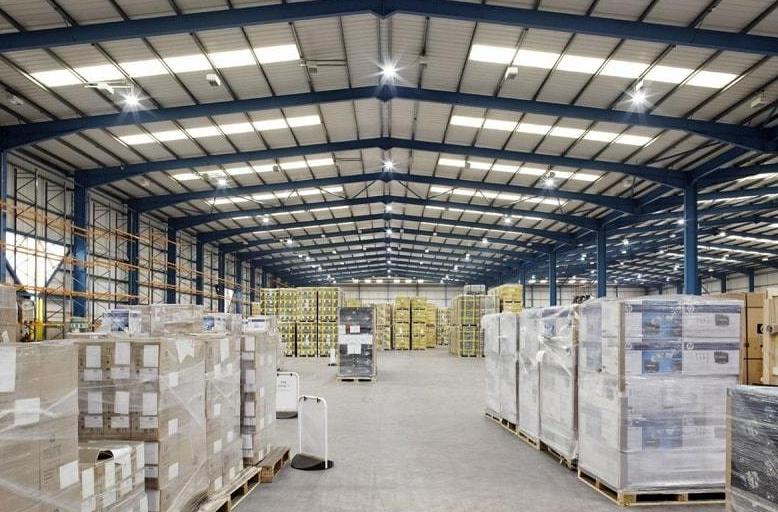
Selection of luminaires for closed warehouses
Closed warehouses store all goods that need to be protected from atmospheric influences and precipitation. To organize high-quality lighting, you must follow a few recommendations:
- Use the same type of fixtures to illuminate racks, shelves and aisles. The light must be uniform.
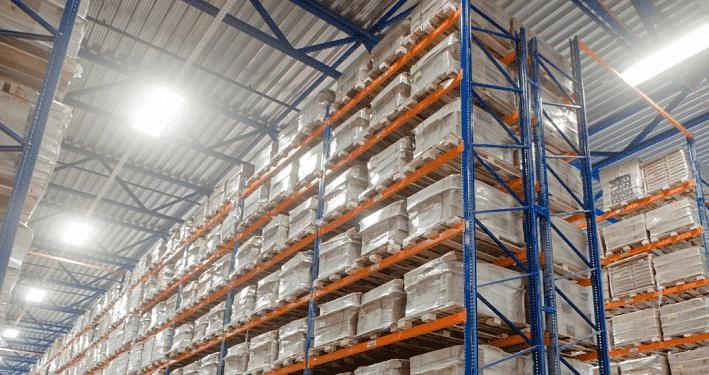
![high racks]() When using high shelving, it is important to pay attention to the lighting between them.
When using high shelving, it is important to pay attention to the lighting between them. - If the ceiling height is low, it is allowed to hang low-power equipment on cables or other suspended structures.
- For rooms of great height, the so-called "bells" are used - special shades that distribute light over a large area. Select the power according to the height of the location and the characteristics of the lamps.
- The number and location of fixtures should be selected according to the size of the warehouse and the nature of the work performed.
In places where the light needs to be turned on only from time to time, it makes sense to use systems with motion sensors.
The choice of lighting fixtures for an open warehouse
Open warehouses are used for products and bulk materials that are not afraid of weathering. This option can be both in the form of a platform, and with shelving or canopies. The features are:
- Most often, lamps are installed on special masts. Their location is selected so that no shadow is formed on the working platform during loading or unloading.
- Can be used as a place to install the edges of canopies on nearby buildings and sheds.
![lamps can be mounted on visors]() In the presence of canopies in an open warehouse, lamps can be mounted on them.
In the presence of canopies in an open warehouse, lamps can be mounted on them. - If racks or stacks are used in the warehouse, then the lighting should be taken out 5-6 meters higher.To prevent a shadow from falling from the structures, the lamps are placed around the perimeter, as well as in each passage.
- During the operation of overhead or gantry cranes at loading and unloading sites, the minimum level of illumination should not be less than 50 Lx.
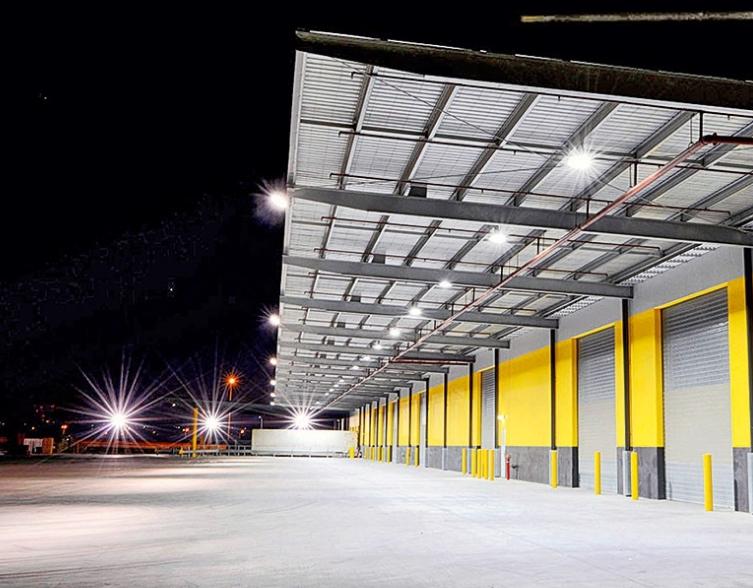
By the way! Since open structures are well illuminated by natural light, light sensors can be installed so that the lamps turn on when visibility deteriorates below a certain limit.
Naturally, when choosing equipment, you need to choose only lights designed for installation on the street.
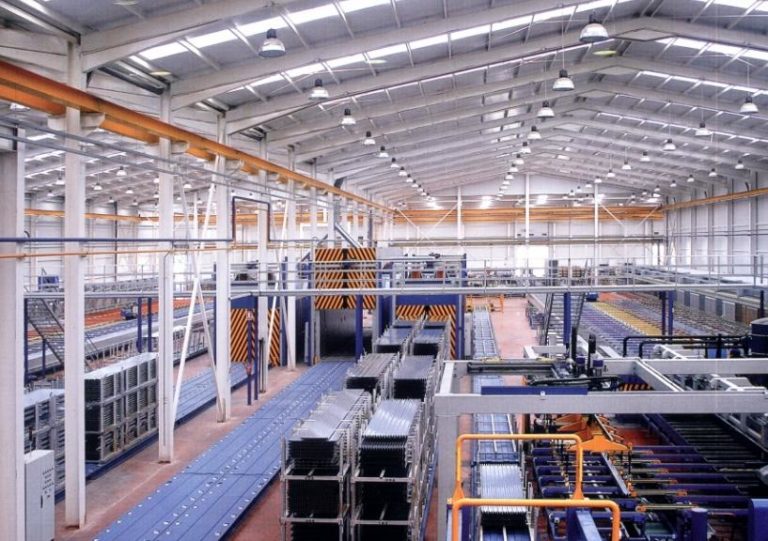
Features of installation of lighting systems in warehouses
All standards are collected in the PUE and SNiP, in accordance with them, when carrying out work on lighting equipment for warehouses, several requirements must be observed:
- Before the start of installation, a project is drawn up and agreed upon. It indicates the location of all fixtures and their power, as well as switches, connection points, power cable entry and other important information.
- The system must be provided with protection against short circuits. It is selected for a specific warehouse in accordance with safety standards and features of fixtures.
- Only options that are resistant to damage and capable of withstanding loads at least 50% higher than planned should be used. Pay special attention to junction boxes and connections.
![Pay attention to safety during installation.]() During installation, attention should be paid to the safety of the system.
During installation, attention should be paid to the safety of the system. - Lay the lighting line separately from other conductive lines. An emergency shutdown system is provided to comply with safety standards.
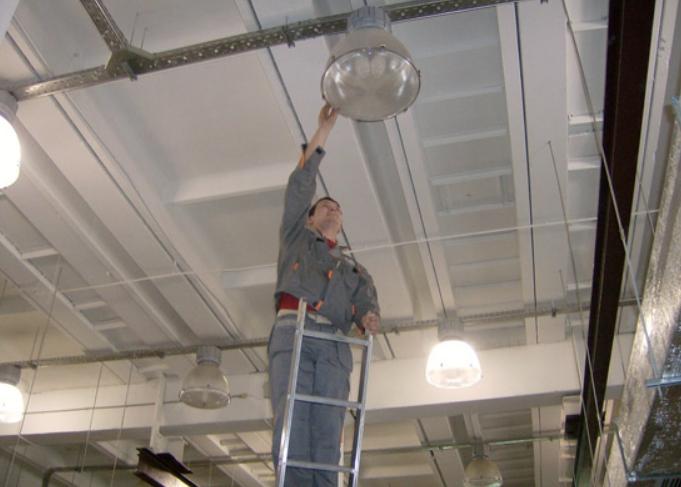
When installing in open warehouses, it is necessary to install the lanterns so that they do not interfere with the operation of cranes and do not pose a danger to freight transport.
How to organize warehouse emergency lighting
The regulations contain requirements for emergency lighting. Its main purpose is to ensure the safety of personnel. Depending on the type, it is classified into two main varieties:
- emergency lighting necessary for the safe evacuation of all employees located in the warehouse, in the event of a power outage to the main lights. This is necessarily a separate line, operating either from an independent power source or from a backup system. Illumination standards - not less than 0.5 Lx inside and not less than 0.2 Lx outside.
![and clearly orients in the direction]() Modern emergency lighting provides good visibility and clearly orients in the direction of evacuation.
Modern emergency lighting provides good visibility and clearly orients in the direction of evacuation. - The security lighting usually starts after the main system is turned off and should be around 5% of the standard brightness. The minimum standards are 2 Lx inside warehouses and 1 Lx outside. It is necessary in order to be able to complete work and safely leave the premises during power outages.
![emergency lamp]() Emergency lamp with rechargeable battery.
Emergency lamp with rechargeable battery.
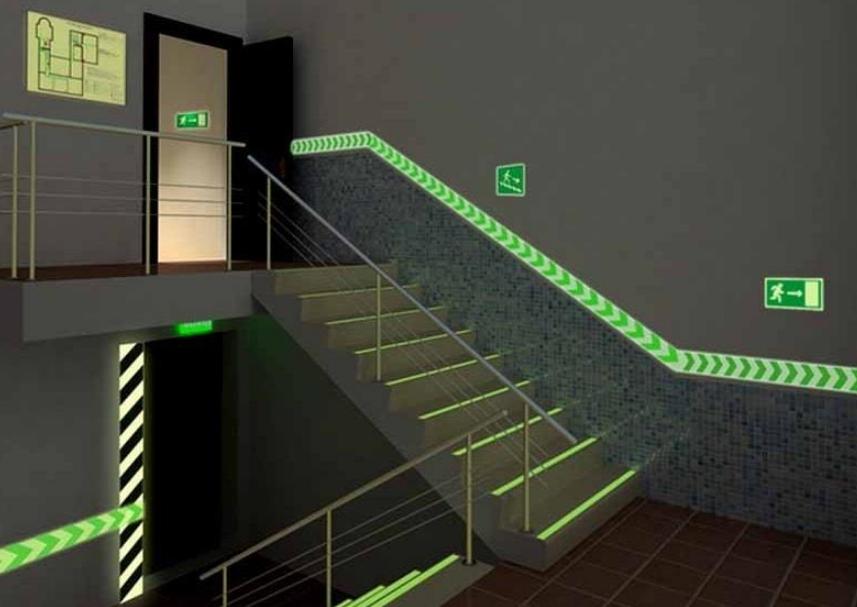
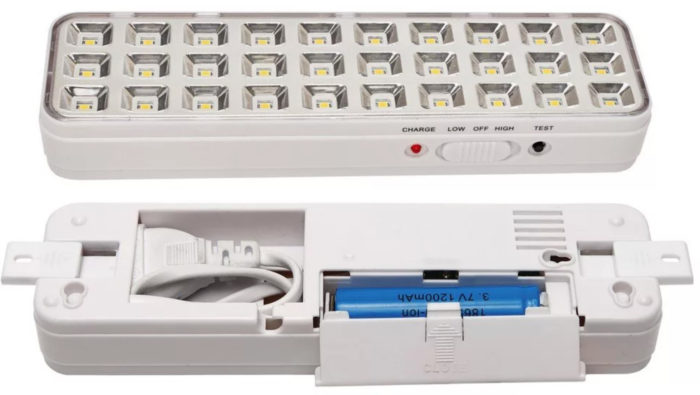
For emergency lighting, luminaires with built-in batteries are often used, they must ensure the operation of the equipment for at least an hour after shutdown.
Are emergency lighting allowed in warehouses?
Emergency lighting in the warehouse a few years ago was prohibited by the regulatory act PPB 01-03 for security reasons.In the absence of people, it is impossible to guarantee the normal operation of the lamps when using a voltage of 220 V, there is always the possibility of an emergency situation.
But with the advent of low-voltage LED lamps, it became possible to use standby lighting, if necessary. At the same time, it can serve both as security lighting and as an emergency light during power outages.

Do not forget about such an option as security lighting, which can be located along the perimeter of the territory or around the building to ensure good visibility and prevent intruders from entering.
At the end of the video: An example of electrical work in a tire warehouse.
Arranging lighting in a warehouse is not difficult if you comply with the requirements of regulations when choosing artificial light sources. At the same time, it is important to select equipment in accordance with the category of the room and the features of the work being carried out.