Lighting in medical institutions
Lighting in hospitals and other medical facilities must meet a number of requirements and is regulated by law. When drawing up a project and installing light sources, it is necessary not only to provide a certain illumination, but also to choose the optimal color temperature, as well as to correctly position the lamps. All requirements are set out in SNiP and SanPiN.
General requirements and norms for lighting medical institutions
There are a number of aspects, compliance with which is mandatory, therefore, first of all, they are taken into account:
- Artificial light should be combined with natural. The more natural light, the better, so the windows in medical institutions are usually made large.
- There should be a separate lamp on the desktop in the offices of doctors, nurses and other staff. Additional lighting is also required for the patient examination area, as well as other areas where good visibility is required.
![Lighting in medical institutions]() In medical facilities, the quality of lighting should be ideal.
In medical facilities, the quality of lighting should be ideal. - All hospitals and other health care facilities where staff work at night should have emergency lighting. And in the aisles, on the landings and near the exits from the floors, illuminated signs must be hung in case of an emergency evacuation.
- All chambers, study rooms and other premises, the list of which is in the documentation, must be equipped with ultraviolet lamps. They are used for sanitizing the air and are switched on according to the schedule that should be in the room.
![Lighting in medical institutions]() Ultraviolet light kills most pathogenic bacteria.
Ultraviolet light kills most pathogenic bacteria. - Before proceeding with the wiring and installation of lighting equipment, the project must be agreed and approved by the supervisory authority.
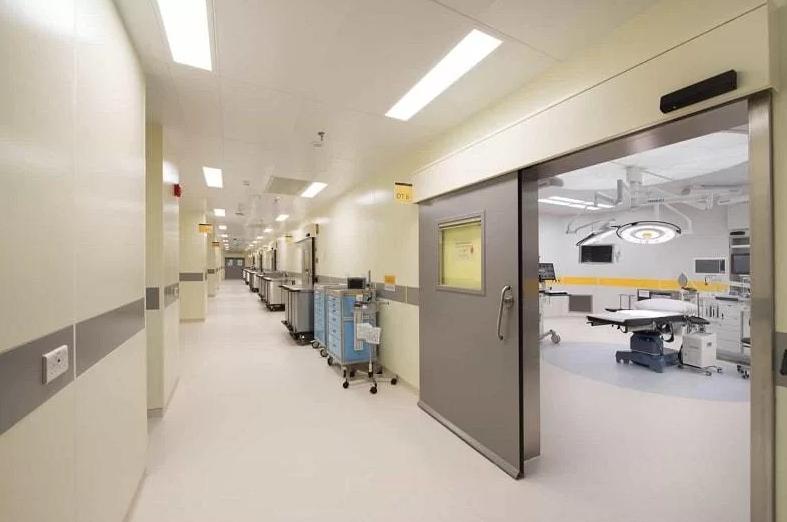
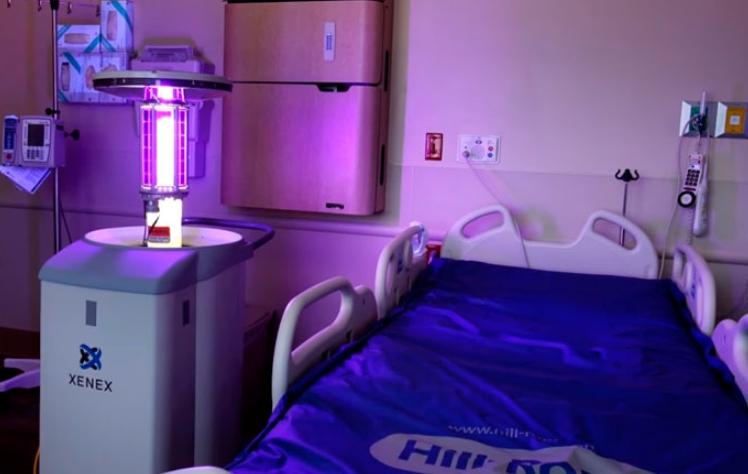
It is important to ensure safety when laying communications. This applies primarily to switches for quartzization, they are arranged so as to prevent accidental activation.
Lighting of medical premises must comply with the standards. All indicators listed below are the minimum benchmark, below which you cannot fall. BUT make the light brighter is not prohibitedif it improves visibility. It is important to consider the following rules:
- Doctor's office. The overall illumination should not be lower 150 lx per square meter. It is obligatory to install additional lamps on the desktop and in the patient examination area.
- Chambers. To ensure comfortable conditions, the illumination should be from 150 to 250 lux. And bedside areas are equipped with an additional light source with brightness from 250 to 500 lx.
- corridors in medical institutions and landings. They should maintain illumination in the range from 150 to 250 lux. The same indicator should be met in waiting areas and corridors of polyclinics.
- bathrooms, showers and other similar rooms are illuminated according to the norm in 100-200 Lx.
- Libraries if available, it is necessary to equip with lighting that provides indicators from 250 to 500 lux.
- Premises used for emergency care. Optimal range - from 500 to 1000 lx.
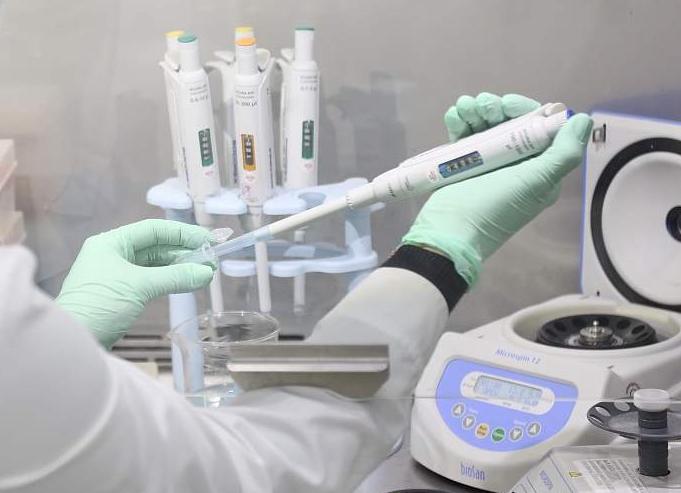
- Laboratories. In this case, there are also two norms, the total indicator should be from 250 to 500 lx. And the workplace is necessarily illuminated separately, here the value is higher - from 500 to 1000 lux.
![Lighting in medical institutions]() The workplace in the laboratory is always illuminated additionally.
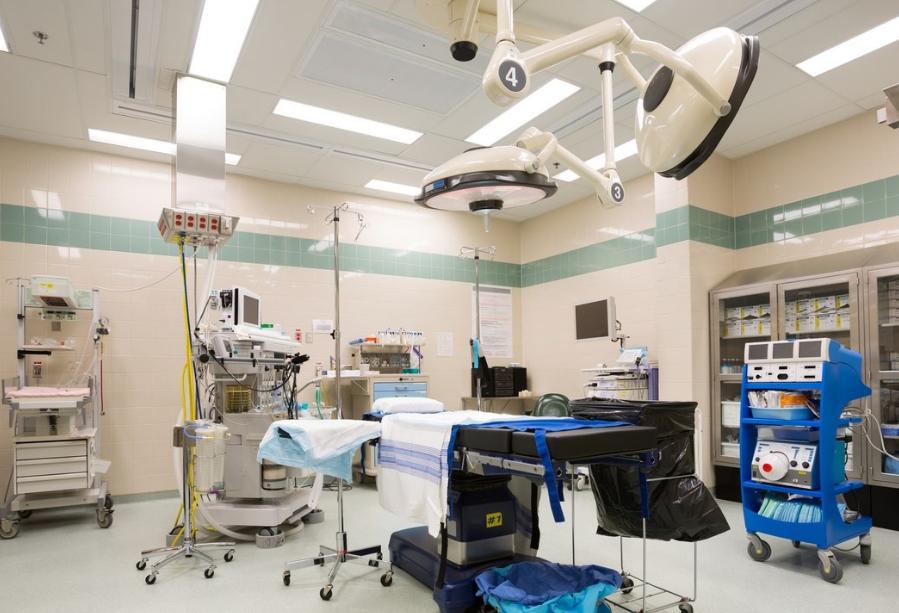
The workplace in the laboratory is always illuminated additionally. - Operating require special attention, the general norm is 500-1000 Lx. But the place of surgical operations requires the installation of special equipment, since here the illumination should be from 20,000 to 40,000 lux.
The equipment is selected individually based on the area of the room, its shape and other features. There are no restrictions, the main thing is to comply with the norms established by law.
It is best to use several lighting modes, since during the day there is no need to turn them on at full power.
Recommendations for choosing lighting equipment and color temperature
Currently, two types of equipment are used for lighting medical institutions - fluorescent and LED. Each has its own characteristics that are worth parsing. Concerning fluorescent lamps, they have the following differences:
- Most often, tubular elements are used, which are installed in special fixtures. There can be several lamps in one light source, it all depends on the required power.
- Due to the phosphor, which is coated on the inside of the flasks, they give a soft diffused light that does not create discomfort for the eyes. But due to the content of mercury vapor inside, a health hazard is created when damage lamps. There are also strict requirements for their recyclingwhich are mandatory to comply with.
- The power consumption is small, while luminescent equipment does not tolerate frequent switching on and off. It fails at the moment of launch, so it is desirable that the light is constantly on.
- Over time, the characteristics of the phosphor deteriorate and the light changes its performance. That's why change lamps are needed at regular intervals, even if they seem to work normally at first glance.
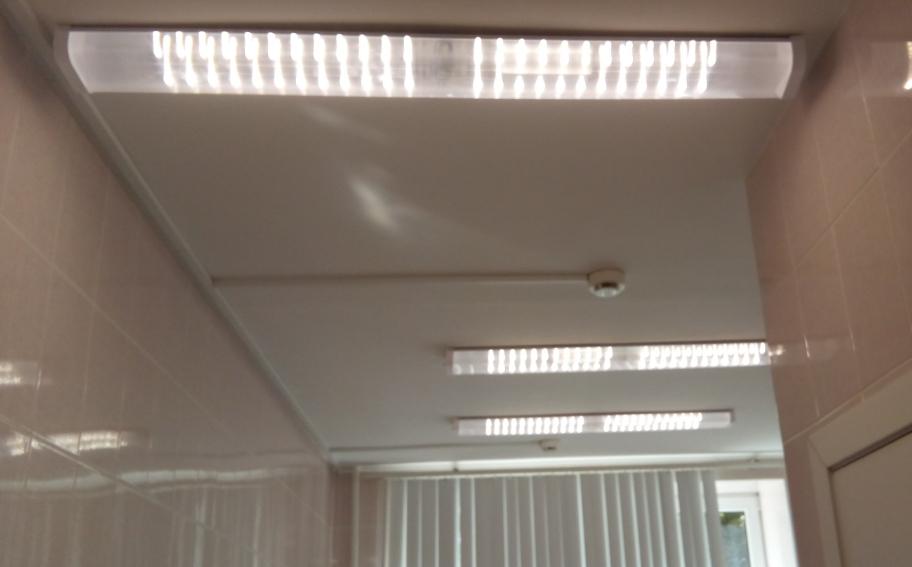
By the way! This solution is most often found in older buildings that have not yet been reconstructed. It is morally obsolete and is not installed at new facilities.
Concerning LED lamps, they comply with regulatory documents and are used in modern medical institutions as the main option. The features are:
- The light quality is close to daylight. This creates optimal working conditions and reduces eye strain.
- LED equipment consumes a minimum of electricity, which reduces lighting costs. The difference is visible immediately after switching to this type of lamp.
- The service life of high-quality diode equipment is from 40 to 60 thousand hours. The resource is much longer than that of fluorescent light bulbs.
- Over time, light characteristics diodes are almost unchanged. Therefore, they can be used much longer, and changed only if the lamp fails.
- Products are safe, do not contain harmful substances and do not get very hot during operation. There are different options for fixtures - both tubular and standard lamps or light panels, it all depends on the characteristics of the room.
Features of the placement of fixtures
When choosing an installation site, several requirements must be observed. Regardless of the room, remember that the light should be distributed evenly to provide a comfortable environment. The main features of the location of light sources in medical institutions are as follows:
- In treatment rooms and other rooms where the patient lies on the couch, need to install shadowless ceilings. Therefore, recessed or panel light sources are most often used.
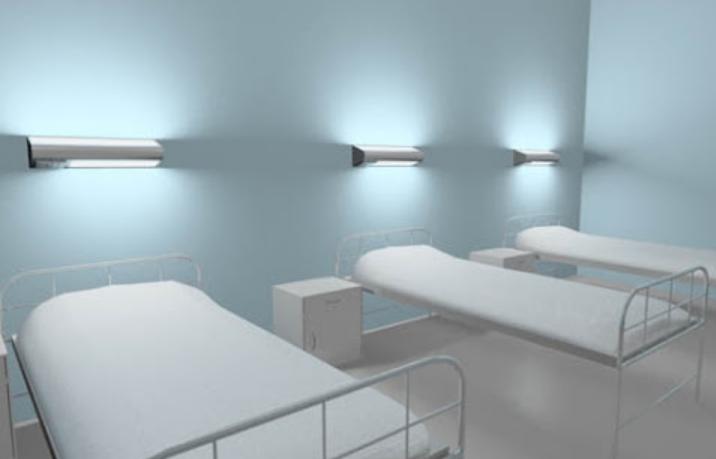
- Additional lighting at the head of the beds in the wards, as well as in the places of examination, is most often placed on the wall, minimum height 170 cm. It is important that the light source is sufficient to highlight the desired area.
![Lighting in medical institutions]() Bedside lamps are located no lower than 170 cm from the floor.
Bedside lamps are located no lower than 170 cm from the floor. - In the wards, a night light lamp must be placed above the door, which works when the main lighting is turned off.
- The location and power of the ultraviolet lamp is determined individually. It can be both stationary and mobile.
- Emergency lighting must be powered by a separate source, most often a battery that ensures the operation of the equipment for at least an hour. In this case, the light bulb power should be at least 5% of the norm.
We recommend watching the webinar: Effective lighting solutions for lighting medical facilities.
The requirements are mandatory, since not only the work of the doctor, but also the comfort of the patients' stay directly depends on them. It is best to install economical and durable LED equipment.