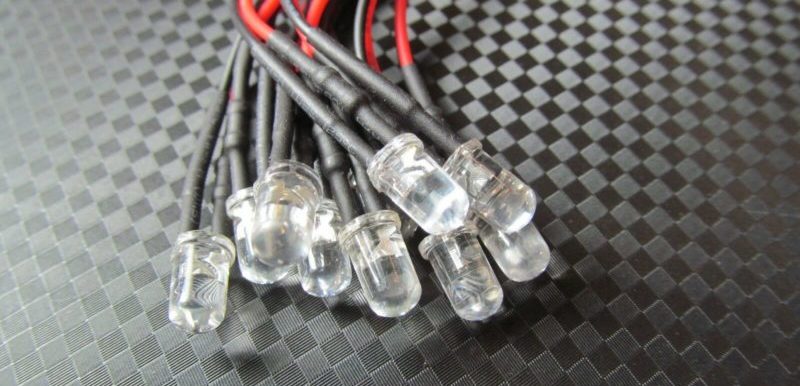
Connecting an LED to 12 volts
The LED is a reliable element that will work effectively only if it is installed correctly. Turning on the 12 volt LED should be done with particular care. So, a current-limiting resistor must be present, we must not forget about the polarity, as well as the use of the same diodes in one chain.
What it is
LEDs have long been popular lighting fixtures. This is due to their excellent energy efficiency and long service life (compared to conventional light bulbs). In addition, prices continue to fall as the production of these items increases.
Main advantages:
- durability - up to 10 years of continuous glow;
- strength - not afraid of shock and vibration;
- variety - many sizes and colors of glow;
- low power consumption - about 10 times more economical than a conventional light bulb with similar characteristics;
- fire safety - due to low power consumption, they do not overheat, therefore they are not capable of causing a fire.
LED (light emitting diode) is an abbreviation for light emitting diode. It is known from the school physics course that it is polar. Therefore, the LED will not work if the polarity is not observed, and there is also a possibility of its burning (breakdown will occur). The reverse breakdown voltage of the semiconductor structure is 4-5 volts. At the same time, it can still work with the correct connection, however, destructive processes will begin in it, which will significantly reduce the service life.

Simply put, a light emitting diode (LED) is a semiconductor device that glows when an electric current is passed through it. Because light is generated in a solid semiconductor material, LEDs are described as solid state devices. The term "solid-state lighting" distinguishes this technology from other sources that use heated filaments (incandescent and tungsten-halogen) as well as gas discharge (fluorescent lamps).
How to choose an LED to connect to 12 volts
The required type of diodes is selected based on specific tasks. There are many options on the market, from indicator to heavy duty. To illuminate the buttons and indicators on the instrument panel in a car, you can use low-power diodes. To illuminate the interior of an apartment or car, simple super-bright ones are used.For installation in head optics, daytime head lights of cars or flashlights, powerful LEDs are installed.
From a technical point of view, there are no restrictions on power and current consumption. The main thing is that the voltage of the diode does not exceed the voltage of the power supply.
An important factor is the size and shape of the case. Depending on the purpose, round-packed diodes or surface-mounted parts (SMD) can be used. It all depends on the needs and tasks.
What diodes can be connected to 12 volts
There is practically no voltage limit for LEDs. Therefore, almost any of them can be connected to 12 volts. The main thing is to follow the rules. LED light bulbs typically require 1.5 to 3.5 volts depending on color and brightness. If you see a 12 volt light emitting diode on the store counter, then in fact you are offered an assembly of several crystals connected in series.
Connection options
It's time to get acquainted with the basic connection options.
to one resistor
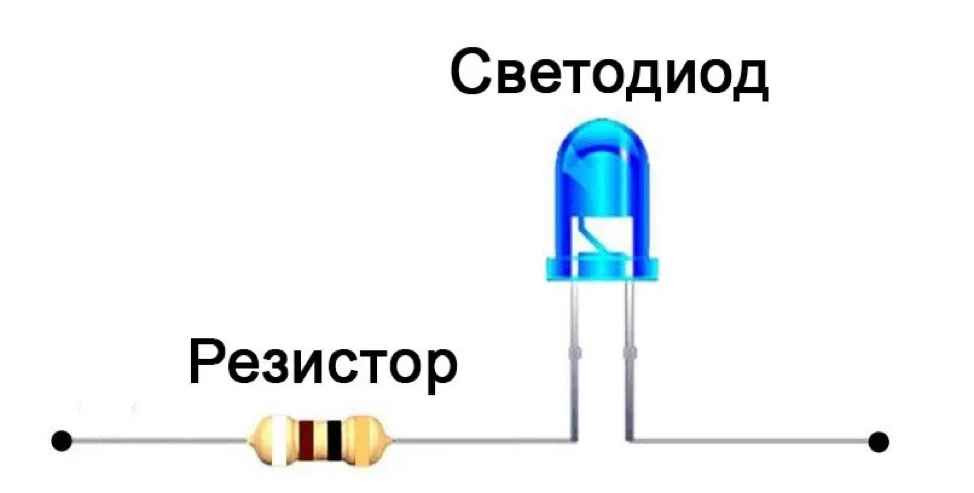
As we have already found out above, the LED has polarity. Therefore, it is connected to a DC power supply. The most common types consume about 10-20 mA. In fact, this is the main characteristic of the part. The second parameter indicates the voltage drop. For ordinary LEDs, it is in the range of 2-4 V.
The only correct connection scheme is with a current limiting resistor. It is selected according to Ohm's law. The resistance is calculated as the difference between the source voltage and the voltage drop divided by the product of the maximum diode current and the safety factor (typically 0.75).
Ohm's law: "The amount of current in a section of a circuit is directly proportional to the voltage applied to this section and inversely proportional to its resistance."
It is also necessary to calculate the power of the resistor. It is calculated using a simple formula: the difference between the source voltage and the voltage drop squared, divided by the resistance in ohms.
Series connection of several LEDs
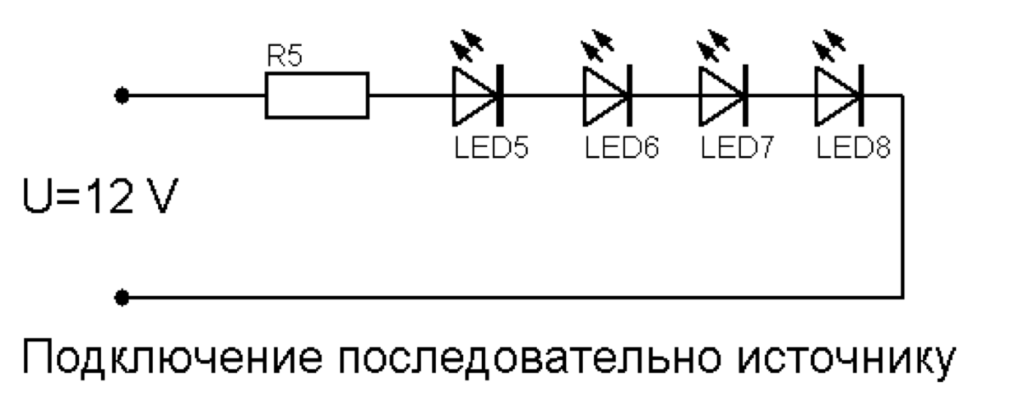
Serial connection is the installation of two or more LEDs in one row. This circuit also uses a single current-limiting resistor. The calculation formula is similar for a single diode, but the voltage drop is summed up.
For example, let's take our theoretical white LED at 3 volts and 20 mA. We connect three units in series. Thus, the sum of our voltage drop will be 9 volts. The remainder of three volts is divided by the current strength of 0.02 amperes with a reliability factor of 0.75. As a result, we find out that we need one 200 ohm resistor.
Each diode to a separate resistor
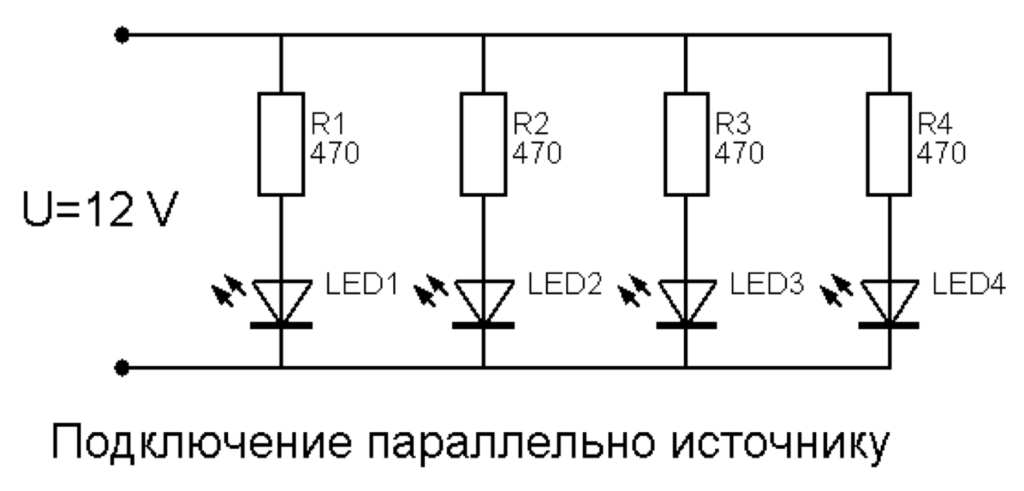
In this circuit, each LED is connected to the plus and minus of the power supply. Despite the fact that circuits with one common resistor can be found on the Web, in practice such a solution is impractical. Even in the same batch, diodes differ in terms of current consumption and voltage drop. As a result, we get a different intensity of the glow of the diodes. The resistance is calculated for each diode separately.
How to find out the polarity of an LED
Looking at an ordinary round light emitting diode, you can see that its two terminals have different lengths. Thus the cathode and anode are designated.The anode is longer and is connected to the positive output of the battery or power supply, and the cathode to the negative.
Also, the cathode on some types of cases can be marked with a small saw cut. There are exceptions, so it is always worth studying the instructions for a particular diode.
How to connect to 12 volts
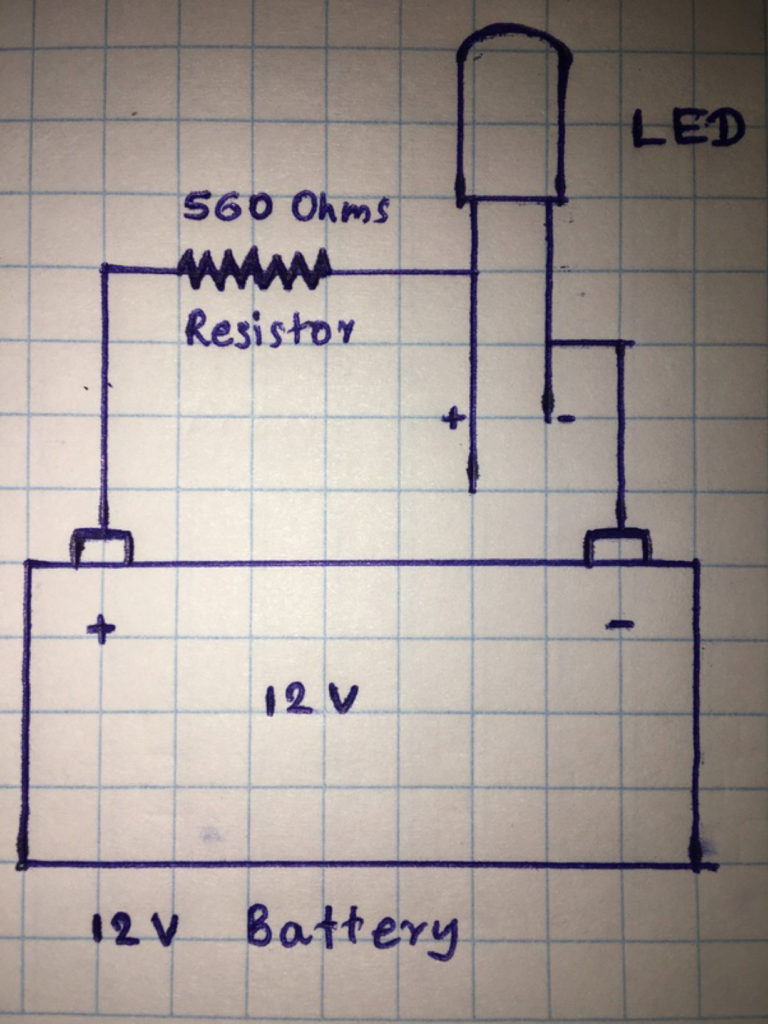
The scheme for connecting an LED to a 12 V power source does not differ from the standard one, but it is necessary calculate the resistance and power of the resistor. To check or pre-test the assembly, one 1 kΩ resistor is sufficient.
For example, let's take the most common type of LED - white with a maximum current of 20 mA. In fact, the voltage does not play a special role. The main thing is that the current does not exceed the maximum allowed parameters. The voltage drop, depending on the model, is from 1.8 to 3.6 V. For convenience of calculations, we take 3 volts.
Resistance for LEDs

We calculate the parameters:
- The difference between the power supply voltage and the voltage drop is 12-3=9.
- The product of the maximum current (amperes) and the reliability factor is 0.02*0.75=0.015.
- We calculate the resistance (kΩ) - 9 / 0.015 \u003d 600 (kΩ).

Resistor power calculation:
- The difference between the power supply voltage and the voltage drop is 12-3=9.
- According to the formula, we square - 9 * 9 \u003d 81.
- We divide by the resistance of the resistor in ohms - 81/600 \u003d 0.135 W.
Thus, the MRS25 resistor (0.6 W, 600 Ohm, ± 1%) is ideal for us. As of mid-2020, its cost is about 8 rubles. Usually there is no need to calculate the power of the resistor. However, it is important to do this to test a future build.
Connecting powerful LED diodes to 12V
When connecting modern powerful crystals or their assemblies, the principle does not change. A quenching resistor must also be present in the circuit. For example, you can take the LED, which is popular on Chinese trading floors. This is an assembly of several crystals connected in parallel. The current draw is 350 mA and the voltage is still 3.4 volts.
Substituting the parameters in our formulas, we can easily find out that we need to install a resistor with a resistance of 32 ohms and a power of 2.2 watts.
Efficient connection to one IP
Above, we have already found out that an unlimited number of LEDs can be powered by one power source. The main thing is to have enough power. However, simply connecting bulbs in parallel with a resistor for each of them is inefficient. We saw from the previous point that more than 2/3 of the power is dissipated in the current limiting resistor. Therefore, the question often arises of how many LEDs can be connected to 12 V.
The most efficient connection to 12 volts is a string of three LEDs in series with one resistor. All LED strips powered by a 12 V power supply are produced according to the same scheme.
Connection problems
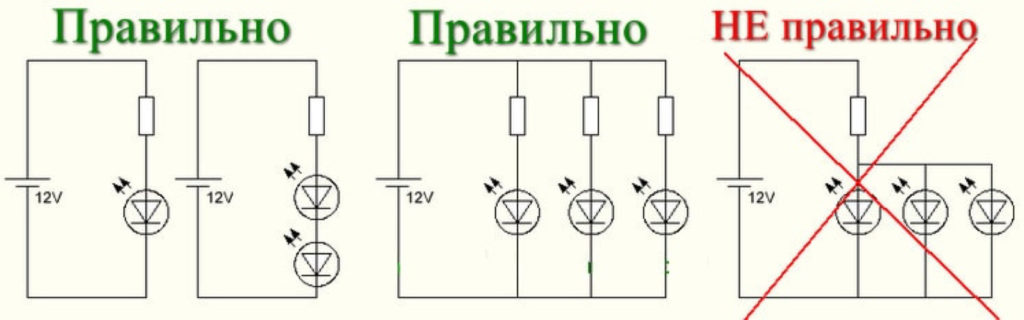
Schematic diagram of LED connection:
- Do not use a current limiting resistor. Since too much current will pass through the LED, it will soon fail.
- Serial connection without resistor. Even if you think that feeding four 3V resistors into a 12V network is a good idea, you are wrong. Due to the weak control of the current strength, the elements are quickly destroyed.
- Using one resistor when connecting diodes in parallel. Due to differences in characteristics, the diodes will shine with different intensities. Increases the rate of destruction.
We advise you to watch a video on the topic: Proper connection of LEDs.
Conclusion
The reliability of LEDs is much higher than incandescent lamps and gas-discharge models, but only when connected correctly. Therefore, we must not forget about the need for a current-limiting resistor, which is selected in a simple form. Polarity is also mandatory, especially when mounting the diode to a 12-volt network.