Stretch ceiling lighting with LED strip
LED strip under a stretch ceiling is a solution that looks unusual and is suitable for any room. To make such a backlight, you do not need to be an electrician, anyone can do the job. But there are many features that are worth considering in order to secure the elements correctly.
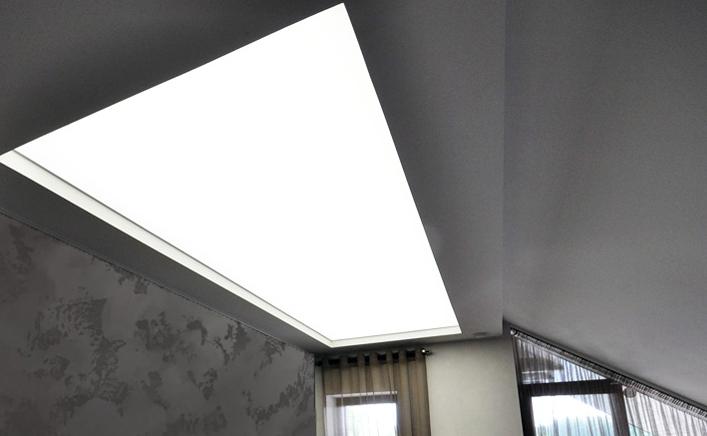
Why is it needed
You can put the tape both above and below the canvas, or use other schemes to achieve the desired effect. Typically, LED strip or single elements are used for such purposes:
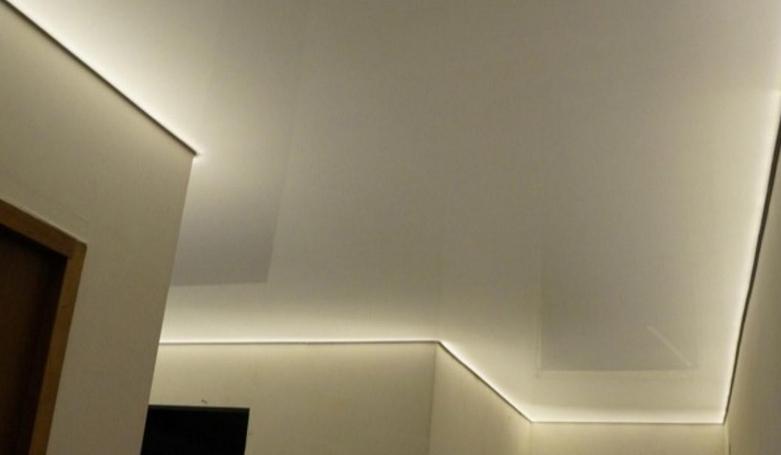
- Decorative lighting around the perimeter of the room or in niches that are pre-built from drywall.Options can be used with the location of the tape in multi-level structures, on ledges or around the circumference of a protruding element, which creates a floating effect.
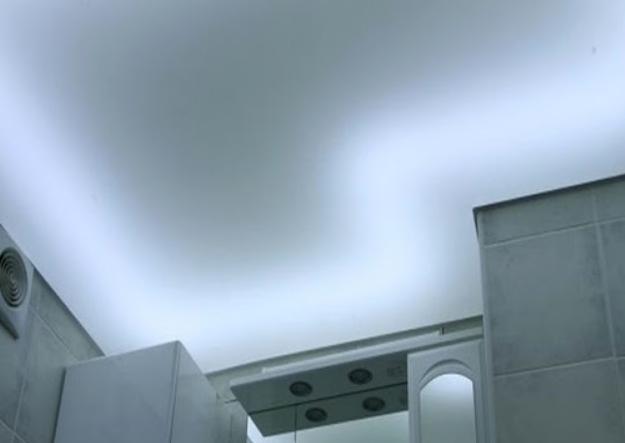
- Basic lighting. Most often, in this case, monochromatic options with high power are used to ensure optimal luminous flux. The tape is most often located around the perimeter or above the canvas.
- Creation of artistic effects - the starry sky, various shapes or abstract lines.
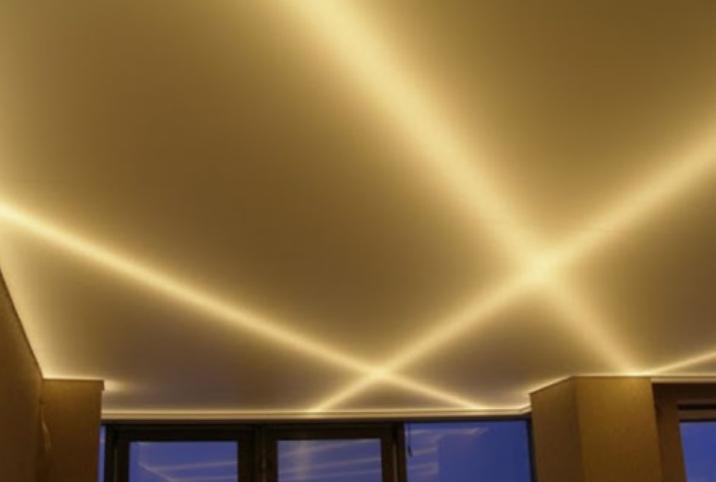
The fabric of the stretch ceiling scatters the light of the diodes, which provides an additional decorative effect.
Advantages and disadvantages of a constructive solution
Using an LED strip has many advantages when it comes to the overhead option. If the ceiling is already stretched, then you can place the backlight a little lower, this is also a good solution that has the same advantages. The main advantages are:
- The service life is 50,000 hours. You can place the elements above the ceiling and not worry that you will have to change them in a year or two. Depending on the mode, lighting will work from 10 to 20 years and even more.
- Small sizes. A width of a couple of centimeters and a height of less than 5 mm make it possible to fit the tape almost everywhere, even if the indentation of the canvas from the ceiling partition is small. In such cases, it will not be possible to install built-in lamps.
- During operation, the LEDs do not heat up much, which is important for a confined space. Of course, to improve heat transfer and eliminate problems, it is better to use an aluminum profile, it will additionally remove heat and eliminate overheating.
- You can implement different projects and make the backlight of any color.And due to the remote control, you can adjust the brightness or hue in a few seconds.
- Low power consumption. This is an economical way of lighting, which consumes many times less electricity than analogues.
If we analyze the shortcomings of a constructive solution, it is worth noting several important nuances that should not be overlooked:
- It is necessary to prepare the structure and install the LED strip in advance. After that, the masters must carefully carry out the installation so that dust does not get on the installed elements.
- If something is done incorrectly, then it will not be possible to redo it without dismantling the ceiling.
- To replace a burned-out element, you will have to remove the canvas, for this you need to call the masters. The service costs money.
- It is necessary to correctly place all the details of the system. If you leave the controller under the ceiling, it will overheat during operation, which will cause a quick failure.
- Until the canvas is stretched, it is impossible to assess how bright the backlight is and whether the result corresponds to what was intended.
Which LED strip and other accessories to choose
At choice you need to take into account several recommendations in order to select reliable equipment and ensure long-term operation of the system. This is important when placed above the ceiling. Remember the following tips:
- For general lighting or white light, mono-color LED strips are best. At the same time, they differ in color temperature - warm white - up to 2700 K, neutral - from 4000 to 4500 K and cold - 6000 K and more. There are plain types of different colors, they can also be used.
- Multi-color options are good because you can change the shades in a wide range, as well as adjust the brightness to achieve the desired effect. There are several varieties, it is necessary to select taking into account the requirements for lighting and the characteristics of the stretch ceiling.
- Select the power supply according to the total power consumption. It depends on the power of the LEDs and their number per linear meter. You need to use a model that is at least 30% more powerful, then the unit will not work under maximum load and will last much longer.
- You will need a controller for RGB strips to change their colors. More expensive models can smoothly change shades, create overflows, running lights, etc. The power should be the same as that of the adapter or a little more. The controller should be selected according to the type of multi-color tape.
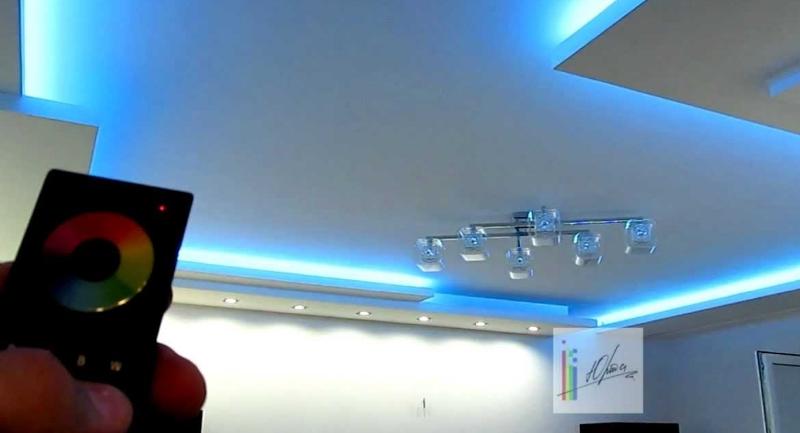
These are the main elements, additional nodes can be used. Do not forget about the wires that connect the parts. You can buy connectors that connect the tape without a soldering iron.
DIP and SMD technologies - features and differences
Two types of LED strips, which differ in their design and some other characteristics. Understanding the design is easy:
- DIP is an option well known to everyone since the last century, the basis is hemispherical LEDs, which are installed in household appliances, cars, etc. They are also attached to a flexible base. To get a tape, usually there are from 24 to 120 pieces per meter. The more diodes, the more uniform and brighter the light. There are only plain colors, the main colors are white, yellow, blue, green and red.
- SMD stands for Surface Mount Device.Diodes are soldered or glued on top of the base, the numbers after the abbreviation show the length and width of the element. Products can be both monophonic, and multi-color (RGB). They are the most common and are more suitable for indoors due to their affordability and small size.
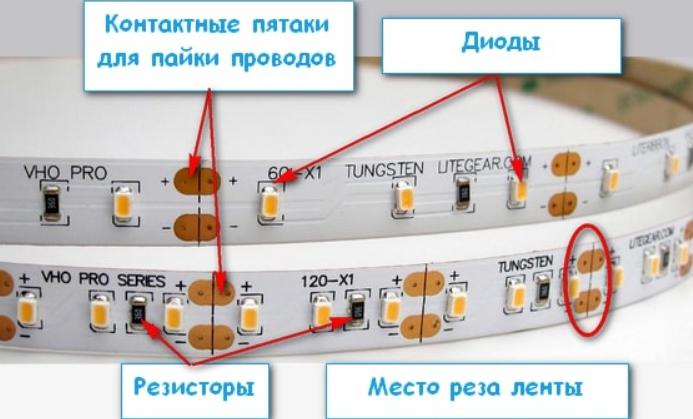
SMD options are distinguished by even light, so it is better to use them in rooms.
How to install the backlight with your own hands
The instructions for carrying out the work depend on which version of the stretch ceiling LED lighting is selected. You should determine in advance the appropriate method, prepare everything you need and follow the recommendations from the appropriate section.
Features of installation in a ceiling plinth
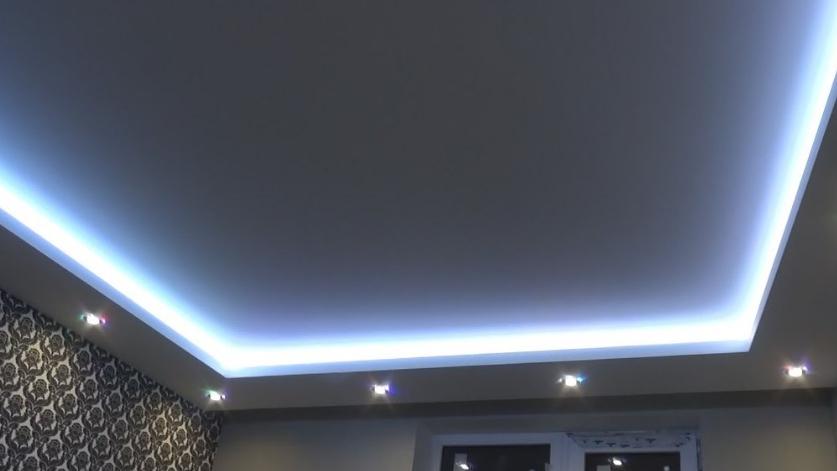
In this case, the backlight is on the outside and is done after laying the canvas. This simplifies the work, you can take your time and think carefully about the location of all the elements. Follow these simple guidelines:
- Choose a skirting board of medium or large width. Determine the position relative to the ceiling, usually leaving a gap of 3 to 10 cm wide.
- Determine the position of the LED strip. It should be located so that it is not visible from the height of human growth.
- Attach the wires to the tape with a connector or solder. Consider the location of the power supply and controller. If the plinth is wide, then you can put it in a niche. When connecting, observe the polarity and check the reliability of the connections.
- Glue the tape around the perimeter of the room. There is an adhesive layer on the back side, but if it does not hold well, then it is better to additionally use double-sided tape.The surface must first be cleaned of dust and primed if it is porous.
- The plinth is glued last, this is the most convenient option. Nothing interferes with the work and you can set everything perfectly even.
If the room temperature is high, then it is better to glue an aluminum profile to the wall and attach a tape to it so that it cools better.
Hidden lighting around the perimeter
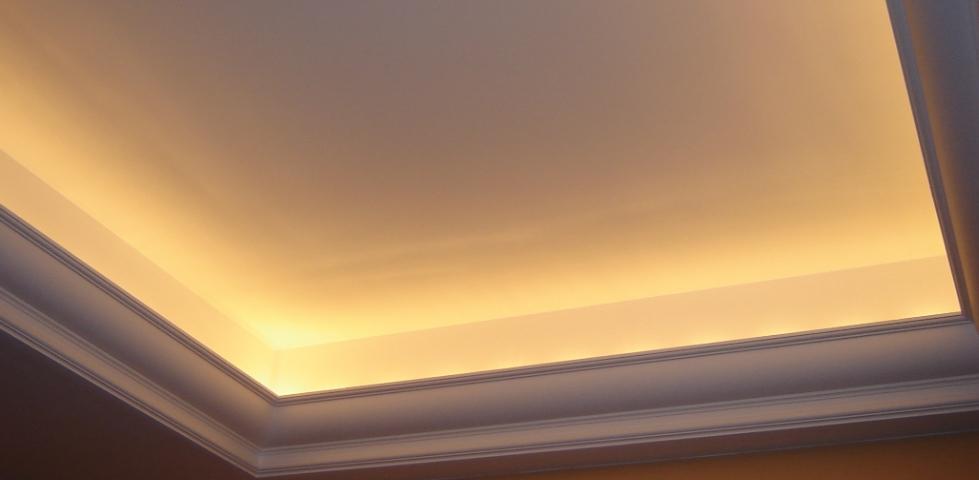
Work should be carried out taking into account several recommendations:
- Order a ceiling made of a translucent canvas that transmits light well. Companies have special options, you just need to determine the color.
- Specify the level at which the canvas will be stretched. Based on this, select the installation line and mark it on the walls, the marks will still be hidden later.
- Consider the location of power supplies and controllers. Since you can put pieces no larger than 5 meters, you usually need 2 or more segments. All control and power supply elements must be taken out of the ceiling, as they serve less than the tape and you will have to remove the canvas when replacing. For power, you can solder wires of suitable length.
- Stick the tape with double-sided tape of increased strength, such is sold in automotive stores. Check the performance in advance so that there are no questions.
- After tensioning the canvas, turn on the backlight and adjust the brightness and mode, if possible.
In the same way, you can place the LED strip on the ceiling surface to create different effects. In this case, it is important to ensure a secure fastening, so mounting adhesive can be used.
directional
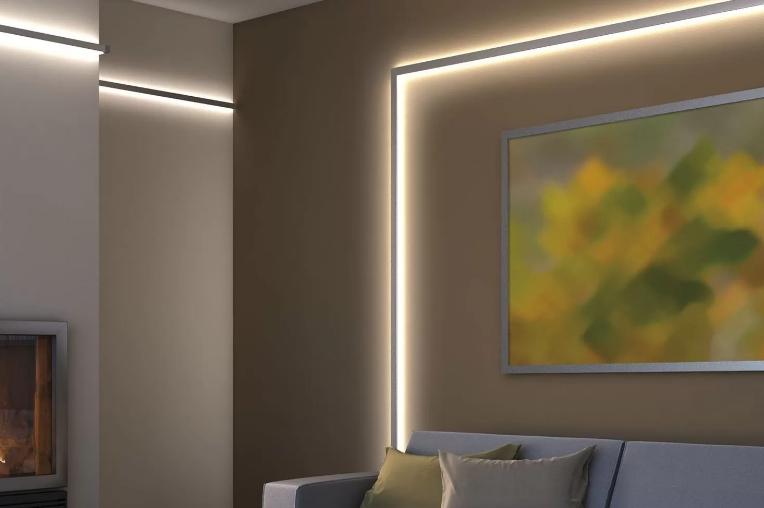
If you need to highlight window openings, you can use LED lighting. At the same time, it must be remembered that temperature and humidity differences near the window can be greater than in the room, so you need to:
- Think about the location of the tape. It should be positioned so as to highlight the opening, but at the same time not create discomfort to the eye and not give reflections into the room. Make marks on the slopes so as not to make mistakes during installation.
- Choose an aluminum profile with a diffuser in which the backlight will be installed. It must be cut in advance at an angle of 45 degrees in order to dock perfectly evenly at the corners. It is most convenient to do it with a hacksaw for metal.
- Fix the profile with liquid nails or dowels. In the second case, you need to drill holes for the screws and select a sweat so that their caps become flush with the surface.
- Choose the location of the power supply and controller so that they are not visible. For example, you can stick them on double-sided tape on the underside of the windowsill. Attach the tape to other elements using a connector or solder the contacts.
- Carefully stick the tape inside the profile and cover with a diffuser. Check work.
often do niche lighting under curtains across from the window. In this case, it is also desirable to use an aluminum profile that diffuses light.
dotted
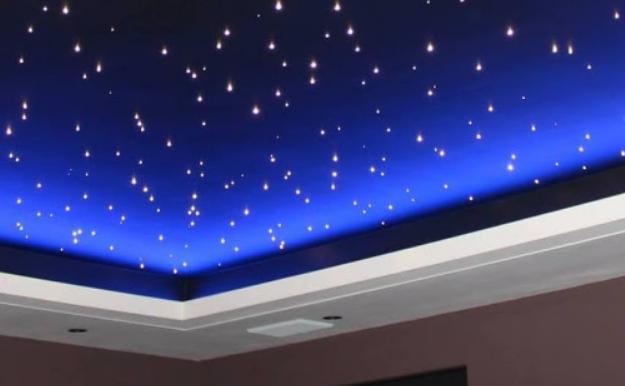
Many people know this option under the name "starry sky" and making it is much easier than it seems at first glance. You can assemble the system on your own if you follow a simple instruction:
- Before installing a stretch ceiling, you must first install LED strip. It can be placed around the perimeter using an aluminum corner or in several rows on the surface. It is better to use a profile with a diffuser so that the light is uniform.
- You need to fasten the elements securely, it is best to use dowel-nails, since over the years double-sided tape will lose its properties. You can also use modern adhesives. When connecting, remember that the power supply and controller must be outside the ceiling.
- Ordering an opaque canvas so that the LED strip does not give reflections is important to obtain the desired effect. You can choose options that slightly transmit light.
- After installing the ceiling, you will need Starpins. These are special elements of small thickness, with which you can achieve the effect of a starry sky. Use a needle to make holes in the canvas and insert pins into them. It is safe for the ceiling, it will last the same amount. Arrange pins in a chaotic manner or create a map of a section of the starry sky with some kind of constellations.
You can add pins later if the effect is not enough. They hold well in the material without any fixation.
How to change the LED strip under the stretch ceiling
If the backlight located above the canvas has stopped working, you need to find out the cause and carry out repairs. There may be several options here:
- First of all, check the power supply. Usually if it burns, there is a characteristic smell. But to be sure, it is better to put another one. If the light did not appear with him, then the problem is not in the power supply.
- Check the performance of the controller, it most often breaks down in such systems. Solve the problem with a replacement.
- If the tape does not work, then you will have to remove the canvas, otherwise you will not be able to get to the ceiling. To do this, you need to call the masters to heat the ceiling and remove it from the profiles.
- Pre-prepare replacement tape to quickly get the job done and pull the ceiling back.
It is not difficult to make the backlight of a stretch ceiling if you choose the appropriate option and follow the instructions. The main thing is to buy high-quality components and do everything according to the scheme when assembling.