Attic floor lighting features
The light in the attic differs from standard solutions due to the design features and the presence of sloping ceilings, on which it is much more difficult to correctly position the lamps. And if you initially make mistakes, then it will be difficult to eliminate them, since you will have to shift the wiring, and in some cases, redo the repair.
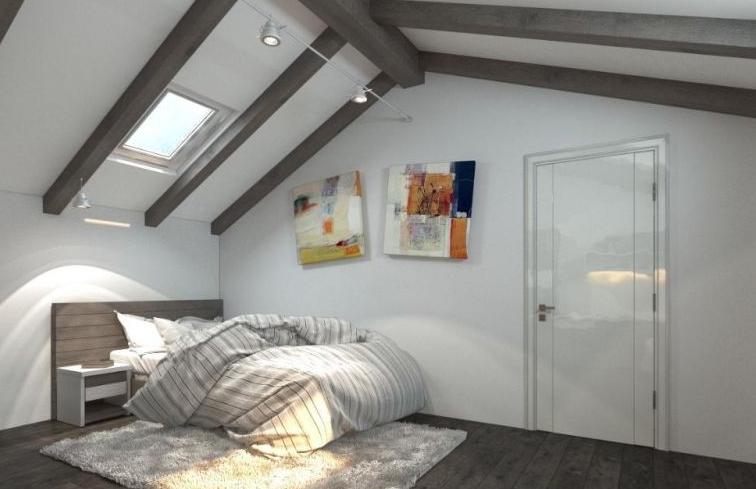
Organization of attic floor lighting
It should be noted right away that if the rooms in the attic are made standard and they do not have sloping ceilings, then you can install lamps according to general requirements. But if the rooms have inclined surfaces, it is worth considering a few recommendations:
- Massive chandeliers and other similar options are ineffective, as they do not provide normal illumination. They are not suitable for a corner ceiling and clutter up the space, which is unacceptable.
- It is better to use a large number of lamps and place them around the perimeter.At the same time, it is important to be able to adjust the direction of the light and its brightness in order to provide comfortable lighting.
![Adjustable lights]() Adjustable lights are a great option for the attic.
Adjustable lights are a great option for the attic. - Decorative lighting is appropriate, which will visually expand the space and focus on the right areas. Options with highlighting the contours of the room or window openings are also suitable.
- To create the effect of increasing the room, it is worth using reflected light when the flow is directed to a wall or a sloping ceiling.
- When choosing, the style of the design of the room is taken into account, so you need to think about this moment in advance.
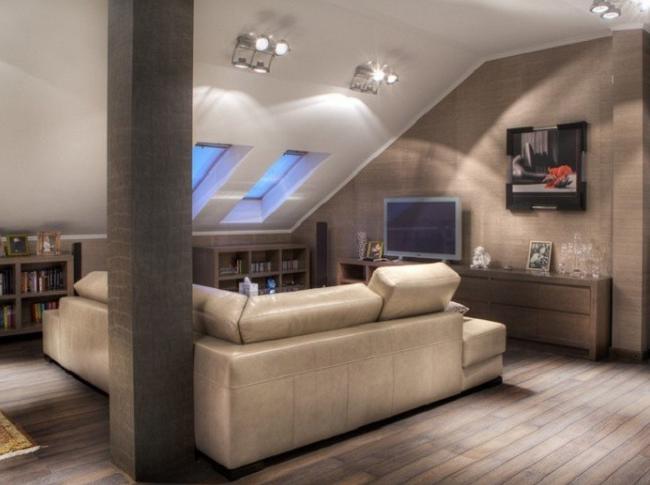
By the way! For the attic floor, combined light is great when different types of equipment are combined.
The choice of lamps for the attic
Before starting work, you need to choose lamps for attic ceilings, there are many options, but the following solutions are best suited:
- Local illumination in the form of adjustable wall lamps, sconces or mobile lamps that can be placed on the floor or on the table. This option is needed to ensure comfortable work or rest and to allocate a separate area in the room.
![Beam variant]() The directional beam option looks good on an inclined surface.
The directional beam option looks good on an inclined surface. - Spotlights. Only adjustable models are suitable here to adjust them to the room. They can be both built-in and overhead, if it is not possible to cut them into the ceiling.
- Track systems are an excellent solution, since a tire is fixed on the surface, on which you can put a directional lamp in any place and adjust it almost as you like.
![The track version looks stylish.]() The track light is customizable to any room.
The track light is customizable to any room. - Lamps with diffusers.These can be either matte elements that give a uniform light, or crystal shades that cast reflections on the surface and provide a decorative effect.
- LED Strip Light can be used both as a decorative design element and as a general light, if you fix an aluminum profile with a diffuser and stick several rows of high-brightness tape inside it.
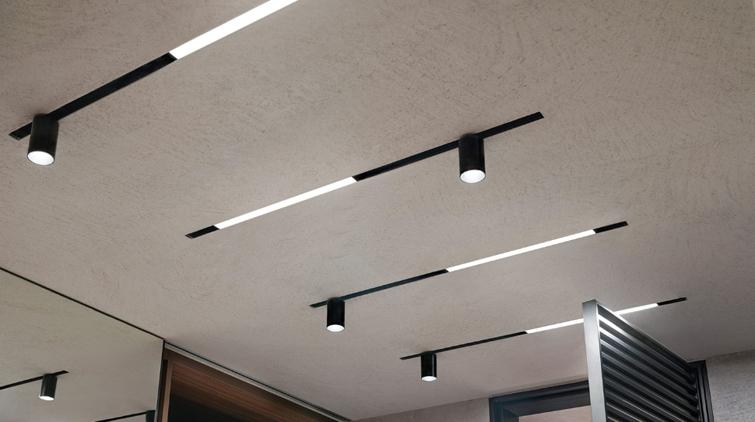
- light lines - another solution that can be implemented both on stretch and suspended plasterboard ceilings. Suitable for modern interiors.
![light lines]() Light lines are a great solution for a sloping ceiling.
Light lines are a great solution for a sloping ceiling.
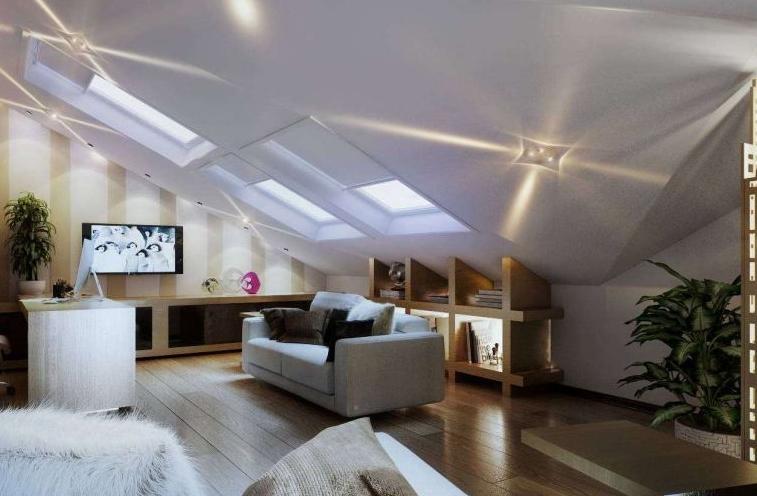
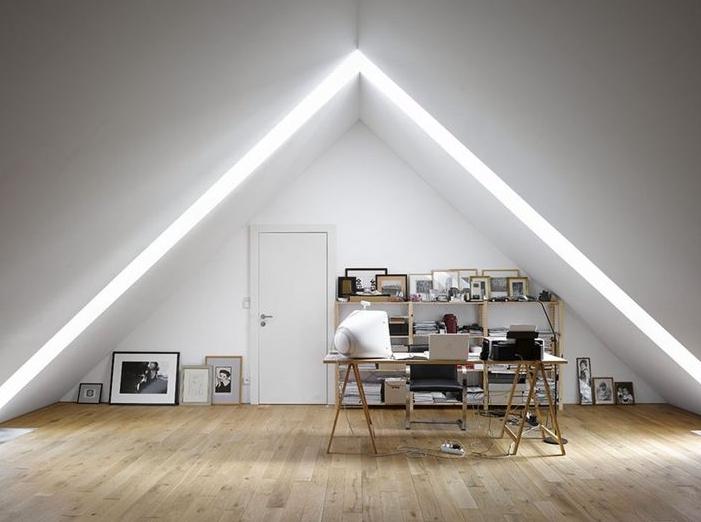
A chandelier on an attic ceiling can only be used if there is a horizontal section, and the sloping surfaces are not very large.
Conducting electrical wiring in the attic area
The safety of the system and its convenience depend on the correct cable laying. Wires are required for both lighting and sockets, so the system is quite complex. There are a few tips to keep in mind here:
- Since the attic is located under the roof, the supporting structures are almost always wooden, which imposes special installation requirements - the material supports combustion.
- A project is always drawn up in advance, in which all the lamps and sockets are indicated in detail, as well as the places for laying the cable. It is important to consider the arrangement of the furniture in order to install the equipment where it is needed.
- Lay the cable only in special non-flammable corrugations to ensure safety. Their size is selected according to the number of cables. If possible, you should avoid installing junction boxes in the attic or make them as small as possible.
- Fasten the corrugations to the beams using special fasteners. It is important to fix them firmly so that the wiring does not hang out.
![corrugations with wiring]() Often corrugations with wiring are laid under the crate.
Often corrugations with wiring are laid under the crate. - Laying is best three-core copper cable, its cross section is selected according to the planned load with a small margin.
- Always leave long enough ends to connect sockets, switches, lights and other equipment. The wires must not be pulled.
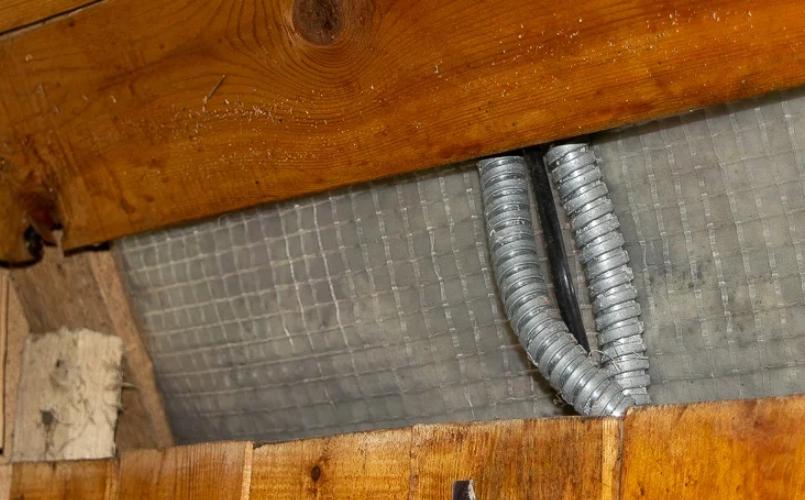
It is best to involve a professional designer in the drafting of the project. Then all the important nuances will be provided for the system to meet the established requirements.
Options for the location of lamps in the attic room
Lighting an attic with sloping walls requires a special approach, but it’s easy to figure out the location of light sources:
- If there is a horizontal plane in the middle or the slopes converge in the center, classical systems can be used. Best fit chandeliers with shades hanging at a certain height, which is selected according to the situation.
- For sloping surfaces, it is worth using either luminaires with flexible legs or options with adjustable brackets to set the position of the shades as needed.
- Track systems can be mounted on horizontal, inclined or vertical surfaces. It is important to comply with the installation conditions that are prescribed in the instructions. Plafonds are placed after work is completed.
- Spotlights are used for inclined and even planes. Best suited for stretch ceilings and drywall structures. It is important to correctly calculate the power of the lamps and the location of the equipment.
- The LED strip can be mounted in niches, on ledges, or simply glued along the contours. You can use an aluminum profile with a diffuser for uniform illumination.
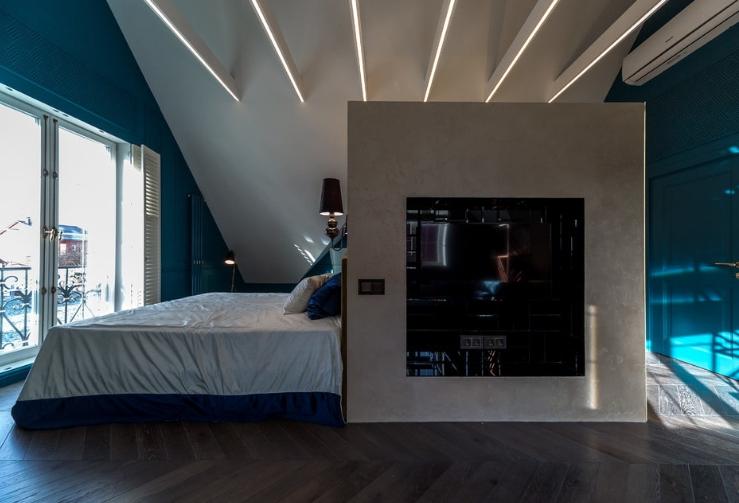
You can combine several types of lighting to achieve the best effect.
How to zone space
Beveled slopes can complicate the division of the attic into functional areas, so you should carefully select the lamps, and when planning their location, remember the following tips:
- Use a bright light for the work area that will provide good color rendering and will not cause discomfort. It is better to give preference to the natural spectrum. It is important that the lighting is regulated, so wall or table lamps.
- If there is a nursery on the attic floor, you need to provide high-quality general lighting and highlight functional segments. Particular attention is paid to the play area and the desktop, if the child needs to do homework.
![Attic floor lighting features]() Correctly zoning the space and lighting it with high quality is very important.
Correctly zoning the space and lighting it with high quality is very important. - For those who are engaged in needlework, it is worth choosing the type and power lighting based on the characteristics of the hobby. It is important to provide comfortable conditions under which vision will not strain.
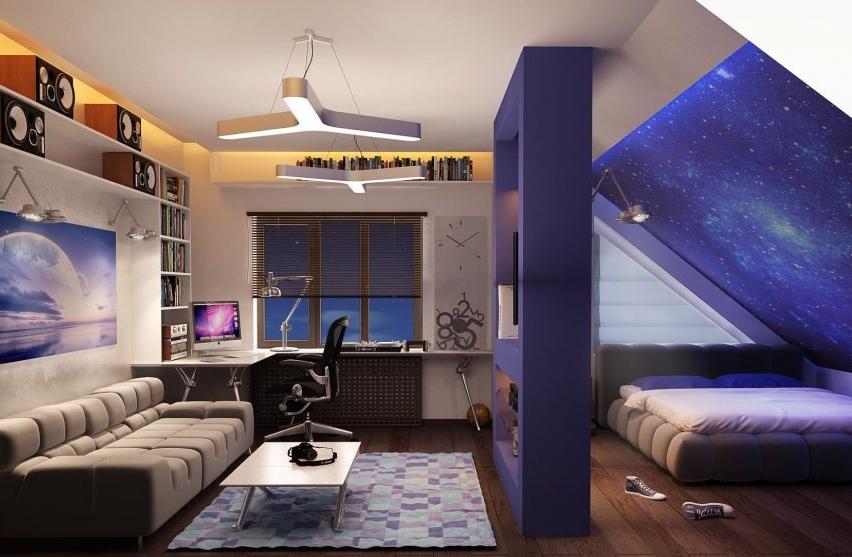
Video materials: Lighting solutions for ceilings in the attic.
Bright and modern interior in Loft style with elements of brutalism on the attic floor of a private house.
It is not difficult to make lighting on the attic floor if you understand its features and draw up a detailed project in advance. It is important to choose the right luminaire models and safely lay the wiring.
