Description of the energy-saving lamp circuit
Household energy-saving lamps (ECL) are in demand today, despite the popularity of LED lamps. This is due to their convenience, reliability and efficiency. There are lamps of different power, from 20 W to 105 W. To make the operation comfortable, we recommend that you study their device, which has its own specifics.
Composition and principle of operation
Any gas-discharge energy-saving lamp consists of a glass bulb with an inert gas or mercury vapor inside. Inside the flask, two electrodes are brought out, to which voltage is supplied from the network.
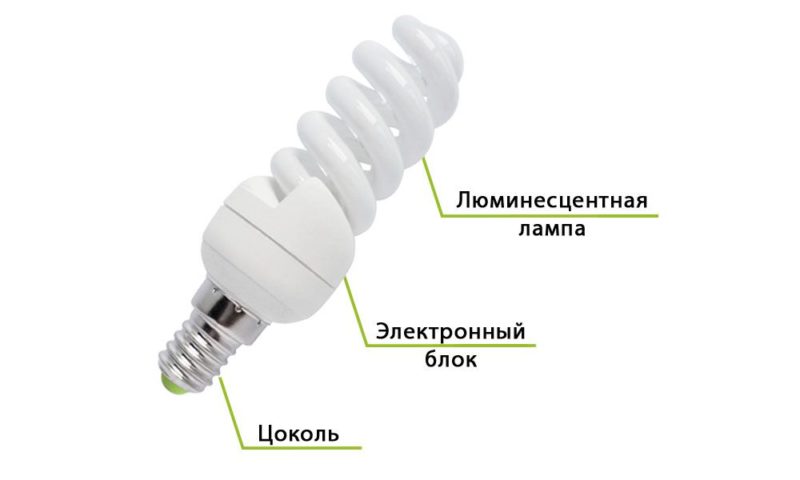
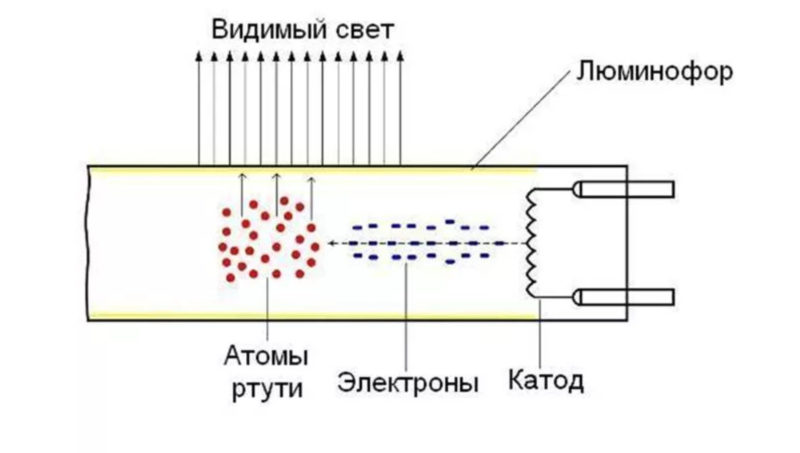
The principle of operation is as follows: the current causes heating of the electrodes. Between them there is an arc discharge. Manages processes ballasts (electronic ballast), electronic circuit with transistors and capacitors.
The arc discharge between the electrodes affects the mercury vapor inside the bulb and causes the appearance of ultraviolet radiation. It is invisible to the eye, so the inner walls of the flask are coated with a phosphor. Passing through the phosphor, ultraviolet radiation turns into white light in the visible spectrum. The specific shade and glow temperature depend on the composition of the phosphor.The choice of coverage affects the cost.
Energy-saving lamps give a higher light output than traditional incandescent lamps.
The main disadvantage of energy-saving lamps is the impossibility connections to the 220 V network directly. Mercury vapor has a high resistance, and a high-voltage pulse is required to form the desired discharge.
At the moment of discharge, the resistance inside the bulb becomes negative. If you do not provide for protective elements in the circuit, the manifestation of a short circuit is inevitable. The protective function in tubular installations is performed by an old-style electromagnetic ballast, which is mounted directly into the luminaire.
In compact modern ESLs, the electromagnetic ballast is replaced by a small electronic ballast circuit. The durability and efficiency of the entire structure depends on the quality of the ballast.
Scheme of an energy-saving lamp
The scheme includes:
- starting capacitor, giving an impulse;
- a set of filters for smoothing ripples and eliminating interference;
- throttle to protect the circuit from current surges;
- transistors;
- driver for current limiting;
- a fuse that prevents ignition of the circuit during power surges in the network.
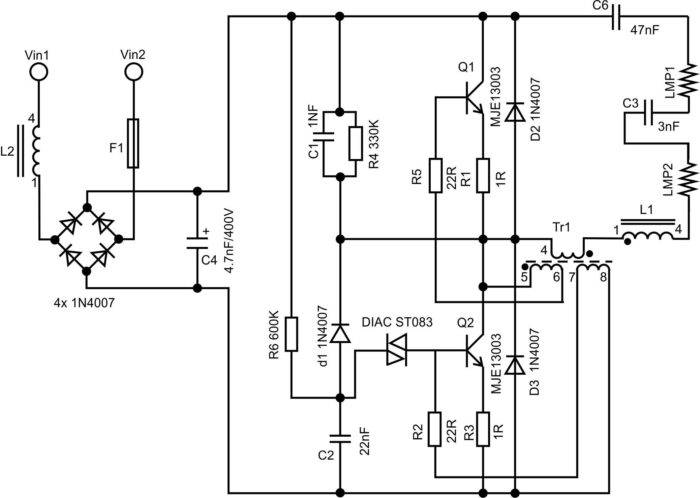
In the master module, a current pulse is generated, fed to the transistor and opens it. The capacitor is charging. Charging speed depends on circuit components.
From the transistor key, the pulses are transmitted to a step-down transformer, then the pulsed voltage is fed through the resonant circuit to the electrodes.
A glow is formed in the tube, the parameters of which depend on the capacitor. A triggering pulse with a voltage of about 600 V requires a protective system.
After the breakdown of the electrodes, the shunt capacitor sharply reduces the resonance and puts the device into operating mode with a uniform stable glow.
Do I need to change the schema
The scheme of energy-saving lamps does not need improvement or refinement. The changes concern repair faults.
If the device does not turn on, you can try to restore it yourself. The lamp base is disassembled and the circuit is removed. First, visible problems are eliminated, then a check by a tester follows.
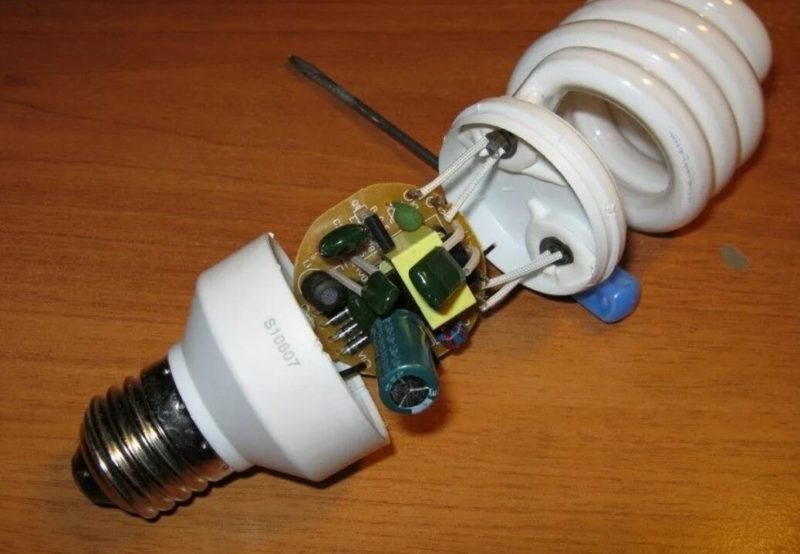
A common cause of failure is a blown fuse. It is visible to the naked eye. The diagram will have a darkened element with signs of burn-through. The component is desoldered and replaced.
The filaments of the bulb are considered separately. To check, you need to unsolder one pin from each edge and measure the resistance with a tester. The indicators must be the same. If the thread is burned out, you need to solder a resistor with a suitable resistance to the parallel spiral. After that, the lamp should work.
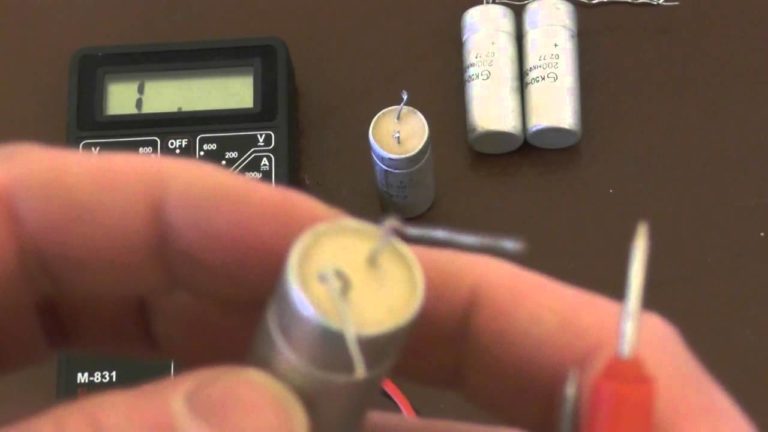
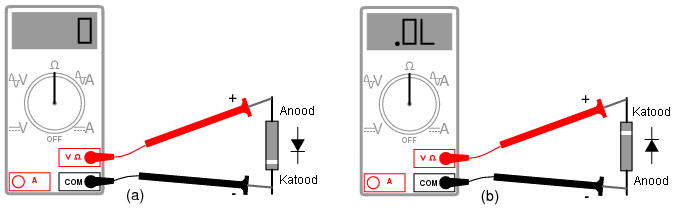
Transistors, capacitors, diodes and other elements in the circuit are checked with a multimeter. Serious system overloads can lead to a short circuit in some nodes. It is necessary to identify such a node and solder the part.
Recommendations for use
Energy-saving lamps are convenient and are used almost without restrictions in lighting equipment. However, the operation must be carried out according to the rules in order to avoid costs and losses.
Be sure to take into account the temperature range of a particular device. It's listed in the specification.Do not expose the lamp to extremes outside the specified range.
The video is devoted to a detailed analysis of the circuit and a simple method of repair
In electrical circuits with energy-saving lamps, stabilizers and soft start devices designed for simple incandescent lamps should not be used. These components do not meet the capabilities of gas-discharge devices.
During operation, it is important to observe the warm-up rule, which provides for turning off the device only after 5-10 minutes of operation. Sudden power surges adversely affect the elements of the system.
It will be useful to observe safety precautions when working with devices. Energy-saving lamps emit ultraviolet radiation, which has a negative effect on humans. Too high a dose of radiation leads to premature skin aging, allergies, sometimes provokes migraine attacks or epilepsy.
For this reason, gas-discharge energy-saving lamps are best installed at a distance from the place of permanent residence of a person. Installing the device in a table lamp is definitely not a good idea.