Ceiling lighting features
Ceiling lighting is the main option for any apartment or house. The choice of equipment depends on the comfort of staying in the room and the type of room. In addition, it is important to use only safe appliances that last a long time and do not require high costs for replacing light bulbs.
Varieties of ceiling light
Options can be distinguished depending on the type of ceiling. There are main varieties that are repelled when describing the types of ceiling lighting. But this does not mean that one or another type of lamp can only be used in a certain design. It is important to understand the features in order to choose what is best suited for a particular room.
For wooden and concrete ceilings
It is not difficult to make ceiling lighting on such bases, as they are distinguished by resistance to stress. But at the same time there are a number of restrictions, for example, recessed lights cannot be installed.In addition, when working with wooden structures, fire safety standards must be strictly observed. The main features are:
- Usually the main lighting provides chandelierwhich is placed in the middle. For rooms of a small area, a lamp with a diffuser canopy may be enough. For fastening, hooks or brackets are used, which most often come with the kit.
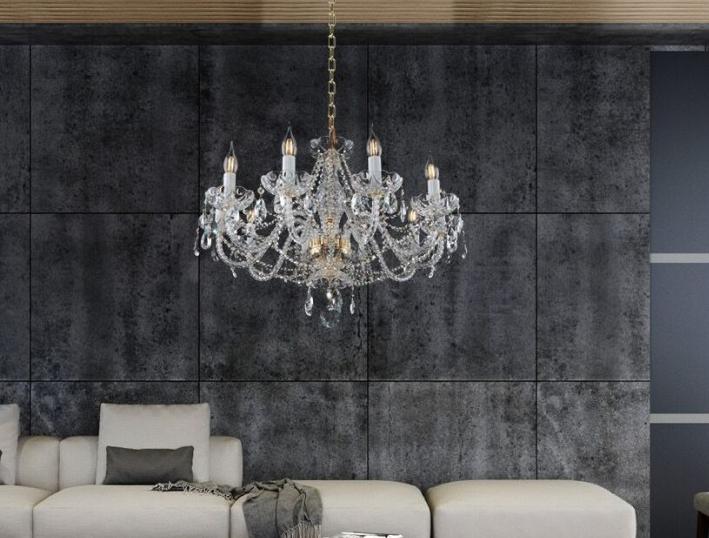
![The more light bulbs, the more area the chandelier can illuminate.]() The more light bulbs, the more area the chandelier can illuminate.
The more light bulbs, the more area the chandelier can illuminate. - If you need additional lighting, put overhead lights or track systems of suitable length. There are a lot of varieties, it is worth choosing according to the style of decoration of the room and lighting requirements. The main thing is to pre-wire.
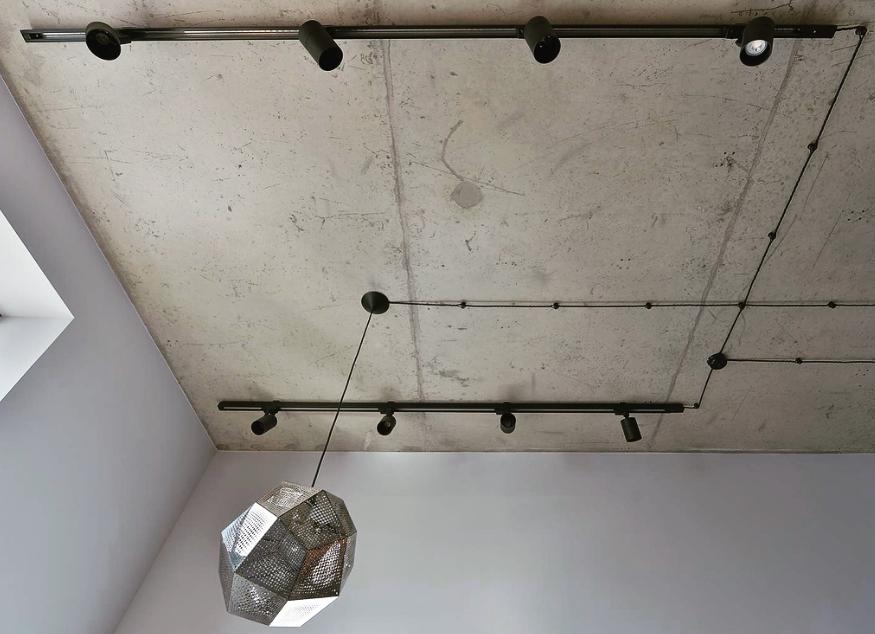
![Ceiling lighting features]() Track lighting system with open wiring on a concrete ceiling.
Track lighting system with open wiring on a concrete ceiling. - To create contour lighting using LED strip, a ceiling light is used. plinth. The easiest way is to fix it indented from the surface in order to put the tape into the resulting cavity. Due to this, the light will be uniform around the perimeter.
![Ceiling lighting features]() The contour can move from the ceiling to the walls, creating an interesting effect.
The contour can move from the ceiling to the walls, creating an interesting effect.
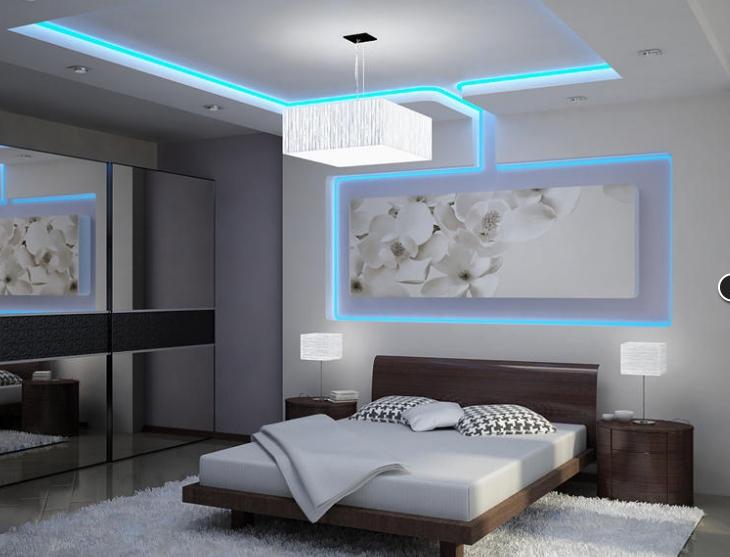
You can buy an aluminum plinth with a niche for the LED strip and a diffusing plug. This option is well suited for modern interiors.
For stretch ceilings
Stretch fabric is not only a convenient option for quickly transforming a room. It can use different types of ceiling lighting. Typically the following solutions apply:
- The main light source is located in the middle. If the room is elongated, there may be several of them to ensure normal lighting. There are no special restrictions, the main thing is to prepare the installation site in advance: fix the bracket and run the wire, since this will not work after pulling the ceiling.
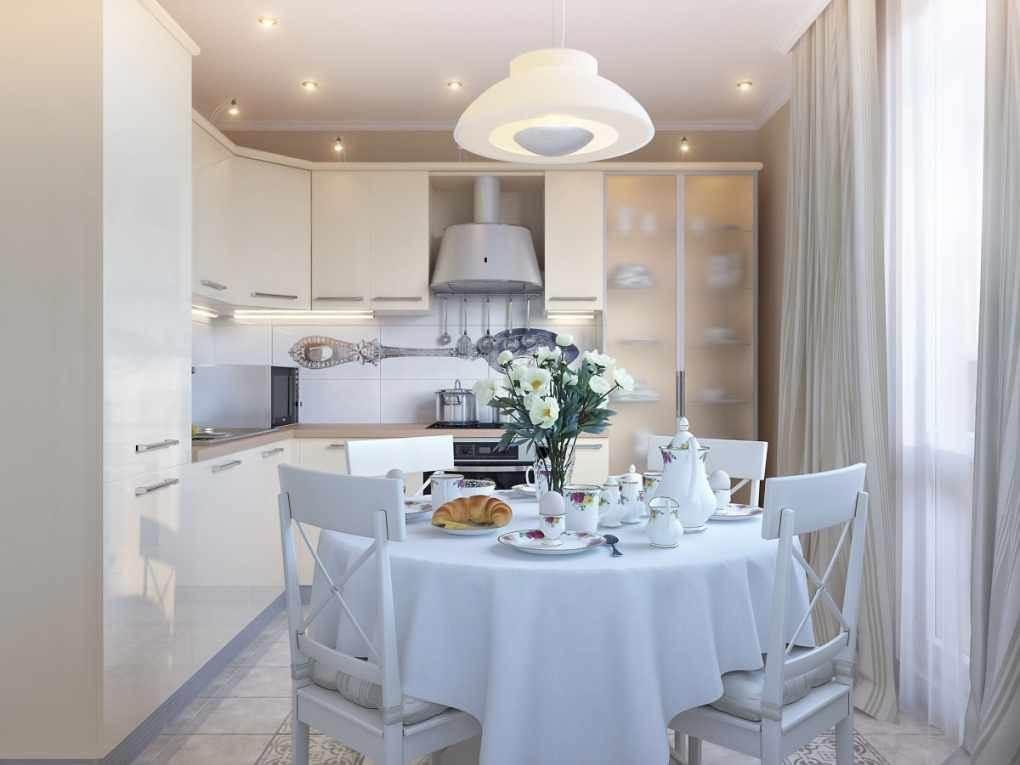
![A lamp in the center of a small kitchen.]() A lamp in the center of a small kitchen.
A lamp in the center of a small kitchen. - Additional lighting can be almost anything. The cavity under the canvas allows you to install built-in equipment, the main thing is that it fits in size. For normal installation on the ceiling, rings of a suitable diameter are preliminarily glued, and then a hole is cut out inside.
![Ceiling lighting features]() Lamps can be placed on the sides of the stretch ceiling.
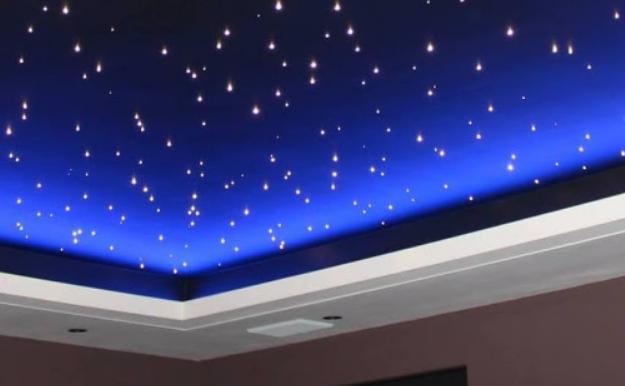
Lamps can be placed on the sides of the stretch ceiling. - You can achieve effects that are not possible on other types of ceilings. For example, using special pins to create a starry sky or make the entire surface glowing. This is realized by attaching light sources above the ceiling and stretching a translucent light-diffusing fabric.
![Ceiling lighting features]() With the help of special pins, you can create the illusion of a starry sky.
With the help of special pins, you can create the illusion of a starry sky.
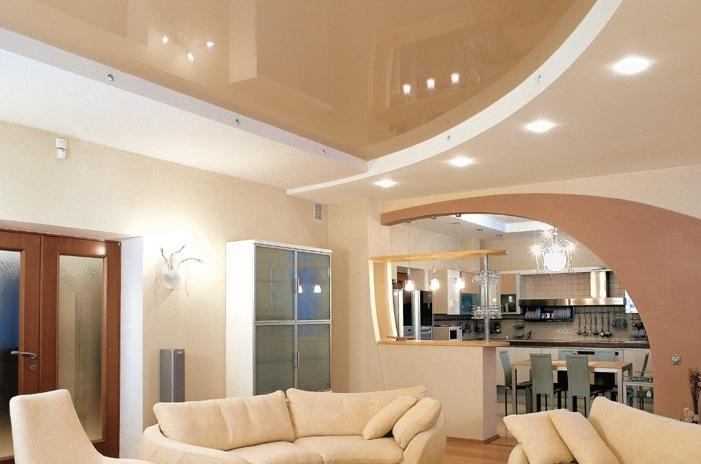
On stretch ceilings, it is especially important to make an accurate project in advance and designate locations all light sources to conduct wiring.
For two-level and multi-level structures
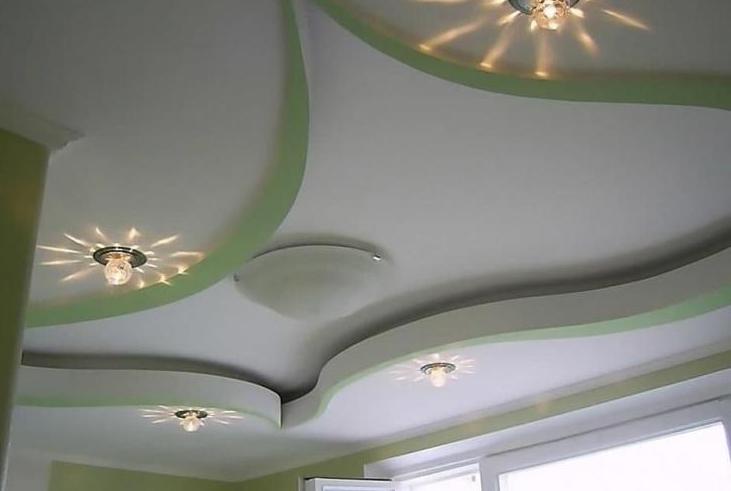
When choosing lighting for such systems, a few simple recommendations are followed. The main thing is to take into account the design features and the size of the room.. You need to remember the following:
- To highlight the protruding elements, use the backlight around the perimeter, hidden in a niche. The result is the effect of a "floating ceiling", which gives the atmosphere originality.
- If the protrusion is in the middle, it is worth choosing a compact main light source so that it does not hang too much. With a high ceiling height, there are no special restrictions, the main thing is that the light sources do not interfere with movement.
- For projections on the sides, built-in lights are perfect.Their number and location depends on the design configuration and zoning of the room.
For plasterboard ceilings
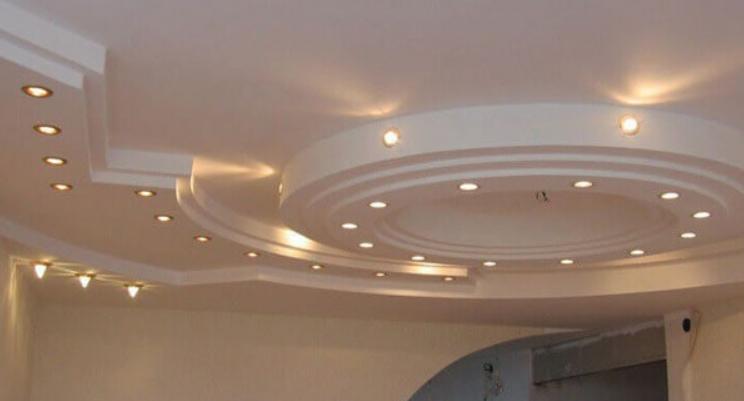
This option is popular, with its help you can implement almost any project. At the same time, the choice of lighting for a plasterboard ceiling has the following features:
- When installing heavy elements for the main lighting, the place of their attachment is reinforced to the surface sheathing with drywall. This will eliminate any problems and simplify the work. The size and configuration of the fixtures are selected according to the room, there are no restrictions.
- The material allows you to install built-in equipment, which is convenient for additional lighting. Its dimensions are selected for the space above the ceiling.
- If you need to install a backlight, a niche is made for it. Its size depends on the effect that you want to get in the end.
On drywall and stretch ceilings, a special profile is often used, from which light figures or broken lines can be made.
Types of fixtures for lighting the ceiling
There are many options, but all of them can be divided into several main groups according to design features. When choosing, proceed from the characteristics of the room and the characteristics of the equipment:
- Chandeliers. The main light source is most often installed in the middle. In a long room, you can hang 2 or more.
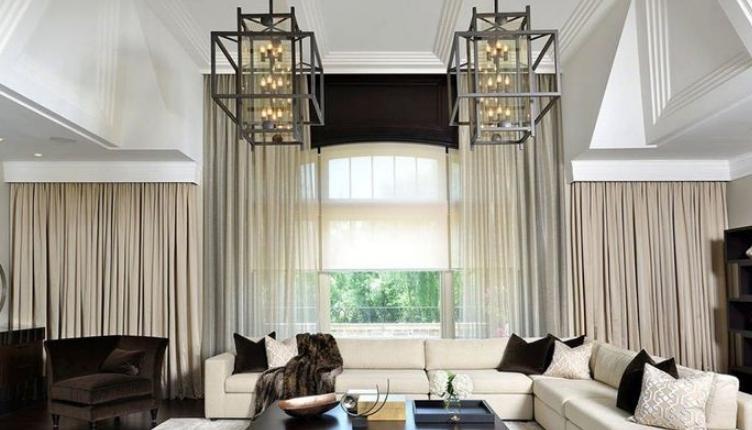
![Ceiling lighting features]() Two chandeliers in the living room are a modern solution that looks original.
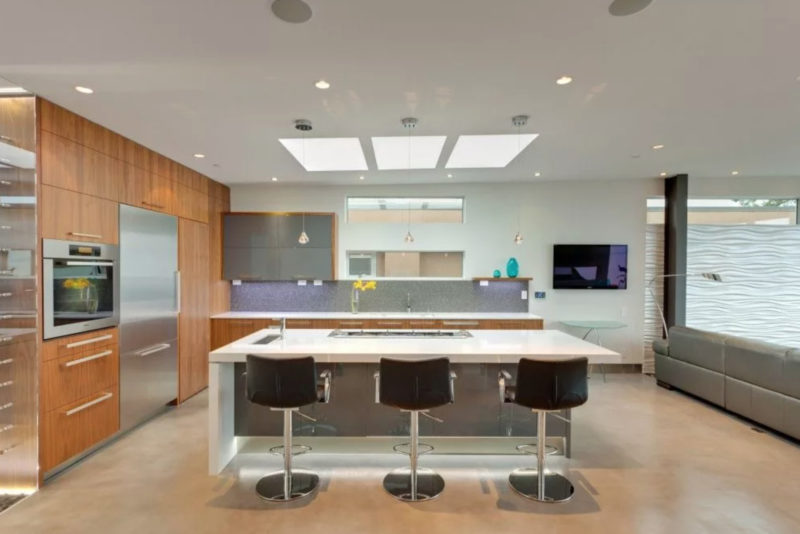
Two chandeliers in the living room are a modern solution that looks original. - Recessed luminaires (spots). Suitable for hollow structures, can be standard or adjustable.
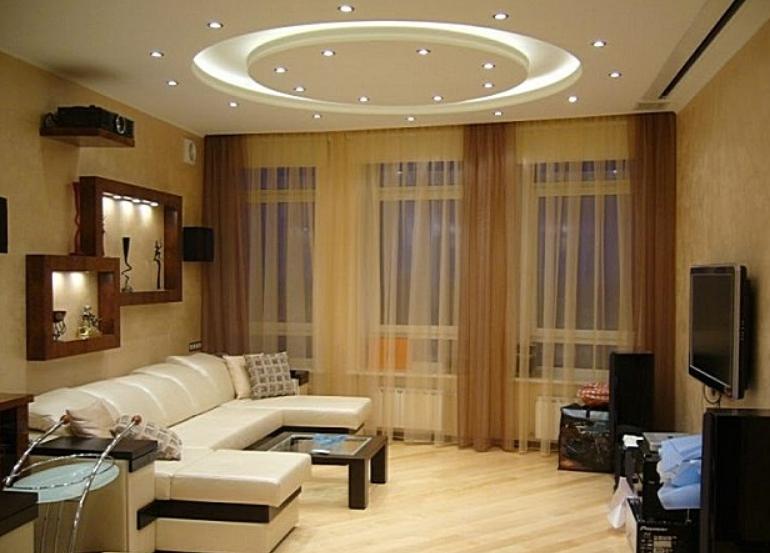
![Ceiling lighting features]() Spotlights in combination with a light niche look stylish.
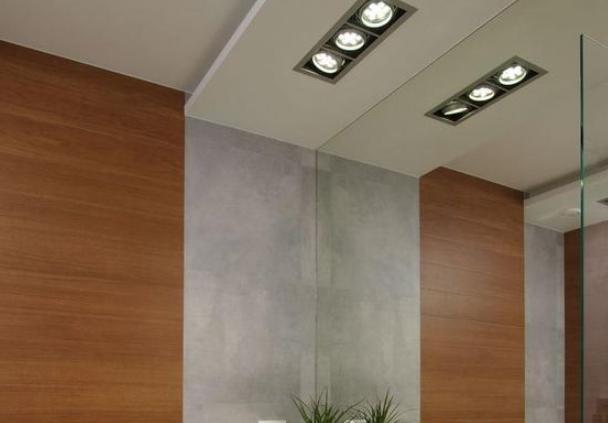
Spotlights in combination with a light niche look stylish. - Overlay models. Apply on those grounds where there are no voids.
![Ceiling lighting features]() Overhead lamps come in different sizes and shapes.Lamps and light-emitting diodes are used as an element of light.
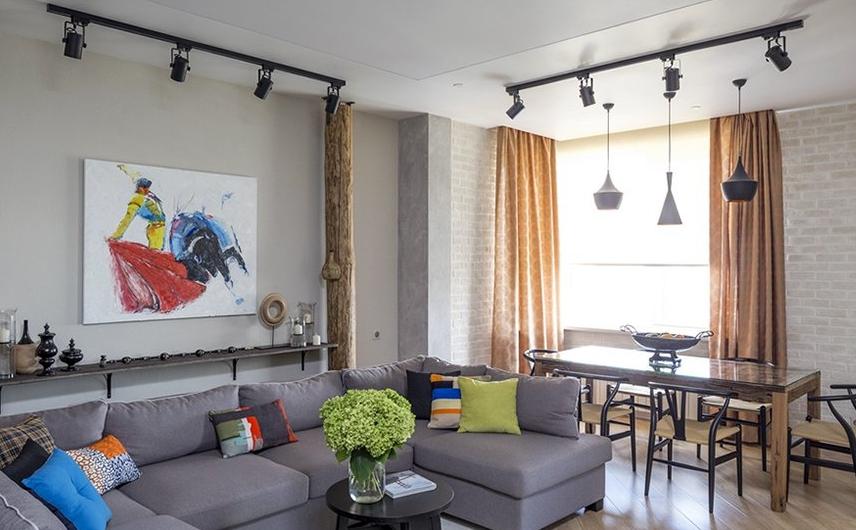
Overhead lamps come in different sizes and shapes.Lamps and light-emitting diodes are used as an element of light. - Track systems. Due to the tire, you can put ceiling lamps anywhere, which is very convenient.
![Ceiling lighting features]() Track systems are a convenient and practical solution.
Track systems are a convenient and practical solution. - Light modules. They include from two spotlights and provide good light in a small area.
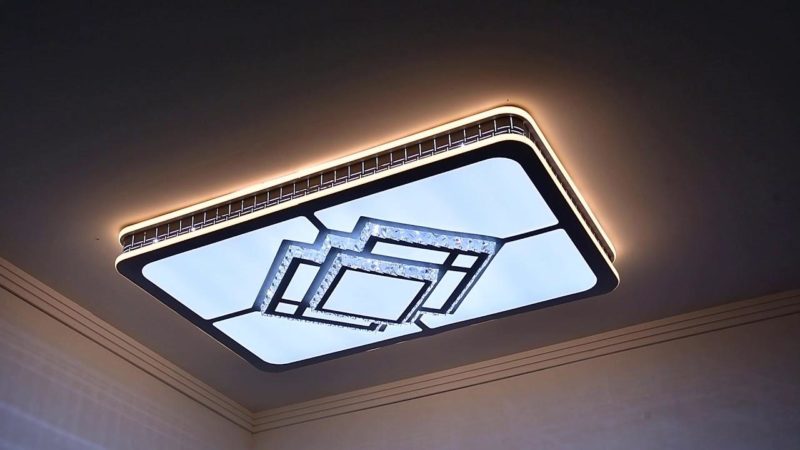
- LED panels. Can serve as a replacement for a chandelier.
![Ceiling lighting features]() An example of lighting the dining area with light panels.
An example of lighting the dining area with light panels. - LED Strip Light most often used for lighting. But if you stick several rows, the light intensity will be sufficient for the main lighting.
![LED strip allows you to implement projects of any complexity.]() LED strip allows you to implement projects of any complexity.
LED strip allows you to implement projects of any complexity.
Calculation of the number of fixtures
To determine the number of lamps, it is necessary to take into account the type of room and illumination rate for her. All indicators are registered in SNiP, for convenience they are collected in the list:
- Living rooms and kitchens - from 150 lm per meter.
- Children's - from 200 lumens.
- Bathrooms, bathrooms, showers and corridors - from 50 lm.
- Dressing rooms - from 75 lumens.
- Offices and libraries - from 300 lm.
These are the minimum standards, most often the level of illumination is made higher. To adjust the intensity of the light, several modes are used on the switch or Dimmer to adjust the brightness.
The choice of ceiling lighting for different rooms in the apartment
Depending on the characteristics of the premises, different types of equipment are used. It is important to properly position it in order to qualitatively illuminate individual zones and ensure an even distribution of light throughout the room. To do everything right, you need to remember simple recommendations:
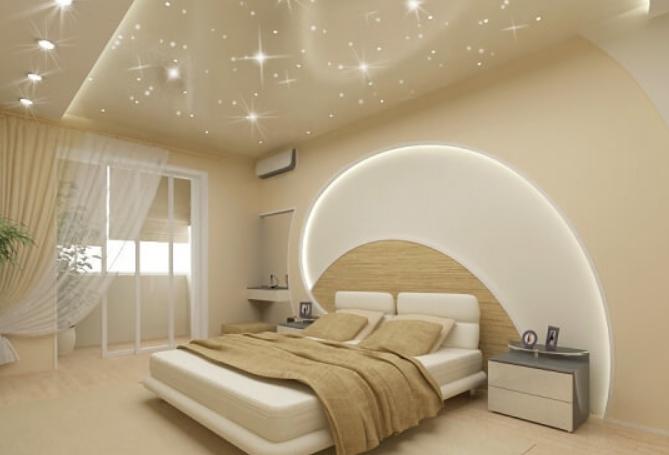
- Bedroom. In this room, you should create a calm environment conducive to relaxation and rest. Therefore, when choosing light sources, preference is given to yellowish options. The main lighting should have several modes of operation. Decorative lighting is also often installed, it can be either spotlights or LED strip. You can select separate zones if necessary - the space in front of the mirror or the working area, if available.
![Ceiling lighting features]() The effect of the starry sky in the stretch ceiling of the bedroom.
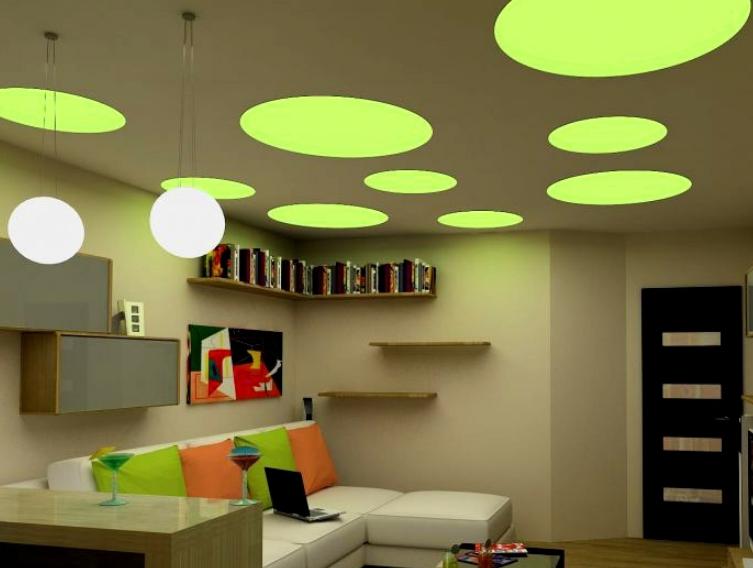
The effect of the starry sky in the stretch ceiling of the bedroom. - Living room. This room must be illuminated with high quality and provide for all the nuances of use. The main attention is paid to the guest area, the table should be illuminated with high quality, any suitable equipment is used for this. Decorative lighting is also often used to decorate the interior and emphasize the unusual design of the ceiling. If there are areas in the living room - for relaxation, games, needlework, etc., the light for them is selected individually. It is desirable that it be turned on separately from the main one.
![Ceiling lighting features]() Modern living rooms can be illuminated in a very original way.
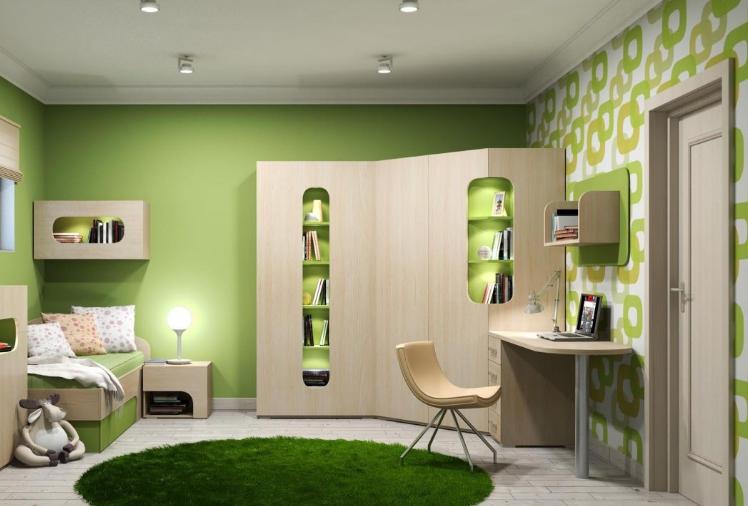
Modern living rooms can be illuminated in a very original way. - Children's. In this room, it is important to create a comfortable environment for vision so that children's eyes do not get tired. For this, light sources are selected only with a natural spectrum close to daylight. It is necessary to allocate functional zones - playing and for preparing lessons, for this additional equipment is used. LED lighting will be appropriate, which serves not only as a decoration, but also as a night light during sleep.
![Ceiling lighting features]() In the nursery, you need to create an ideal environment so that the child’s eyesight does not strain.
In the nursery, you need to create an ideal environment so that the child’s eyesight does not strain. - Kitchen. If the room is small, you can provide normal lighting due to one chandelier located exactly in the middle of the free space. Well, it is better to use additional light for the work surface and the dining area.There are many options, you can use both conventional spotlights and adjustable models.
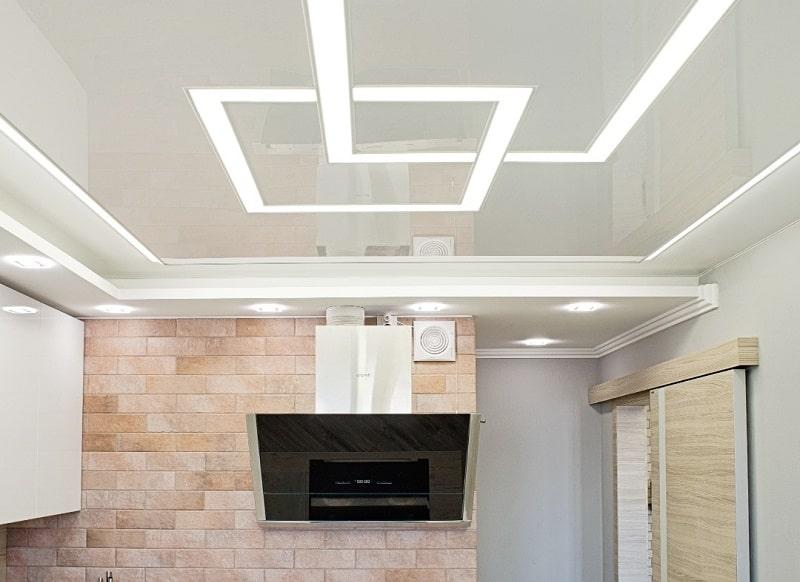
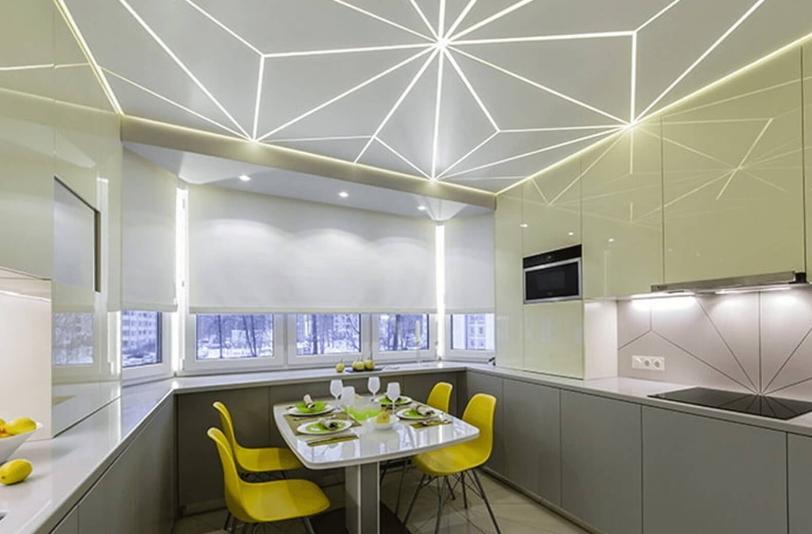
![can replace the traditional chandelier.]() For the kitchen, light lines are perfect and can replace a traditional chandelier.
For the kitchen, light lines are perfect and can replace a traditional chandelier. - Bathroom and toilet. Here you can ensure the normal intensity of light due to spotlights. The number and location is selected depending on the area and shape of the room. It is important to take into account the color and reflectivity of surfaces, the choice of equipment power depends on this.
![Ceiling lighting features]() The built-in module in the bathroom provides enough light.
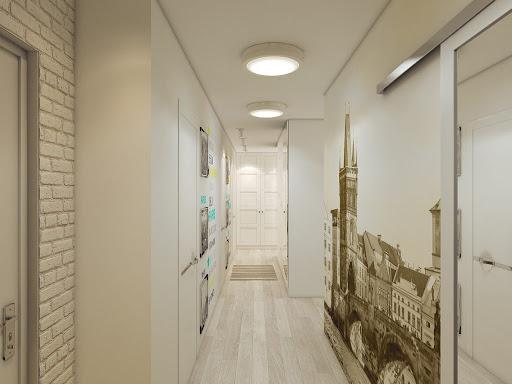
The built-in module in the bathroom provides enough light. - Hallway or corridor. In apartments, most often these rooms are small in size. Therefore, for normal lighting, two or even one row of spotlights is enough. If the space is square, the light sources must be arranged differently so that they are distributed evenly across the ceiling. It is worth paying attention to the space in front of the mirror.
![Ceiling lighting features]() If the corridor is long, you can install several fixtures linearly, along the entire length of the ceiling.
If the corridor is long, you can install several fixtures linearly, along the entire length of the ceiling.Recommended for viewing: The secret of perfect lighting in the apartment.
Picking up ceiling lighting for an apartment is easy. The main thing is to take into account the features of the room, the design of the ceiling and its dimensions. You can implement different options, it is best to use several lighting modes in living rooms.