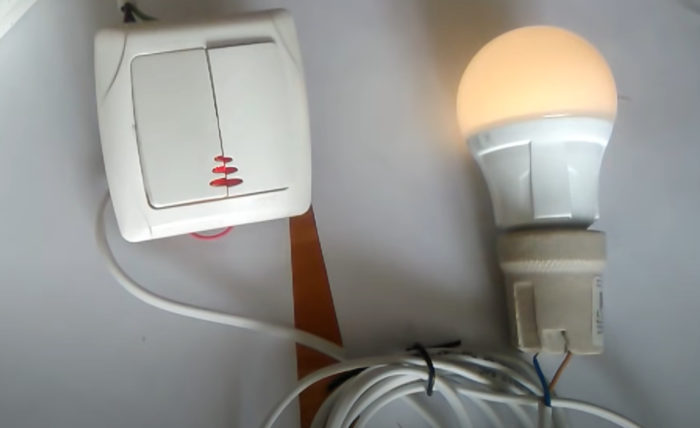
The main reasons for the dim burning of the LED lamp
LED lighting is rapidly taking over the market. Incandescent lamps have practically no competitive advantages over semiconductor devices. But some users are faced with an unpleasant phenomenon: the lamp continues to burn even when the switch is turned off. This glow is dim, incandescent, or lamp flashingbut at night it can be very annoying. To figure out how to deal with this phenomenon, you need to find out its causes.
LED lamp quality
The first thing you should pay attention to when an unpleasant effect appears is the quality of the lamp. Inexpensive products may have:
- poor insulation through which leakage is possible;
- circuit solutions that reduce the cost of construction, but worsen the quality of operation.
And here it is impossible to predict the direction of fantasy of manufacturers from Southeast Asia.
Wiring faults
One of the reasons for the glow of LED lamps is the natural aging of electrical wiring and the appearance of leaks through the insulation. This can cause tension to appear in completely unexpected places. In most cases, it is small, but enough for the LED device to glow faintly.
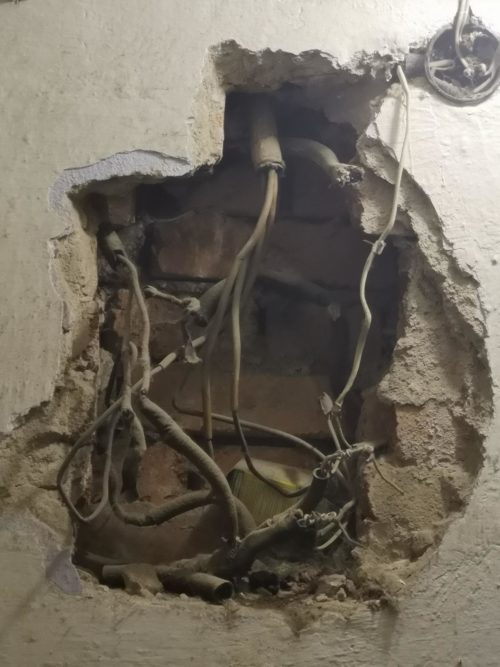
The condition of the insulation can be checked with a megohmmeter (checking with a multimeter in most cases is a waste of time due to the low measuring voltage). For a 220 V network, the insulation resistance should not be less than 0.5 MΩ. But even if a deterioration in the state of insulation is detected, often nothing can be done - it is impossible to accurately determine the location of the damage. And since the electrical wiring in residential and public buildings is hidden, its complete replacement is carried out during the overhaul of the premises.
Influence of capacitance
It must be taken into account that the leakage can be capacitive in nature. In this case, one plate of the capacitor is a wire, the other is a second wire, a grounded conductive element (armature), a damp wall, etc. It is much more difficult to detect such a malfunction with a megger without experience. It should be borne in mind that this problem cannot be solved even by a complete replacement of the wiring.The capacity from this will not go anywhere, and more than that - it directly depends on the quality of the insulation.
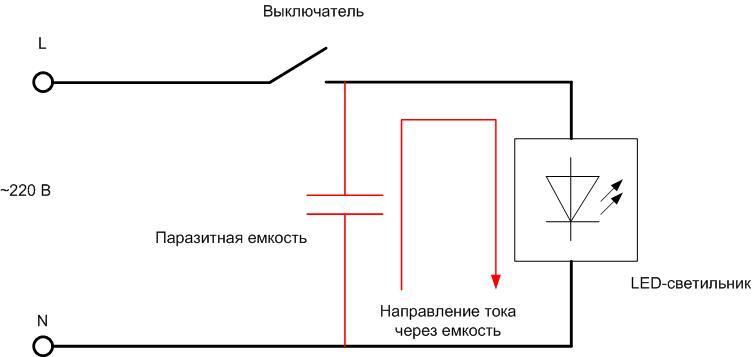
Also, parasitic capacitance can cause an unauthorized glow if there is voltage relative to ground on the neutral wire. Its source is the voltage asymmetry in phases, which is characteristic of end-user networks (220 V). Through the inter-wire capacitance, this voltage creates a small current, at which the LED lamp burns dimly even in the off state.
And still it is necessary to note the effect of pickups. There is a situation when another phase wire is laid parallel to the phase wire for a long distance and a short distance. If a sufficiently powerful load is connected to it, then the current flowing through such a conductor creates an electromagnetic field that induces voltage in the LED power wire. It may be sufficient to continuously or intermittently light the LED.
If the illuminated switch
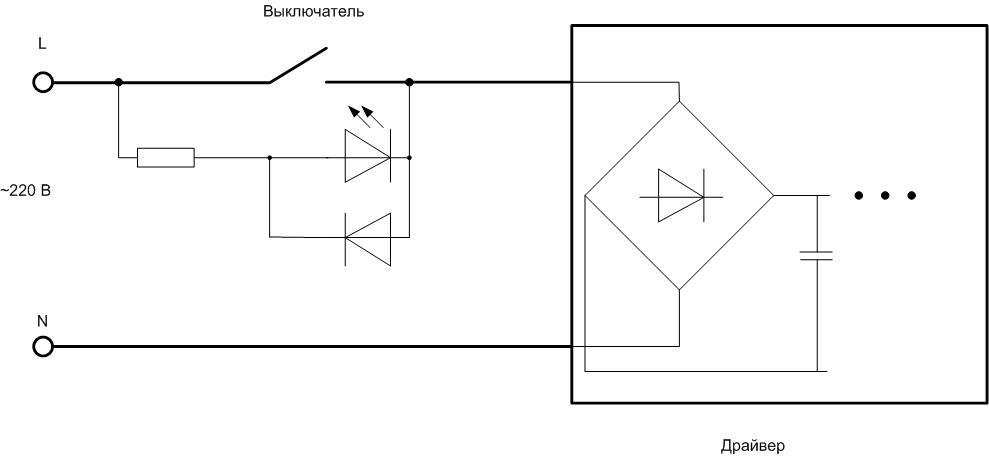
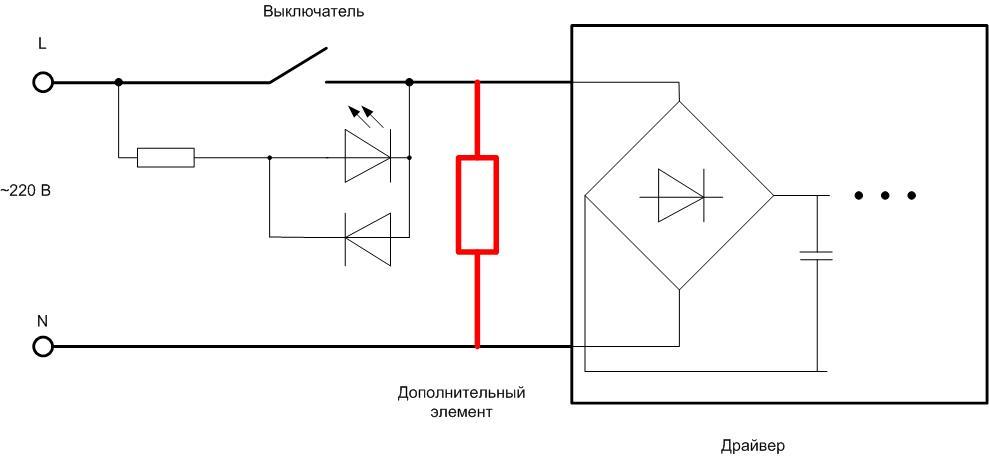
Illuminated light switches are popular in everyday life. When the lighting is turned off, a low power LED (or neon bulb) illuminates the location of the switching element. If the switch is closed, it will bypass the backlight circuit.
As long as incandescent lamps were used, there were no problems. The resistor limited the current to a small level, not enough for the filament to glow. With the transition to LED lighting, the situation has changed somewhat. There is still not enough current through the resistor to light the LED on its own. But at the entrance of the lamp stands driver. Its input circuits form a rectifier with a smoothing capacitor. The capacitance is charged for a long time with a small current, then instantly gives the accumulated charge to the circuit. Visually, it looks like periodic LED flashes.
Recommended for viewing:
Incorrect lamp connection
Another reason for the glow of LED-illuminators can be incorrect connection of the switch and the lamp. If the lamp is connected so that the switch breaks not the phase, but the neutral wire, then when the switching device is turned off, the lamp remains energized, and any leakage in the neutral wire causes the lamp to barely burn or flash periodically.
Important! This situation is also unacceptable from a security point of view. During any repair work, there is a risk of electric shock even when the circuit breaker is turned off.
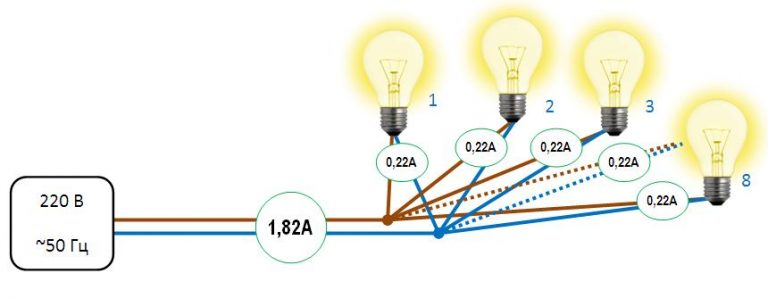
Poor LED quality
Contrary to popular belief, the quality of the light emitting elements is hardly a single reason for an LED lamp to glow on its own after being turned off. Theoretically, cheap LEDs of unknown origin can have low substrate insulation resistance, but this will more likely lead to leakage of current that initiates the glow. Such a defect should be revealed on the first inclusion of the lamp during the check at the time of purchase, and any consumer will refrain from purchasing a lamp with reduced brightness or no glow.
Related video: The lamp shines but is not bright
How to fix the problem of the lamp glowing after it is turned off
The method of eliminating the glow becomes clear after identifying the reasons for the abnormal operation of the LED lamp. In order of the reasons listed:
- The decision to replace the wiring is a radical one. Before deciding on this voluminous work, you need to try all the other methods.
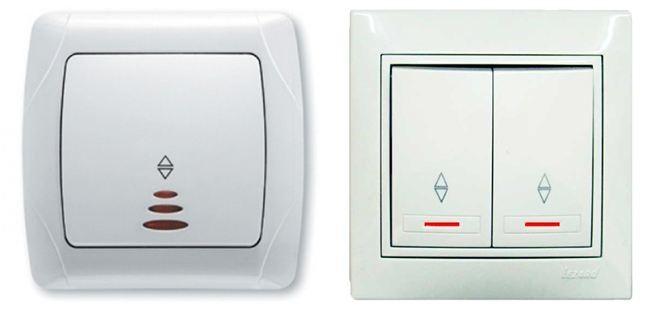
- In many cases, the problem of capacitive conduction is solved by installing a switch that simultaneously breaks the phase and neutral wires. For domestic purposes, such switching elements are not produced, but you can take an ordinary two-gang switch and connect it so that one contact breaks the phase wire and the other is zero. Two keys must be replaced with one from another switch of the same series or mechanically connected both halves.
![The main reasons for the dim burning of the LED lamp]() Two-key and one-key light switches.
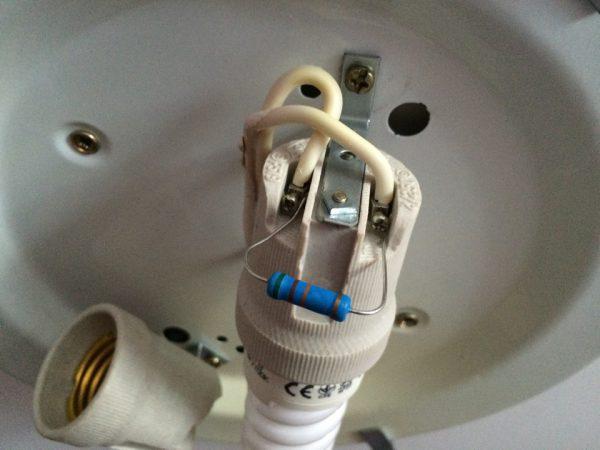
Two-key and one-key light switches. - If the backlit switch is the problem, then the easiest way is to take it apart and bite out the LED or neon bulb. If the backlight needs to be preserved, then a resistor can be connected in parallel with the lamp. Its resistance must be chosen at least 50 kOhm and power at least 2 watts. This can be done directly on the lamp socket. The resistor will shunt the capacitance and respond to part of the parasitic current. It is even better to use a capacitor with a capacity of up to 0.01 microfarads for this purpose - it will not heat up (even weakly). You can use a capacitor from the starter daylight lamps or other capacity for a voltage of at least 400 V.
![The main reasons for the dim burning of the LED lamp]() An additional element (resistor) to eliminate the glow.
An additional element (resistor) to eliminate the glow. - Another good way is if the group works lampsincluded parallel, one of them can be replaced with an incandescent lamp.
![The main reasons for the dim burning of the LED lamp]() Convenient place to connect a resistor.
Convenient place to connect a resistor. - Finally, the incorrect connection of the neutral and phase wires can be corrected by swapping them in any suitable place, but before the power switch (terminal block, junction box, etc.).
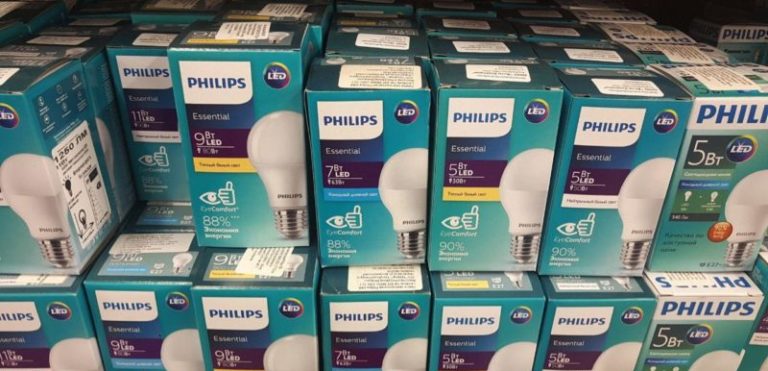
Poor quality lamp repair or replace it with another manufacturer's product. One of the options for rating manufacturers in terms of reliability is presented in the table:
| Place | 1 | 2 | 3 | 4 | 5 |
|---|---|---|---|---|---|
| Manufacturer | Philips. | Osram | Gauss | Feron | camelion |
| Country | Netherlands | Germany | Russia | Russia | Hong Kong |
If this is not a single lamp, but a chandelier or lamp, you can try to replace the internal wiring and terminal blocks with better ones. This can help.
The problem of the glow of the LED lighting device after removing the voltage is solved. It's just a matter of correct diagnosis. A mistake can lead to unjustified losses of time and money.