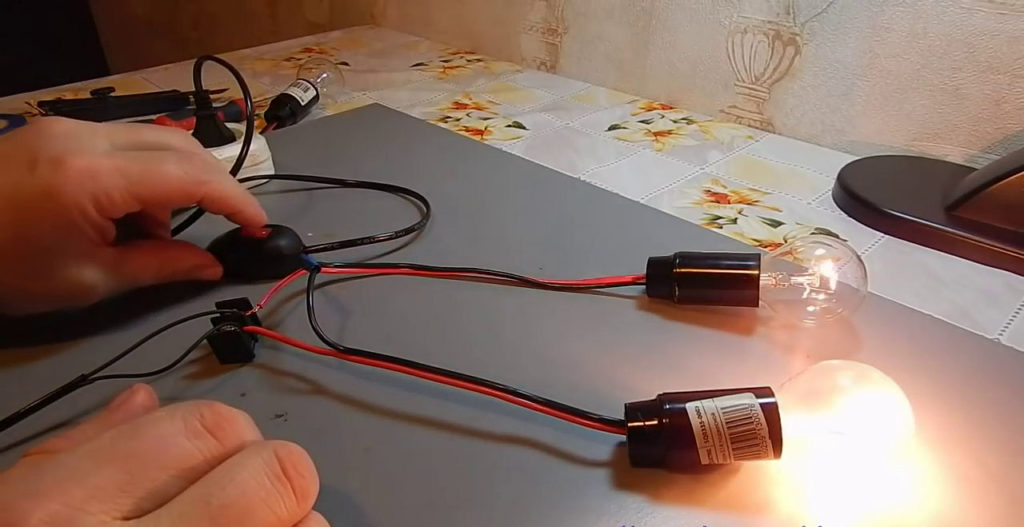
How to connect light bulbs in series and parallel
Every day we use light sources. The lamps in the sources are connected in series or in parallel. Each method has its own characteristics and is effective in specific situations.
Is it possible to connect light bulbs in parallel
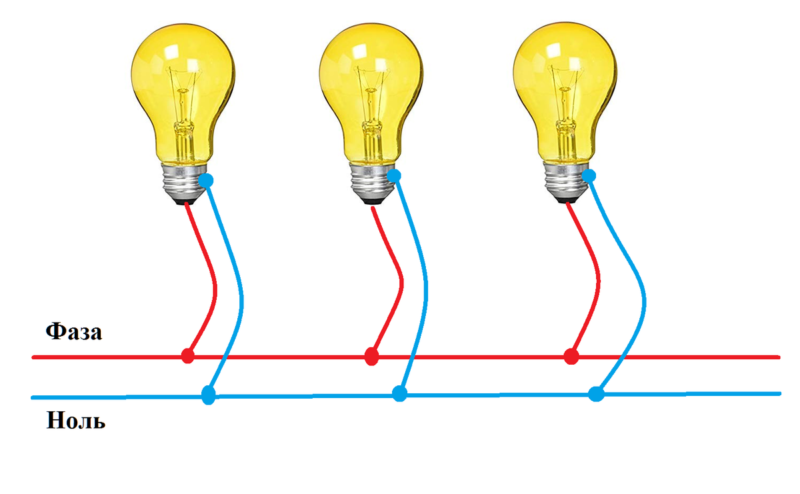
This type of connection is the most efficient. The lamp is connected to phase and zero. When connecting two or more lamps, the voltage supply wires can be twisted.
But more often all loads are attached to a common cable. Parallel connection can be beam or stub. In the first option, a separate cable is connected to each lamp. In the second, phase and zero are fed to the first light source, the rest of the devices are partially fed.
When using halogen lamps with a transformer, it must be remembered that they are connected to the secondary winding of the converter using terminal blocks.
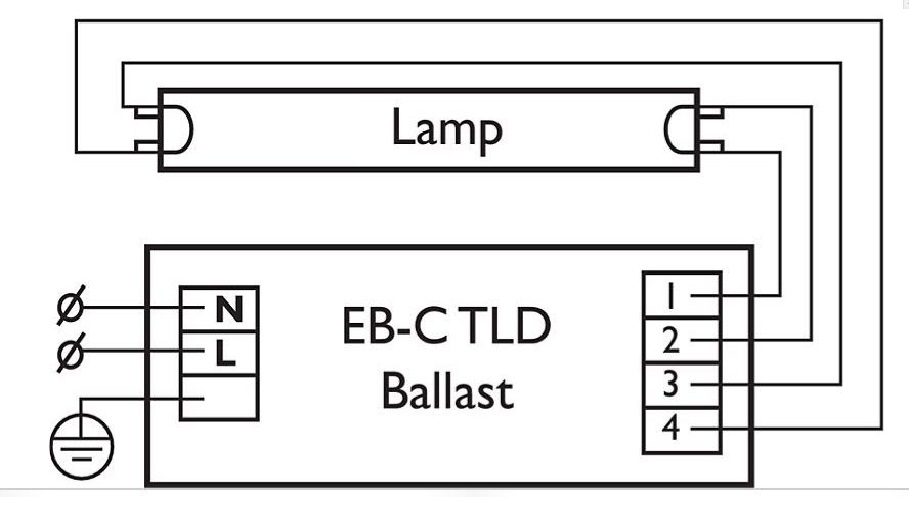
Parallel connection can somewhat smooth out the shortcomings of lighting equipment, reduce the flicker of fluorescent lamps. A capacitor is added to the circuit to shift the phase of all circuit elements.
Rules for connecting light bulbs
When connecting lamps, you must follow the rules. Consider serial and parallel connections.
Sequential
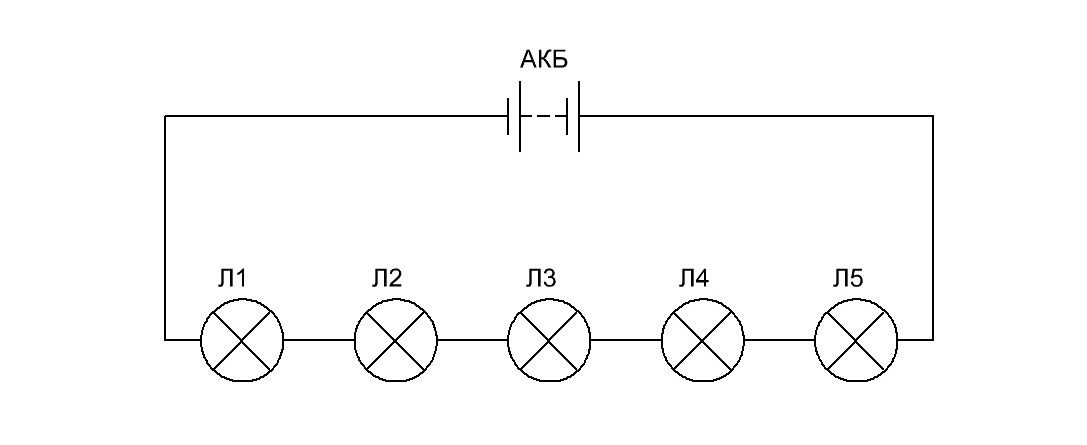
A serial connection involves connecting to a 220 V network so that the same current will flow through all the elements in the circuit. In this case, the distribution of voltage drops is proportional to the internal resistances of the loads. Power is also distributed proportionally.
When using a connection in series with a common switch, the illuminators will not burn at full strength. When connecting lamps of different powers, a device with a higher resistance will have a brighter glow.
The diagram of a standard serial connection is shown in the figure below.
Parallel
It is distinguished by the supply of full mains voltage to each lamp. The current will be different, depending on the resistance of the device.
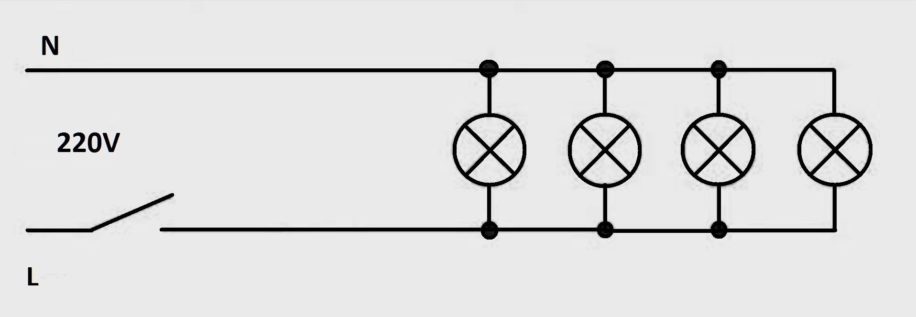
The conductors are brought to the lamp sockets in the same way, sometimes according to the bus principle, when all loads are connected to a common line.
You can connect as many light bulbs to one supply. The switch works in the same way as in series connection.
Pros and cons of parallel connection
Pros:
- if one element fails, the rest will continue to work;
- the circuit gives the brightest possible light, since full voltage is applied to each device;
- as many wires as you like can be taken from one lamp to connect additional loads (one zero and a specific number of phases will be required);
- suitable for energy-saving electrical devices.
There are practically no disadvantages, except for a large number of conductors in an extensive system with many lamps.
Application
In everyday life, a parallel connection is very common. For example, Christmas tree garlands, where all the bulbs have the maximum brightness of the glow.
By connecting, you can create interior lighting of any length. Replacing a burnt element is easy. Two 60W fixtures can be swapped for one 10W lamp without compromising lighting performance. This property of the circuit is used by experienced electricians to identify the phase in three-phase networks.
Halogen lamps and incandescent devices not only give a bright glow, but heat the environment. For this reason, they are often used in garages, hangars or workshops for space heating. To do this, connect the devices to the network, placing them in a metal block. The design warms up to 60 degrees and maintains a comfortable temperature in the room. However, high power leads to frequent burnout of the lamps.
Related video: WHAT IS SERIES AND PARALLEL CONNECTION
Parallel connection is used in strip lights, chandeliers, street lighting. At the same time, each lamp can be controlled separately, which increases the convenience of using a common network. It is only necessary to mount the required number of switches in the system.
In houses and apartments, not only lighting devices, but also various equipment are connected to the network in parallel.
When creating lighting fixtures with LED elements, a mixed connection is often used based on a series load circuit, followed by its parallel connection with the same chain.
We advise you to look: How to understand whether to connect lamps or loads in series or in parallel
An example of calculating the connection of lamps of different power
To understand the differences, it is enough to know Ohm's law and other simple electrical laws.
Suppose there is an incandescent bulb for a voltage of 220 volts. At a frequency of 50 Hz, it is a purely active resistance, so it is more convenient to deal with initial issues with it. If the lamp has a power of 100 watts, then when turned on, current will flow through it I=P/U=100 watts/220 volts=0.5 A (approximately enough for reasoning). It will drop the full voltage of the network 220 volts. You can calculate the resistance of a thread: R \u003d U / I \u003d 220 volts / 0.5 amperes \u003d 400 ohms (approximately).
If you connect a second similar light bulb in parallel with the first, then it is obvious that the entire mains voltage will be applied to each lamp. The consumed current Icon will branch into two streams and a current will flow through each light bulb I=U/R=220 volts/400 ohms=0.5 amps. The consumed current will be equal to the sum of two currents (as Kirchhoff's first law says) and will be 1 A. As a result, both lamps will be under full mains voltage, the rated current will flow through them, and the total luminous flux will be equal to twice the flux of one lamp.
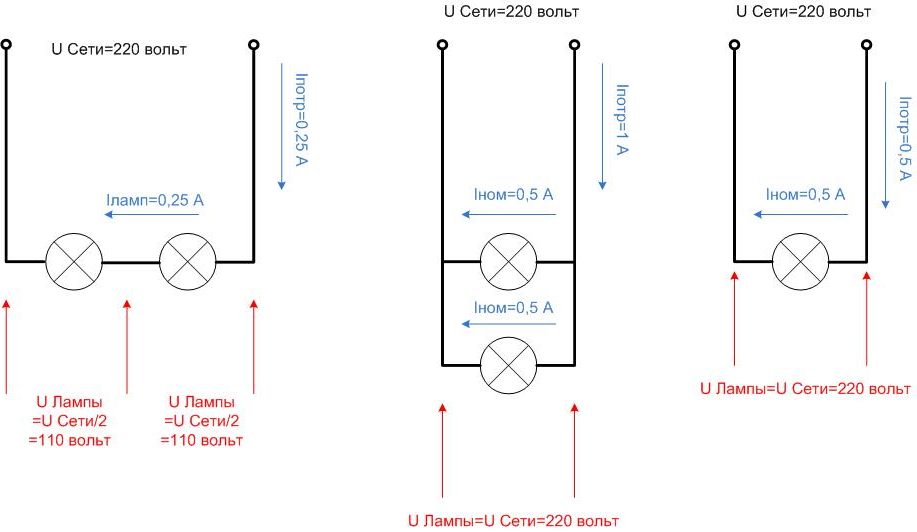
If two identical lamps are connected in series, then the mains voltage will be divided between them, and about 110 volts will fall on each.The total resistance of the circuit will be Rtot=400+400=800 Ohm, and the current through each lamp (when connected in series, it is the same for each element) will be Ilamps \u003d U / Rtotal \u003d 220 volts / 800 Ohms \u003d 0.25 A. The result is:
- only half of the mains voltage drops on each lamp;
- A current flows through each lamp, reduced from the nominal by 2 times.
To estimate the luminous flux of incandescent lamps for this case, you can use the Joule-Lenz law. The glow of incandescent lamps is carried out by heating the filament. For a period of time t, the thread will release the amount of heat Q=I2*R*t=U*I*t. The current will be halved, the voltage on one lamp will also be halved. So we can expect a decrease in the luminous flux in 2*2=4 times. For two lamps, the flux will decrease by half relative to one lamp in nominal mode. That is, when connected in series, two bulbs will shine about twice as dimmer as one.
The problem can be solved by using lamps with an operating voltage two times lower than the mains voltage.. If you use two hundred-watt light sources for a voltage of 127 volts, then 220 volts will be divided in half, and each lamp will operate in nominal mode, the luminous flux will double compared to one lamp of the same power. But this does not get rid of the main drawback of such a scheme - if one lighting device fails, the circuit breaks, and the second lamp also stops shining.
All of the above applies to lamps with the same power. If the power of the fixtures is noticeably different, then the following effects occur in the circuits. Let one 220 volt lamp have a power of 70 watts, the other 140.
Then the rated current of the first I1=P/U=70/220=0.3 amps (rounded), the second - I2=140/220=0.7 amp. Filament resistance of a less powerful lamp R1=U/I=220/0.3=700 ohm, second - R2=220/0.7=300 ohm.
A lamp with more power corresponds to a lower filament resistance.
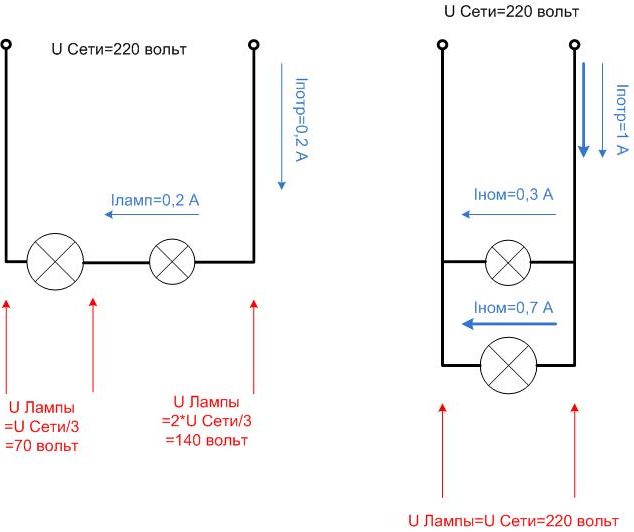
When connected in parallel, the voltage on both devices will be equal, each lamp will have its own current. The total current consumption is equal to the sum of two currents Ipotr \u003d 0.3 + 0.7 \u003d 1 ampere. Each lamp operates in nominal mode and consumes its own current.
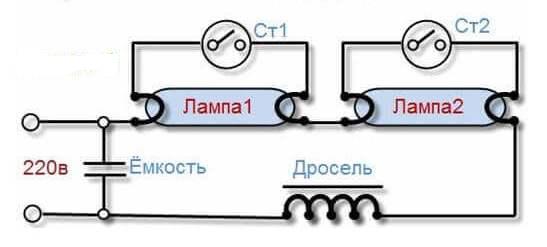
When connected in series, the current will be limited by the resistance Rtot=300+700=1000 Ohm and will be equal I=U/R=220/1000=0.2 A. The voltage will be distributed in proportion to the resistance of the thread (power). On a 140 watt lamp, it will be 1/3 of 220 volts - approximately 70 volts. On a low-power lamp - 2/3 of 220 volts. That is, about 140 volts. Both lamps will shine with a short duration due to a decrease in voltage and current, but the mode for them will be light. Another thing is if lamps are used at half the mains voltage. On a lamp of lower power, the voltage will be higher than the permissible one, and the difference will be greater, the greater the difference in power. Such a lamp will soon be out of order. And this is another drawback of the sequential inclusion of lamps. Therefore, such a connection is rarely used in practice. An exception is the series connection of fluorescent lamps. It is believed that with this scheme they work more stably.
Summing up the differences between parallel connection and serial connection:
- when connected in parallel, the voltage on all consumers is the same, the current is distributed in proportion to the power of the lamps (if the power is the same, then the currents will be equal), the total current consumption is equal to the sum of the currents of all lamps;
- when connected in series, the current through all the lamps will be the same, it is determined by the total resistance of the circuit (and will be less than the current of the lowest-powered lamp), the voltage at the consumers will be distributed in proportion to the power of the lamps (if it is the same, then the voltages will be equal).
Using these principles, you can analyze the operation of any circuit.
How to avoid mistakes
It is necessary to connect electrical appliances to the network in compliance with the rules of electrical engineering. Connection features are not obvious and may be incomprehensible to people far from the subject.
It is important to consider:
- Each type of connection has features associated with Ohm's law. In a series connection, the current is equal in all parts of the circuit, while the voltage depends on the resistance. In a parallel connection, the voltage turns out to be the same, and the total current strength is the sum of the values \u200b\u200bof the individual sections.
- Any circuit should not be overloaded, this can lead to unstable operation of devices and damage to conductors.
- In a parallel connection, the cross section of the wires must correspond to the applied load, otherwise overheating of the conductors is inevitable, followed by melting of the winding and a short circuit.
- A phase is supplied to the switch, zero goes to the lighting device. Failure to follow this rule may result in electric shock when replacing the lamp, since the device is energized even when it is turned off.
- The main wire from the lamp is connected to a common contact. If it is connected to a tap, only part of the circuit will work.
- Before installing the switch, it is better to mark the wires in advance. During installation, it will be easy to connect the conductors of the same name to each other.
Failure to follow recommendations may cause unstable operation of lighting equipment, rapid burnout of lamps and cause serious injury with a risk to life.