How does the light switch work in the apartment
The household light switch was invented back in the 19th century and did not undergo fundamental changes over the first almost a hundred years - only the design changed slightly. Only in the last few decades has there been a rapid development of electrical engineering in this segment, and now the consumer can choose different devices according to their design and purpose.
How does a single-gang switch work?
A household one-button switch is a familiar element of the environment.
Its main parts are:
- base with fastening elements;
- movable panel;
- contact group with movable and fixed contacts;
- decorative elements (usually made of plastic).
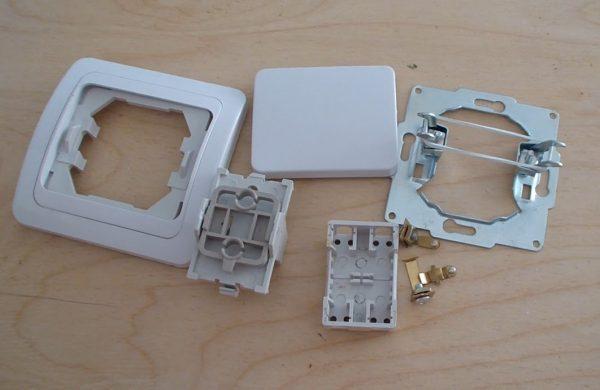
The principle of operation of any switch is similar - when exposed, open and close the electrical circuit. But different devices do this in different ways, depending on the features of the device and functionality.
Design Options
Lighting switches may vary in protection degree (IPxx, where xx are two digits indicating the level of protection against solid objects and particles and against water). Depending on it, the area of \u200b\u200bapplication of the device is determined. So, switches with IP 21 are used only indoors, and with IP44 or 54 they can also be mounted outside.
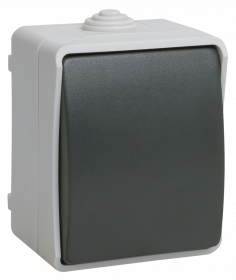
There are also switches for surface mounting and built-in type. The former are mounted on a lining and used in conjunction with open wiring. The latter are mounted in a recess on the wall, into which the socket box is built. Such installation is used with hidden wiring and is more aesthetic. The probability of mechanical damage to the devices is less, but the complexity of the arrangement is much higher.
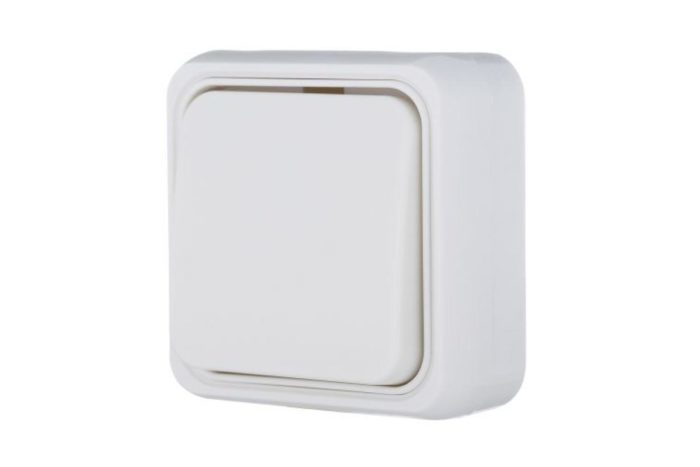
Also, the switches differ in the rated load (current or power) that the device can switch. The value indicated on the body or in the data sheet must not be exceeded.
| Breaker type | Device type | Load capacity of contacts, A |
| MAKEL Mimoza 12003 | Double key | 10 |
| Simon S27 | Button | 10 |
| Jilion 9533140 | Two-key through passage | 10 |
| Bylectrica Praleska | Three-key key | 6 |
| Schneider Electric GSL000171 GLOSSA | Cross | 10 |
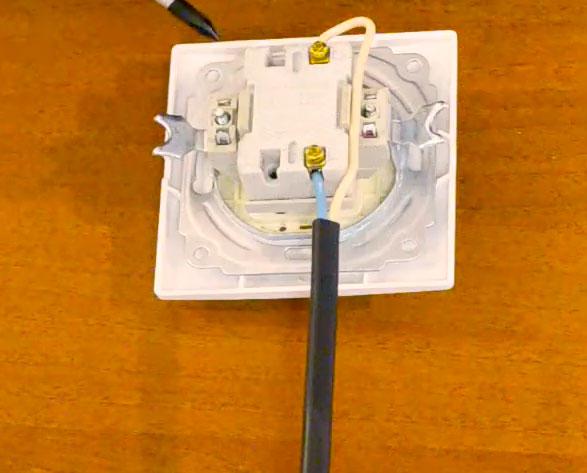
The device and operation of the backlit switch
Many switches are now equipped with a backlight circuit. It performs several functions:
- allows you to locate the switch in the dark;
- serves as an indicator of the disconnected state of the switching device;
- in some cases, the glow indicates the integrity of the lighting circuit (and in the case of incandescent lamps, the bulb is in good condition).
The lighting circuit is assembled on a device, for the glow of which a very small current is enough - a few milliamps. LEDs or miniature neon lamps are suitable for use in such conditions.
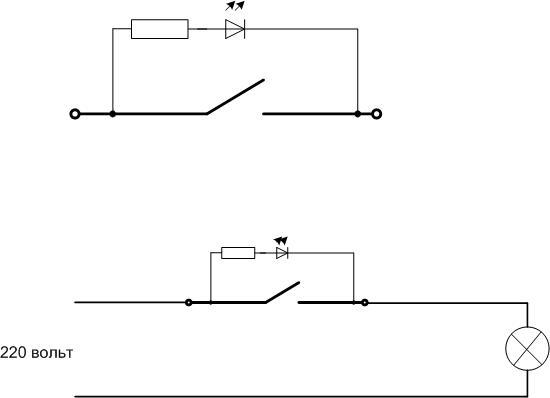
From the wiring diagram it can be seen that when the main switching device is turned off, a current limited by resistor and lamp resistance. If the switch is closed, the backlight circuit is bypassed and the LED is off. If you turn off the lamp, then there will also be no glow - the circuit is broken.
In an era dominated by incandescent lamps, the backlight circuit had no effect on the operation of the circuit. When energy-saving and LED lamps became widespread, even an extremely small current flowing through the resistor and LED in some cases causes unpleasant flashing lamps. To combat this phenomenon, it is necessary to shunt the lamp with a resistor of several kilo-ohms or a capacitor.
Terminals for connecting wires
There are two main types of terminals for connecting conductors to a switching device:
- screw – the conductor core is clamped by tightening the screws;
- clamping (spring) - it is enough to insert the conductor, the spring-loaded platform will press it itself.
Spring terminals are more convenient, installation is faster. But screw ones are considered more reliable.
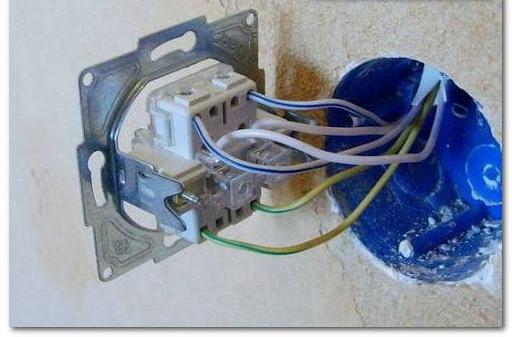
On the other hand, if the wiring is carried out with a cable with aluminum conductors, one should remember about the plasticity of this metal.Screw terminals require periodic tightening, otherwise bad contacts and the corresponding consequences cannot be avoided. Spring will tighten the wire themselves.
Marking on devices
Sometimes symbols can be seen on the front of the switch. They indicate the scope of the device.
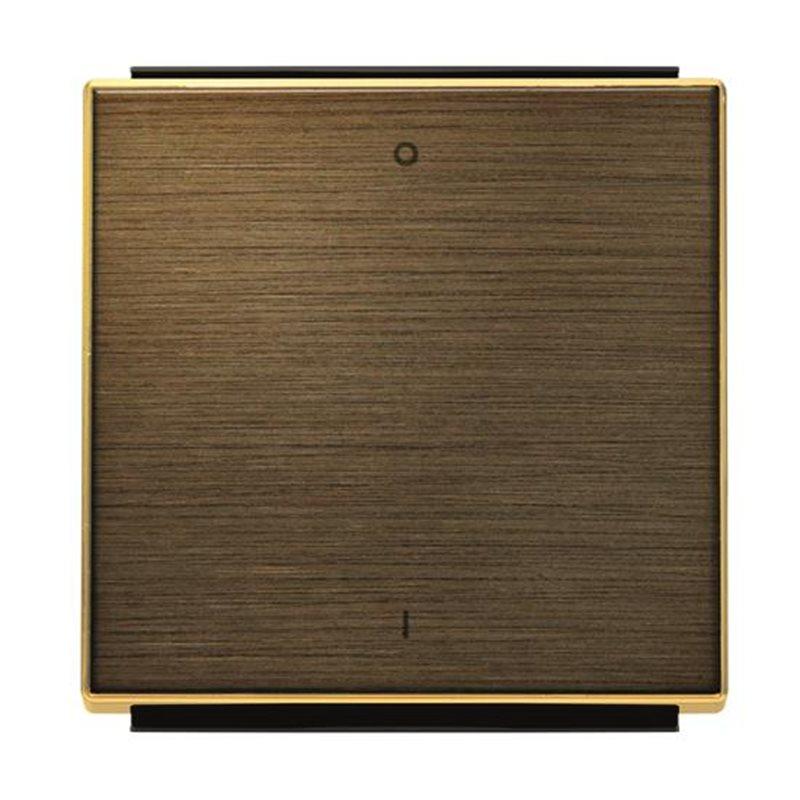
Conventional light switches equipped with keys may be labeled I and O, which means the on and off position.
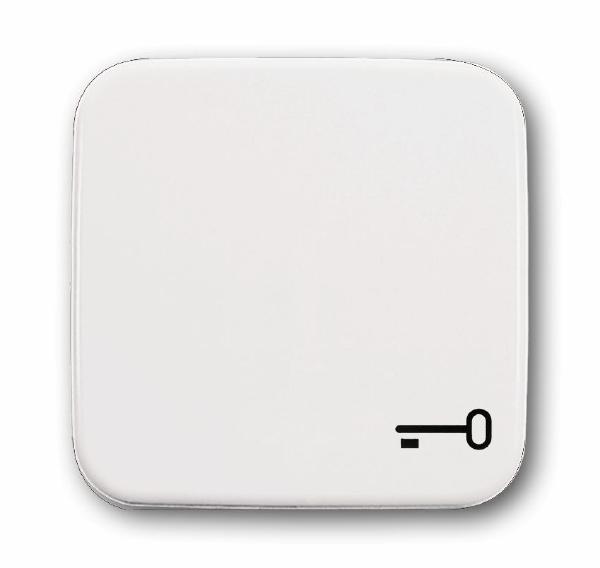
Also, for conventional devices that work only for closing and opening an electrical circuit, a designation in the form of a key symbol can be applied.
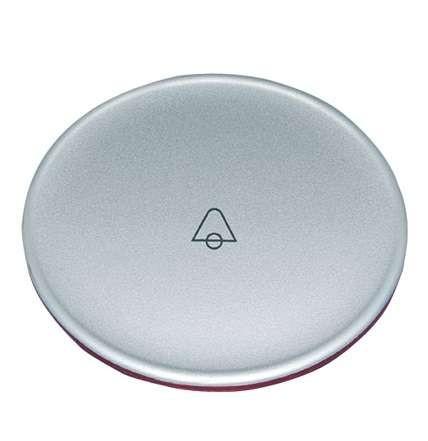
Pushbutton switches without fixation in one of the positions can be used both as bell buttons and as switches in a lighting system assembled on the basis of impulse relays. Such devices are marked in the form of a bell (bell).
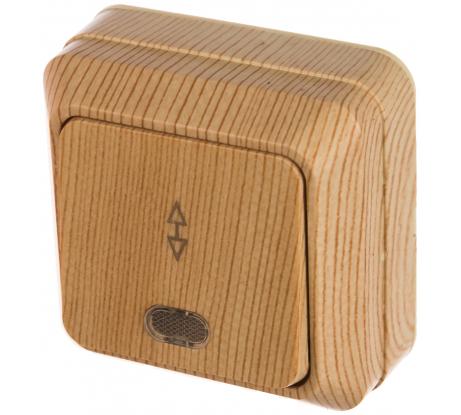
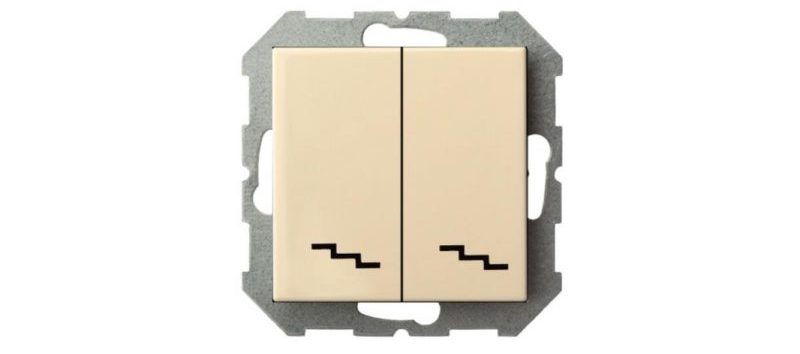
For appliances pass-through type symbols can be applied in the form of a double-headed arrow or in the form of a flight of stairs.
Some manufacturers have keys with space to insert a character. But in general, there is no single standard for marking devices, just as there is no obligation to put symbols on the front. Therefore, many manufacturers, both little-known and world leaders in the electrical engineering market, often neglect the application of designations.
The device of switches of various types
The purpose of any switching device is to turn on and off the light when exposed to it.But the required impact may differ depending on the design.
Key
This design is familiar to everyone. A conventional switch, in one position the contacts are closed and the light is on, in the other they are open and the lighting is off. They are available in single, double and triple versions.
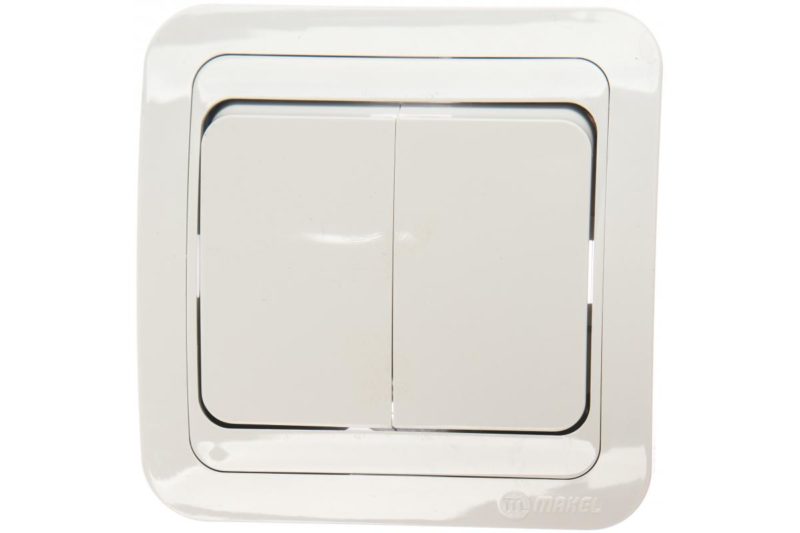
The device of the key-type switch has not changed much over the years - a movable panel that controls the contact group is hidden behind decorative plastic parts. All this is assembled on a supporting structure.
Button
The basis of such a switch is a button. There are two options for this device:
- With fixation. Works like a keyboard. When pressed for the first time, the button is fixed in the on position. At the second - it is wrung out to the off position.
- Without fixation. When pressed, the contacts close, when released, they open. Can be used for electric bells and for circuits with impulse relays.
The first type of devices is usually built into fixtures. The second one is mounted on a vertical plane.
Corded (rope)
The rope-type switch (“puller”) is available as a built-in wall lamp, and as an independent device for controlling lighting in a room. It is controlled by a cord that must be pulled.
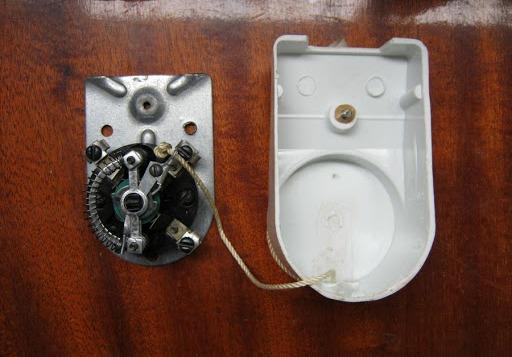
A rather complex mechanism works according to a simple algorithm - each manipulation of the rope changes the state of the contacts to the opposite:
- to turn on the light, you need to pull the cord once;
- turn off - pull a second time;
- turn it on again - the third time and so on in a circle.
With a certain degree of assumption, such a switch can be called a mechanical implementation of an impulse relay.The contact group in most cases works on closing-opening.
Turning
Rotary switches close and open contacts when the handle is turned. This is quite inconvenient, so such devices are now rarely used and only for design purposes.
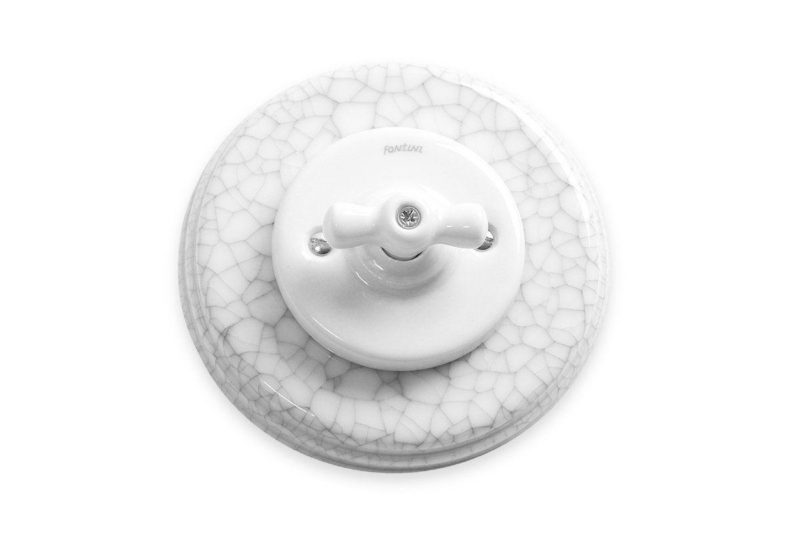
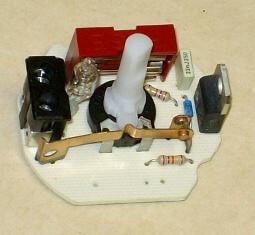
This category also includes some types of modern switches combined with dimmers (dimmers). To turn off the handle, turn it towards the minimum brightness and tighten it until it locks. To turn it on, turn the knob in the opposite direction.
Acoustic
Acoustic switch reacts to sound. The built-in microphone picks up the sound and converts it into an electrical signal, which is then amplified, filtered, compared with the set threshold.
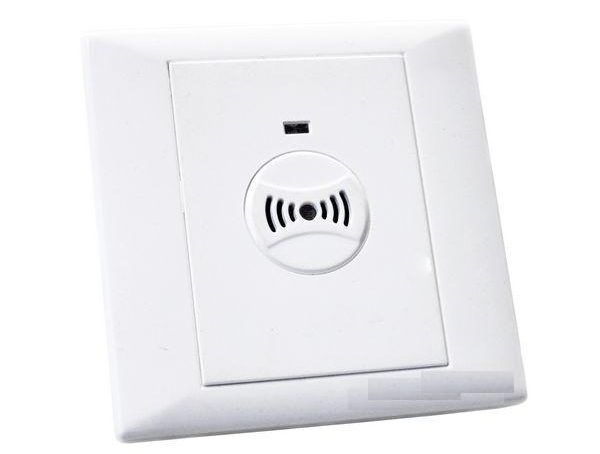
If the specified level is exceeded, a command is generated to turn on or off the load. Such a device convenient if there is a person with limited mobility in the apartment. But the noise immunity of such devices leaves much to be desired - unauthorized triggering from extraneous noise is possible.
Sensory
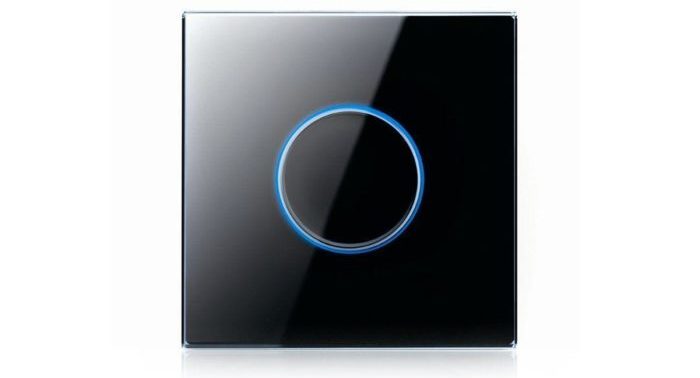
The device of the touch light switch is different in that to turn on the lighting, it is enough to touch the panel without making any effort to press it. The main advantage is the ability to embed additional functions, which is important when used in systems such as "Smart House". In other cases, it has more of an aesthetic function for decorating rooms in the Hi-Tech style.
The difference in functionality
Switches of even the same type and design can perform different functions.In most cases, this difference is determined by the design of the contact group, but not always.
Key
Ordinary household electrical circuit breaker, the most common type. Depending on the number of keys, it controls the corresponding number of contact groups.
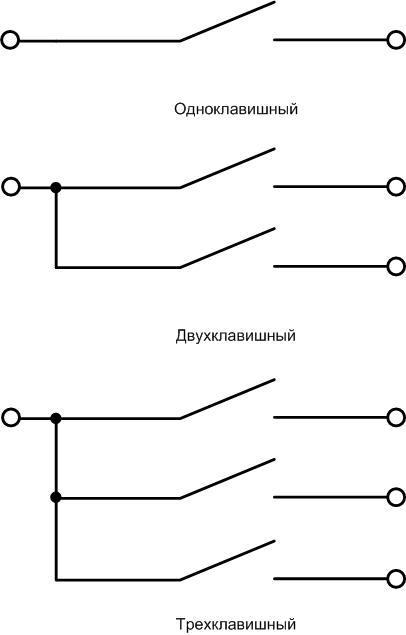
The contact pins on the supply side are usually combined.
Button
The principle of operation of a switch with a button differs only in the direction of action and, in some cases, in the absence of fixation in the pressed position.

The functionality of the contacts is the same, but it is arranged a little differently and is indicated by a different symbol on the diagram.
checkpoint
This type of switch is more like a switch. It is equipped with a changeover contact group - in one position one pair of contacts is closed, in the other - the other. Such devices are available in single-key and two-key versions.
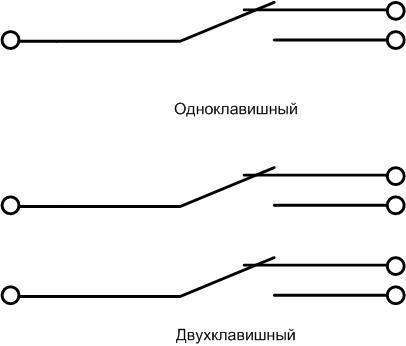
In appearance, it may not differ from a regular key (if there is no marking), but its internal circuit is usually applied on the back side. Available in single or double version.
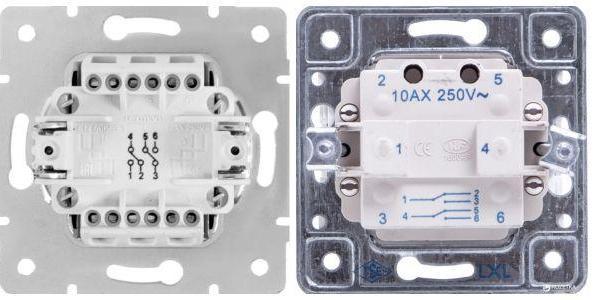
Such devices are used in cases where it is necessary to organize independent lighting control. of two or more points.
Cross
This switch has one key controls two changeover groups of contacts connected in a special way.
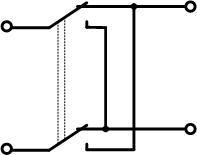
Such a device is used in conjunction with walk-throughs where it is necessary to control the load from three or more places.
Combined devices
To increase the comfort of light control in an apartment, office or at work, devices have been created that combine several functions. You can, for example, buy:
- rotary switch with dimmer;
- pass switch with dimmer;
- other appliances.
Devices based on microcontrollers have unlimited possibilities for combining functions. Such switches are used in Smart Home systems.
Recommended for viewing.
There are many household light switches available for sale, differing in design, functionality, and appearance. With their help, you can organize a lighting system from simple to controlled from a smartphone. To do this, it is important to understand the possibilities and know the range of modern switching devices.