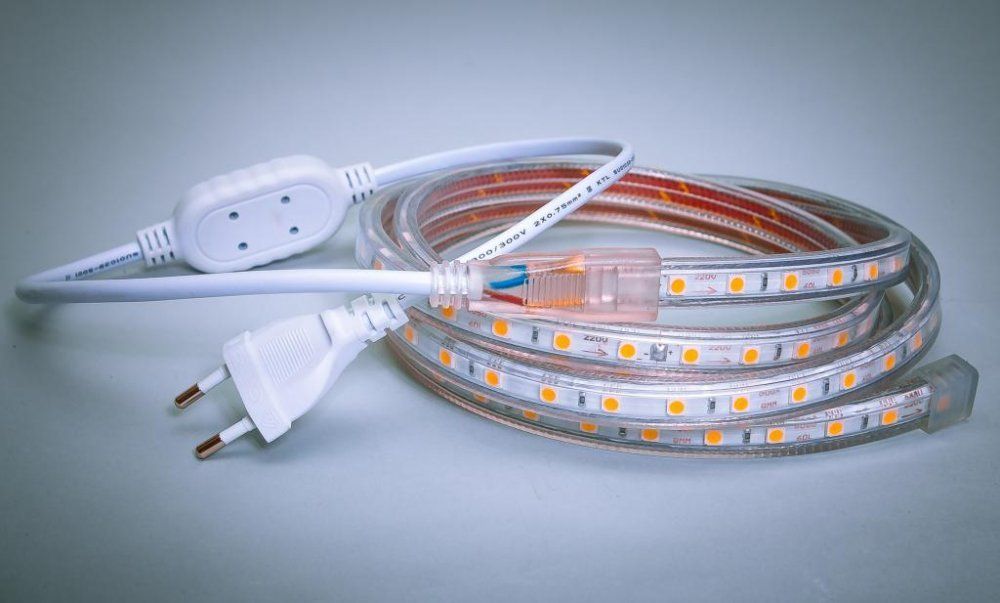
Scheme for connecting an LED strip to a 220V network
Lighting devices in most cases are powered by a 220 V household electrical network. Of the alternatives, perhaps only lighting devices connected to the on-board network of cars or motorcycles can be mentioned. In other cases, at the beginning of the LED strip power supply circuit, there is always a 220-volt alternating voltage source, be it a household outlet or a switchboard. In practice, there are various options for connecting LED-lamps, which depend on the parameters of the lighting device.
220 V tape features
The most trivial option is to use a tape designed for the full voltage of the network. However, it is highly undesirable to directly connect the lamp to a household network. Although the light emitting elements are one-way conductive and glow during the positive half-wave of the sine wave, a voltage of reverse polarity is applied to them during the negative half-wave.LEDs are not designed to work as high-voltage rectifiers, so the reverse voltage for them will be too high, and the life of the elements will be short. The LED strip should be switched on through a rectifier - it is better through a bridge assembly (full-wave circuit).

The downside of using high voltage with equal power is a reduced current, so the segments of the web can be connected in series with a total length of up to 100 m (low-voltage lamps - up to 5 m). Also, a plus is the ability to use conductors of reduced cross-section for connection, but not to the detriment of mechanical strength.
Important! The main disadvantage of this option is the extreme undesirability of using a high-voltage tape indoors.
You can use to adjust the brightness Dimmer - it is connected to the rectifier. The dimmer can be either manual with a rotary key or remote controlled.
Low voltage tape
If, according to local conditions, it is impossible to use a 220 volt lamp, you will have to use tapes for a voltage of 5/12/24/36 volts. And there are various connection options to the home network.
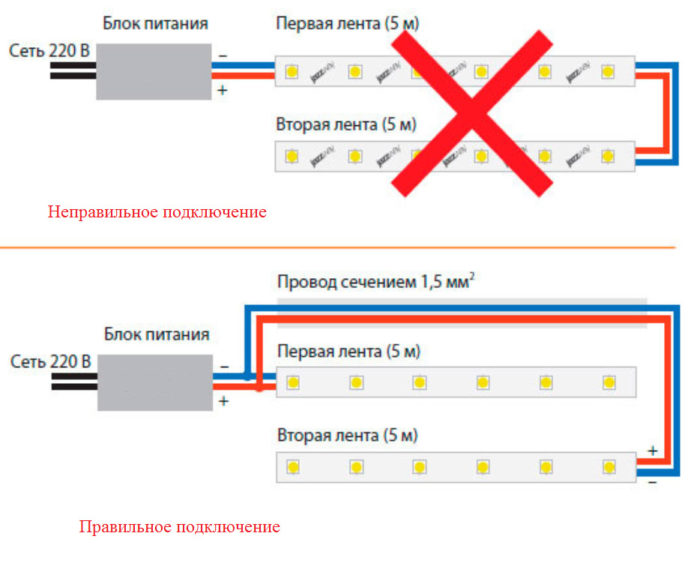
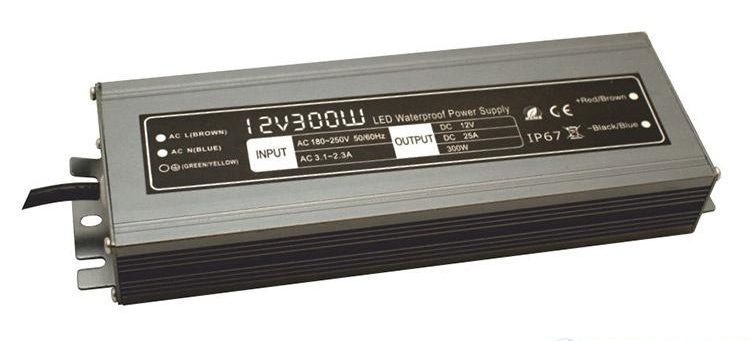
Power Supply
The most obvious option is to operate the lighting device in conjunction with a power supply for the appropriate voltage. Bulky and uneconomical sources, built according to the classical scheme with a step-down transformer, have long been displaced from the field of LED lighting by light and powerful pulsed units.Therefore, the choice of PSU is made mainly according to two parameters:
- output voltage;
- maximum allowable load power.
The first characteristic is selected simply: the voltage must correspond to the voltage of the tape. The second depends on the load and is calculated by the formula Rbp=Rud*L*K, where:
- Rud - the power consumed by one meter of the web;
- L - the total length of the tape segments;
- To – safety factor equal to 1.2..1.4.
The result is rounded up to the nearest standard value. If the power supply does not indicate power, but the maximum allowable current, it can be converted into power using the formula Рbp=Imax*Uout.
with ballast element
Connecting an LED strip to a 220 V network without a power supply is possible, but undesirable for security reasons. Each point of the circuit will be under full mains voltage, so all manipulations must be performed with the tape completely turned off. But if safer options are not available, you can connect to the network through a resistor that will extinguish the excess voltage. Its value is chosen so that at the operating current (determined by the power of the lamp), the difference between the mains voltage and the rated voltage of the tape falls on it:
Rb \u003d (Unetwork-Unom) / (Inom), where:
- Rb – value of ballast resistance;
- Network – mains voltage;
- Unom - rated voltage of the tape;
- Inom - rated current of the tape, calculated according to the formula Rud * L / Unom.
Important! In this calculation, it is necessary to use the amplitude value of the mains voltage of 310 V.
If you set the values of the nominal voltage of the tape 5 volts, the power of 1 meter of the web is 10 W and the total length is 5 m, you can calculate the value of Rb:
Rb \u003d (310-5) / ((10 * 5) / 5) \u003d 305 / 10 \u003d 30.5 Ohm. You can take the nearest standard value of 33 ohms. At first glance, such a connection is much cheaper and easier than with a power supply.

In fact, everything is not so rosy. First you need to calculate the power dissipated in the ballast, as the current multiplied by the voltage (here the effective voltage value of 220 V is taken):
Pb \u003d Inom * 220V \u003d 10A * 220V \u003d 2200 W. It is difficult to find a resistor of such power, and it will have the appropriate dimensions. And with an increase in the power of the canvas, the calculated resistance will fall, and the dissipated (wasted!) Power will grow, so this method is applicable only for low-power lamps. This problem can be circumvented by using a capacitor instead of a resistor as a ballast. Its capacity is calculated using the following formula:
C \u003d 4.45 (Unetwork-Unom) / (Inom), where C is the capacitance in uF.
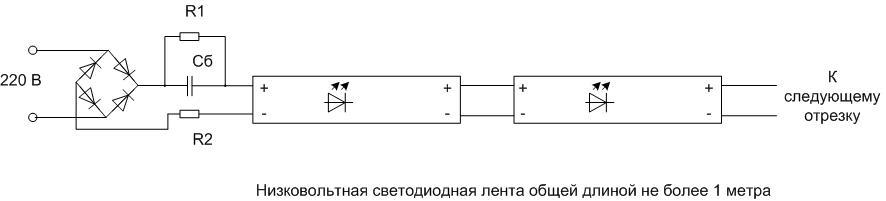
The capacitor must be designed for a voltage of at least 400 V, and two resistors must be added to the circuit:
- R1 - with a resistance of several hundred kilo-ohms to discharge the capacitor after turning it off;
- R2 - to limit the charge current at the time of switching on, its value can be several tens of ohms.
But this problem is not the only one:
- It was mentioned about electrical safety issues during the operation of tapes with such a connection. Therefore, only a tape in a silicone sheath can be powered in this way, and the joints must be carefully insulated.And it would be a very bad idea to use such a connection in wet rooms (pools, baths, aquariums).
![Silicone coated options]() Options in a silicone shell are not afraid of water, but they heat up much more strongly.
Options in a silicone shell are not afraid of water, but they heat up much more strongly. - The calculation is correct only for a certain tape of a given length. With any replacement or change in the length of the web, the ballast must be recalculated.
- The voltage in the network in normal mode can deviate within 5%, the maximum allowable is 10%. Also, the accuracy of the most common resistors is 10%. Taking into account the spread of the parameters of the tapes relative to the declared ones, the voltage on the tape (and the current through the LEDs) can differ significantly from the calculated ones, even if the calculations are refined by actual measurements - simply due to fluctuations in the mains voltage. The result can be, on the one hand, a decrease in the brightness of the glow, on the other hand, the failure of the lamp due to overcurrent. This problem manifests itself more clearly, the lower the supply voltage of the tape. When using a capacitor, the problem is exacerbated because the range of capacitances is rarer than the range of resistances, and the actual accuracy is lower.
- When using a dimmer to adjust the brightness or a controller to control the color of the glow RGB tapes the current through the LEDs will change, at the same time the voltage drop across the ballast will change, which will also exacerbate the instability of the voltage drop on the tape synchronously with the change in current. That's why the use of devices for regulating the intensity of radiation is excluded.
Due to the totality of problems, such a connection should be used only if it is completely impossible to use the power supply for the appropriate voltage.
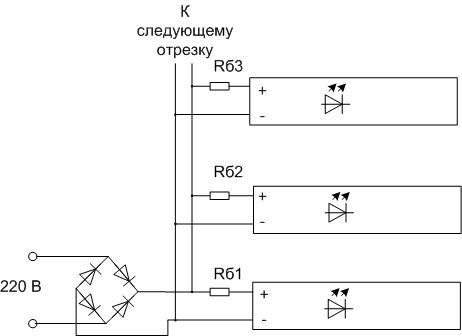
If several pieces of fabric with a total length of more than 1 meter are used, they must be unite parallel. Otherwise, the strip conductors will not be able to handle the total current of the lighting system. It is even better to calculate the ballast for each segment separately. If replacement is required, only the blade being replaced will be subject to recalculation. The diode bridge must withstand the total current of all sections of the tape with a margin.
Typical connection errors
When connecting the tape to the network through the power supply, the most common mistake is the wrong power calculation. Therefore, when you first turn it on, it would be ideal to measure the actual current consumption with an ammeter, convert it into power and compare it with the maximum power of the power source. This procedure must be done without fail if, when turned on, the power supply starts making uncharacteristic sounds, there are signs of excessive heating, etc.
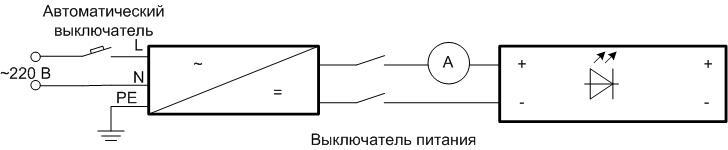
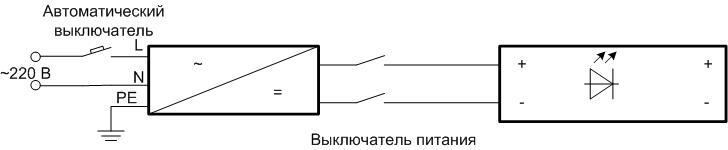
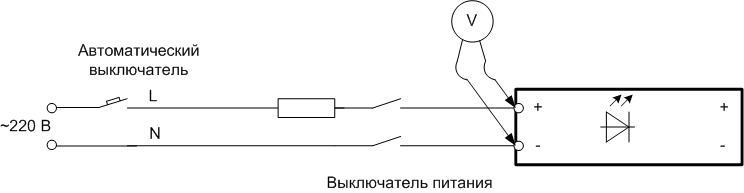
When using a power supply, it is highly desirable to provide a switching device on the input side and on the output side. On the high side, disconnection can be made by simply removing the plug from the socket. In the case of a permanent connection, it should be possible to remove the voltage from the input by turning off the circuit breaker (it should always be there!).
It is not necessary to observe phasing (connection of zero and phase to the corresponding terminals of the power supply unit), this does not affect the performance in any way - there is a rectifier at the input of the switching power supply. But when switching, it is necessary to break the phase conductor or phase and zero at the same time (when connected through a socket, this is done by itself).The earth conductor (PE), if any, must always be connected - this is the only way to ensure safe operation. The protective earth must not be interrupted.
With a transformerless connection, the importance of measuring the actual current is even more important. But instead, when you first turn it on, you can measure the actual voltage on the contact pads of the tape. If it strongly deviates from the nominal, it is necessary to correct the nominal value of the ballast in the appropriate direction. If the voltage at the consumer is lower than necessary, then you need to reduce the value of the resistor or increase the capacitance of the capacitor. If the voltage is higher, do the opposite. Measurement must be done with all precautions, without touching the non-insulated parts of the multimeter probes.
Also, for low-voltage tapes, it may be a mistake to use connecting conductors with a cross section less than required for the existing current. During operation, it is necessary to pay attention to the temperature of the wires (ideally, if there is a pyrometer, a thermal imager or other diagnostic equipment for this purpose). If there is an increase in heat, you need to replace the wires with thicker ones. To avoid mistakes initially, you can use the section table.
| Cross-section of a copper conductor, sq. mm | 0,5 | 0,75 | 1 | 1,5 | 2 |
| Maximum allowable current with open laying, A | 11 | 15 | 17 | 23 | 26 |
Be sure to watch: LED strip 220 Volt top or trash, the better and worse the tape 12 Volt.
You can connect the LED strip to 220 V in various ways. But the best way is still switching power supply application. All other methods are an alternative in hopeless cases.