Calculation of power consumption of LED strip 12V
LED lighting has almost completely replaced incandescent lamps. Due to their low power consumption and powerful light output, LEDs save millions of kilowatts of energy generated on the planet. The low power consumption of the LED strip and its mass application have already conquered most of the world. In this article, we will look at what the power of an LED strip is, how to calculate it, what it affects and how to use this parameter correctly when choosing.
Determination of power
Power is a physical quantity, an indicator that characterizes the amount of energy consumed over a period of time. The unit of measurement, according to SI (international system of measurement) is watt, abbreviated W.
The calculation formula will help us calculate the power:
P=I*U,
where P – power, I – circuit current, U – mains supply voltage.
Based on the formula, to determine the power of the device, we need to measure the current and voltage in the circuit. To measure the current, the ammeter is connected in series to the circuit (make a break in any wire and connect the ammeter probes to it), the voltage is measured at the connection point.
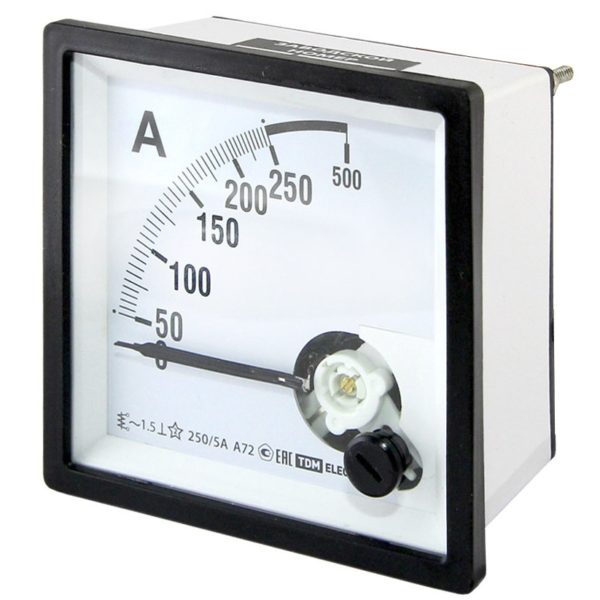
Such a formula helps to calculate and find out how many watts of energy the device will consume in one hour of time, and in our case it helps to determine how much power the power supply should be purchased.
Example: current strength 4 A, supply voltage 13.5 V, power is 4 * 13.5 \u003d 54 W.
LED Strip Light
The LED strip is a flexible strip based on a copper conductor, LEDs are placed over the entire area. It is divided into modules. The module is a section of the tape on which three LEDs and a resistor are installed. Thanks to this design, it is possible delete non-working area and replace his new.
LED strips have a degree of protection. It is selected depending on the place of application and environmental conditions. For example, the IP20 class is only suitable for dry rooms, as it will protect the tape only from dust. Degree of protection IP68 reliably protects not only from dust, but also from moisture, drops and splashes of water.
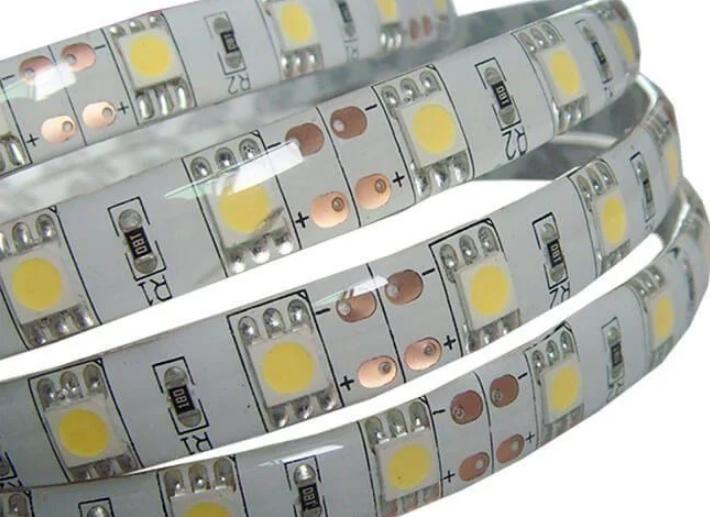
LED strips differ in the size of the LEDs installed in them, their power consumption, color and light output. Later we will look at how to determine how much power and how much tape we need for the right and high-quality lighting.
How to determine the power of the LED strip
The parameter to which you need to pay attention in the first place. As a rule, the amount of light emitted also depends on it.Tapes with higher power consumption have more luminous flux. It depends on the type of LEDs installed in the modules. There are many types different LEDs. Let's look at a few of them using an example in the table.
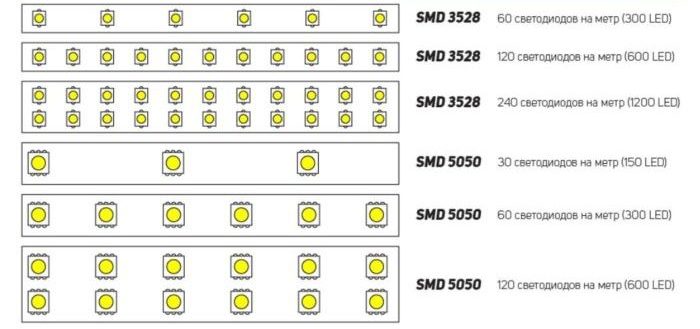
The figure above shows how many LEDs are installed in one meter of the LED strip. Each LED has an individual power consumption, if you know its type, then the power can be calculated using the formula and parameters from the table below.
Using simple mathematical calculations, you can also calculate the energy consumption of one meter of tape per hour of operation by multiplying the number of LEDs by their power.
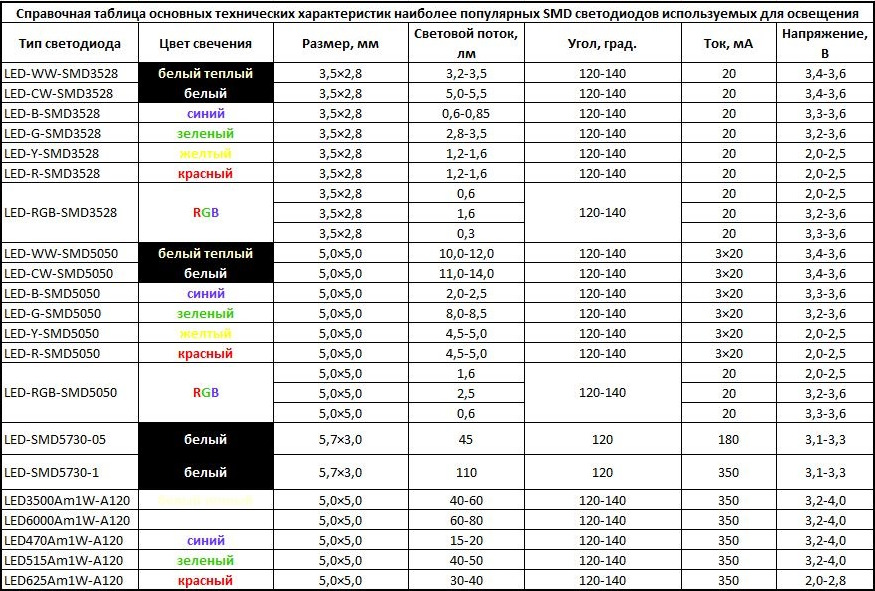
Calculation example: you have chosen an LED strip with an LED type SMD3528, on an area of one meter, the number of elements is 60 pcs. Green ribbon. From the table: current 20 mA (I), voltage 3.2 V (U). Convert milliamps to amps 20/1000=0.02. P \u003d I * U, 3.2 * 0.2 \u003d 0.096 W. The number of LEDs is 60, the power of one is 0.096 W, therefore 60 * 0.096 \u003d 5.76 W. The power of the LED strip per meter was 5.76 watts. One coil contains 5 m of LED strip, 5*5.76=28.8 W, so the power consumption will be 28.8 W per hour.
The manufacturer indicates the power on the packaging of goods, but it is strongly recommended to check it before installation. It may turn out that it does not correspond to the declared. Let's give a clear example of the difference in the power of LED strips in the table.
Table of power consumption of LED strips of different types.
| LED type | Diodes per 1 meter | Power, W |
| SMD 3528 | 60 | 4,8 |
| SMD 3528 | 120 | 7,2 |
| SMD 3528 | 240 | 16 |
| SMD 5050 | 30 | 7,2 |
| SMD 5050 | 60 | 14 |
| SMD 5050 | 120 | 25 |
How to choose the right power supply
The tape power supply is selected based on the load that is connected to it. To do this, the total load of all connected tapes is summed up. Depending on the convenience of switching and the power of the equipment, two or more power supplies can be used in the lighting system.
For the correct and stable operation of the equipment the power reserve of the device must be at least 20% connected load. It allows you to reduce the heating of the device.
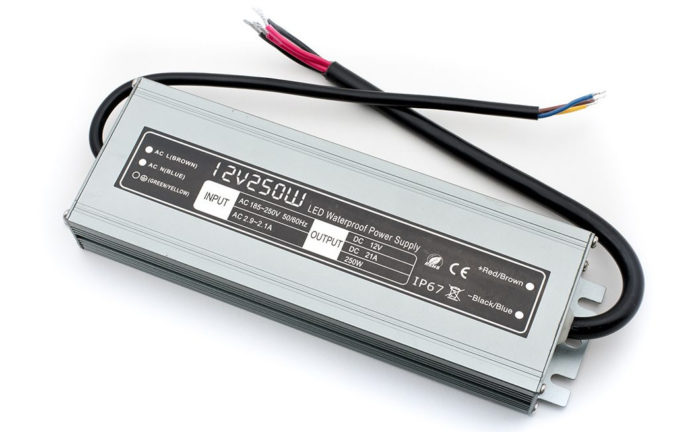
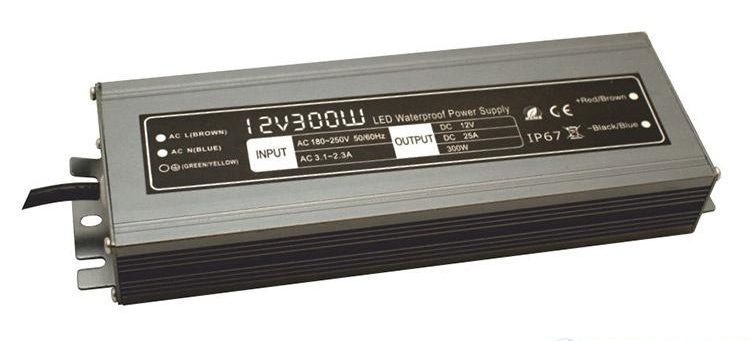
The label of any power supply indicates how much load it can withstand. If the total calculated load of the circuit is 200 W, then the given example of a power supply will completely suit us: 200W+20%=240W. Do not exceed the permissible load threshold - the device will heat up and quickly fail.
What power to choose a tape for lighting a room
We promised to tell you how to find out how much light is needed for the necessary and high-quality lighting in the room. Knowing the power of the LED strip, it is not difficult to determine how much light we will receive from it. In the table of characteristics, such a parameter as luminous flux is indicated. What does this mean?
Theory
Light flow - a value that indicates how much light the emitted stream emits. It is measured in lumens (Lm for short).
Illuminance is measured in lux (abbreviation according to SI - lx) - shows the ratio of the magnitude of the fall of the luminous flux from one meter of height to one square meter of area.
Illumination depends on how far away the light source is. The farther away the lamp, the weaker it shines. In physics, this phenomenon explains the inverse square law.
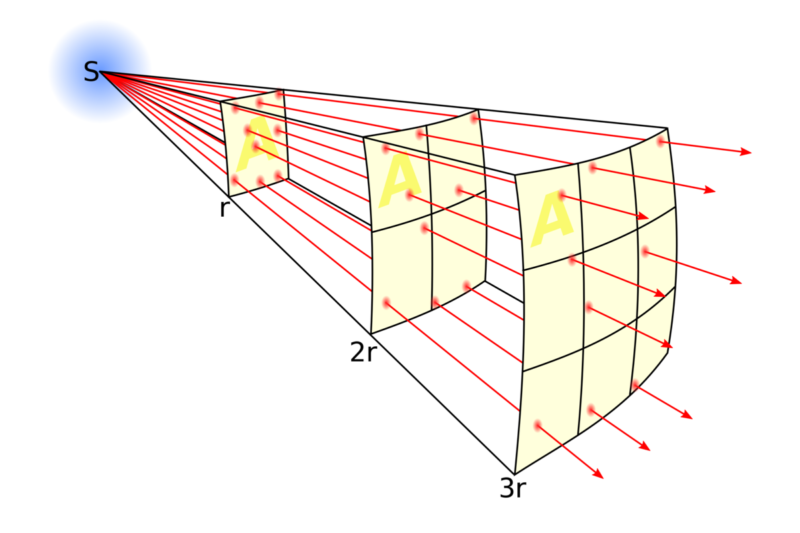
The inverse square law states that the value of a certain physical quantity at a particular point in space is inversely proportional to the square of the distance from the source, which characterizes this quantity.
Calculation
Let's say the ceiling of our room has a height of 3 m and 20 cm. The already compiled ceiling height coefficients will help us simplify the calculation task:
- Height 2.5 m - 3 m = coefficient 1.2;
- Height 3 m - 3.5 m = coefficient 1.5;
- Height 3 m - 5 m = coefficient 2.
Table of norms of illumination of a dwelling.
| Room type | Illumination level, LK | The maximum value of the pulsation coefficient,% |
| living rooms | 150 | 20 |
| Kitchen | 150 | 25 |
| Bathroom | 50 | - |
| The corridor | 50 | - |
| Toilet | 50 | - |
| Hallway | 30 | - |
| stairs | 20 | - |
The table indicates that the living room requires a minimum of 150 lux of illumination. The formula for calculating using the coefficient:
E=N*K*S,
Where N - required illumination K - ceiling coefficient, S - area of the room.
Let's take the average values of the dimensions of the room 3 meters wide and 4 m long, the ceiling height is 3.2 m, therefore:
150*1.5*12=2700 lm.
Calculate the luminous flux of the tape. Consider the calculation on the example of SMD5050 tape 60 pcs/m, white color.The table shows the luminous flux of 11-12 lumens from one LED. We take 5 meters of tape, 60 LEDs in a meter, 300 in five meters. We will multiply the average value of the luminous flux 300*11.5=3450 lm. Received the value of the strength of the luminous flux of 3450 lm.
Conclusion: 5 meters of tape will be enough to illuminate the living space.
Useful video: Connecting and calculating the power of an LED strip.