How to mount the LED strip yourself
LED lighting is rapidly replacing other light sources, even from those niches where the positions of traditional devices seemed unshakable. Moreover, the appearance of LED equipment on the lighting market has made it possible to create new lamps, which not so long ago did not even exist. So, LED strip is rapidly gaining popularity. With its help, you can create a bright, durable, but energy-efficient household or decorative lighting. Installation and connection of the LED strip can be done independently.
Methods for mounting LED strip
This class includes luminaires with a supply voltage of 12.24 or 36 V. Such devices are recommended for use in residential or office premises (devices for 220 V can also be used outdoors). The choice of the method of mounting the lighting device is made on the basis of its linear or specific power. This is the name of the power consumption of 1 meter of canvas.
Low power LED luminaires
This category includes devices with linear consumption up to 10 watts. They can be mounted directly on the underlying surface. For fastening, manufacturers have provided a regular adhesive layer. You just need to remove the protective shell and stick the substrate in the right place. The natural movement of air is enough to cool the lamp.

The success of the event largely depends on the preparation of the surface:
- the place of gluing the canvas should be even;
- it must be cleaned of dust, pollution;
- immediately before the sticker, it is necessary to degrease the prepared surface along the entire length (if it is not paper wallpaper).
If it was not possible to glue the canvas the first time, it will not work the second time to use the standard adhesive layer. You will have to use double-sided tape, which must be glued along the route of laying the canvas, and then attach a tape lamp to it. The same method can be used immediately if there are doubts about the quality of the regular glue. For example, when storing a lamp for a long time.
Another way is to use modern glue. For example, from the series "liquid nails" or some kind of superglue. It is not worth completely lubricating the surface of the canvas - one drop per few centimeters is enough.
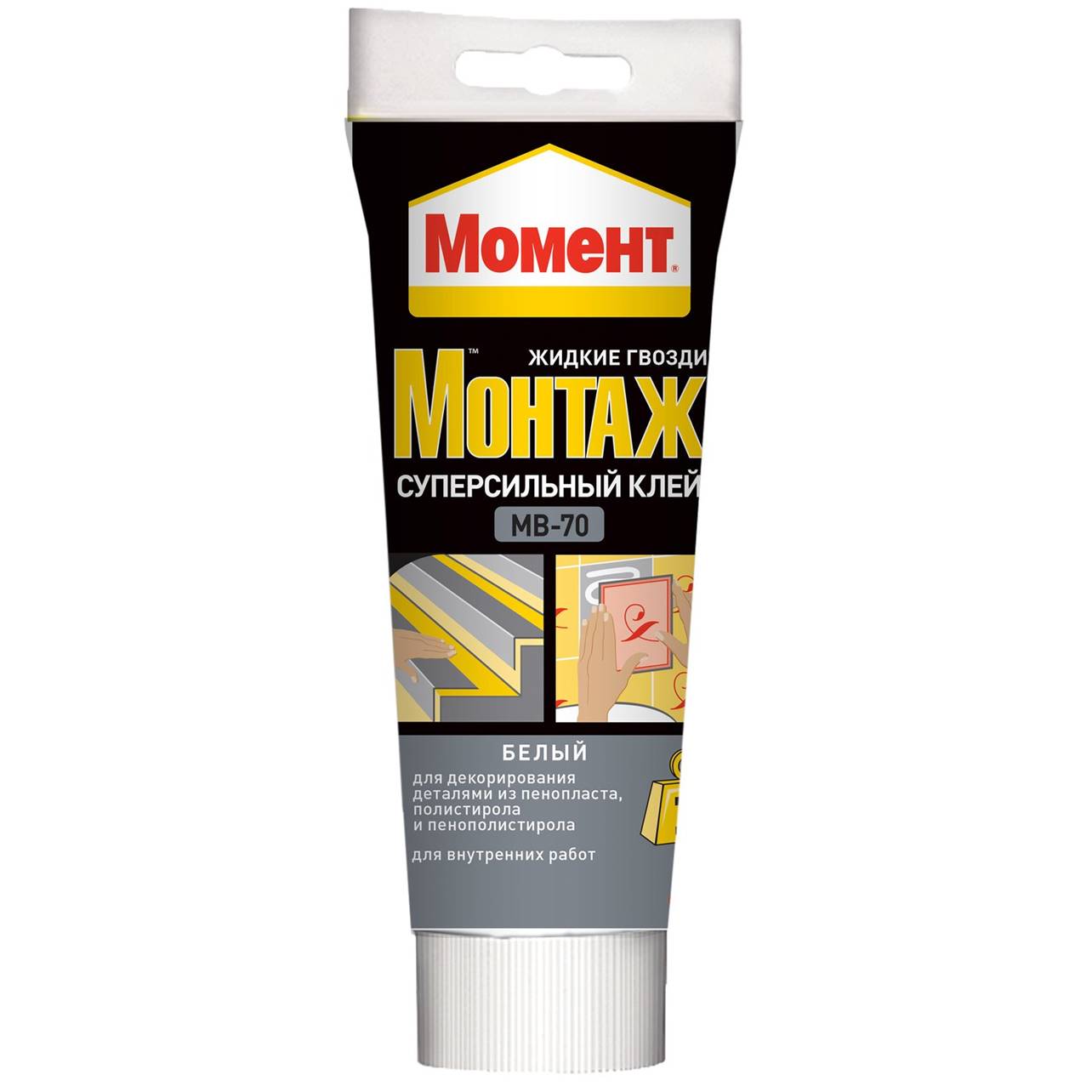
Do not use hot melt adhesive to fasten the LED strip light sheet. During operation, the substrate will inevitably heat up, the hot-melt adhesive will melt, the canvas will peel off quickly enough.
to alternative fastening methods can be attributed to the suspension of the tape using metal staples and a furniture stapler.This path cannot be recommended as it is easy to damage the web guides during assembly. The method of suspension on plastic clamps is deprived of this drawback, but the aesthetic moment in this case is close to zero. Therefore, this path is applicable only when the luminaire is suspended outdoors.
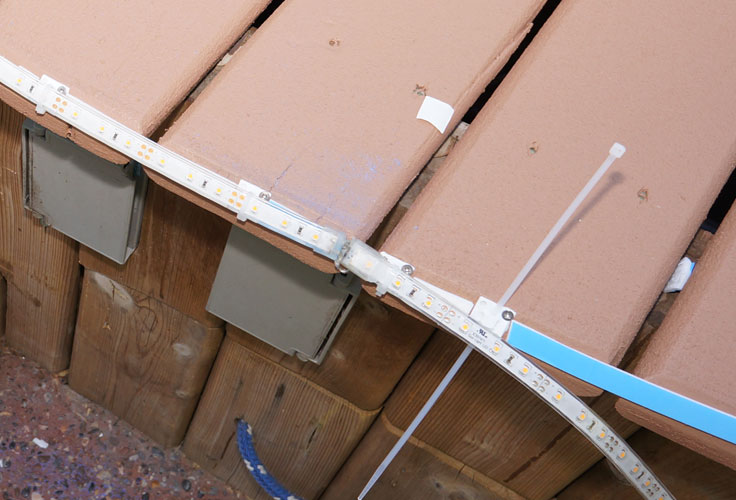
Medium power tapes
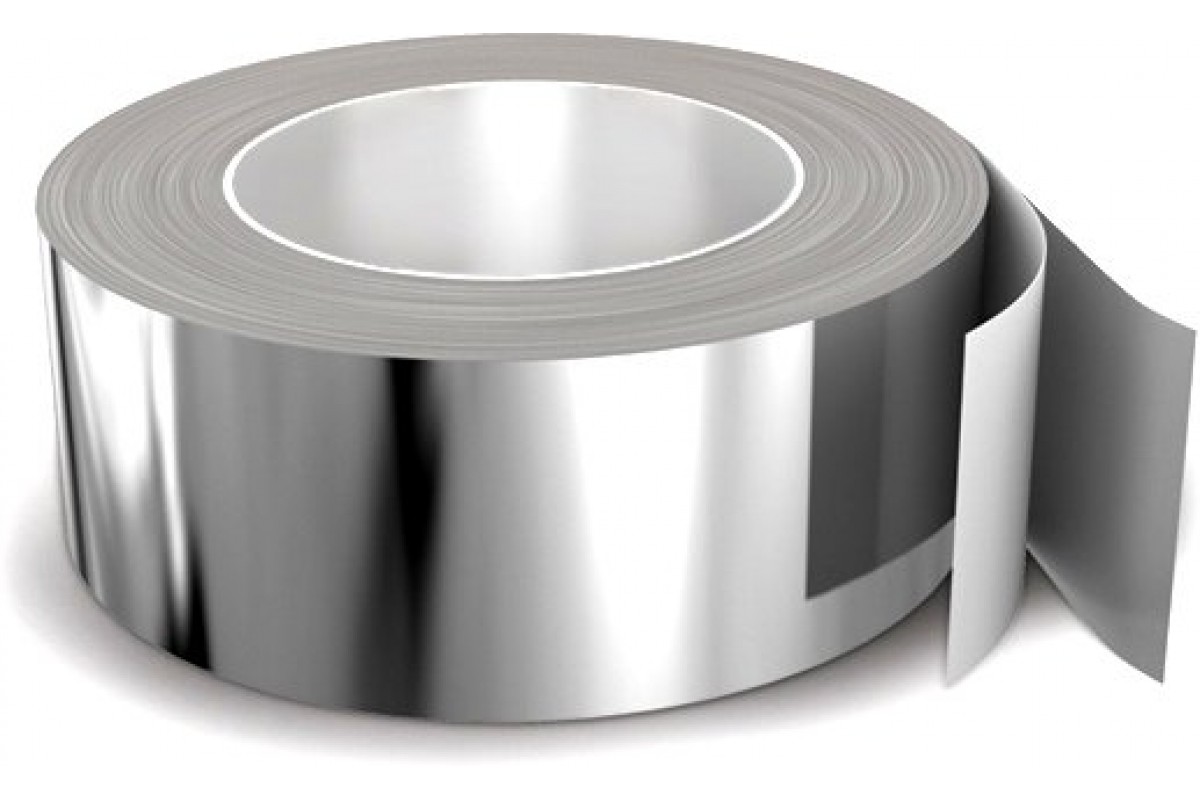
If 1 meter of the lamp consumes 10-14 watts, it will already need a small heat sink. It can be double-sided adhesive tape based on aluminum. If the fabric is glued to such an adhesive base, then with an open laying, sufficient heat dissipation can be carried out in such an inexpensive, uncomplicated and rather aesthetic way.
Important! Aluminum tape conducts electricity. When removing the protective layer from the luminaire fabric, contact pads may be exposed on the reverse side. It is necessary to insulate them with any material (duct tape, plastic, rubber) in order to avoid a short circuit when you first turn it on.
Installation of high power luminaires
If the LED strip consumes more than 16 W per 1 m of length, it must be mounted on an efficient heat sink. For this purpose, use an aluminum profile, which is specially made for mounting LED strips. Three types of profile are available for sale:
- overhead – easy to mount on the surface or on a suspension;
- angular – optimal for installation in corners for lighting at an angle of 45 degrees;
- mortise - completely hidden in the thickness of the groove.
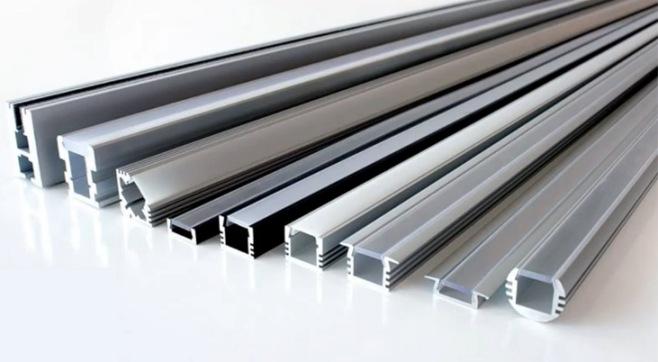
In addition to the technical function, the profile also plays a decorative role. Here you also need to be careful not to stick unprotected pads on aluminum.
Wiring diagram
The LED strip is a bay that can be cut in certain places. If you follow this rule, then the shortest segment will contain several series-connected LEDs and a resistor.
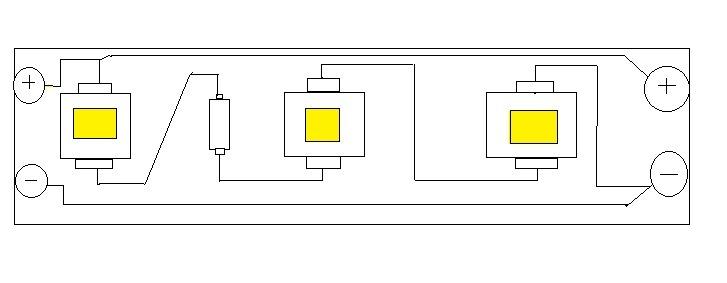
The scheme of the RGB (RGBW) tape is somewhat more complicated, but the principle is the same - when cut in the established places, you can get a segment with series-connected elements.
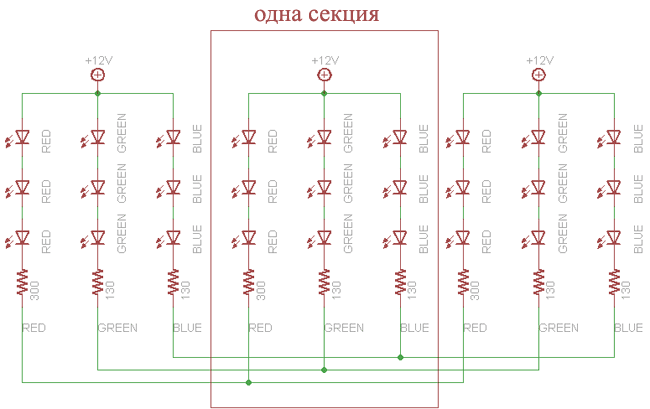
If you cut non-neighboring terminals, then you can get several such segments connected to each other. Therefore, the prepared pieces of tape are also connected in parallel to each other, but they must be connected in series. So the scheme of this lamp is built.
To assemble a complete circuit, you will need a power source for the appropriate voltage and current consumption, which is equal to the current of the full length of the web used with a margin of 20-30%. LEDs are undemanding to many parameters of the supply voltage, so they do not need a power supply with a good smoothing filter or even a stabilizer. A light, compact and inexpensive switching voltage source is quite suitable.
You will also need a power switch. In some cases, a mains protection circuit breaker will be required. As a result, the general scheme for connecting a monochrome tape will look like this:
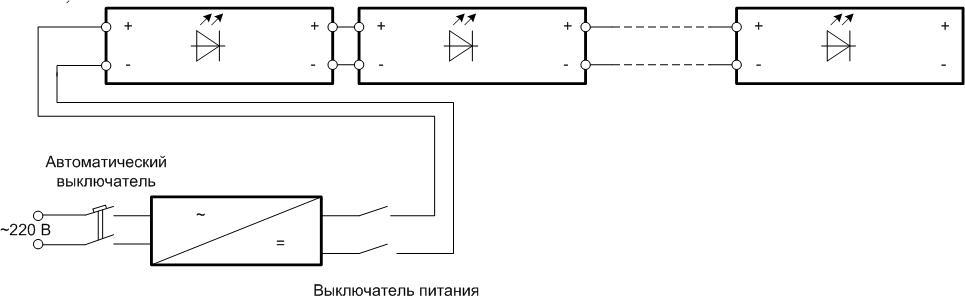
The minimum current of the circuit breaker is selected with a small margin from the ratio Iwork>Itape*(220/Usupply), where Usupply is the supply voltage of the tape.
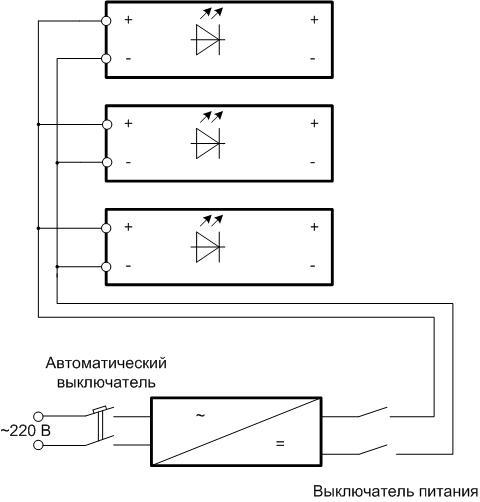
According to this scheme, you can connect pieces up to 5 meters long, up to a maximum of 10 meters.If the total length of the segments is longer, then too much current will flow through the conductors on the web, which will lead to overheating or burnout. Therefore, canvases with a large total length are divided into groups of 5-10 meters and fed in parallel.
An RGB tape is connected in a similar way, but it is not interesting to use it in a static mode, so another element appears - an RGB controller that controls the colors of the glow in the dynamics.
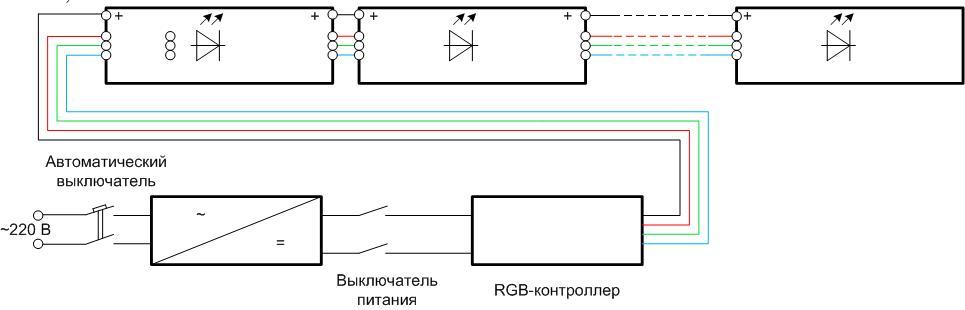
If the total length does not allow the tape to be powered in series, they proceed in the same way as in the monochrome version, but one more problem is added - the load capacity of the controller. In order not to overload its outputs, signal amplifiers are added - one for each group of segments.
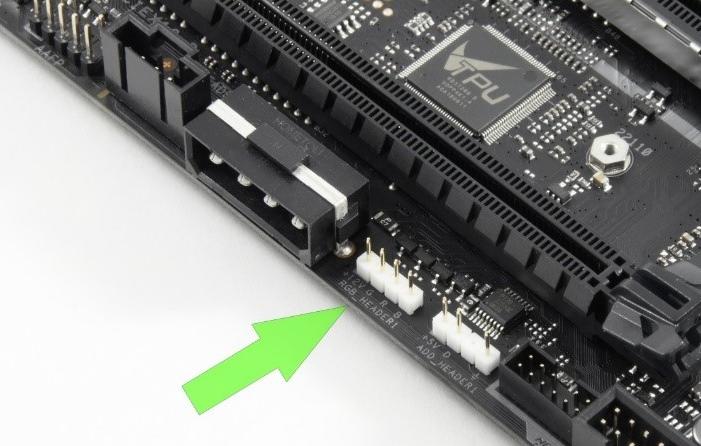
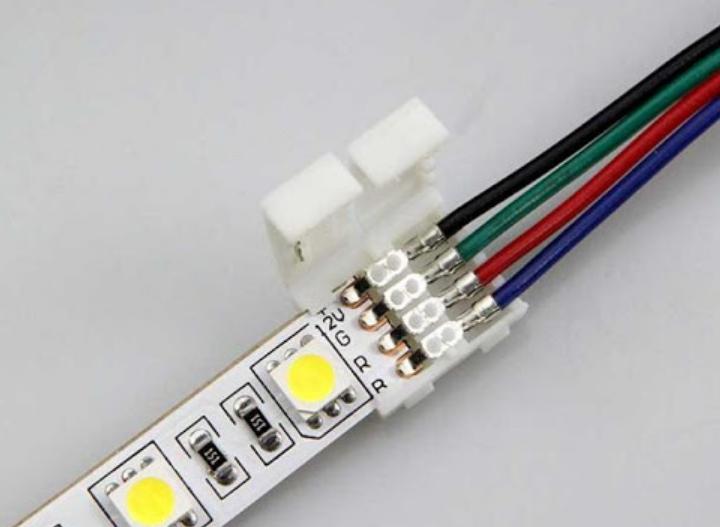
To connect the components to each other, you can use special connectors. With their help, segments of the canvas are connected to each other at different angles. But, despite the assurances of the manufacturers, the reliability of these devices cannot be compared with the traditional soldering. Therefore, it is recommended to master this process and mount the tape only with a soldering iron.
What to look for before buying
To approach the choice of LED-luminaire with all responsibility, you need to understand what the characteristics affect. They can be divided into two groups - electrical and light parameters.
- The main electrical characteristic by which the tape is selected is the power consumption. It is convenient to express it as a specific value - this is the power consumed by one meter of the canvas.It depends on the number of LEDs on this length and on their type. Knowing the specific power and the length of the tape, you can quickly calculate the total energy consumption.
- Another necessary parameter is the operating voltage of the tape. Indoors, canvases from 12 to 36 V are used, 220 V lamps are used for outdoor lighting.
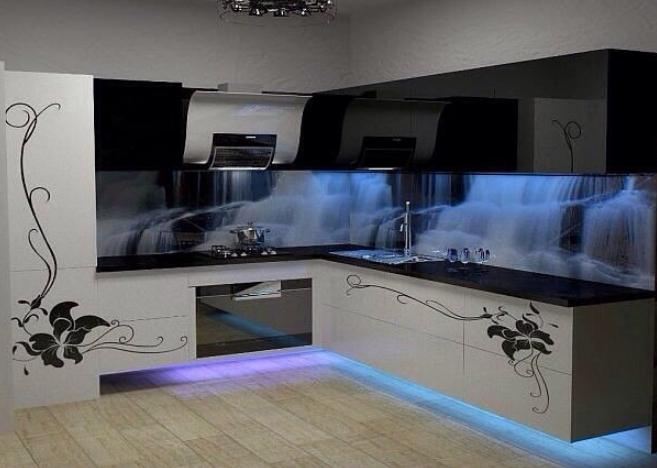
These characteristics will help you choose a power source. And the lighting parameters are needed to organize optimal illumination:
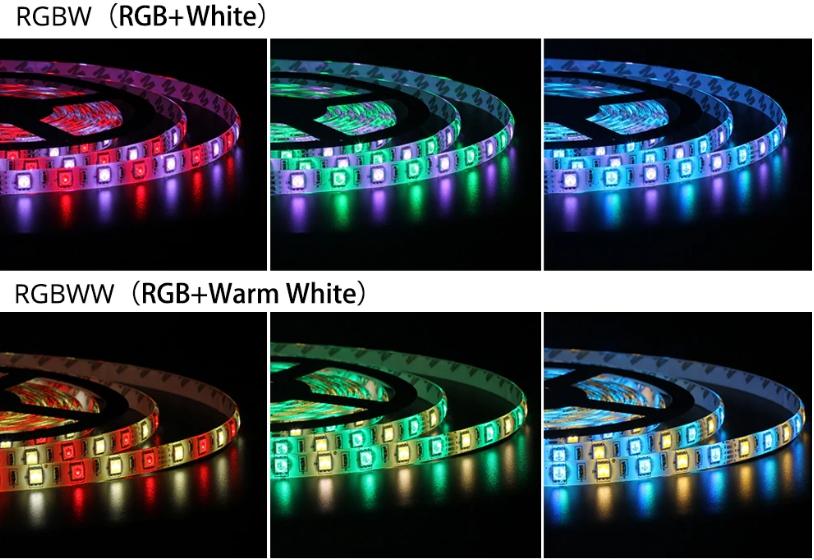
- glow color - monochrome or RGB;
- color temperature of the glow - with its increase from 3500 to 7000 K, the emission spectrum shifts from warm red-yellow shades to cold blue-violet;
- opening angle - determines at what angle the light will be emitted (along the canvas, the lighting sectors overlap, so this parameter will determine the angle across the base).

Among the important parameters it is also necessary to note the degree of IP protection. The first digit indicates the level of protection against solid particles, the second - against moisture ingress. IP68 and above allows you to mount and operate the lighting device even under water.
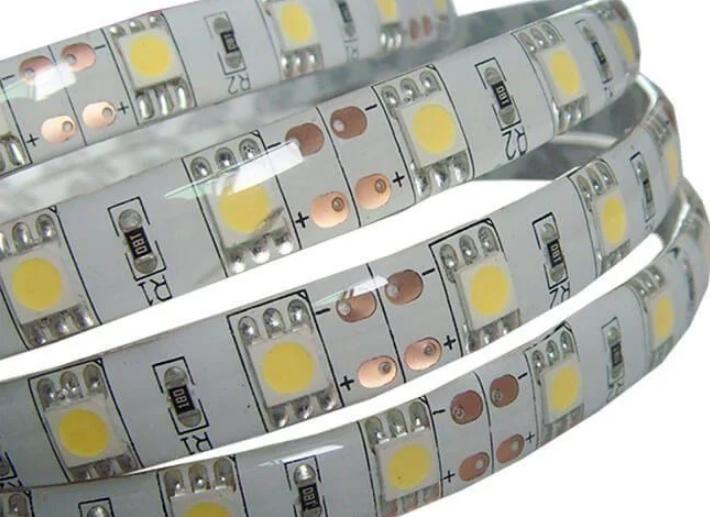
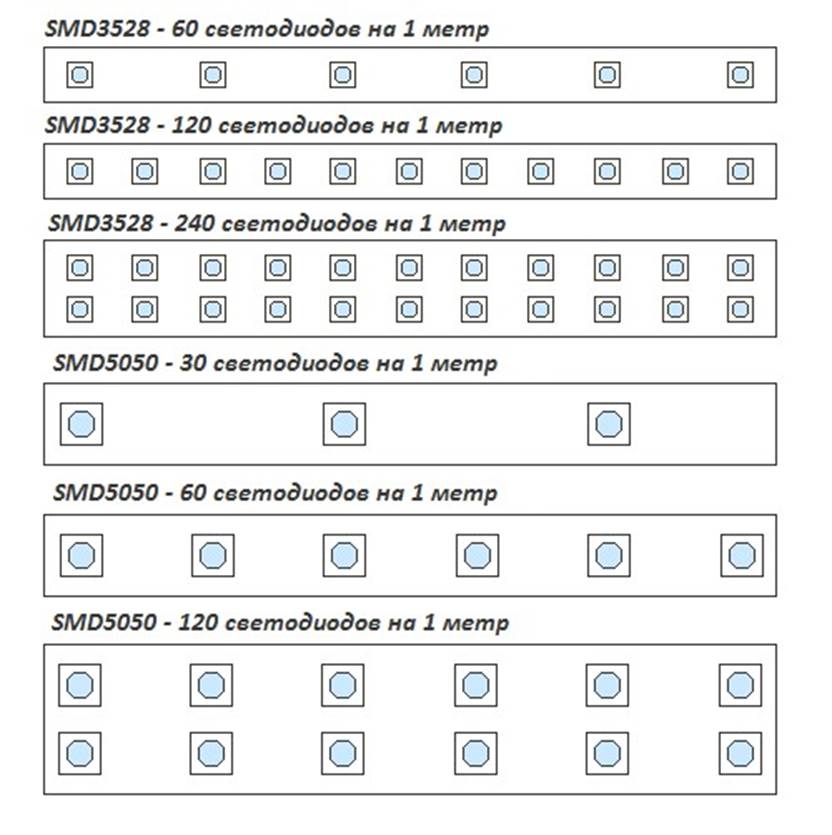
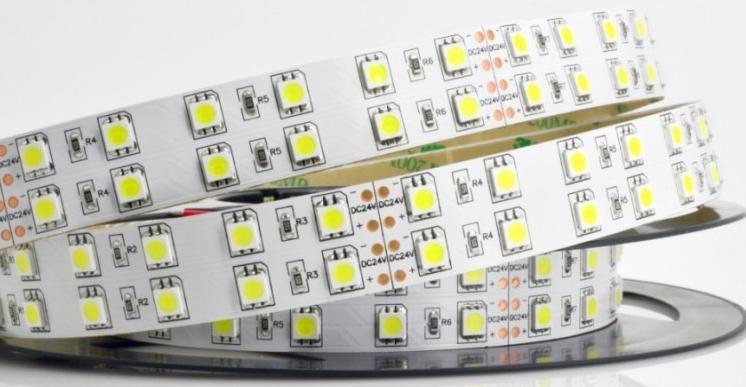
Separately, it is necessary to mention the cutting step (determines what minimum segment of the web can be obtained) and the number of LEDs per meter. This parameter itself does not carry information, but it can be used to indirectly estimate the power if it is unknown. And sometimes the color of the base is important. It determines how the lamp will fit into the interior.
Tools and LED strip installation process
After processing all the information, analyzing it and selecting the right luminaire, you can begin the installation of the LED strip. To do this, you need tools:
- scissors for cutting pieces of fabric of the desired length;
- glue or double-sided tape to strengthen the fastening - if necessary;
- aluminum tape or profile - for tapes of high power density;
- connectors of the required length or a soldering iron with consumables (only for serious craftsmen);
- wire cutters for cutting pieces of wire;
- knife or insulation stripper for stripping the ends of the conductors.
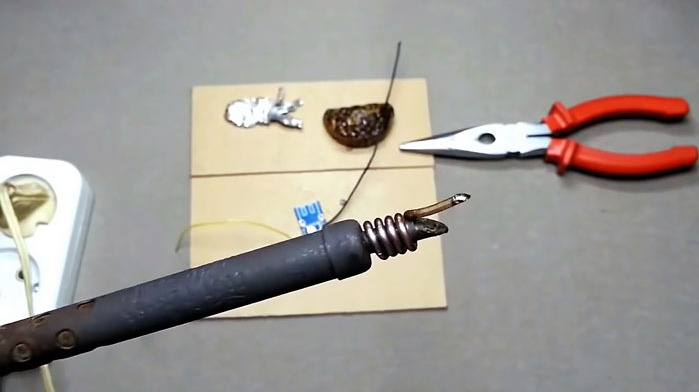
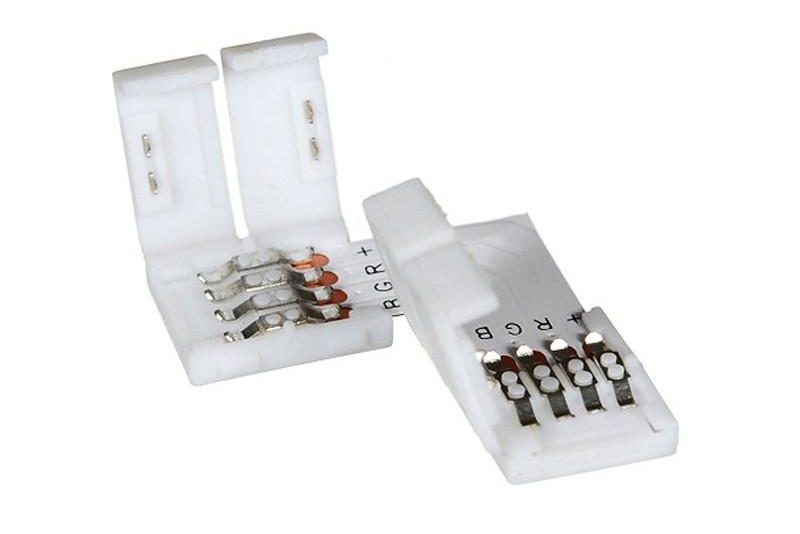
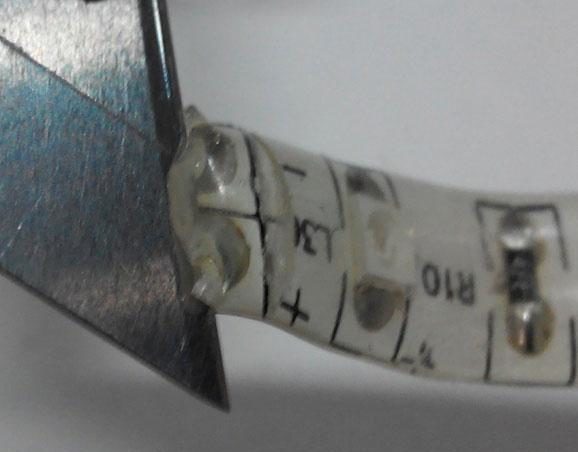
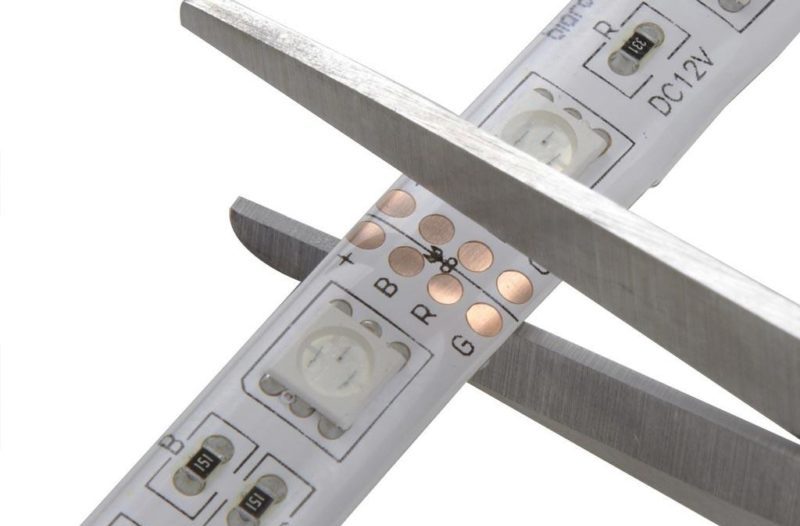
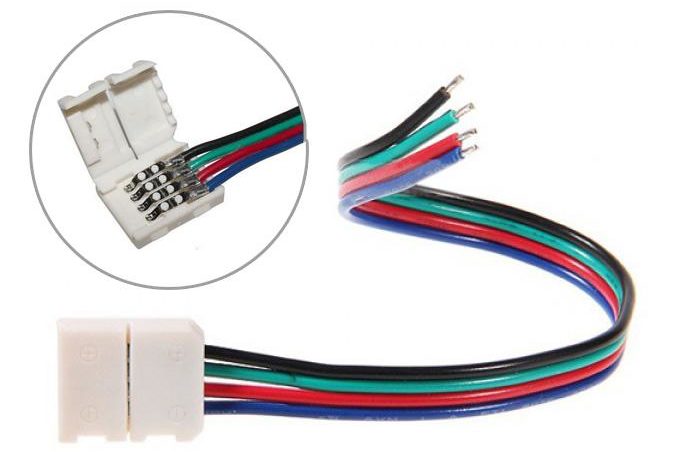
When planning the installation, it is necessary to determine the installation location of the power supply so that the length of the wires from the 220 V source to the consumers (lighting tape) is minimal. Then you need to think about fastening the canvases, inspect and prepare the surface. If the tape is powerful, you need to start by attaching the profiles. If not, you can immediately start gluing the pre-cut canvas. After sticker, you can connect segments. If the installation is carried out by soldering and outdoors, then you may have to increase the power of the soldering iron - even a small breeze significantly reduces the temperature of the tip.
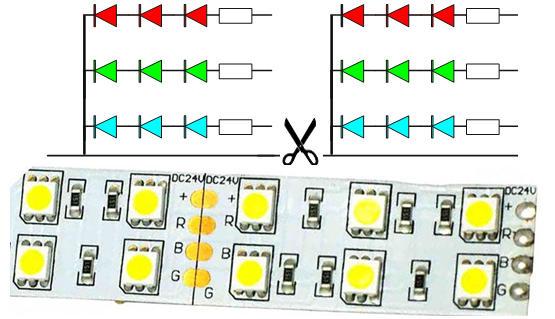
The power switch should be installed in a convenient and accessible place.Then, with pre-prepared wires, the RGB controller, if any, and the power supply are connected.
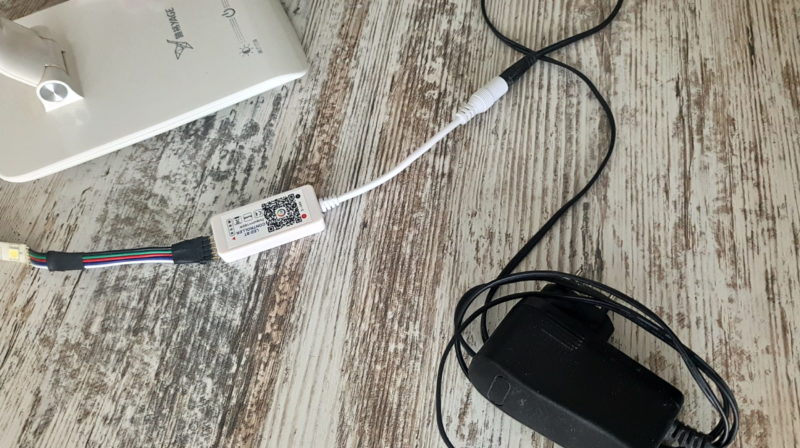
It is imperative to connect the power supply to the 220 V network through a circuit breaker - existing or newly installed, this can save you from many troubles.
There is nothing complicated in installing LED strip. A home master with little skills and knowledge can cope with this task on his own.