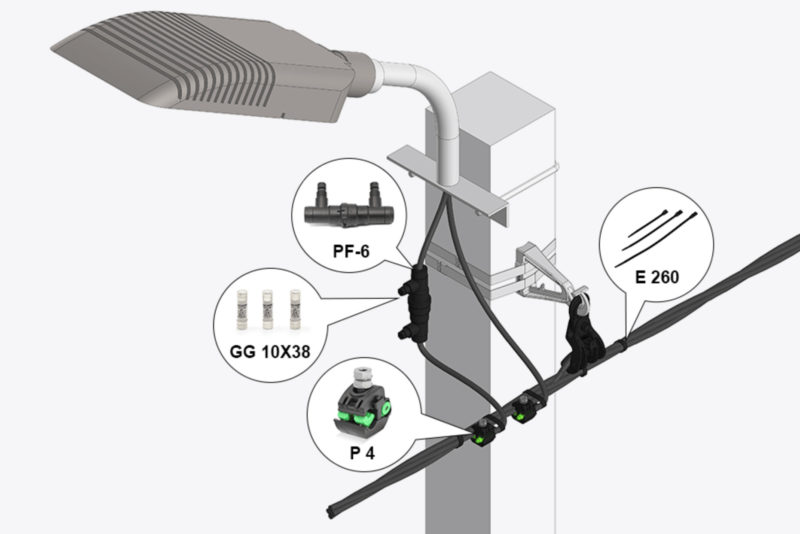
Features of installation and connection of street lamps
Outdoor lighting on a site near a house in a village or dacha is not only aesthetics and comfort, it is also a safety issue. Therefore, the issue of arranging the illumination of the territory must be taken seriously - miscalculations in planning can be expensive, including in the literal sense.
Recommendations for lighting control
An important point is the choice of control scheme and connection of street lighting. The easiest way is to make sure that the lamps are controlled manually - turning on and off from the operator. But modern household electrical engineering allows even a semi-skilled master to create automatic lighting control circuits or create dynamic special effects.
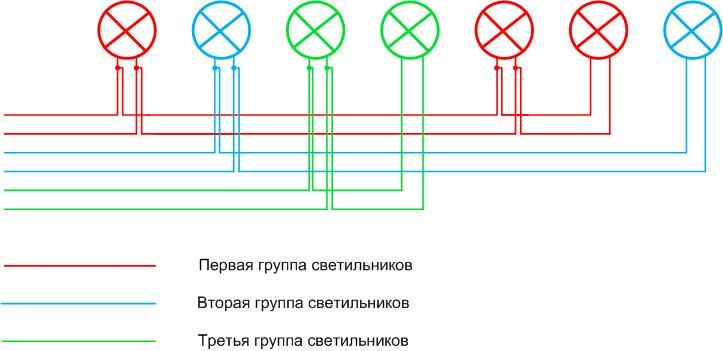
All fixtures must be combined into groups according to their functional purpose. For example, some devices should turn off automatically with the first rays of the sun. They connect via photorelay. Others should shine a little longer, they are connected through another light relay with a different response level.The third group of luminaires must be controlled only manually. They are connected through a conventional switch. All this must be considered at the design stage.before the purchase of components and the start of installation.
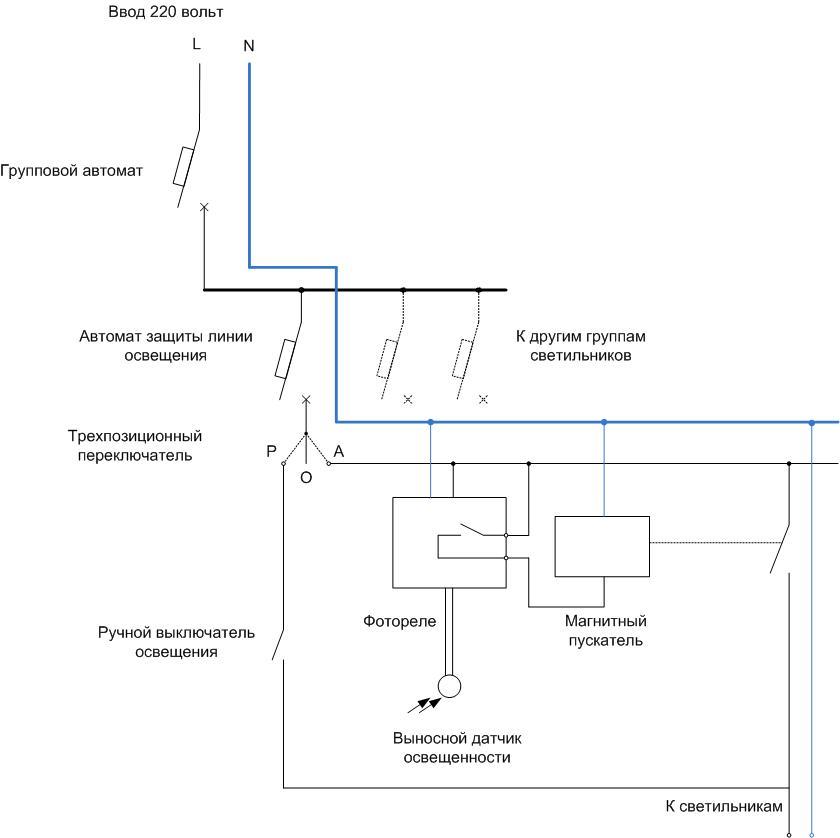
Each group of luminaires must have its own control scheme:
- A group machine and a light line protection machine must be mandatory. In addition to the protective function, they serve as switching devices that allow you to turn off the entire switchboard or one line for repairs or other work.
- Three position switch. They choose the type of control - manual or automatic, plus there is a "Disabled" position. If manual mode is not needed, or there is no automation scheme, you can not set it. But in the future, you can mount.
- Manual light switch. Allows you to control the lamps in manual mode. It will also come in handy during the repair in case of failure of the automation circuit.
- Photorelay. Turns on lighting at dusk, turns off at dawn. Provides significant energy savings.
- Magnetic switch. Needed to increase the load capacity of the photorelay. If the power of the lighting relay contacts is sufficient to switch the lighting load, you can not install it.
Instead of a photorelay, you can install a controller that will control the lighting according to a given program. It can be industrial or home-made (including based on Arduino). In this case, the possibilities of lighting control are greatly expanded.
Selection of equipment and consumables
With a certain degree of conventionality, all lamps are divided into:
- facade - illuminate the area immediately adjacent to the house;
- suspended - suspended on walls, poles and building structures;
- mast - are installed on special supports, representing a single structure with the lamp;
- landscape - highlight elements of landscape and architecture;
- marker - denote elements of the landscape, for example, paths.
Thematic video: Choosing decorative outdoor spotlights.
All lamps, except for the direct function of creating a luminous flux, also have a decorative purpose. Therefore, the choice of a device is always the task of the owner, and here his imagination is limited only by the design of lighting devices according to the degree of protection according to GOST 14254-2015.
For the organization of electrical lines that feed the lanterns, it is necessary to use only copper conductor products. Although now there is a trend towards the widespread acceptance of aluminum conductors, but from a technical point of view, copper has only advantages, although it loses in economics. The cross section of conductors for lighting networks depends on the load, but in most cases, 1.5 sq. mm is sufficient to ensure the current throughput. It should also be taken into account that the lanterns can be located at a considerable distance from the switch cabinet, so an additional check for voltage losses should be carried out. The voltage drop in the line depends on:
- section (the larger it is, the less loss);
- core material (for copper, the resistivity is lower than for aluminum - the losses will be less);
- line length.
The easiest way to check is to use an online calculator. The voltage at the farthest lamp should not be lower than the original by more than 5%. If this condition is not met, then increase cable section or wire one step and repeat the calculation.
No less important is the question of choosing the method of laying the supply wiring products. And here the aesthetic function comes to the fore. For these reasons, the open method is swept aside immediately. An exception is small sections of wiring performed by a suspended method, when it is impossible to do without it. For example, laying from facade to facade. And such installation is carried out at a height of at least three meters. It is convenient to use for these purposes an insulated wire with a carrying cable (SIP). Such a wire does not require an additional supporting structure, which must be used in case of cable suspension. First, a metal cable is pulled, then a cable is attached to it along the entire length. But the most aesthetic is the underground laying of electrical lines. An armored sheath cable is most suitable for it, but it is expensive. Therefore, most often they resort to laying a conventional cable (for example, VVG) in pipes.
Step-by-step execution (installation and connection)
It is necessary to start work on organizing the lighting of the site by drawing the location of the fixtures on the plan. To select the number of lighting fixtures, you can use SNiP (or more modern joint ventures - updated SNiP). For home use, they are not required, but their study will allow you to navigate the minimum required number of fixtures.
| Territory | Main and auxiliary entrances of parks, sanatoriums, exhibitions and stadiums | Sidewalks, porches, walkways and central alleys | Side alleys and auxiliary entrances of parks | Open car parks on streets of all categories, driveways between rows of box-type garages |
| Minimum illumination, lx | 6 | 4 | 1 | 6 |
The norms of illumination of public areas can be correlated with areas of private property that carry approximately the same function and recalculate lux into lumens. To do this, the illumination in lux must be divided by the area of the illuminated area in square meters. The minimum required luminous flux will be obtained, under which it is necessary to select the power of lighting fixtures and their number.
Since the laying of a cable or a self-supporting wire in a suspended manner in such cases is unacceptable for aesthetic reasons, in 99% of cases an underground arrangement of lines is chosen. Therefore, future trenches must also be applied to the plan. While everything is on paper, the project is easy to optimize and minimize in terms of the amount of work. Once the excavation has begun, it will be more difficult to do so.
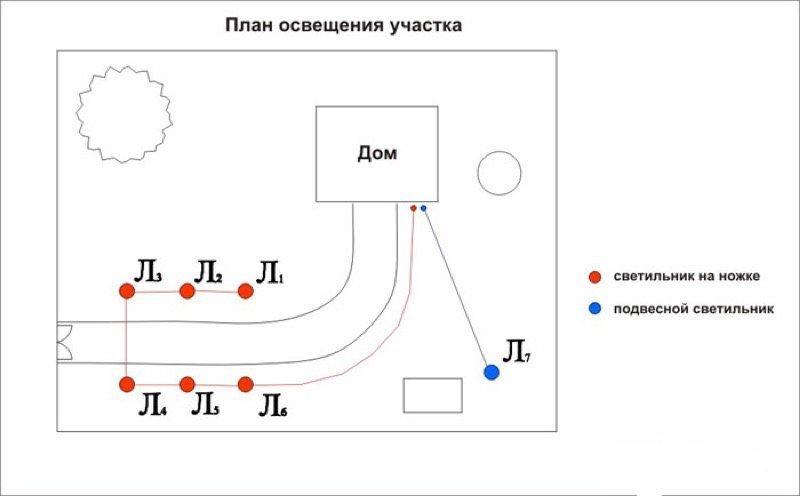
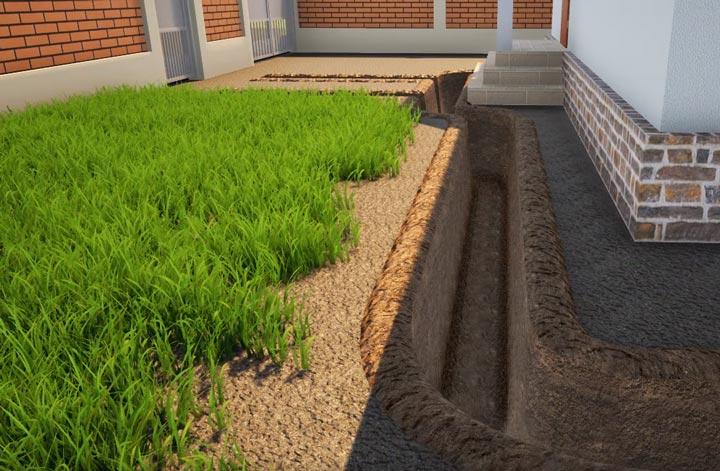
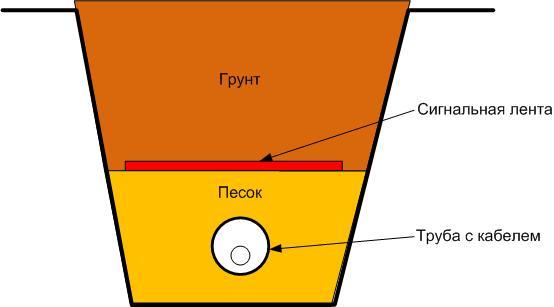
According to this plan, it is necessary to dig trenches 70 cm deep from the switchboard, and in the places where the lamps are installed on the ground - holes a little larger than the base. In the trenches, it is necessary to equip a sand cushion 100 mm thick.
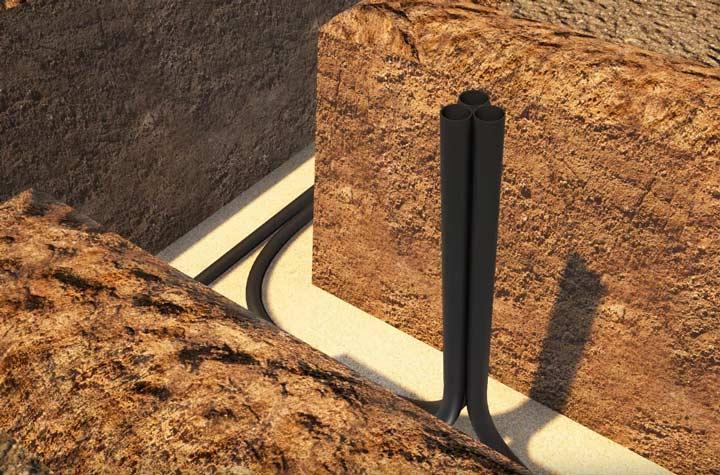
After that, it is necessary to lay the cable (if the option with an armored sheath is chosen) or plastic pipes with a diameter of 22 mm to protect the lines from damage. In places of future installation of light sources, the pipe is brought to the surface, then again goes into the ground to the next lamp. By this point, it should be completely clear how the fixtures are grouped.
Important! It is desirable to provide in several places the cable exit from under the ground for the installation of sockets.
Depending on the scheme, each installation site may have two or three pipe outlets. Each group of illuminators uses its own “pipeline”.
After that, with the help of a cable, sections of the cable are pulled into the pipe with a margin of 30-40 cm at the exit for future connection.
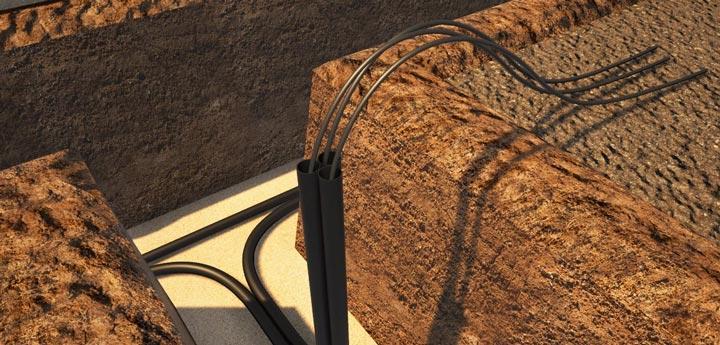
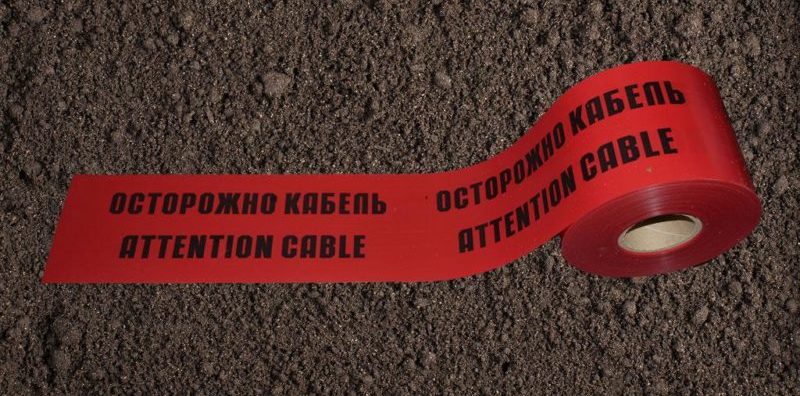
Then you can fill the pipe with sand with a layer of 100..150 mm and bury it. It is very useful to put a signal tape on top of the sand cushion. During earthworks in the future, it will warn that the cable line runs deeper.
The result should be such a "sandwich":
The next step - installation of street lamps. It is performed according to the design of the device and the manufacturer's instructions:
- some lighting fixtures require the arrangement and pouring of concrete foundations;
- others have a thrust bearing that requires only a gravel backfill for drainage;
- nothing is needed for hanging lanterns.
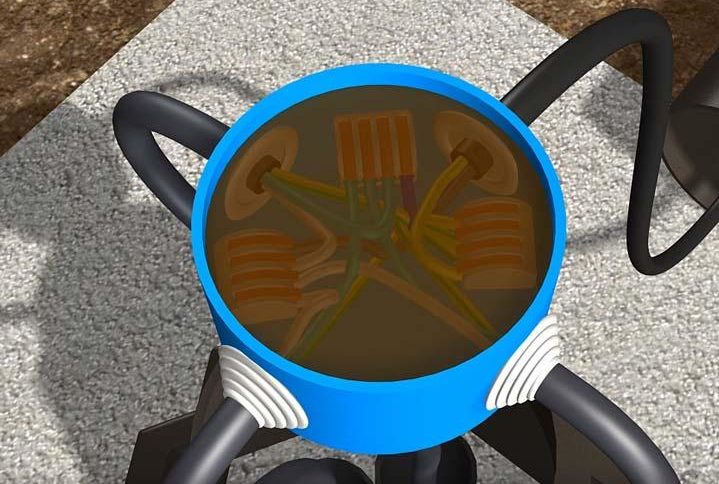
After that, you can connect the cable conductors in the junction boxes. It is convenient to use Vago or similar terminals for this. To protect the installation, it is desirable to fill it with a special epoxy compound.
Important! After the installation is completed and the compound has completely solidified (but before connecting the luminaire lamps and the supply side), it is necessary to measure the insulation resistance with a 1000 V megger. Riz should not be less than 1 MΩ.
The last step is the connection of street lamps, their final assembly, the connection of the power side of the cable to the switchboard.After that, you can apply voltage, try out the switching circuit, adjust the automation and, as a result, enjoy high-quality lighting.