How to install and connect a motion sensor to turn on the light
The motion sensor is relatively inexpensive. You can buy it in specialized stores and on trading platforms on the Internet, including the popular Aliexpress. Its cost will pay off many times over if it is built into an automatic lighting control system. The sensor will turn on the light only if there are objects (people, cars, etc.) in the controlled area. Also, the motion detector can control surveillance cameras, give an alarm, etc. You can connect any motion sensor yourself.
Selecting a sensor model
The first step is to select the sensor type. Radio frequency (microwave) are expensive. They are installed to control large areas (warehouses, parking lots for equipment, etc.).Considering the harmfulness of electromagnetic radiation, ultrasonic and infrared sensors are used for domestic purposes and small-scale production. The former are more sensitive, more noise-resistant, but also more expensive. In addition, pets can hear ultrasound, and this can cause them a feeling of discomfort (there is a version that has not been proven by practice that ultrasound repels small rodents and insects). For this reason, infrared sensors are used in residential premises and offices. Plus they're cheaper. Other sensor selection criteria:
- Range. Must be no less than the distance to the farthest point of the controlled area. It makes no sense to overpay for a long range.
- Control Angle. Ceiling-type sensors in the horizontal plane control the area with a 360-degree opening. Wall-mounted - 180 or less (due to the design). For wall sensors, it is desirable to control the anti-vandal zone (below the sensor) - from there, attackers can disable the device.
- Switched power. If it is not enough to control the existing load, you will have to install repeater relays.
- Supply voltage. If it differs from 220 volts, you will have to organize additional power sources.
- Degree of protection. It must ensure the operability of the device in the selected location - indoors or outdoors.
| Motion Detector | Operating principle | Range, m |
| Smartbuy ceiling | IR | 6 |
| REXANT DDS 03 11-9211 | IR | 12 |
| REXANT 11-9215 | IR | 9 |
| REXANT DDPM 02 11-9217 | RF | 10 |
| TDM DDM-01 SQ0324-0015 | RF | 8 |
There are also other characteristics for choosing a sensor (color, power consumption, release time, etc.), but they are not of fundamental importance for connection and installation.
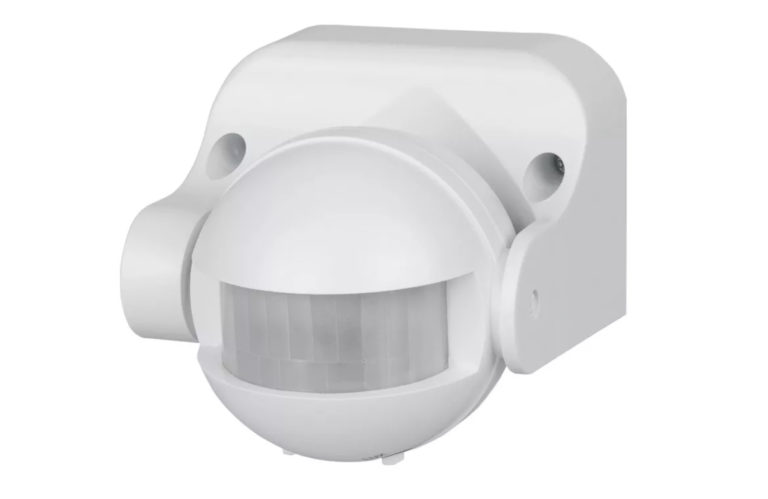
Choosing a place to install the detector
First of all, the sensor must be installed so that it "sees" the controlled area. The viewing angle in the horizontal plane should cover the area from which the object may appear. If the sensor does not cover the entire area, two or more devices will have to be installed. Information about the opening angle in both planes can be found in the instructions for the device. You can also find out the optimal installation height of the detector there.
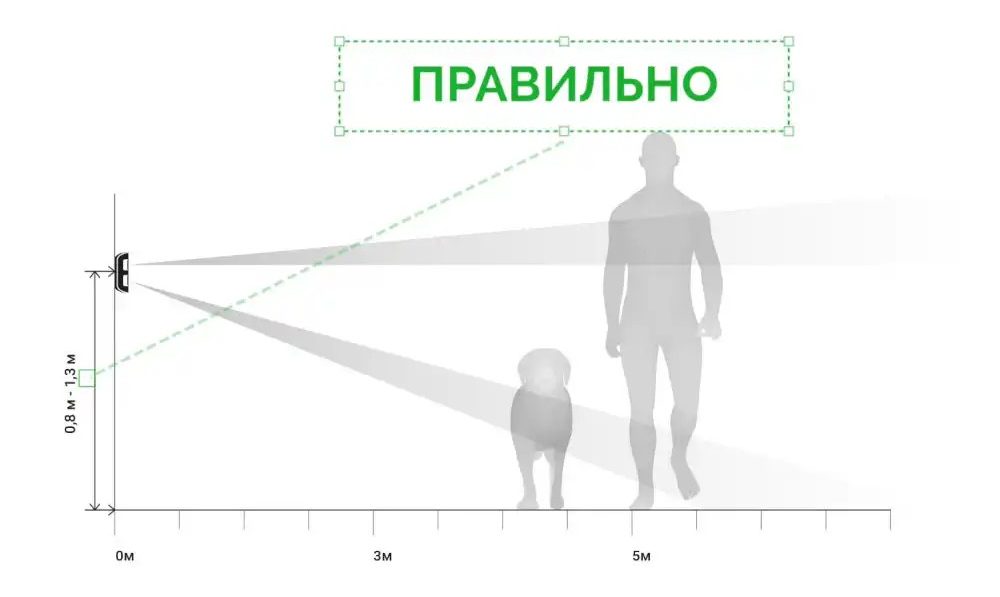
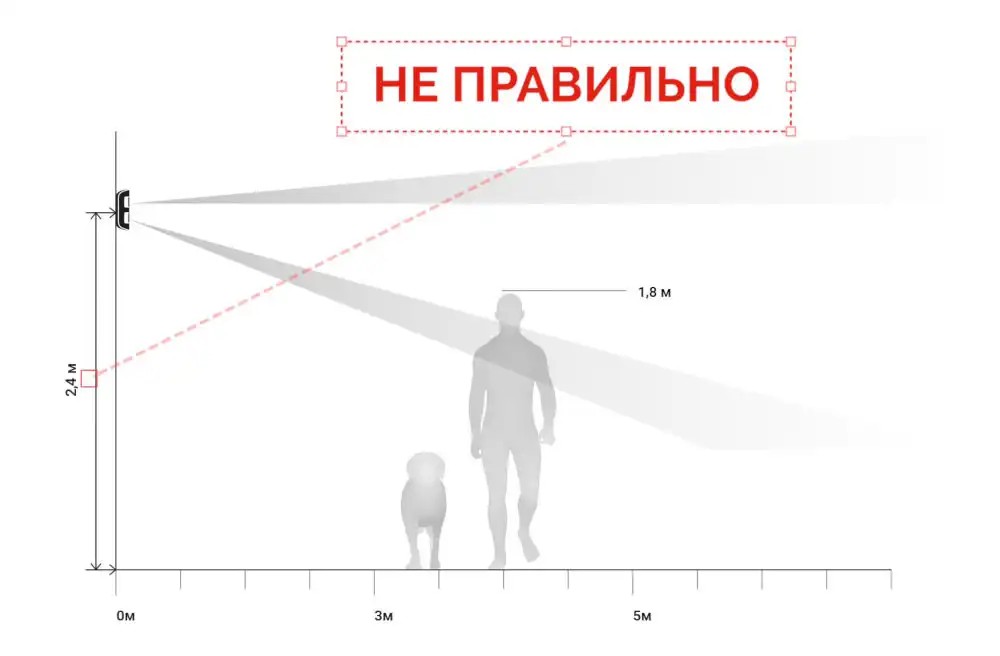
By selecting the mounting height and viewing angle in the vertical plane, it is necessary to find such a position of the sensor that it would work confidently when a person appears and would not react to small animals. Otherwise, false positives (or non-operations) cannot be avoided.
Installing a sensor in an apartment
In the apartment, the motion sensor is used in rooms of two categories:
- with temporary stay of people (entrance hall, part of the staircase) - where you need to turn on the light for a short time;
- with a permanent stay of a person (kitchen, living rooms, bathroom).
In the first case, everything is quite simple. The sensor is connected according to the selected standard scheme - from those discussed below. In this case, in addition to saving electricity, additional convenience is achieved - the light for the person who enters turns on without the help of hands. After some time (selected at at the construction site) the lighting is turned off.
In the second case, such a scheme is inconvenient.If you enter the kitchen and sit still, the lights will soon go out. You will have to periodically activate the detector by making movements. This is inconvenient, so it is better to provide a three-position switch that allows you to take the automation out of work by forcibly turning on the light.
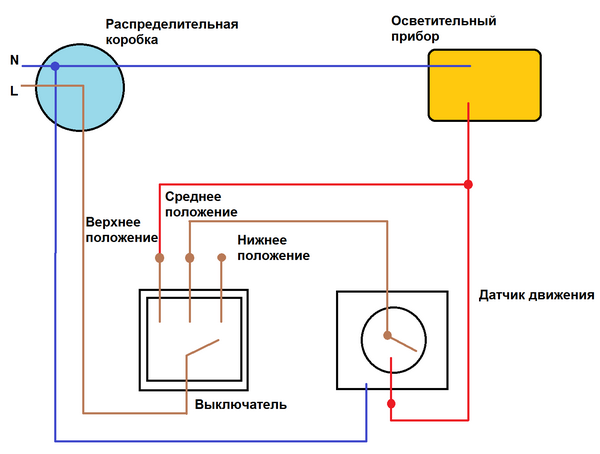
The problem is aesthetic. Three-position switches that can fit into the interior are difficult to acquire. The decision to apply this scheme is up to the owner of the premises. The connection process in this case differs little from the usual installation. It is necessary to find a place to install a three-position switching element, bring a phase wire to it from the junction box. Lead two wires from it already to the sensor installation site, and connect both wires according to the diagram.
Sensor terminal designation
There are two main options for sensor designs - with two connection terminals or with three. There is no standard for marking terminals, and each manufacturer is free to introduce its own designation system. But in most cases, for two-pin sensors, the pins are marked:
- L - for connecting the phase wire of the 220 volt network;
- L1 - to connect the wire to the load (possible options are Out or an arrow pointing outward, etc.).
For three-wire models, the terminals are designated:
- L - for connecting the phase wire of the 220 volt network;
- N - this terminal must be connected to the neutral wire;
- A - output for load control (possible options are Out or an arrow pointing outward, etc.).
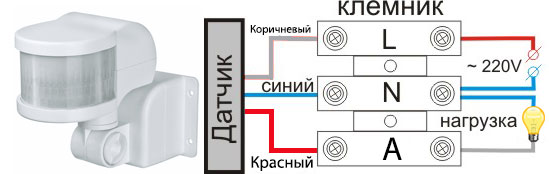
Connection options for different modifications are discussed below.
Detector connection options
The circuit diagram for connecting the sensor motion sensor is simple. If you remember that the motion sensor is a light switch that works automatically, it's easy to figure out the installation. But, unlike a simple switch, a motion detector needs to be powered by an internal circuit. And developers solve this problem in different ways, hence a certain difference between connecting devices of different modifications.
2-wire circuit
Such a sensor is included in the break in the power supply circuit of the lamps. The form factor of many detectors is the same as that of household light switches, so they can be installed in the same installation boxes. This option requires virtually no rework of existing household wiring.
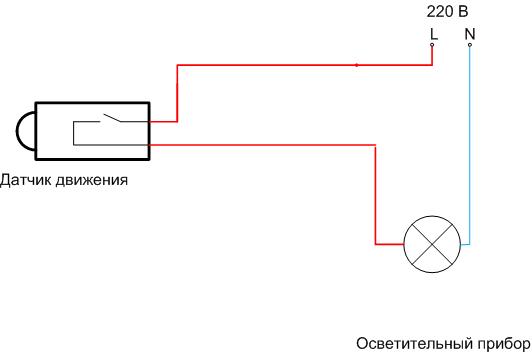
Important! To ensure the normal operation of the sensor, it must be included in the break of the phase wire. This point must be checked before starting installation.
3-wire circuit
Other models require the connection of a neutral wire for normal operation.
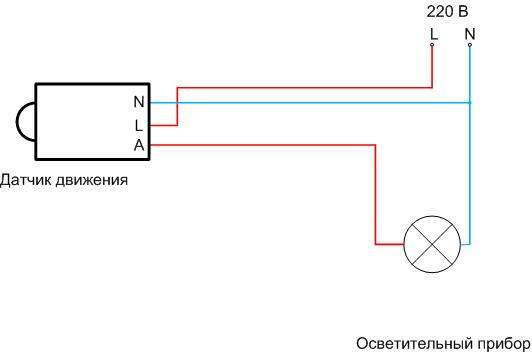
In most cases, such a connection inside a house or apartment will require a change in wiring, wall chasing, etc.
Connecting a 3-wire sensor in a 2-wire version
For those who do not want to start a major overhaul just to install a motion sensor to automatically turn on the light, in some cases the following scheme can help out.
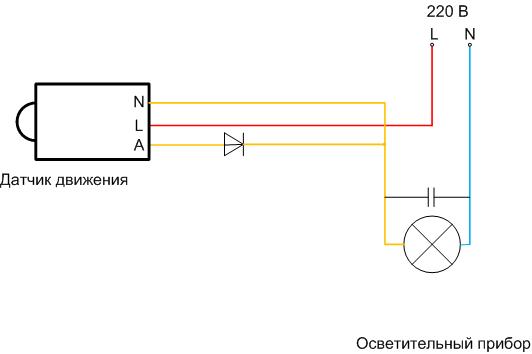
In this case, the lamp must be shunted with a capacitor with a capacity of 2.2 microfarads and designed for a voltage of at least 400 volts.It has a small resistance to alternating current, so the N terminal of the device will be permanently connected to the neutral conductor of the network. You can install the capacitor directly on the terminals of the lamp holder. A diode must be connected to the control output, through which the light bulb is switched. The semiconductor device must be rated for a reverse voltage of at least 350 volts and the full operating current of the luminaire. This option does not always work. For example, such a scheme is not applicable when using LED lighting elements.
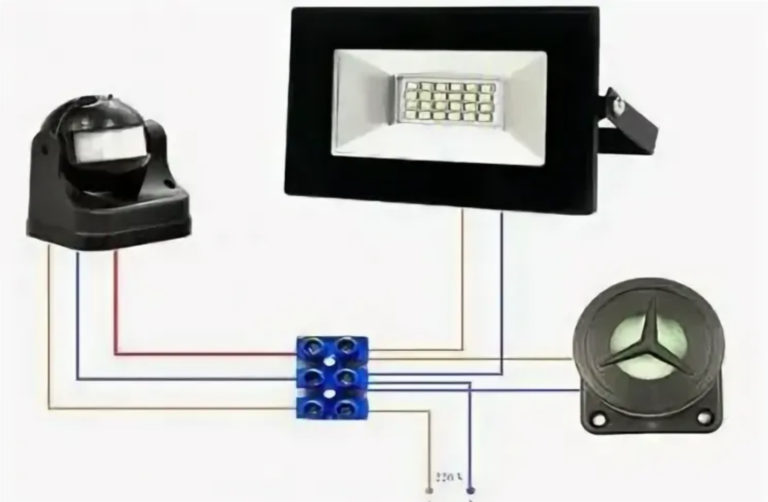
Circuit with a switch
It is possible to supplement the lighting system with a household light switch. It will allow - regardless of the state of the sensor - to turn the light on or off (depending on the chosen scheme).
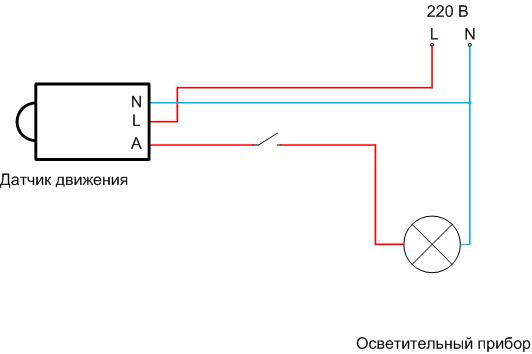
Here, an additional switching element is included in the break in the power wire and allows you to break the power circuit even when the sensor is on.
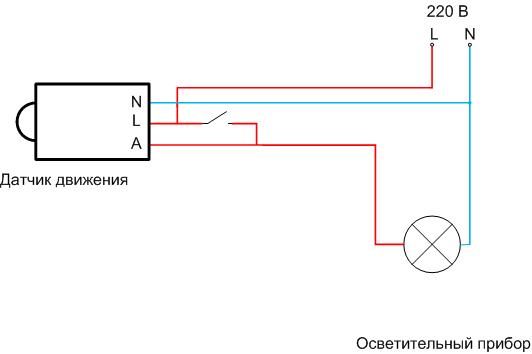
To turn on the light regardless of the motion detector, the switch must be connected parallel output contact group of the motion sensor. This can help if the device malfunctions.
Switching on the load via an intermediate relay
If the load capacity of the motion sensor output is not enough to switch powerful lamps, the problem is solved by installing a repeater relay. It can be used as a magnetic starter or contactor.
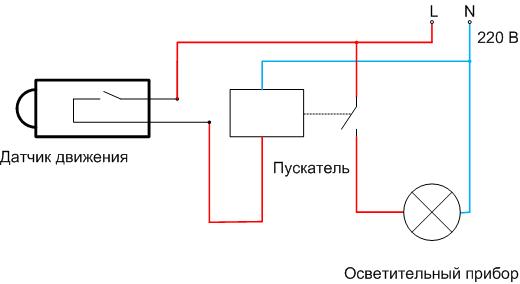
The maximum current of the contacts of the intermediate relay must exceed the operating current of the lighting with a margin.
Parallel connection of several sensors
There are situations when lighting needs to be controlled from several places. Such a need arises, for example, when it is necessary to automate turning on the light in a corridor or on a long staircase and the "range" of one detector is not enough, or when the corridor has a turn. In this case, the output contact groups of the sensors are connected in parallel.
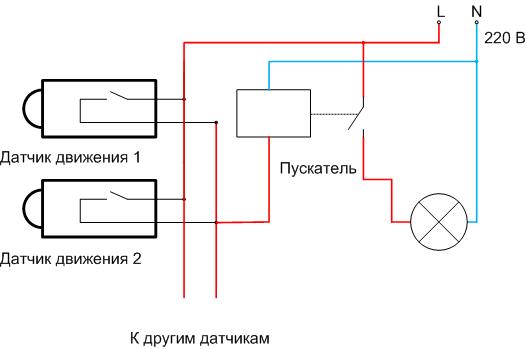
If at least one of the sensors does not allow the connection of a full lighting load, you will need to use a repeater relay.
The video describes three ways to connect sensors in an accessible and understandable way.
Typical errors during installation and connection
When performing electrical installation, phasing must be monitored. The sensor should break the phase wire. You can check this with an indicator screwdriver. After that, it is imperative to de-energize the workplace for safety reasons.
Near the installation site of the infrared sensor, there should not be objects with a contrasting temperature in relation to the environment - radiators, incandescent lamps, etc. It is also necessary to exclude the ingress of jets of warm air from heating elements and air conditioning systems. If the sensor is installed outdoors, there should be no chimneys in its field of view.
Do not confuse detectors with ceiling and wall mounting. They have a different field of view. With the wrong choice, problems will inevitably arise.
If the motion sensor is used as part of a security system and operates during the day, then false alarms can occur if there are overall metal structures (fences, flooring, etc.) in the sensor's field of view. When heated in the sun, the metal can cause the sensor to give false signals.
If possible, protect the sensor lens from getting dirt on it - this will lead to a decrease in sensitivity. If the installation of the motion sensor with the exclusion of contamination fails, it is necessary to ensure regular revision and cleaning of the detector.
Video lesson: 5 mistakes when installing an outdoor motion sensor Ajax MotionProtect Outdoor
If these simple requirements are met, the sensor will last a long time and will save significant amounts on lighting.