How to adjust motion sensor for lighting
The use of a motion sensor to turn on the lighting in many cases allows you to get significant energy savings. The effect is achieved by turning on the light in the controlled area only if there are people or cars on it. The combination of such a detector with a photorelay allows you to fully automate lighting control. If the detector does not have a built-in photo relay, it can be purchased separately and connected in series with the sensor contacts. But to achieve the full effect, the sensor must be adjusted. Regardless of what principle the detector has (infrared, radio frequency, ultrasonic), you can set up any motion sensor yourself.
Characteristics determined during the manufacture of the sensor
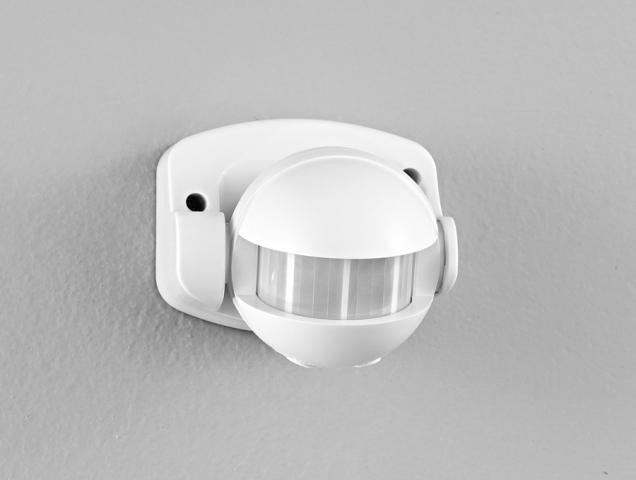
Some of the characteristics are determined by the sensor design and cannot be adjusted.Therefore, it is desirable to determine some parameters before buying. These characteristics include:
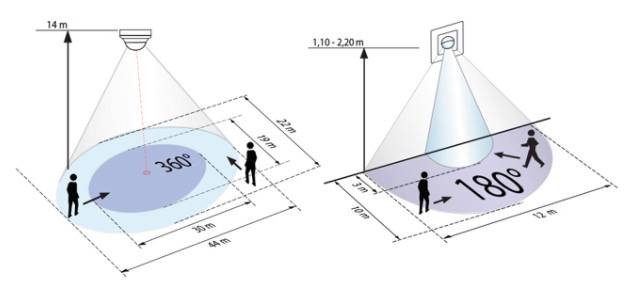
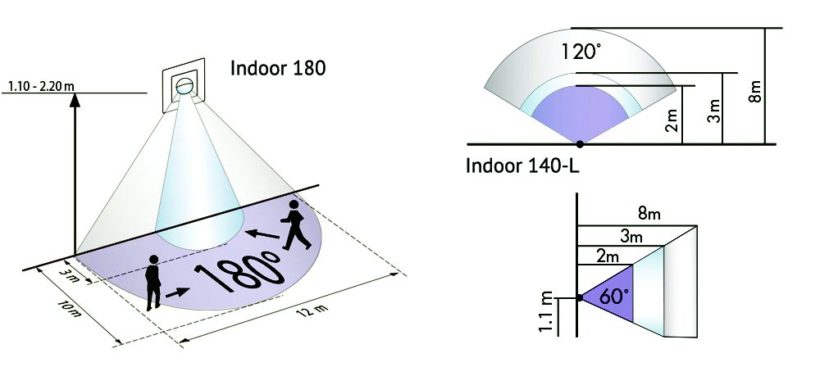
- Viewing angle. Determined by the design of the sensor. Ceiling sensors usually have 360 degrees. For wall-mounted detectors, for obvious reasons, it does not exceed 180 degrees.
![How to adjust motion sensor for lighting]() Viewing angle of wall and ceiling detectors
Viewing angle of wall and ceiling detectors - Detection distance. It also depends on the design and principle of operation of the sensor. The most long-range radio-frequency (microwave) detectors, but they will cost more. They are designed to control storage and other similar premises. In an apartment or entrance, a cheaper infrared (in extreme cases, ultrasonic) detector is enough.
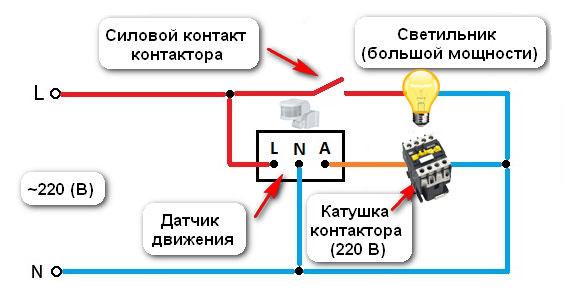
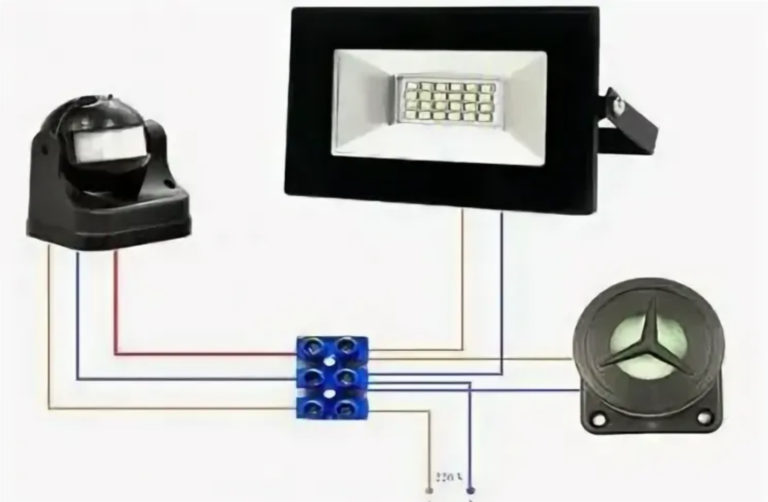
- Load power. Determines which luminaire the sensor can control. Due to the general trend towards LED lighting, even a low power contact set is enough to drive a high performance luminaire. But you need to check the ability of the contacts to switch the voltage of 220 volts.
Important! If the load capacity of the sensor output is not enough, the problem is easily circumvented by using an intermediate relay.
Parameters to be configured
The other part of the sensor parameters can be customized for specific local conditions. This will help optimize the performance of the lighting system and minimize false alarms.
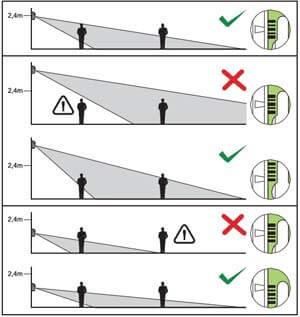
- First, choose the correct installation angle. It is configured in such a way that the object is detected immediately upon entering the controlled area.
![How to adjust motion sensor for lighting]() Options for correct and incorrect setting of the control angle.
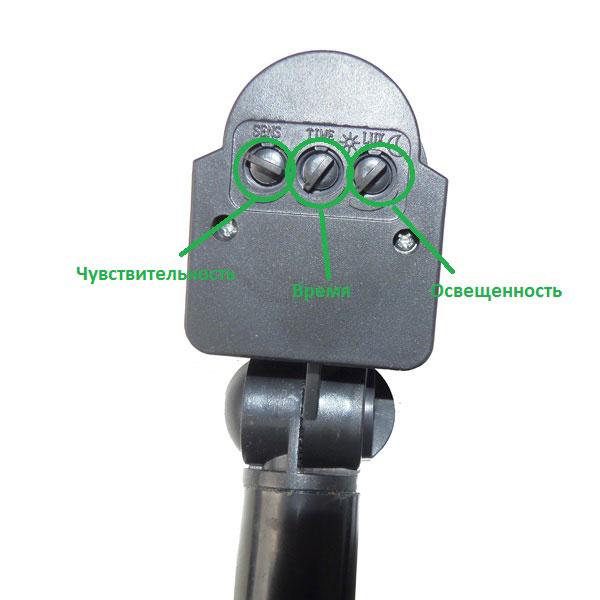
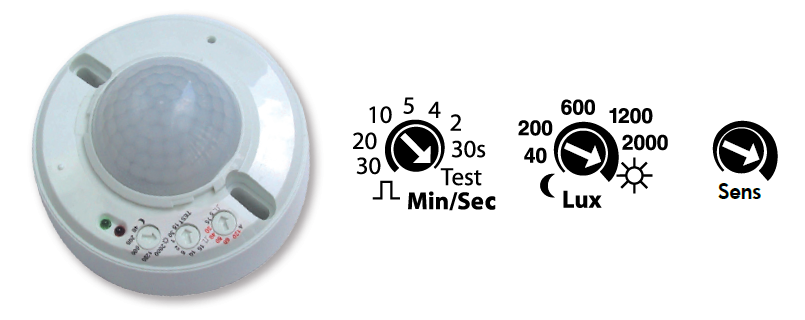
Options for correct and incorrect setting of the control angle. - Secondly, the sensitivity of the sensor is adjusted (the adjusting body is designated SENS from the word sensitive). The essence of this adjustment is to tune out triggers when small objects are detected. In most cases, these are small animals, it makes no sense for them to turn on the lighting.
- Most sensors are equipped photorelay. Without it, the sensor will also work during daylight hours, or they will have to be turned off manually. The threshold for the photorelay operation must be adjusted so that the detector does not allow electricity to be consumed during the day, but turns on the lighting in time at night. The control body is marked LUX or Day Light (daylight).
- Many models have the ability to adjust the turn-off time delay. This is convenient when leaving the territory - the light will not go out immediately, allowing a person or car to leave not in complete darkness.
Not all detectors have a complete set of settings. Some inexpensive models may not have a response time setting, others may be sensitive to the size of objects.
Setting up the detector in the room
Regardless of the location of the sensors, before setting up the system, you must carefully study the manufacturer's instructions and recommendations for adjustment.
Features of setting the sensor in the room are that a lot of illumination is required for work or life. So, in the corridors, the illumination should be at least 600 lux, and in the working rooms at least 1000 lux. During the initial installation, you can focus on these numbers. The switching threshold should be higher - darkness in the premises comes earlier than on the street.
Outdoor sensor adjustment
On the street, you can not turn on the light until deep darkness. And the level of illumination can be lower. So, in parking lots, in the passage areas, you can focus on the figure 150..300 lux. But the sensitivity must be coarsened. The probability of the appearance of small animals, large insects, objects driven by the wind on the street is much higher.
Sensor parameter adjustment
Not all sensors have fully functional adjustment of all three main parameters, but the adjustment method does not depend on the number of adjustment elements. Each parameter is configured individually.
- Threshold level of illumination. To set up, you need to set the maximum sensitivity of the photorelay and in the evening wait for the level of illumination at which it is desirable to turn on the lighting. In the morning, you can control at what illumination the lamps turn off.
- Adjustment of the motion sensor consists in the selection of sensitivity. You can set the regulator to the least sensitive state, ask the assistant to enter the controlled area and stop at its border. If the detector does not work, it is necessary to increase the sensitivity until a signal is issued, and after that turn the knob a little more in the direction of increase. This is done so that the detector works reliably when people with different anthropological parameters appear. If the detector works immediately, then you should try to reduce the sensitivity until the signal disappears, and then also turn the knob in the direction of operation and a little further. It should be taken into account that the sensitivity of the sensors depends on the direction of movement - along the controlled area or across (in the direction of the lamp).
![How to adjust motion sensor for lighting]() Sensitivity zones for longitudinal and transverse movement.
Sensitivity zones for longitudinal and transverse movement. - Delay time can be set first by zero or a few seconds, and during operation increase to the desired value. And you can immediately conduct an experiment with the assistant leaving the controlled area and set the approximate release time.
If the selected detector does not have any of the adjustments, the corresponding item can be skipped. So, in inexpensive models of IR sensors manufactured by Legrand, sensitivity adjustment (SENS) is not provided. You can only adjust the illumination threshold and release time. Only more advanced products have SENS adjustment.
| Motion Detector | Possibility of parameter setting | ||
| LUX | SENS | TIME | |
| Legrand PIR IP55 | x | - | x |
| Legrand ceiling 360 degrees | x | - | x |
| Legrand Mosaic | x | x | x |
| Legrand Valena (ultrasonic) | x | x | x |
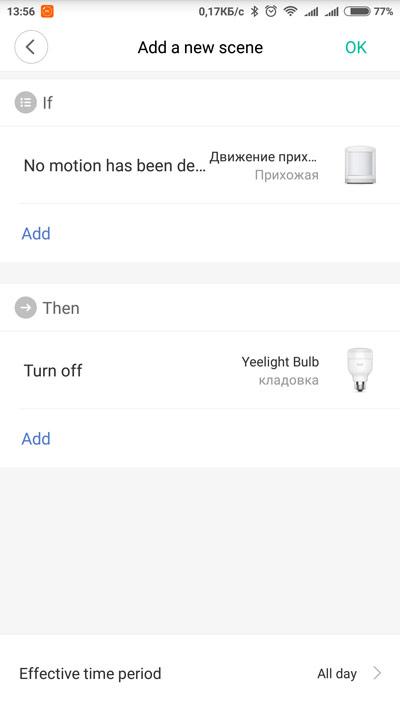
And the detectors manufactured by Xiaomi have not only a full range of settings (by software), but also the ability to set scenarios, which significantly increases the comfort of using the devices.
Checking for Correct Adjustment
You can only check the correctness of the settings in the field, and this process can take more than one day. At first, you need to carefully monitor the operation of the sensor and adjust the setting and location of the detector.
- If the detector's photorelay turns on before dark or does not turn off when the desired light level is reached in the morning, its light sensitivity (LUX) should be slightly coarsened. And vice versa, if it is already dark, and when an object appears, the light does not turn on, it is necessary to slightly increase the evening threshold for the operation of the photorelay. It's also good to look at the operation in the morning.The threshold values for switching on and off are slightly different, this is done to prevent multiple sensor activations on the verge of light and darkness (the characteristic has hysteresis). Therefore, it may take several days to reach a compromise result.
- The same goes for the sensitivity of the sensor. If you notice frequent false alarms from the appearance of small animals, then the sensitivity should be reduced by turning the Sens knob. If there is an uncertain response when people appear in the coverage area, the sensitivity must be increased.
- The switch-off delay time (Time) can be initially set to a minimum. If during operation it is noticed that people or vehicles do not have time to leave the controlled area, then the response time can be gradually adjusted upwards until the desired result is achieved.
The setup can take a long time, but it's worth the cost.
Video tutorial on setting up the sensor.
How to avoid false positives
First of all, false alarms are eliminated by carefully adjusting the motion sensor. But this is not always enough. Thus, false alarms of an infrared sensor can be caused by the presence of an irregular heat source (chimney, air conditioner) or a light source (headlights of passing cars) in the sensor's field of view. When detuning the sensitivity from small objects, the angular dimensions of the light spot can be sufficient for false switching on if the animals are in close proximity to the detector. Therefore, it is necessary to install the sensor in places where the appearance of animals is excluded. Also, unauthorized trips can be caused by:
- battery discharge for wireless sensors;
- poor contacts in the connecting line from the detector to the executive module;
- unstable contact of microswitches that protect against opening sensors by intruders.
These situations can be avoided by regular monitoring of the state of the system and timely troubleshooting. But it is unlikely to completely avoid interference.
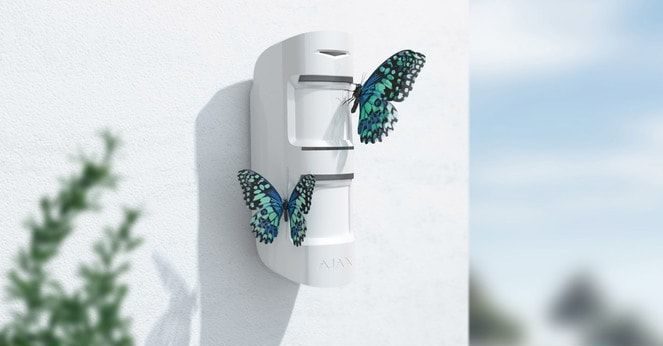
Thus, it is impossible to foresee the crawling of insects on the surface of the outdoor sensor and other unpredictable situations. But it is quite realistic to reduce false inclusions by adjusting and selecting the position of the sensor to a minimum.