Features of LED backlight - what are the types
LED backlighting is used in most modern devices with liquid crystal screens. The quality of the image, the reliability of technology and the service life of the matrix depend on its characteristics. Therefore, it is necessary to understand the features in order to find the best solution when choosing.
Main differences
First of all, you need to understand how this option differs from the previous one. Previously, LCD TVs and monitors were backlit by fluorescent lamps. LEDs have replaced them and have become used almost everywhere due to several advantages:
- Color reproduction improved several times. This applies to both clarity and the number of colors, since with the help of a multi-color RGB matrix, possibilities are opened that were not previously available. Multi-color backlight allows you to provide high-quality transmission of shades, which makes the image an order of magnitude better.
- Most LED-backlit screens have improved contrast ratios as well.This is especially important on large screens, where contrast problems were not uncommon in the past, which had a bad effect on the image.
- Energy consumption figures have been reduced compared to fluorescent backlight options. Moreover, the savings are noticeable - on average, it ranges from 30 to 40%. It is worth noting the long service life of LEDs, today this is the most durable solution, surpassing analogues at times.
- The thickness of the structure when using LEDs is less, which made it possible to make the devices more compact. The weight is also reduced due to the fact that the mass of the LEDs is very small.
- The main advantage of LED lighting is its low price. With all the advantages, the cost of diodes is much lower, which made it possible to reduce the price of TVs and other devices that use such a screen backlight.
As for the shortcomings, users noted that at maximum brightness settings, the eyes can get very tired when watching videos for a long time. Also, in many devices of the first generation, a blue image was observed, it was subsequently removed by increasing the depth of black.
In versions where pulse width modulation is used to control the brightness of the backlight, flickering of the screen may be observed. Usually it is not very significant, but it still affects vision and the eyes get tired faster.
Backlight types
Depending on the performance features, LED backlight for TV and other devices is divided into different types. Understanding the main options is not difficult, since there are few of them and the separation is clear. There are two types of construction:
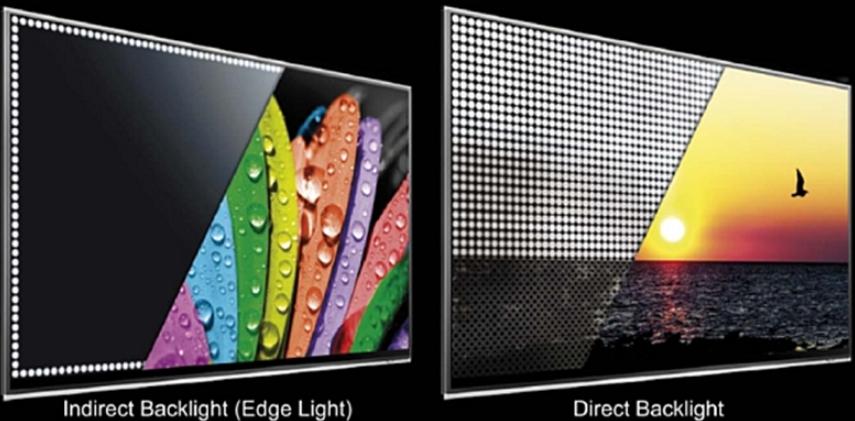
- Direct or matrix. LEDs are located across the entire surface of the monitor and provide a uniform backlight of the highest quality. A complex solution that requires the use of a large number of diodes, but in this embodiment, dynamic control can be implemented to achieve the ideal color setting.
- End, it is also called edge or side, as the light can be located on the sides, top and bottom, or around the perimeter of the screen. In this case, the sources distribute light over the entire surface due to special diffusers, this is a cheaper and easier to implement option used on most devices.
There are also different ways to control the backlight, which is important to consider when choosing TVs:
- Static does not involve any settings other than brightness. This option is used for side lighting.
- Dynamic allows you to control color and is used when broadcasting an image to increase contrast and give colors extra depth.
Another factor is the color of the glow, there are also only two varieties:
- White illumination is used in side-type systems. For it, blue diodes with a yellow phosphor coating are most often used, as this provides a large range of white color.
- RGB- the backlight is a block of LEDs. The most commonly used combined blue and green elements are coated with red phosphor, which gives a wide range of color settings.
To further increase the number of colors and shades, new models use quantum dot LED backlighting.
Types of backlight in TVs and monitors
The type of screen backlight depends on the location of the LEDs and their design. Today, there are three main varieties that are most often found on sale and have features that are best studied before buying a product.
Direct LED or FALD
The two names appeared not because of fundamental differences, but because the manufacturers introduced a slightly improved system as a new solution. This is a common marketing ploy, in fact there are no special differences. As for the features, they are:
- This is a direct type backlight, in which diodes are located behind the screen and are evenly distributed over the entire area. The light goes in the direction of the person, which allows you to create blackout zones. But since the number of diodes is small, the dimming zones are large, which does not give a particular breadth of settings.
- To fix the problems and make this option better, the number of LEDs was increased to 1000 and the technology was called FALD. It is used on many expensive models, as it allows you to create many dimming zones that can be controlled to fine-tune the image.
- Due to the location of the diodes at the edges of the screen, there is no light. Contrast and brightness are both good and the backlight is uniform across the entire area of the screen, even if it is large. But at the same time, the power consumption of a TV or other equipment will be slightly higher.
Edge LED
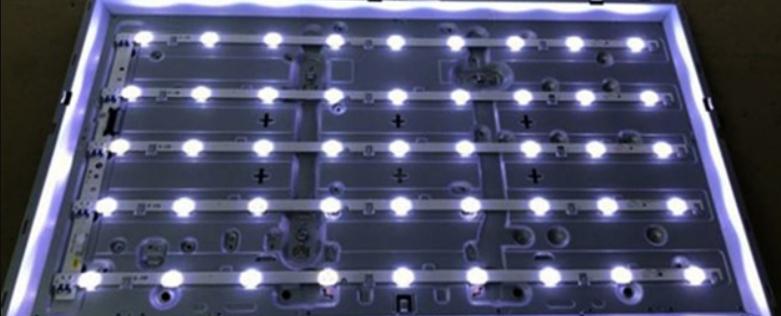
This type of LED matrix backlight has lighting located at the edges of the screen, which leads to the following features:
- In cheap models LEDs put only at the top and bottom of the screen or on the sides. This does not give the proper level of illumination of the entire surface, and you can see highlights at the edges.
- In expensive versions, diodes put around the perimeter. This allows for more uniform illumination and gives a uniform black light around the perimeter, although light is often visible in the corners due to the high concentration of LEDs.
- In TVs with this backlight option, the thickness of the matrix is much smaller.
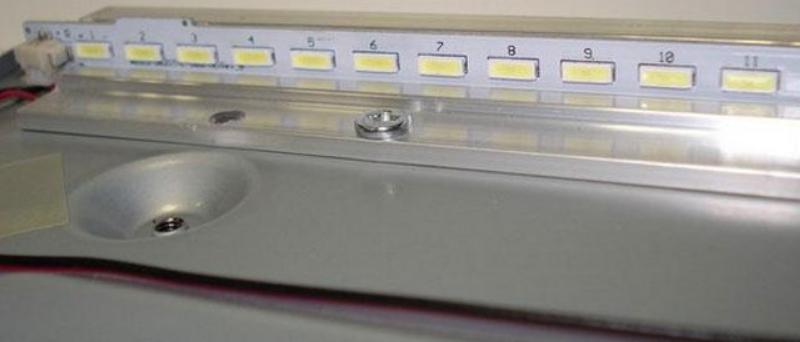
If there are diodes around the perimeter, then the contrast will be good.
OLED
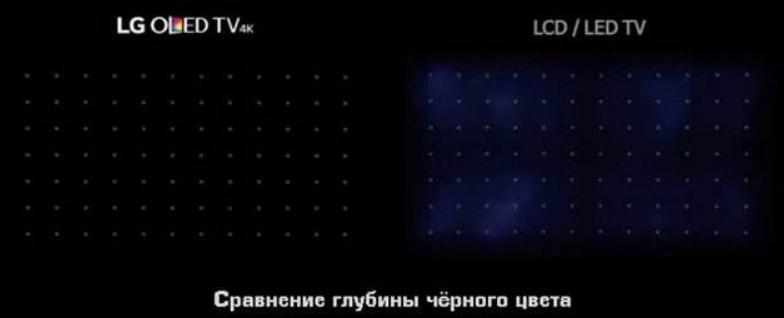
The most modern type, this is not even a backlight, but an independent design option with the following features:
- LEDs do not serve as a source of light, but give a complete image. Organic diodes provide huge color rendering capabilities and improve image quality, the speed is 1000 times higher.
- The display is the thinnest and lightest, since it does not need a backlight. This reduces power consumption. In this case, you can control every part of the screen down to the pixel.
- This option provides a high-quality image from any viewing angle. In fact, this is the most perfect solution, but the price is higher than that of analogues.
From the video it will become clear which backlight to choose and which one to refuse
When choosing a TV or monitor, you should not lose sight of such an aspect as backlighting, since image quality largely depends on it. It is necessary to proceed from the features of technology and budget, the price can change very much.