What is the difference between plinths
On sale you can find light bulbs of various types. The most common base is E14 and E27 - the difference between them is not obvious to many. But if you make a mistake when choosing, you will have to change light bulbs or cartridges in lamps. Therefore, it is easier to understand the features of these options in advance in order to choose the best solution for your home.
Features of socles E27 and E14
Most often, there are screw and pin bases on sale, which differ in mounting the lamps. The options considered in the review are of the same type. It is designated by the letter "E" (short for "Edison Screw type") and is called the Edison base, since it was he who patented this design at the beginning of the 20th century.
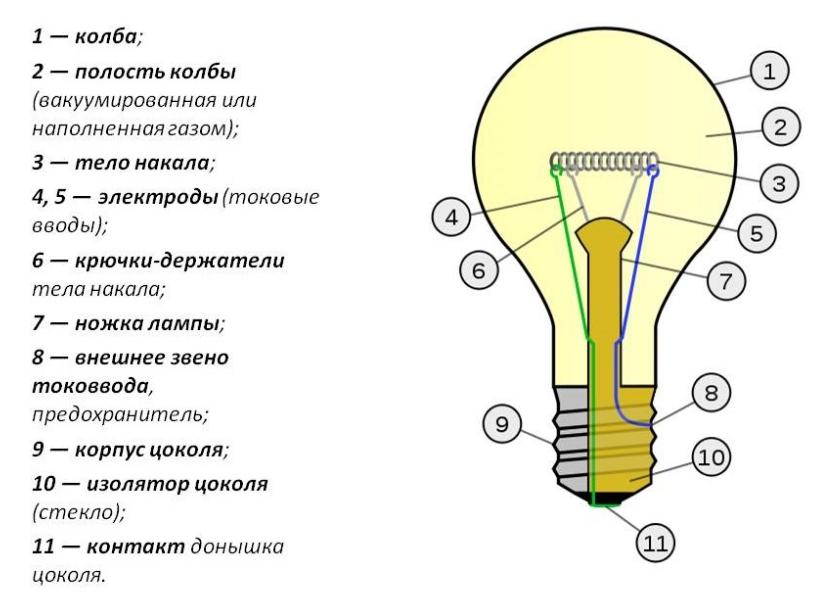
This variety is distinguished by the fact that the light bulbs are screwed into the cartridge along a special thread, which ensures a secure fixation of the light source. The main features are:
- Voltage is supplied through the central contact located at the end of the back.The cartridge has a spring element that is firmly pressed against the surface and ensures the transfer of current with the lowest possible degree of heating.
- The neutral wire is connected to the side and fed to the threaded part. Such a system ensures the safety of the structure and excludes electric shock to a person when replacing a light bulb.
- Products are always made of metal. As for cartridges, they can be ceramic, carbolite and plastic. Each of the solutions has its pros and cons, but it is ceramics that is considered the most reliable and lasts many times longer.
- The thread pitch is the same for both options. It is standard regardless of the type of construction and its diameter.
In European countries, these options are labeled differently. The E27 variant is called ES, and E14 is called SES. At the same time, the operating parameters of the bulbs are no different.
Both varieties are designed for voltages not higher than 250 V. Therefore, the main direction of their use is household lighting. It can be lamps of any type, decorative lighting or street lighting. But for outdoor use, models of lanterns with a high degree of protection against moisture are selected.
What types of lamps are suitable for E27 and E14 sockets
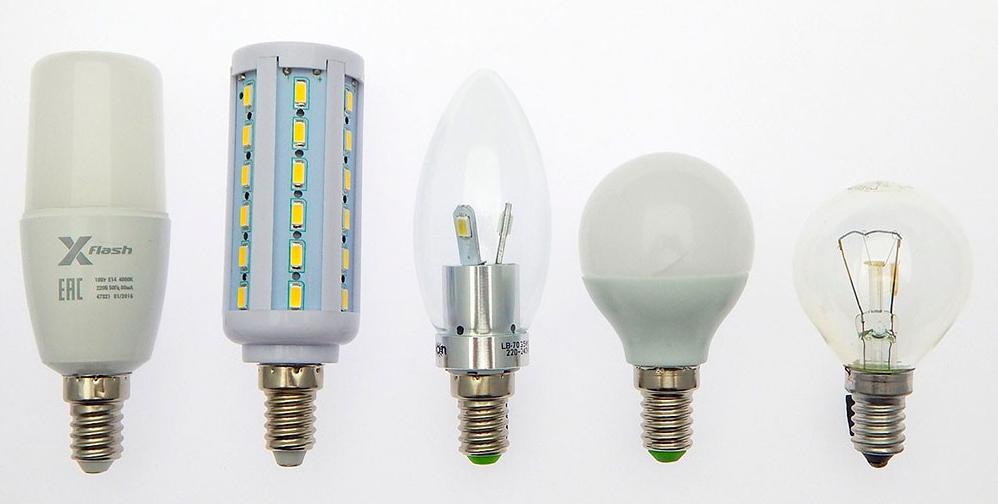
The easiest way is to consider the main options for light sources and see the differences in their applicability with different socles. Everything is quite simple here, you can figure it out quickly:
- Incandescent lamps most often produced with an E27 base, this is a traditional solution. They can have a power of up to 200 W and are used in any type of equipment. As for the E14 option, only light bulbs with a filament with a power of not more than 60 watts can be placed in it.
- fluorescent The equipment can be used with two types of plinths without any restrictions. The power consumption of this type is low, so it is suitable for different equipment. But at the same time there are limitations on the configuration, since the luminous part is quite voluminous.
- Halogen options have a similar design with incandescent lamps. But in comparison with them, they have greater brightness and allow you to achieve better lighting quality. Available for different cartridges, so you can choose the right solution for any of the types.
- LED light bulbs most economical to date. They are available with two types of plinths and almost do not differ in operating parameters. At the same time, the diode equipment does not heat up during operation, which prolongs the life of the cartridges.
Advantages and disadvantages of socles E27 and E14
Each of the options has pros and cons that should be considered when choosing a chandelier or other lighting equipment. The main advantages are:
- The E27 base is the most common in our country. You can buy this type of light bulb at any hardware store and many grocery stores. This option is available even in the most remote villages, it is easy to use and safe. And the price of such products is the lowest of all.
- Option E14 is found in most modern fixtures made abroad. It is not so common with us, but it has one big plus. You can buy an adapter and then a light bulb with an E14 base can be screwed into an E27 socket, which is very convenient.
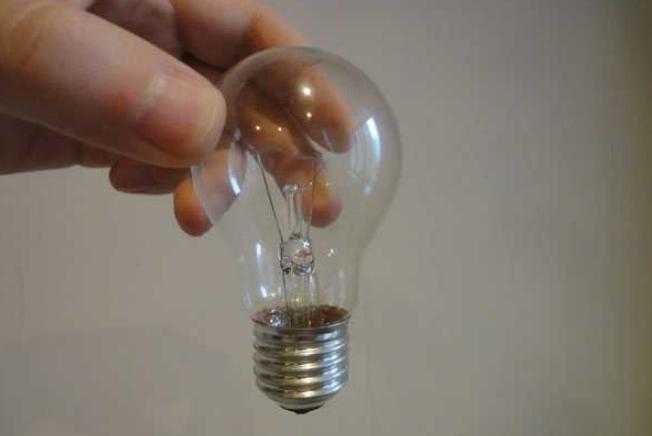
Among the shortcomings, it is worth highlighting that both varieties, when overheated, can stick to the cartridge and replacing the light bulb will cause great difficulties.Over time, the central contact loses its elasticity and needs to be bent in order to securely clamp it.
Cartridges for both types of socles are recommended to be replaced with new ones for preventive purposes at least once every 5 years.
What is the difference between the E27 base and E14
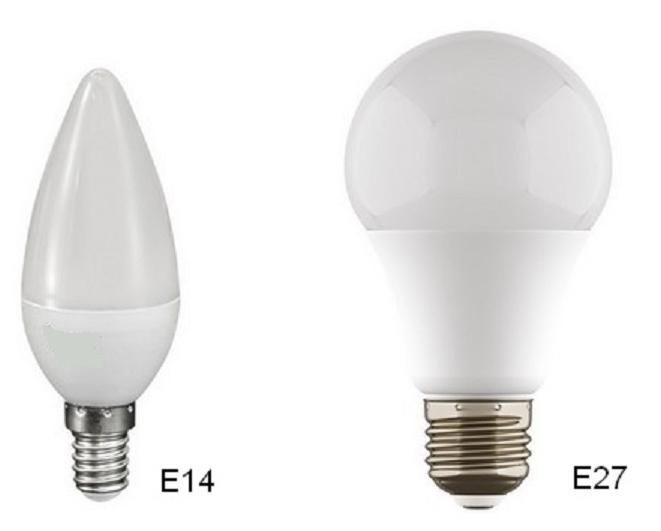
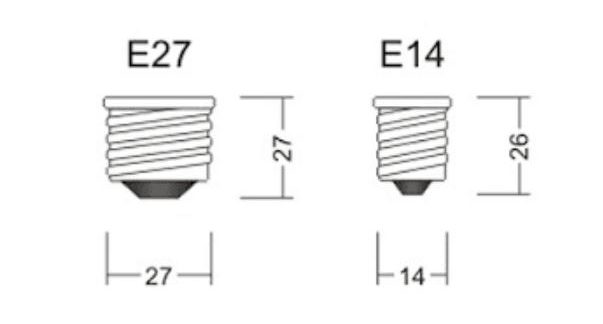
It is easy to distinguish one option from another, since they have different sizes:
- Option E27 has a threaded diameter of 27 mm. Its height is exactly the same and is 27 mm. In fact, this is the most common light bulb, well known to almost everyone.
- The E14 base is much smaller in diameter - 14 mm. That is, the numerical designation suggests the size of the element, which is very convenient.
Another difference can be considered the lower power of light bulbs with E14 sockets. They are not designed for high loads, low-power LED or fluorescent lamps are the best solution. That is, if you disassemble the E27 and E14 base, the difference is only in diameter, everything else is similar.
What are the common features of the socles E27 and E14
If we analyze the general features, first of all it is worth noting that both options belong to the same type - threaded cartridges. They use Edison thread, and the pitch on it is the same regardless of the diameter.
It is worth noting the same thread height - 27 mm. This is the standard that all manufacturers adhere to. The device of the lamps is also absolutely the same, except that the size and configuration of the glass bulb differs. If in incandescent lamps it is always transparent, then in LED modifications it is often matte for more efficient light dispersion.
Video: Let's look at an example if there is a difference between a lamp with an E14 and E27 base
It is not difficult to distinguish the E14 base from the E27, you do not need to be an electrician for this. The difference in diameter is visible to the eye, so no measurements are needed. At the same time, it must be remembered that E14 lamps can be put into the E27 cartridge through an adapter, but the opposite will not work.