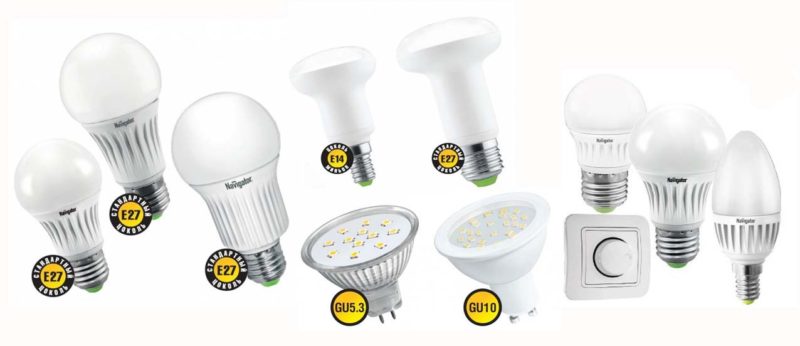
Classification and types of LED lamps
The wrong approach to choosing LED lamps can forever cross out a positive attitude towards them. Having formed an erroneous opinion, the user will not be able to appreciate the advantages of LED lamps in comparison with other lighting devices.
There are several types of LED lamps. Arriving at the store, most buyers pay attention only to power, but this is not enough to select a suitable and high-quality light bulb. It is worth considering the presence or absence of a radiator, types of diodes, color temperature and radiation angle.
plinth
LED lamps are divided according to the type of base into 3 classes:
- E - Edison base (threaded).
- G - pin base.
- T - contacts of fluorescent lamps.
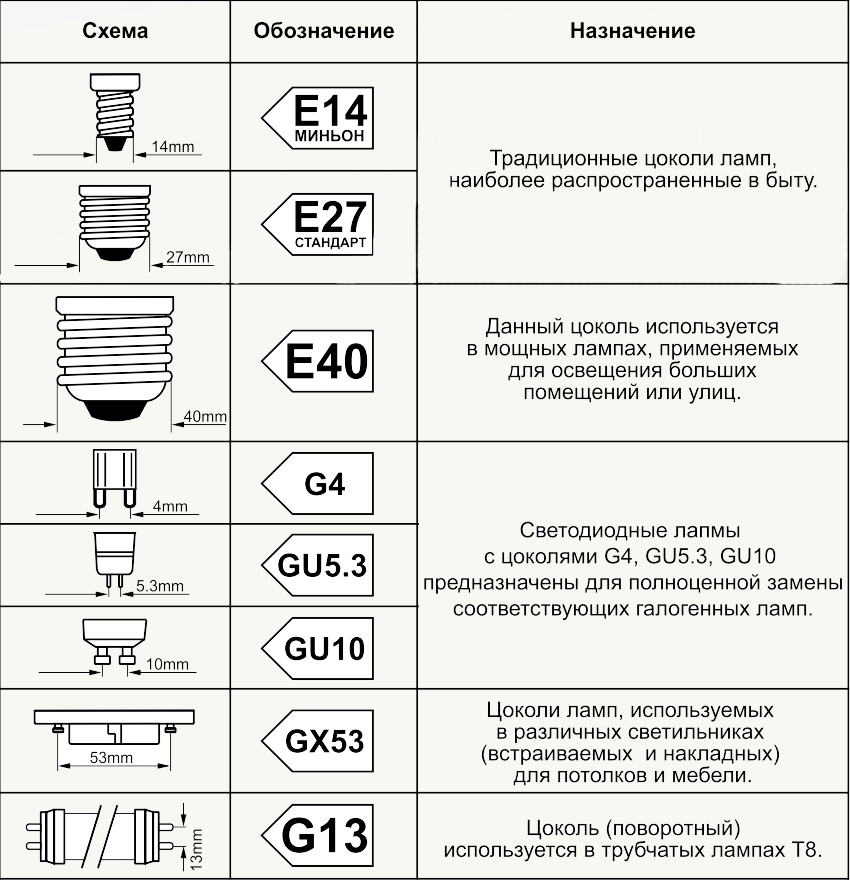
The most common E. After the letter on the package there are numbers that indicate the diameter. The numbers after the letter G indicate the number of contacts. Lamps of this type are bought the least often, since they cannot be connected to a 220 volt network without connecting a power supply. Analogues of luminescent products in the marking also have numbers indicating the distance between the contacts in parts of an inch. For example, T is 8/8 or T is 5/8 inch.
LEDs
You can find the following types of LEDs:
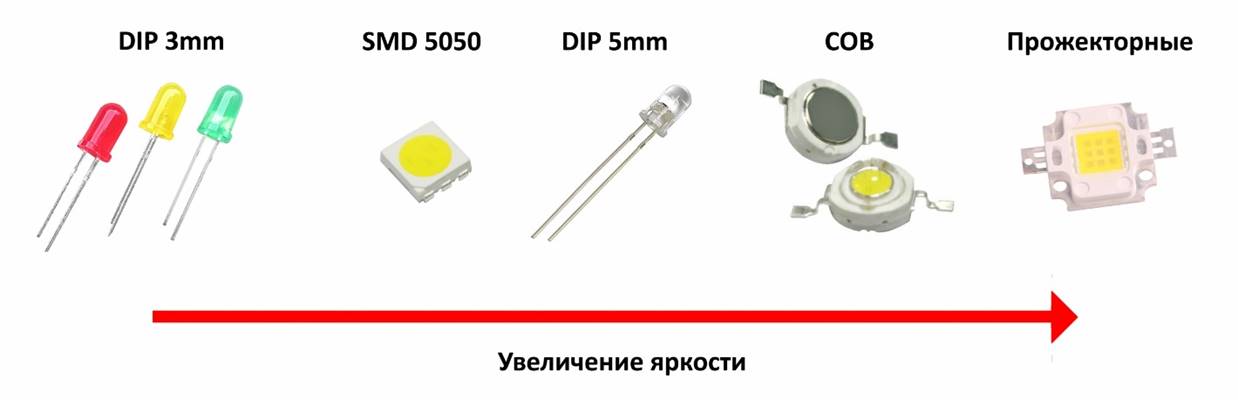
- OWL. An innovative development in the LED lighting industry. Compared to analogues, here the LED is attached directly to the base, which is necessary to increase heat transfer and reduce the size of the device. If the SMD and COB bulbs are the same size, in the second case, you can get a brighter light. Another advantage is the ability to choose a different geometric shape;
- piranha chips. They were used in light bulbs of the first generations. The devices were not distinguished by high power, safety and energy efficiency;
- filament diodes. This technology is under development. But a number of significant advantages are already known: the flow dispersion angle is 360 °, low prices and decent heat removal performance;
- powerful diodes. When buying a light bulb with these types of chips, it is worth remembering a significant disadvantage: overheating. Therefore, here you will need to install a large radiator;
- smd. They are considered the most common. Diodes are mounted on the surface of the matrix. The chips are small, do not heat up much, are reliable and bright.
When Filament lamps are available on the market in sufficient quantities, they are expected to be in demand, as they emit light in the natural range of the spectrum, which is typical for incandescent bulbs. They are also durable and economical.
Colorful temperature
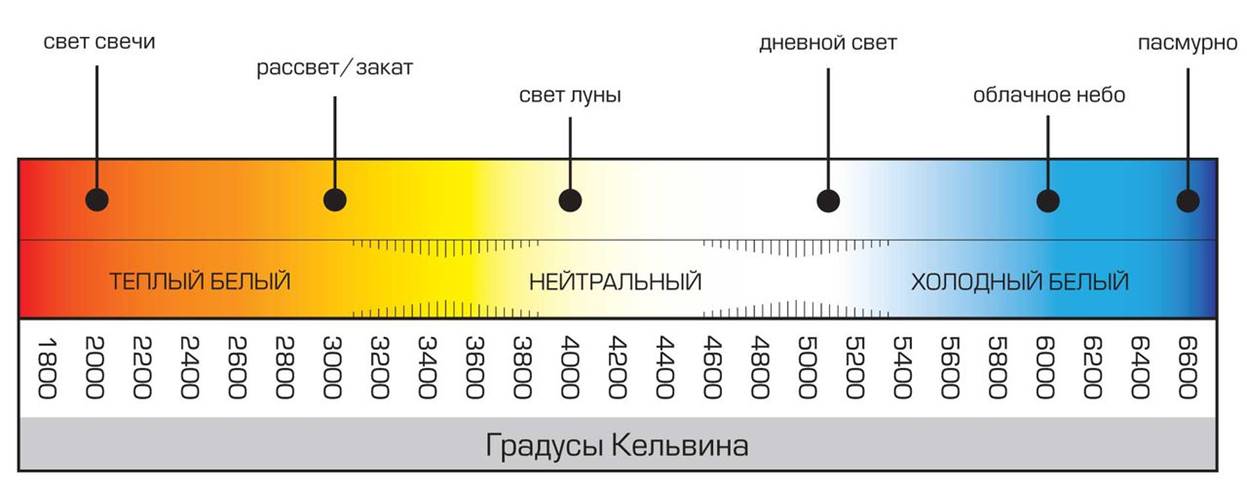
When studying the types of LED light bulbs, do not forget that they differ in color temperature and shade. The choice should be made based on the destination. Even white has several shades:
- 2700 K - reddish. Acquired to create an atmosphere of warmth and comfort in the room.Mostly color is possessed by lamps with medium and low power;
- 3000 K - warm white color with a slight yellowness. Suitable for living room, living room or nursery. Hue creates a feeling of relaxation and security;
- 3500 K - neutral white. Does not create a load on the eyes and does not distort color perception;
- 4000 K - cold white. The light will emphasize the cleanliness in the room, and the objects present in it give clear contours. As a stimulant of brain activity, they are often installed in offices and offices;
- 5000-6000 K. Day white with high brightness. Do not use in residential buildings and apartments, too hard. They are purchased to illuminate a small space, for example, a greenhouse, a production workshop, exhibition halls;
- 6500 K - a bluish shade of daylight. Concentrates attention, but can cause anxiety. A product with such a temperature is installed in technical rooms and hospitals.
In addition to those listed, on sale you can find color modules that are used to create lighting systems and individual lighting options for a house or apartment.
Power
Power is not the main technical parameter when choosing an LED light bulb, but it is perceived as one of the most important, since electricity consumption and efficiency depend on it. When compared to ordinary incandescent bulbs, they consume much less energy.
We advise you to watch the thematic video:
On the case, as well as the packaging of LED devices, there is a power marking. It is in the range from 3 to 25 watts. Basically, the parameter is denoted by the letters "P" or "W".People who are used to using 100W incandescent bulbs can purchase a 15W LED bulb and it will light up the room the same way but use less power.
Chips require less voltage, but they are able to emit more brightness. For example, a 10W LED product would be as bright as a classic 75W incandescent bulb. For more comparisons, please see the table below.
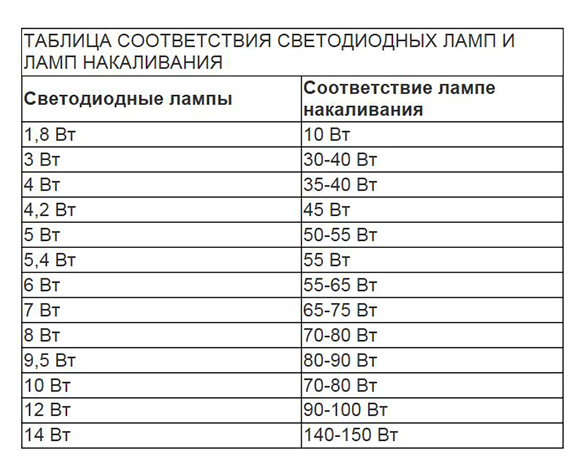
When purchasing an LED lamp, it is worth remembering that inexpensive Chinese products are less powerful and do not correspond to the markings indicated on the packaging. The difference between an expensive lamp and a cheap one can fluctuate within 5 watts. It is recommended not to buy such lighting devices.
Beam Angle
Incandescent bulbs emit light in all directions, as they have a transparent bulb. In most cases, this does not bother anyone. But if it is necessary to create directional illumination, such radiation will be characterized by large losses. LEDs emit light in a beam. This means that there will be no such losses, since the light is directed to certain objects.
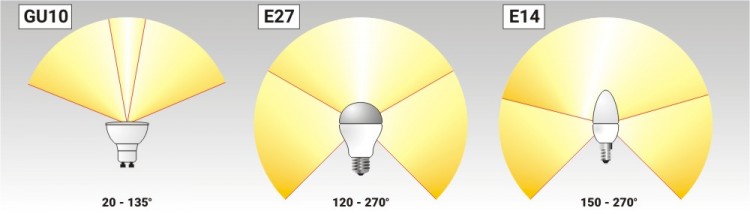
So that the product can illuminate more space, the chips are installed under the flask at different angles. If it is a night light or a spotlight, you will not need a large scattering angle. For a room in an apartment or house, an angle of 180 ° is considered acceptable. If you need to fill a large space with light, you should choose a lamp with an angle of 270 °.
Radiator
The heat sink is an important design element of the LED lamp, which affects the service life. Various materials are used:
- Plastic. It is only used for LED-crystals with low power. Products are inexpensive.
- Aluminum. It has a high heat dissipation rate, but contact may result in electric shock or burns.
- Composite. Provides safety and increases thermal conductivity.
- Ceramics. Provides electrical insulation, devices are expensive.
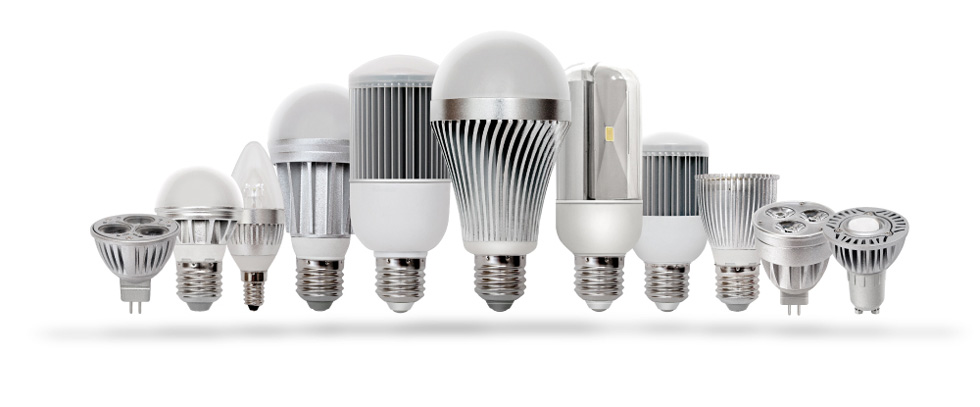
In a suspended ceiling, it is better to buy devices with ceramic or aluminum radiators. Only they will ensure sufficient heat dissipation in a confined space and reliability without a negative impact on technical performance.
The size and shape of the flask
When buying a specific model, you should pay attention not only to the types of LED lamps, but also to the shape of the ceiling lamps for which they are purchased. If the light bulb sticks out of the chandelier or goes deep inside, this will have a bad effect on the appearance.
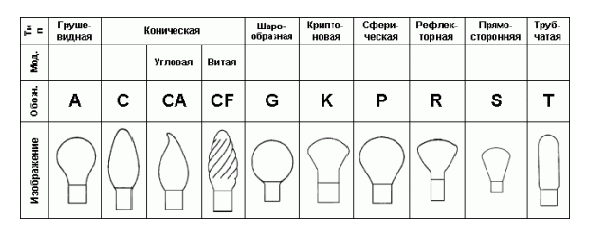
It is worth considering that the size of the lamp does not always affect its power. The shape is also different, for example, a candle, a pear, etc. Not so long ago, small light bulbs with high power up to 15 watts appeared on sale.