Description of 5630 SMD LED
The market for elements for creating LED lighting is saturated with a large number of light emitting devices. Without some training and knowledge, it is difficult to understand the variety of semiconductor elements right off the bat. In this review, to help the novice lighting engineer, the characteristics of the 5630 SMD LED are collected and their impact on consumer properties is analyzed.
Decryption
The designation of the 5630 SMD LED is not clear to the untrained eye. There is nothing complicated in this marking, and the information it carries is important for the use of the device:
- The numbers 5630 indicate the size of the instrument case. Its plan dimensions are 5.6 x 3.0 mm, such a system is adopted for LED lighting. For indicator elements, the housing dimensions are indicated in inch units.
- SMD is an abbreviation for Surface Mounted Device, a device for surface mounting. This category includes leadless radio elements, for the installation of which it is not necessary to drill holes in the board. SMD parts are soldered with contact pads to the polygons of the board from the installation side.
- LED stands for light-emitting diode. In Russian - light emitting diode, Light-emitting diode (SID, SD).
Other light-emitting elements used in lighting engineering are designated according to the same principle.
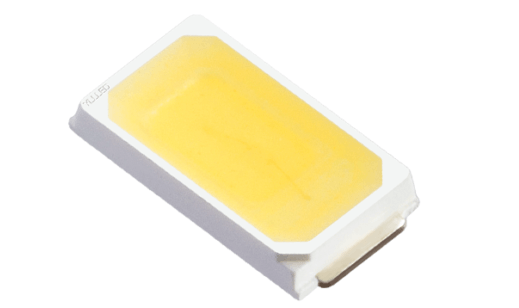
What is the power of 5630 SMD LED
There is some confusion about the power of an LED used for lighting. This confusion is brought in by marketers. We need to separate two concepts:
- Consumed electrical power. It is equal to the product of the operating current and the voltage drop across the element. It is this power that the consumer of electricity pays for, it is easy to measure. For a single LED 5630 device, it is about 0.5 W (the product of 150 mA by 2.8..3.6 V).
- equivalent power. It is equal to the power of an incandescent lamp, which produces a luminous flux equal to that of an LED. LED 5630, giving out (depending on modification) from 50 to 60 lm, replaces a conventional light bulb with a power of 10-15 watts. This parameter is more difficult to measure, and there is a wide field for marketing tricks.
Therefore, to create a light source equivalent to a 60-watt incandescent lamp, you need 4-6 LED 5630, and they will consume 2-3 watts from the power system.
Structural description
LED 5630 consists of a ceramic base on which a crystal with an emitting p-n junction is fixed. This substrate has sufficient thermal conductivity to allow the LED to work with an external heatsink. The crystal is filled with a transparent compound, and a layer of phosphor is applied on top. When a forward voltage is applied, the radiation of the p-n junction initiates the glow of the phosphor.
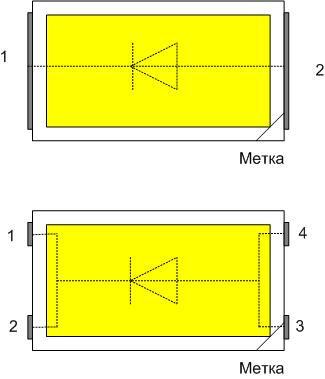
There are two modifications of the LED 5630 housing - with two leads and with four. There are no functional differences between the two versions. Galvanically, pads 1 and 2, 3 and 4 (in the four-output version) are equivalent.To designate pinouts in the area of the cathode terminal there is a mark in the form of an oblique recess.
Specifications
It is logical to divide the technical parameters of LED into electrical (inherent to any diode) and optical (which are characterized by lighting light emitters). Technical parameters are summarized in the table.
| Rated current, mA | Maximum pulse current, mA | Maximum reverse voltage, V | Maximum operating temperature, deg.С | Declared service life, h |
| 150 | 300 | 1,2 | +85 | 25000 - 30000 |
Some of the characteristics (highest luminous flux, power, voltage drop, etc.) are mentioned above. With optical parameters it is necessary to understand in more detail.
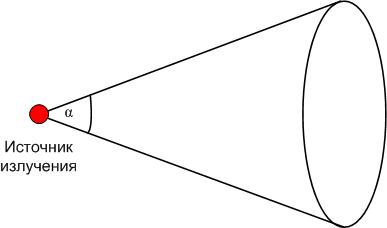
The solid angle of light scattering is most simply represented as a cone emerging from the radiation source. Within the boundaries of the cone, light will be visible, outside - no. The opening angle of the cone will be the desired value. For the considered semiconductor device, it is equal to 120 degrees.
The color rendering index is denoted by the letters Ra or CRI. Its value characterizes the ability of the lighting device not to distort the natural colors of surrounding objects.

It is measured in relative units. Ideally, the LED should have Ra=100, but such a device has not yet been created. CRI=80..90 is considered very good. Under such lighting, distortions of natural colors are practically not observed. A value of 70..80 is considered good, but anything below should not be used.
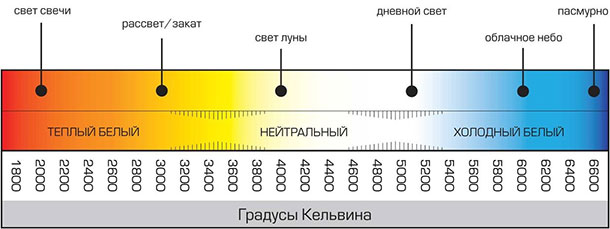
Another important parameter for LED lighting is the color temperature, which determines the emission spectrum. The device with standard sizes 5630 is available in the following modifications:
| Color temperature, K | 2800-3500 | 4000-4500 | 6000-6500 | 7000-8000 |
| Glow characteristic | Warm white | natural white | Cool (cool) white | Cold (cold) white |
| Application | Comfortable light for living spaces | Daylight for living rooms, offices | Jewelry stores, museums | |
This parameter is not intuitively clear, in connection with it there are many myths and misconceptions. In fact, it has nothing to do with the actual operating temperature of a semiconductor device, and characterizes the emission spectrum of the phosphor. The glow of the device cannot be described by a wavelength - the emitted range is quite wide. Therefore, to characterize the spectrum, an analogue of the blackbody radiation region (black body) is used. Simplified, it looks like this: if you take a blackbody, then at absolute temperature zero (0 K) it will look black. But if you start heating it, it will begin to emit a visible color - first, the glow of the red part of the optical range, with a further increase in temperature, the light will shift to the blue-violet region. The spectrum corresponding to the blackbody temperature is used to describe the radiation parameters of LED lighting devices.
Important! The indicated characteristics of the smd 5630 LED are declared by the manufacturers in the LED datasheets. These may differ slightly from manufacturer to manufacturer. It should also be borne in mind that for LED emitters manufactured by well-known manufacturers, the real characteristics in most cases correspond to the declared ones. For cheap elements of unknown origin, the declared parameters may differ for the worse. Unfortunately, the market is now flooded with such devices, they have practically replaced branded products.
How and where is such an LED used
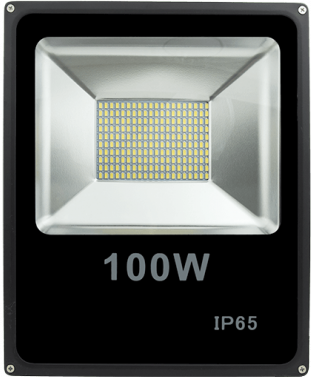
LED 5630 is used as an element of lighting devices with a wide range of applications. It completely replaces obsolete incandescent lamps (taking into account increased energy efficiency and durability):
- in spotlights for lighting territories;
- in lighting residential, office and industrial buildings;
- for lighting equipment of cars;
- for aesthetic illumination of architectural structures;
- to illuminate the artificial landscape;
- for other purposes.
Also, LED 5630 is used to create LED strips, which are used for local illumination of interiors, service engineering structures (stairs, exits, etc.) and outdoor elements.
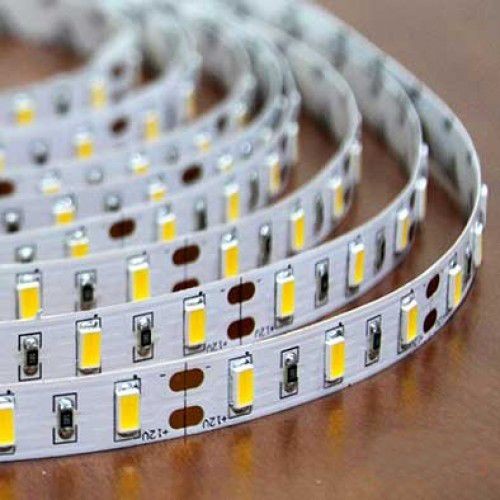
5630 LEDs are popular with designers of light emitting devices and lighting systems. The reason for the widespread use was the harmony of technical parameters, cost and energy efficiency during operation.