How a flashlight works
A handheld flashlight is a necessary tool in everyday life and at work. Where there is not enough lighting, it will help you get the job done, find a malfunction, find a fallen or rolled object. To repair a failed lamp or upgrade it, you need to know its electrical circuit.
How a handheld flashlight works
The device of a flashlight is simple. It consists of a battery compartment and a compartment with an emitter and a reflector, as well as a power switch.
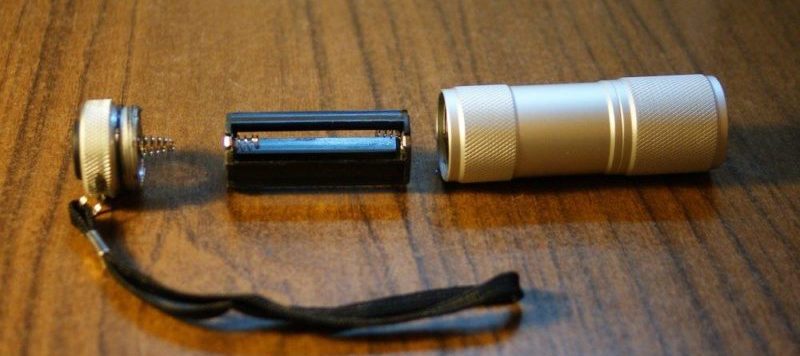
This content has not changed since the invention of a pocket electric lamp, although the element base has changed dramatically.
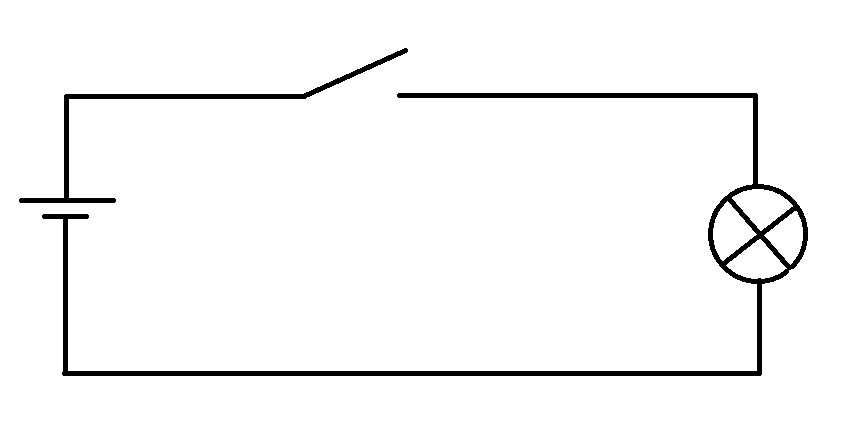
Diagram of a simple flashlight
The electrical circuit diagram of a simple flashlight consists of only three elements:
- batteries (or several);
- power switch;
- incandescent bulbs.
Scheme of a flashlight on LEDs
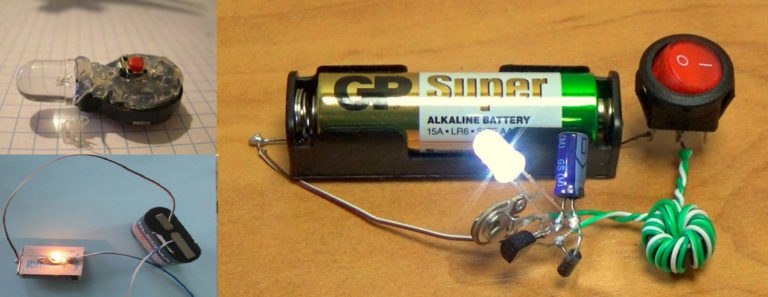
In modern conditions, incandescent lamps are being intensively replaced by LEDs.They could not stand the competition due to lower efficiency and shorter service life. Semiconductor light-emitting elements have also become widespread in portable hand-held lamps. But just taking and replacing a light bulb with an LED (or a matrix of LEDs) will not work. You need a device that would limit the current through semiconductor elements. It's called driver and is an electronic current stabilizer.
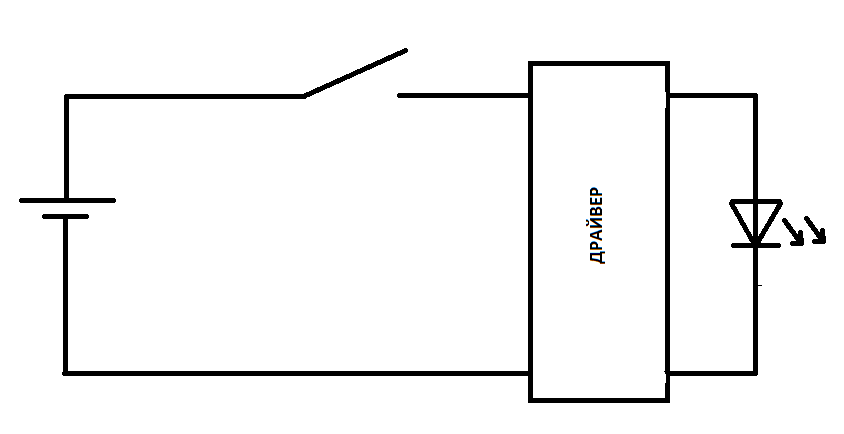
The disadvantage of such a scheme is the low maintainability of such a flashlight - to restore the electronic circuit, a qualified craftsman and appropriate laboratory equipment will be required.
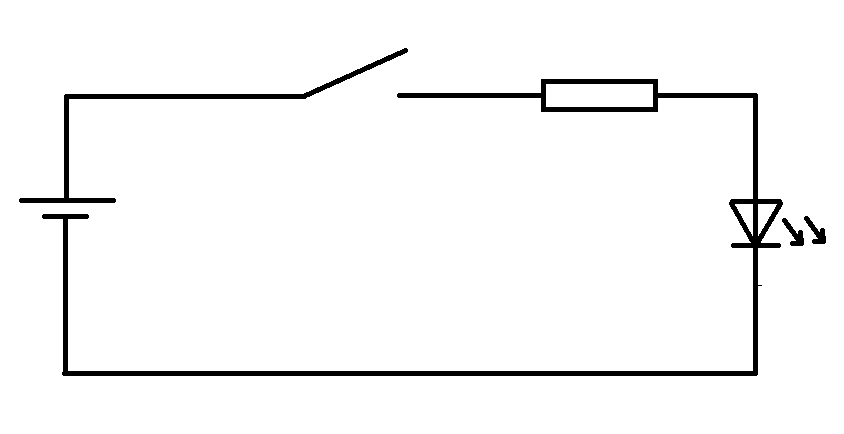
The driver can be a normal resistor, which will limit the current and extinguish excess voltage. But a sufficiently large amount of power will be uselessly lost on the resistance. For a mains-powered lantern, this fact is not important, but for a battery-powered or rechargeable luminaire, such a disadvantage can be critical.
Important! Another element is added to the design of the LED lamp - a heat-removing radiator. Although the radiation of LEDs is fundamentally not related to heating, the Joule-Lenz law cannot be bypassed. When current passes through radiating elements, heat is generated. If you do not take action, then overheating the LED will significantly reduce their service life.
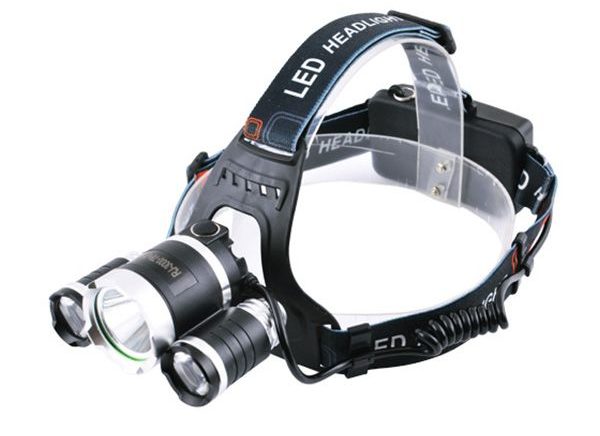
Headlamp diagram
A popular design of the LED flashlight is the headlamp. Such a lamp allows you to completely free your hands and direct the beam of light to the right place by turning your head: following your gaze.This is convenient when repairing a car, when walking in dark areas, etc.
The scheme of such a lamp is based on the principle:
- control circuit (responsible for switching modes);
- buffer amplifier;
- transistor switch to turn on the LED.
One of the options for such a device is when the control unit is made on a standard microcontroller (for example, ATtiny85), in which the emitter mode control program is hardwired, the OPA335 operational amplifier serves as an intermediate amplifier, and the IRLR2905 field effect transistor is used as a key.
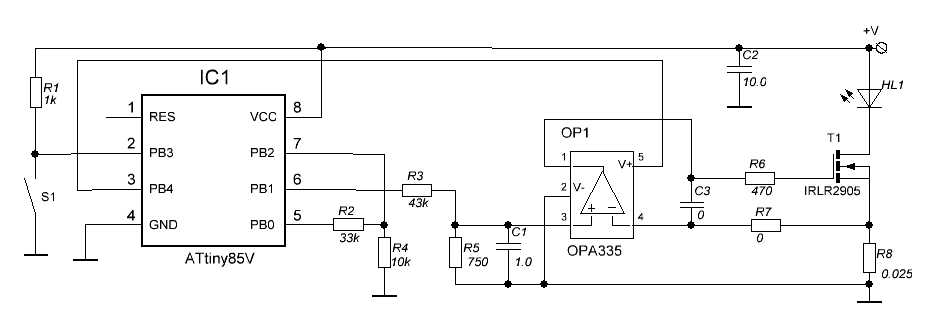
Such a scheme is inexpensive, reliable, but has a technological drawback: the controller must be programmed before installation. Therefore, in mass production, a specialized FM2819 microcircuit is used as a control unit (the abbreviation 819L can be applied to the case). This chip can turn the light emitting element on and off, and is programmed with four modes:
- maximum brightness;
- average brightness;
- minimum brightness;
- stroboscope (flashing light).
The modes are switched cyclically by a short press on the button. A long press puts the flashlight into SOS mode. You cannot change the program (at least, the datasheet does not mention such a possibility). The microcircuit does not require an intermediate amplifier, but very powerful LEDs cannot be connected directly to the output - there is a load limit (and there is protection against exceeding it).
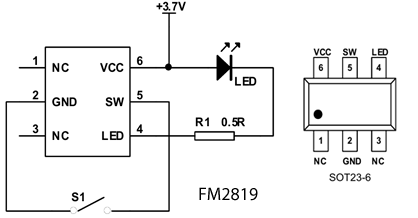
Therefore, powerful elements are connected through a key.In most cases, it is a field effect transistor that allows long-term operation with a large current in the drain circuit, for example, the Fairchild FDS9435A or others similar, which can be selected according to the parameters from the FDS9435A characteristics table.
| Structure | Maximum gate-source voltage, V | Channel open resistance | Maximum dissipated power, W | Maximum drain current in continuous mode, A |
| R-channel | 25 | 0.05 ohm at 5.3 A, 10 V | 2,5 | 5,3 |
The flashlight circuit is reduced to just two active elements and a strapping of several capacitors and resistors (plus battery cells and a matrix of LEDs, by itself).
Scheme of a rechargeable flashlight with mains charging 220
It is more convenient and economical to power the flashlight not from batteries, but from rechargeable batteries. It is even more convenient to have such a lamp, the charge of the elements of which can be renewed without removing them from the case. Simply connect the flashlight to a single-phase 220 V network.
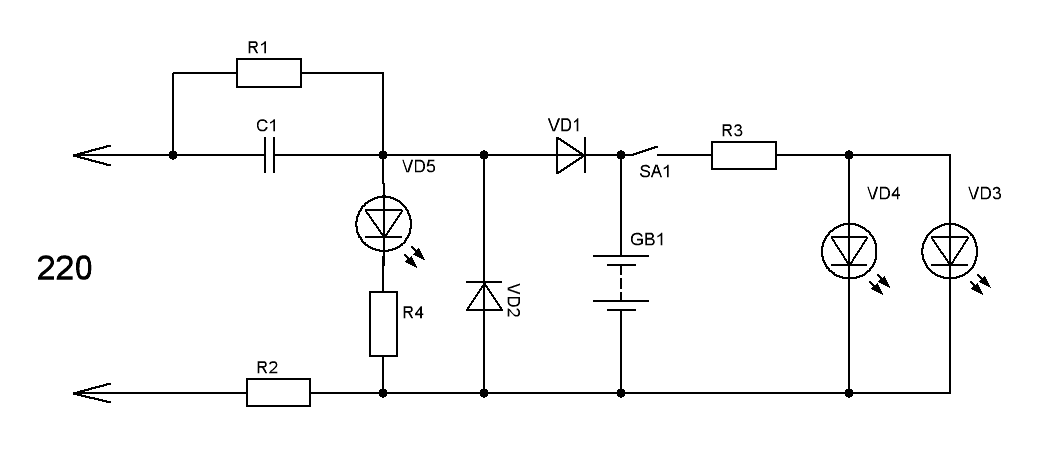
Here are the elements added to the usual scheme:
- full-wave rectifier on diodes VD1, VD2 (can also be assembled in a bridge circuit);
- ballast capacitor for damping excess voltage C1 with discharge resistance R1;
- resistor R2 to limit the battery charge current;
- chain R4VD5 to indicate connection to the mains.
Important! Such transformerless circuits have a significant drawback. If you accidentally touch any point in the circuit, there is a risk of being energized. The use of a network step-down transformer will lead to a significant increase in weight and size characteristics.
Therefore, such a scheme is becoming less common. Batteries can be recharged without removing them using low voltage external power sources (including charging from a USB compliant device).
Modernization of lanterns
Upon closer examination of the flashlight circuit from the previous section, it becomes obvious that the VD5 LED is always on when connected to a 220 V network. Its glow does not depend on the charge and even the presence of batteries. To eliminate this drawback, the indicating circuit must be included in the battery charge circuit. To do this, you need to install a resistor R5 with a power of 0.5 W so that at a current of 100 mA, about 3 V (about 30 ohms) falls on it. The indicating chain must be connected in parallel with respect to polarity.
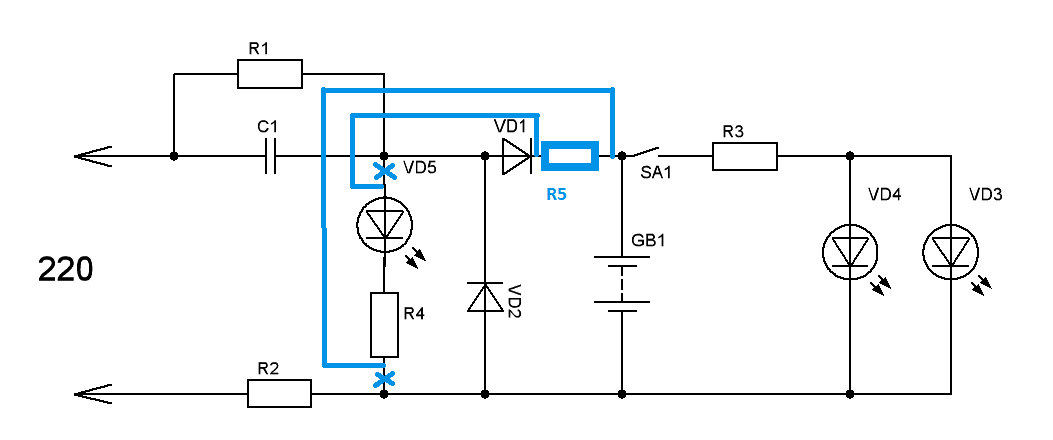
All changes and additions are shown with a blue line. After the alterations, the LED will light up only if there is a charge current (when the power of the radiating matrix is turned off!)

Health check
If the Chinese flashlight is out of order, you can try to find the defective element and replace it either repair. The search algorithm is shown on the example of a lamp with mains charging.
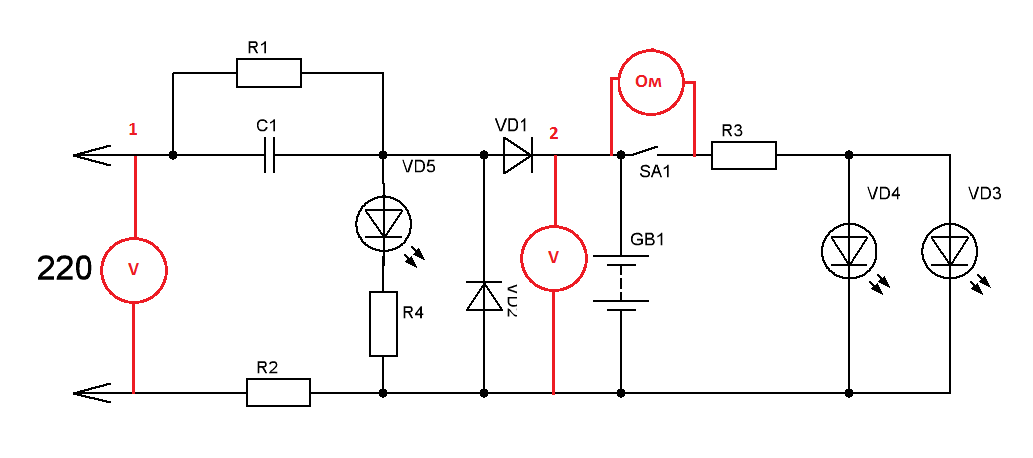
- If the lantern does not shine, when turned on, the indicator does not light up, you need to check whether 220 V is coming to the circuit. To do this, measure the AC voltage at point 1. If there is no voltage, check the power cord and connector.
- If everything is in order, the LED should be on. If not, check its circuit, as well as the VD2 diode for a short circuit.
- Next, you need to remove the batteries and check the constant voltage at point 2 - it should be approximately equal to the voltage of the batteries. If not, check the condition of the diodes VD1, VD2.
- If everything is in order, the batteries are probably bad. You need to check the voltage on them.
- If this is not the case, you need to check the health of the switch by ringing it with a tester in sound test mode (with the device turned off from the network and the batteries removed!).
- If everything is fine here, the fault must be sought in the driver or in the LED matrix.
If you have little knowledge in electrical engineering, upgrading or repairing a handheld flashlight is not difficult. The main thing is to understand its device.