Planning and installation of lighting inside a private house
Lighting in a private house is different from the apartment, as here it is necessary to independently determine the location of the devices, lay the cable and carry out other mandatory work. If standard solutions are used in apartment buildings, then in the private sector any option that meets safety standards can be implemented.
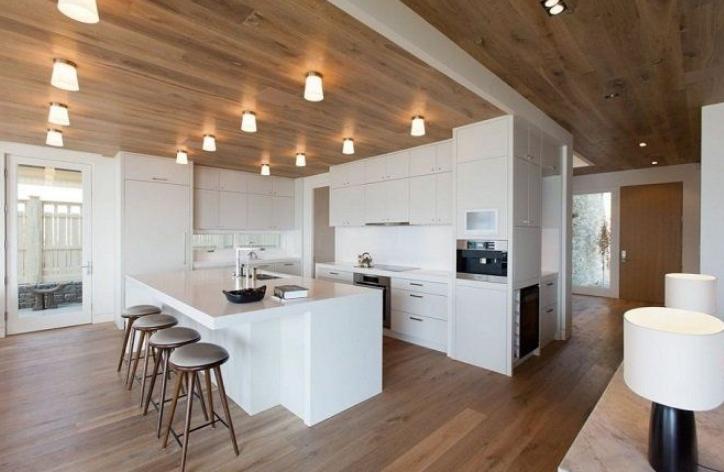
How to plan the lighting of a private house
You cannot work without a clear plan, so first of all you need to draw up a detailed project. This is a mandatory requirement of SNiP and PUE, it cannot be violated. There are a few things to keep in mind when planning:
- It is necessary to draw up a project in accordance with the established requirements, so it is better to entrust the work to specialists. Most often, this is done by the same organization that makes the project at home.
- To eliminate problems, you need to think through all the important points in advance: the location of the equipment in the premises, the number of sockets and switches. It is also important to provide all lighting equipment.
- To simplify the process, you can use standard projects if the layout of the house allows it. They make planning much easier and cheaper.
- The method of laying the wiring and the location of the junction boxes are being considered.
- The finished project must be approved by the supervisory organization. Without this, installation work cannot begin.
- When developing a project, it is necessary to determine the place where the power cable enters the house, the location of the meter and switchboard.
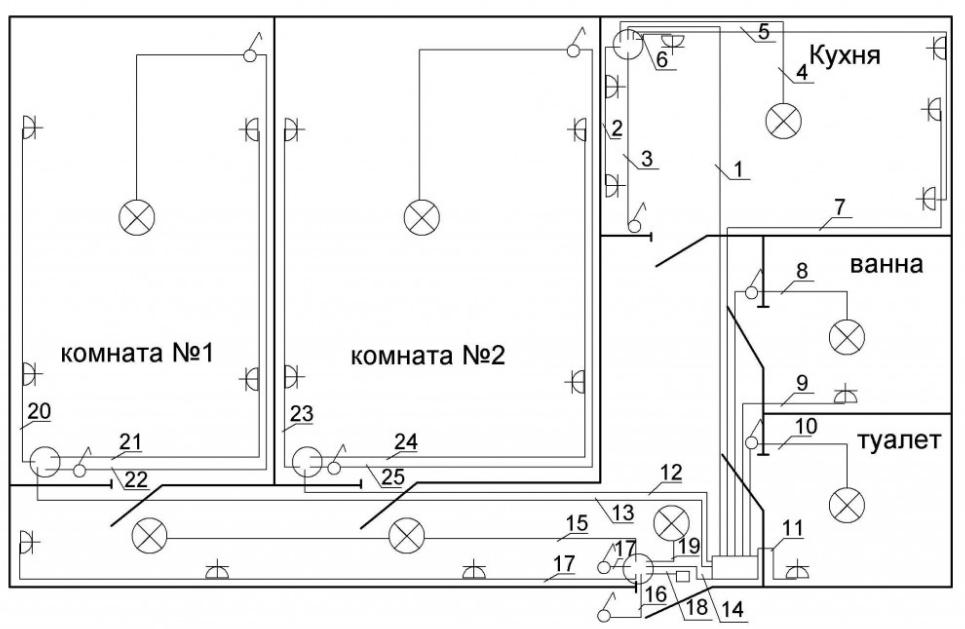
If alternative energy sources are used - solar panels or a generator, then they must also be provided for in the project. If such decisions are made later, it is worth adding them to the project and agreeing on it so that there are no problems and you do not have to pay a fine.
Power supply to the switchboard
The PUE standards indicate two options for connecting the cable - through an overhead line and through an underground connection. It is worth noting that almost always organizations conducting the connection use the air method, they resort to the underground method only in exceptional cases. As for the connection, there are a number of conditions:
- According to the rules, the switchboard must be located in a place convenient for maintenance. Most often, it is placed on the edge of the site so that representatives of the energy supply organization can check the condition.
- If the distance from the nearest post to the shield is more than 10 meters, an additional support must be installed.The cost of its installation is borne by the customer, which increases the budget. If the wire goes across the road, the height of its location should not be less than 6 meters. Therefore, you can not put low poles.
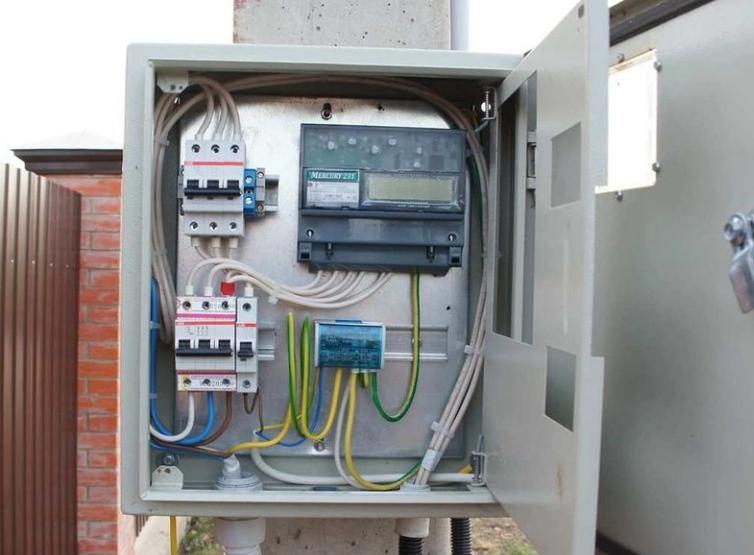
![shield on a pole]() Often the shield is fixed directly on the pole from which electricity is supplied.
Often the shield is fixed directly on the pole from which electricity is supplied. - To connect from the line to the shield, as a rule, a SIP wire with an isolated phase is used, in some cases it is zero. This makes the connection more secure.
- The wire at the entrance to the house must be placed at a height not less than 275 cm. At the same time, it is important to fix it on a solid structure, and insulators should be located at least 20 cm from the surface of the house.
- Through the wall, the wire must be led only through a metal pipe or a special insulating corrugation. When laying, you need to make this part so that moisture cannot accumulate inside.
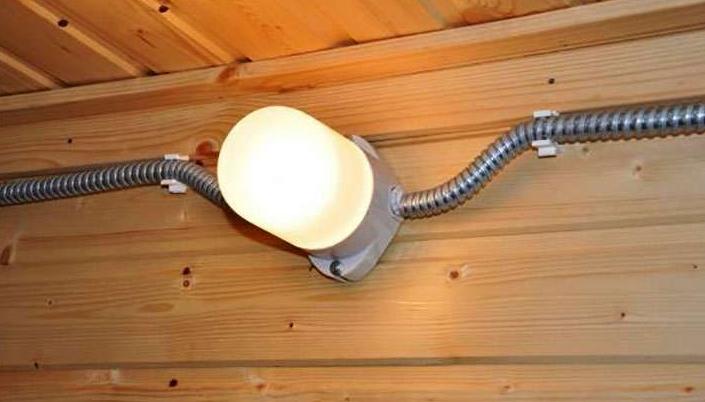
![Planning and installation of lighting inside a private house]() Open type wiring should be laid in corrugations.
Open type wiring should be laid in corrugations. - Sometimes the counter is placed on the outer surface of the wall (for example, in country houses and country houses). In this case, the wire must be protected from damage. If the wall is made of brick or other non-combustible material, plastic corrugation can be used. If the wall is wooden, you will need a steel pipe or metal corrugation.
Requirements for a group shield
This is the name of the shield from which the lighting of the house is diluted. Before obtaining permission to use electricity, you need to assemble a shield so that a representative of the regulatory authority checks it. Here you need to remember the following:
- Ideally, the shield should be in a place that is about the same distance from most rooms in the house. This will save on cable. Also, when choosing a place, it is necessary to take into account a number of requirements of the PUE for the location of the shield.
- All dry rooms are suitable for installation, even the basement can be used, provided that it is not flooded. If there is a danger of flooding, the shield is placed so that it does not fall into the water under any circumstances. It is important to provide convenient access to all elements inside the box.
![Built-in shield]() The built-in shield is very convenient.
The built-in shield is very convenient. - You can not put a shield under the bathroom, bathroom, kitchen and other rooms that can flood the space from below.
- Another limitation is the distance to the pipelines, which must be less than a meter. And it doesn’t matter what kind of pipe runs nearby - gas supply, sewerage, water supply or heating.
- If possible, the cabinet is fully or partially recessed into the surface. But on wooden surfaces, only overhead models should be used. Moreover, select fireproof varieties of shields.
- When a meter is located in the shield, you must choose a model with a compartment for its installation. In such options there is a small glass so that you can take readings without opening the door.
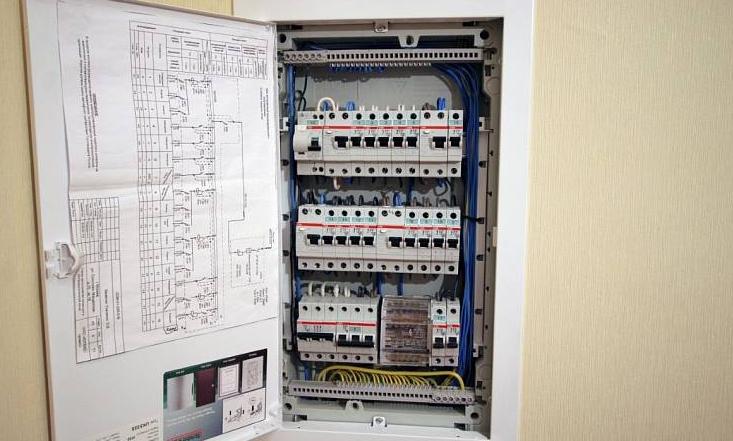
The shield must be locked with a key without fail!
Types of lighting for different rooms
Lighting in a private house inside can be of two types - natural and artificial. The first option depends on the size of the window openings, their location relative to the cardinal points and the weather. The second is much more important, since with its help you can normally illuminate the house at any time of the day.
Types of lighting and their features
There are several options that differ in purpose and equipment used. Therefore, you need to understand each to ensure comfortable light in the house:
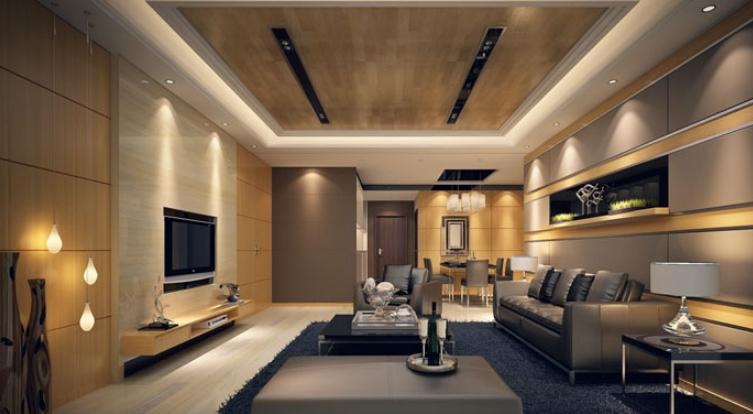
- General lighting. Most often it is one or more chandeliers with multiple plafonds.It is located in the middle to evenly illuminate the room. Instead of the classic version, light panels or spotlights located in large numbers on the ceiling can be used.
- local lighting. It is necessary in order to highlight separate zones or provide comfortable conditions for work, needlework, eating, etc. In this case, recessed, overhead, wall lamps are used. Portable options are also suitable - floor lamps, table lamps, etc.
- Decorative lighting. It is necessary for the design of the room and the selection of individual elements. You can use this option to highlight niches, the contours of the room. Here, modern solutions are especially widely used - led strip, compact spotlights, etc.
Sources of light
In order for the light to be of high quality and provide comfortable conditions, you need to make the right choice:
- Incandescent lamps - cheap, but not very high quality. They do not last long, give only yellow light and get very hot during operation. Consume the most electricity.
- Halogen options are an order of magnitude better, as they give light close to daylight. But at the same time, they also consume a lot of electricity, get very hot and do not last very long.
- Fluorescent much more economical, give a bright light and do not heat up during operation. But at the same time, flickering can be observed, and mercury vapor is used inside, which is dangerous if the flask is damaged.
- LED lamps are the best solution, which are economical, have a lifespan of 50,000 hours and low heating. The light quality is the highest.
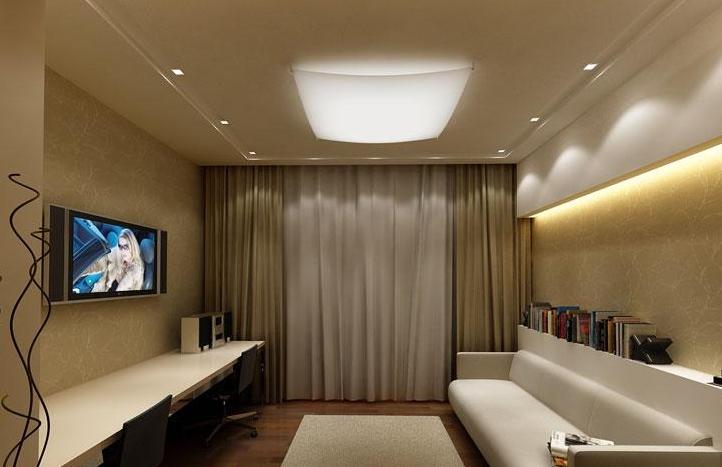
When using different light sources in a room, it is better to select lamps with the same color temperature.
Lighting control inside a country house
Modern trends are such that more and more automation tools are used in homes. But traditional solutions are also in demand. You can control the light in different ways:
- Standard switches is the simplest solution. There are different shapes and sizes.
- Motion sensors and sound switch on the equipment when a person enters the room.
- Remote Control allows you to turn lights on and off and adjust their brightness from anywhere in the room.
- Smart home system helps to control the light from a phone or computer, even if a person is not at home.
At the end of the video, which describes in detail the budget version of the lighting system (in your home)
When installing a lighting system in a house, you need to draw up a project, approve it and lay the wiring strictly according to the scheme. It is important to properly install the shields, think over the lighting system and purchase high-quality and durable lamps.