How to make greenhouse lighting
Lighting in a greenhouse is of great importance when growing plants in conditions of short daylight hours. If you properly organize the system and make heating, then you can get a crop almost all year round, regardless of external conditions. It is important to choose the type of lamps and calculate the required power.
Features of the use of lamps in greenhouses and greenhouses
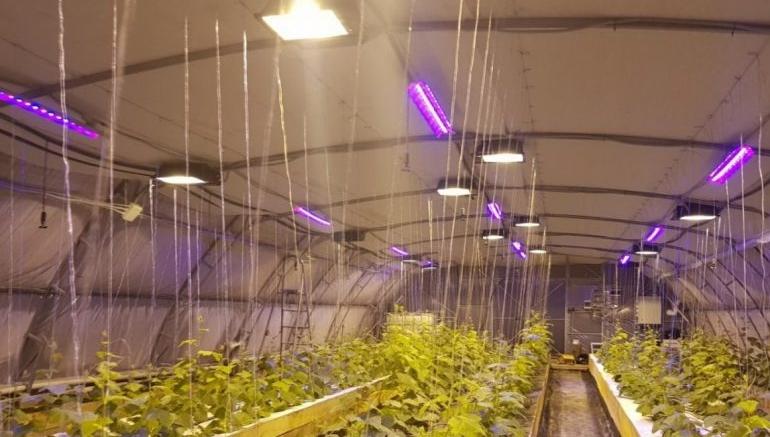
Before choosing equipment, you need to figure out how lighting in a greenhouse differs from other options. It is important that the finished system meets several requirements:
- It is best to conduct the power cable underground. For this, a wire with suitable characteristics is selected, which is laid in a trench with a depth of at least a meter. To protect against damage and extend the service life, the cable is placed in a polyethylene pipe.
- It is also worth drawing up a diagram with all light sources and switches.It is necessary to lay the wire in such a way as to exclude its damage and secure the space. Select a cable with suitable characteristics, which is designed for operation in conditions of high humidity and temperature changes. Ideally, lay the wiring in a corrugated or HDPE pipe.
- When attaching lamps, remember that they should not interfere with natural light. Therefore, massive structures will not work.
- Since the light will work for a long time, when choosing, pay attention to energy consumption.
By the way! If the lamps are not needed in the summer, it is better to make the system quick-detachable and clean it for a warm period.
The video tells about the errors in the installation of the greenhouse, the installation of heating and lighting.
Types of lamps
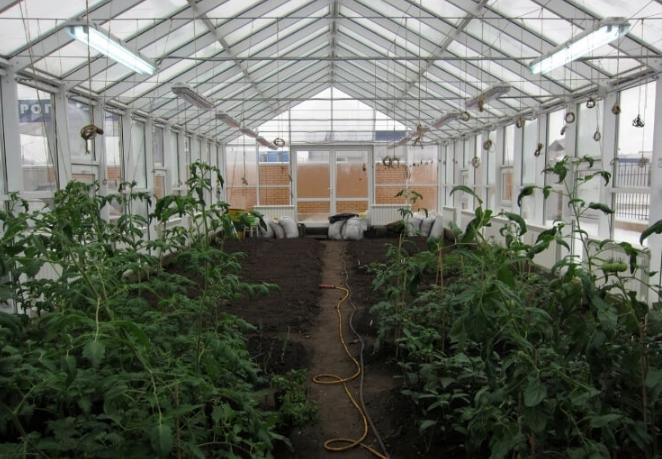
You can use different lamps for greenhouses. Each option has its advantages and disadvantages, which are worth analyzing in order to make a decision.
Incandescent lamps
They are inexpensive, but poorly suited for greenhouses, as they give a predominantly red and orange spectrum. With them, you can grow onions, parsley and other herbs, as the green mass grows best. Incandescent lamps have the following advantages:
- Availability. You can buy different power options at any hardware store.
- They are easy to change when out of order.
- Light has a spectrum that is comfortable for human vision.
But this solution has more disadvantages:
- High power consumption, this is the most costly option. In this case, most of the electricity is spent on heating the spiral, and not on light radiation.
- Service life is only 1000 hours.
- The brightness is low, for good lighting you need a lot of light bulbs.
- The flask gets very hot during operation, which can cause plant burns or deformation of the polycarbonate.
infrared
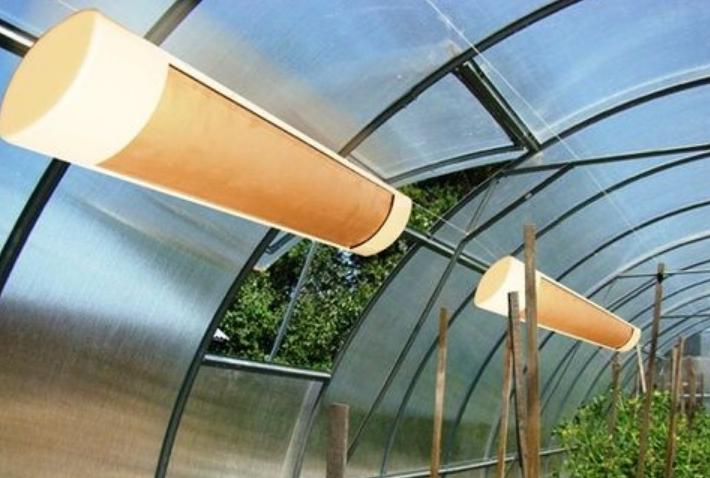
They appeared recently, but have become popular in greenhouse lighting, as they allow solving several problems:
- These are ideal lamps for a greenhouse in winter, as they not only provide light, but also warm the soil and plants. In fact, this is an artificial sun that gives a spectrum that is as close as possible to natural.
- infrared lamps give a good light, under which the plants feel good.
- Installing the equipment is easy, anyone can do it.
Among the shortcomings, one can single out a rather high cost of equipment. Also, such lamps are not suitable in warm weather, as they constantly heat the surface, which can lead to overheating of seedlings or plants.
LED
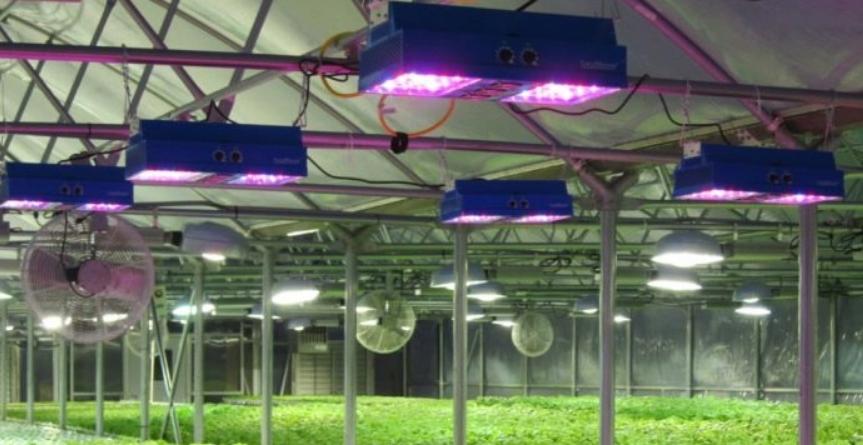
This type is used most often, popularity is increasing every year, since LEDs have many advantages:
- Low power consumption with good power. This is one of the most economical solutions, 10 times more profitable than incandescent lamps.
- Equipment safety. Diodes do not heat up during operation, do not emit harmful substances, they can be left on even at night.
- The resource of work is about 50,000 hours. This is at least 10 years with moderate operation.
You can buy ready-made models or make them yourself. For example, make a lamp for seedlings in a greenhouse using LED strip.
Among the shortcomings, one can single out the need to install power supplies and the high price of high-quality equipment.
Video about the advantages of LED lamps.
Fluorescent
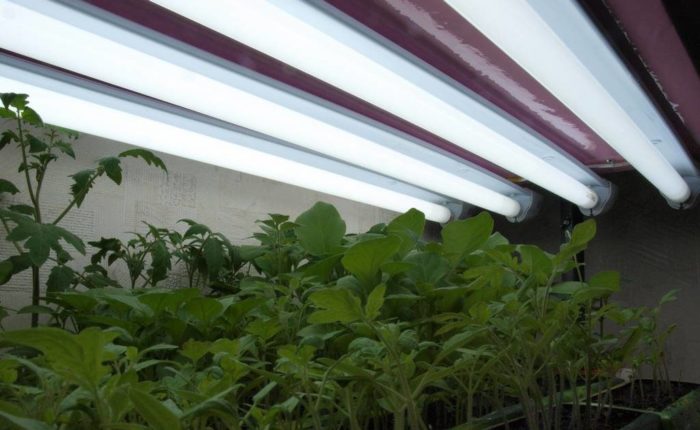
This option is often used for greenhouses and greenhouses, as it has many positive characteristics:
- During operation, the lamps practically do not heat up, which ensures safety.
- You can choose lamps with a spectrum suitable for plants, models with cold white light are best suited.
- Power consumption is low and second only to LEDs.
As for the disadvantages, first of all it is poor performance of fluorescent lamps at temperatures below 5 degrees. Also, this option does not differ in light output and to ensure bright lighting, you need to put a lot of light bulbs or lamps.
sodium
This solution is also used in greenhouses, especially if the structures are large. The features are:
- The emitted spectrum is well suited for plants, although red and orange colors predominate there.
- Lamps are inexpensive and last a very long time. This reduces lighting costs.
- Lamps radiate heat and are used as an additional source of heating in winter.
Have sodium lamps and cons, the main of which is strong heating of the flask during operation. They are more suitable for large rooms, where the distance to the leaves of plants is sufficient.
Mercury
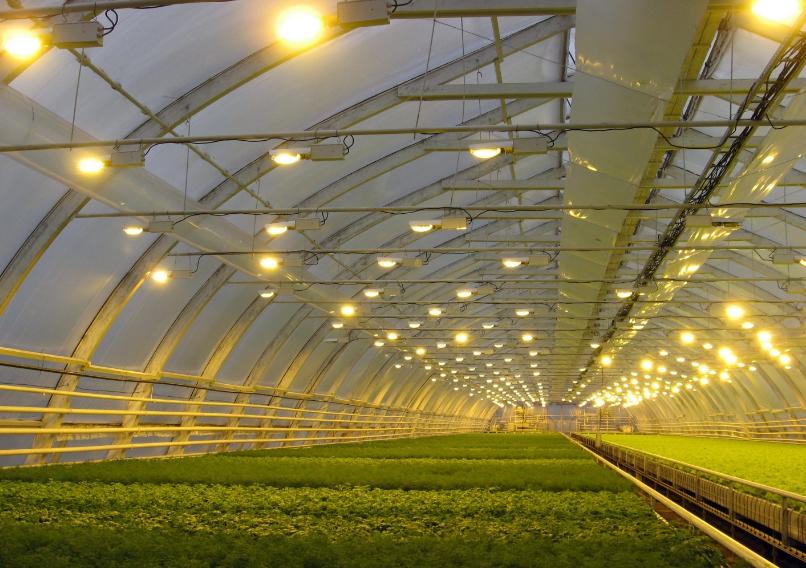
This variety is often used in winter lighting, as it gives a bright light and radiates heat, which is used as heating. Features are:
- With small dimensions, the brightness of the lamps is very good. They emit a lot of ultraviolet light, which is good for plants.
- Energy consumption is small, lighting costs will be small.
- Installing fixtures is no more difficult than standard ones.
Important! Due to the mercury content in the flask dispose of lamps can only be subject to a number of requirements.
It is worth remembering that the lamps are very hot, therefore they pose a health hazard and can cause a fire.
Metal halide
This type of light bulbs is distinguished by high cost and short service life. But at the same time they are popular when used in greenhouses for the following reasons:
- The radiation spectrum suits plants best. This type has optimal light output.
- The dimensions are compact, such lamps take up little space.
Of the shortcomings Note the high voltage requirement.. If it is unstable or there are drops, the flask may explode.
How to calculate the required lighting brightness
In order not to make mistakes in the calculations, you should remember:
- Choose lamps with light, the spectrum of which is as close as possible to natural sunlight. When additional illumination, select equipment with peaks in the red and blue spectrum.
- Take into account the norms of illumination for a particular culture. Data can be found in special directories or on sites on crop production (they are indicated in suites).
- Time to calculate depending on the length of daylight hours and cloudiness.
- Consider the height of the lamps, the higher it is, the more powerful the equipment you need.
At the end of another video.
It is not difficult to equip lighting in a greenhouse if you choose the right type of lamps and calculate the correct power. The main thing is to take into account energy consumption, since the cost of light depends on it.