How to organize LED aquarium lighting
LED lighting for aquariums has become widely used relatively recently. Many still put traditional options in the form of incandescent lamps or halogen lamps. But if you understand the issue and properly equip lighting using LEDs, you can provide ideal conditions for aquatic life and plants.
Features of LED Lighting
This option differs from the rest primarily in safety. In the manufacture of LEDs, poisonous and dangerous substances are not used, and if a type designed for a voltage of 12 volts is used, then nothing bad will happen when it comes into contact with bare wires. In addition, this species has many other advantages.
Pros and cons
It’s worth starting with the advantages, since there are many more of them.First of all, it should be noted that the direction of LED lamps for aquariums is developing rapidly and new models appear every year. Over the past few years, such lighting has evolved from a little-known to one of the most popular in the world. In addition, it is worth noting additional advantages:
- During operation, the LEDs almost do not heat up. This eliminates the need to remove excess heat, as is the case when using metal halide lamps in large containers. The cooling system is not only complicated, but expensive, plus it constantly consumes electricity.
- The service life of LED lighting is many times longer than that of any other analogue. Incandescent bulbs burn out on average once a year. And metal halide options, even expensive ones, after six months of use begin to change the spectrum, which has a bad effect on plants. LEDs do not change spectrum for at least 5 years.
- The energy consumption of the considered type of lighting is several times lower than that of any other solution. The savings are huge given the fact that the light is on for a long time. LEDs consume a minimum of electricity, this is the most economical solution for today.
- If you install a dimmer, you can adjust the brightness of the lighting. There is no such possibility in any other lamp. But, most importantly, when the brightness changes, the spectrum does not shift and the plants receive exactly the light that they need.
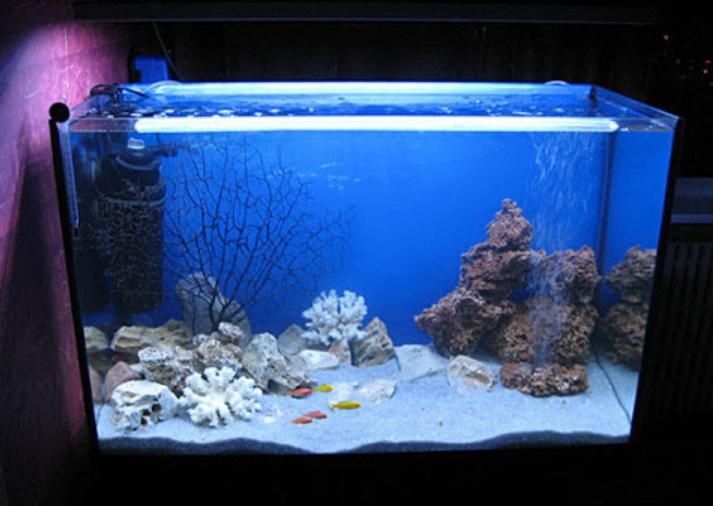
The luminous flux in the diodes is directed and distributed at an angle of 120 degrees. It does not scatter, which further increases the lighting efficiency.
The main disadvantage is the need to install a power supplySometimes it's hard to find a place for it. But if desired, it can be brought to a certain distance to be placed nearby. Another point is the difficulty of choosing a lamp of the right size for old aquariums, but if necessary, you can assemble the backlight even with your own hands.
Backlight methods
Previously, only one option was always used with the top placement of luminaires due to the fact that the lamps did not allow the use of other solutions. In addition, heated light elements created a danger with any other method of installation, an additional heat removal system was needed. Thanks to LEDs, the backlight can be implemented in three different ways:
- Solid overhead lighting. The traditional option involves the location of one or more light sources from above. Moreover, lamps or diode tape can be placed both under the cover, and at some distance, if a home-made version is used and thus the light intensity is regulated. Best suited for square or rectangular containers. Ideally, if the aquarium will have one or 2-3 species of fish with similar preferences and a moderate amount of plants.
- Side lighting solid or point type. Suitable for small aquariums built into furniture. In this case, the lighting comes from the back and side walls so that the light cones do not intersect in the water. It is best to use LEDs with a minimum brightness or adjust it with a dimmer. This option allows you to create the effect of inverse tiering, when the bottom of the tank is best lit, the top is shaded, and only reflected light hits the bottom.
- Perimeter lighting. In this case, the LED strip is located along the vertical or horizontal edges of the aquarium. Light comes from all sides and normally illuminates the container, while there is not very much of it, which is important for many plants and fish. The method is great for aquariums with many fish and plants, it does not overload the space and can be used around the clock. And the tape consumes little electricity, so this method is also the most economical.
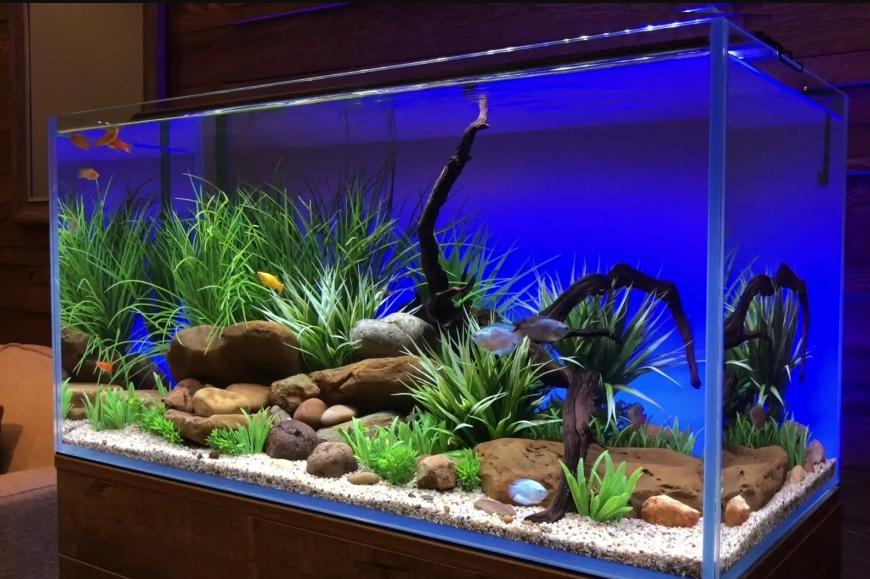
It is best to use rectangular or square aquariums. Round or oval options are much more difficult to qualitatively illuminate.
Calculation of lighting for an aquarium
For a normal life of fish in the water there must be a sufficient amount of oxygen, most of which is produced by plants. To do this, they need a certain amount of light, so it is important to calculate the optimal level of illumination. In addition, if the plants are in the dark, the carbon dioxide content in the water rises, which is extremely dangerous. Therefore, it is necessary to carry out calculations taking into account several recommendations:
- Previously, power was calculated in Watts (W), but this option is not suitable for LED equipment. Therefore, first of all, you need to choose the indicator of illumination per liter of water, it is calculated in Lumens (Lm). The requirements are as follows: 50 lm is an average value suitable for most aquariums, 40 lm is an option for containers in which there are a lot of ferns, mosses and similar plants, 60 lm is the norm with a dense population of fish and plants that require additional light.
- Even more accurately, you can calculate if you use the norm of illumination in lux.1 Lux (Lx) is equal to 1 Lm of light distributed over an area of one square meter. There are rules that should be followed. So, for rectangular aquariums with undemanding plants, the range from 6 to 10 thousand lux will be optimal, for light-loving options, you need to increase the value to 10-15 thousand. To calculate, you need to multiply the area of \u200b\u200bthe aquarium in square meters by the norm of illumination. For example, 0.2 x 10,000 = 2000, where the result is the required lamp power in Lumens.
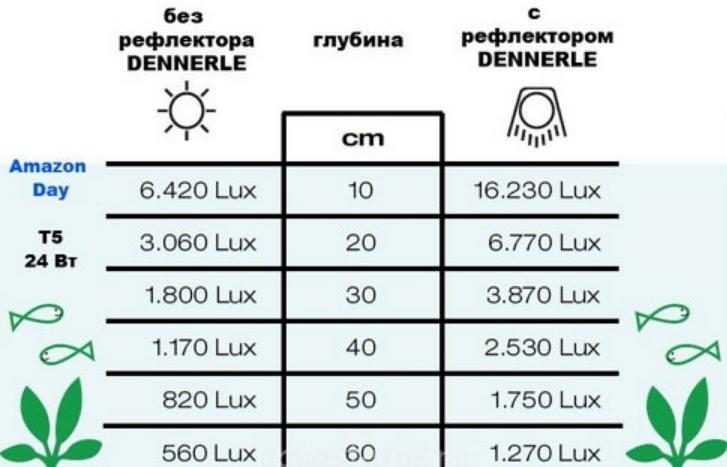
- It is worth considering the reflection of water. If a cover is used, then the indicator will be 20%; without a cover, up to 40% of light can be lost, which is also significant. When the cover is white on the inside, the losses will be reduced by 20%, and if you use reflectors, you can increase the efficiency of LED lamps or strips even more, below is a picture with a comparative analysis.
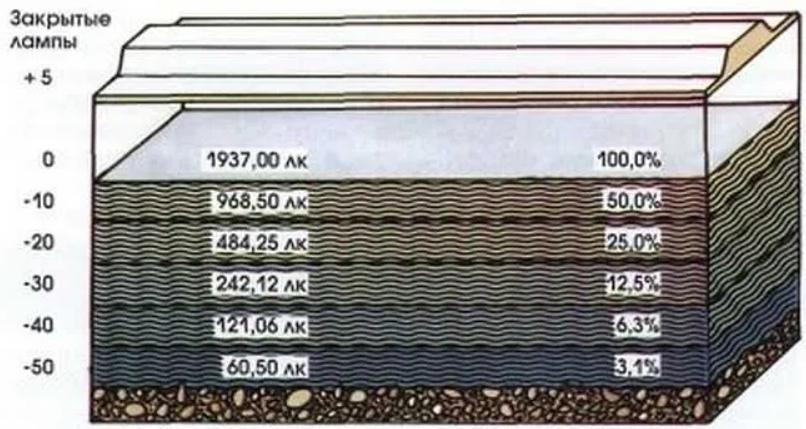
- Another factor is the loss of brightness of light in water with increasing depth. It is because of this that such high light standards are used for aquariums. The calculated data is in the diagram below, and it is necessary to determine the level of illumination from them. The values are given in percentages, so it is easy to adapt them to your conditions and calculate suitable indicators.
An excess of light is just as dangerous as its lack - instead of a beautiful aquarium, you can get a blooming swamp that will not look the best.
In addition to brightness, there are other aspects that are important. They are also worth considering in order to create comfort for all inhabitants and improve the appearance of the aquarium:
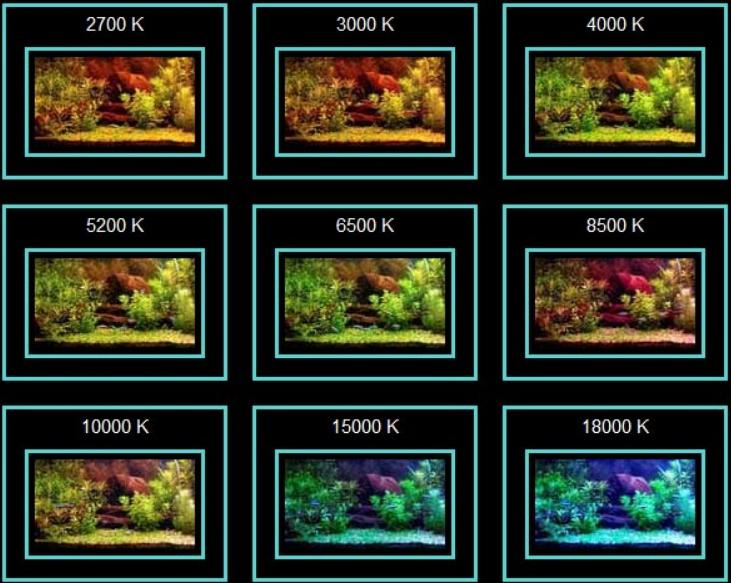
- Colorful temperature - an indicator on which depends how the surrounding objects are perceived. It is measured in Kelvin. So, at noon, when the sun is at its zenith, its brightness is approximately 5500 K. Here you need to remember that too dim light gives off yellowness, and too white distorts colors. For plants, the range from 6500 to 8000 K is best suited, depending on the species, fish need from 5500 to 20,000 K, and reefs need from 9000 to 20,000 K.
![Color temperature greatly affects the perception of the contents of the aquarium.]() Color temperature greatly affects the perception of the contents of the aquarium.
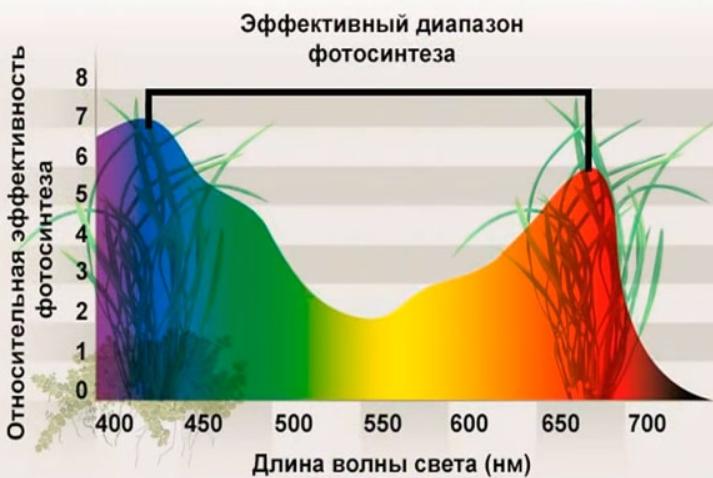
Color temperature greatly affects the perception of the contents of the aquarium. - The spectrum is another important indicator on which the processes of photosynthesis in plants directly depend. Therefore, it must be selected carefully, taking into account that blue and red shades are more important for photophilous cultures, and only blue is suitable for unpretentious ones. Choose options for the contents of the aquarium so that the plants do not get sick and develop in ideal conditions.
![Effective range for plant photosynthesis.]() Effective range for plant photosynthesis.
Effective range for plant photosynthesis. - The last factor in planning lighting is the length of the daylight hours. In order for fish and plants to be in conditions as close to natural as possible, it is necessary to provide lighting for 10-14 hours a day. In order not to turn the backlight on and off manually, it is best to buy a timer that is set in time and works offline.
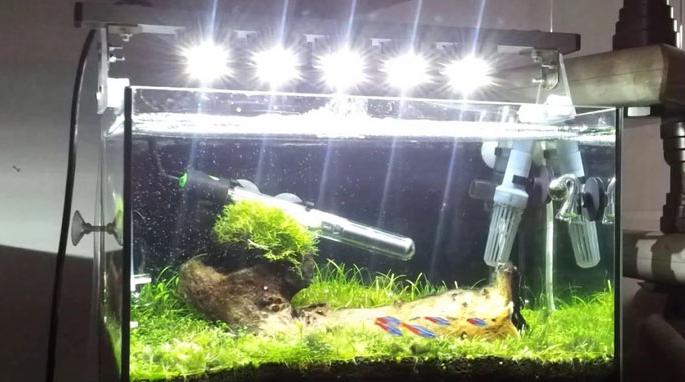
24-hour lighting of the aquarium with LED lamps is undesirable, as algae will begin to multiply actively because of this.
How to make LED lighting with your own hands
To independently assemble a lighting system, you do not need to be an electrician and have a good understanding of electronics. It is enough to be able to use a soldering iron, and sometimes you can work without it, it all depends on the chosen method.
Using standard lamps
The option is suitable if large or small bulb holders are already built under the cover. Instead of conventional incandescent bulbs, they are simply screwed in. LED with suitable brightness and spectrum. It's very simple and takes a few minutes.
But at the same time it is important not to set too powerful lighting. If you get a lot of light, you can reduce the brightness by installing a dimmer. It must be added to the system instead of the standard switch and connected according to the instructions that are always given upon purchase.
You can also remove the reflector, if present, so that the light is diffused and not concentrated in one direction. Due to this, you can make the brightness much less.
If the aquarium has a cooling system that is needed when using halogen lamps and variants with filament, it should be turned off to reduce electricity consumption.
LED Strip Light
Lighting an aquarium with LEDs attached to a tape is one of the easiest and most convenient solutions that you can do yourself. In this case, you need to follow a simple instruction:
- Buy an LED strip with suitable indicators of brightness and light spectrum. It is better to choose not multi-colored RGB-options, but plain, which are of two types - with warm and cold lighting. They burn much brighter and provide high quality light, while multi-colored ones do not give an ideal spectrum even at maximum settings. The tape is sold by linear meters, which is very convenient.
- Calculate the desired light intensity. Based on this, you can find out how many LEDs you need for lighting.If the aquarium is small, you can simply fix them around the perimeter of the top cover. And if the capacity is larger, you will need several rows, it all depends on the result of the calculations.
- fasten the tape can be on a piece of glass or plywood, you need to choose an element of a suitable size as a base. To improve the reflection of light, the surface can be pasted over with paper or simply painted white. Consider the location of the tape: it should be spaced at the same distance for uniform illumination. Cut it is possible only in designated areas, connect with a connector or soldering. It is easy to attach - from the back side you need to remove the protective layer and press the tape to the surface.
- Bring out the wire to which the power supply and dimmer are connected to adjust the brightness. All work should be carried out carefully, the connections should be soldered well and covered with heat shrink tubing to protect against oxidation and damage.
- Check work. Adjusting the brightness is easy, and if the light is too strong, you can turn off 1-2 strips to reduce the intensity. To increase the illumination, a sticker on the surface on both sides of the foil tape is suitable.
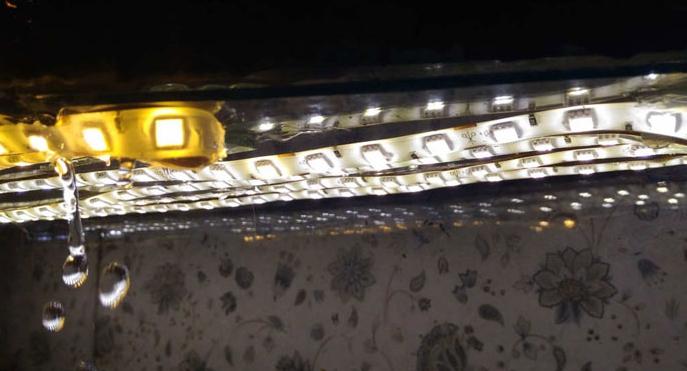
In aquariums, you must use a moisture-resistant LED strip, which is marked IP68. It is placed in a silicone shell and does not fail even if it falls into the water.
LED lamp manufacturing
To make lighting using DIP type diodes or tape, you will need a wire, a soldering iron, a plastic pipe blank. Handy materials can also be used. The work is done like this:
- If there is an old lamp in the cover for a gas-discharge tubular lamp, you can adapt an LED light for it. To do this, pick up a piece of polypropylene pipe with a diameter slightly smaller than the lamp. The length should be such that it can be tightly inserted into the luminaire without additional fastening.
- Carefully wind a tape of suitable power around the tube in a spiral, removing the protective film and gluing it to the surface. At the end, connect the wire with a connector or soldering iron and check the operation. In this case, you need to install a dimmer, since it is difficult to guess the brightness, and due to the reflector in the lamp, the light will be distributed throughout the aquarium without scattering to the sides.
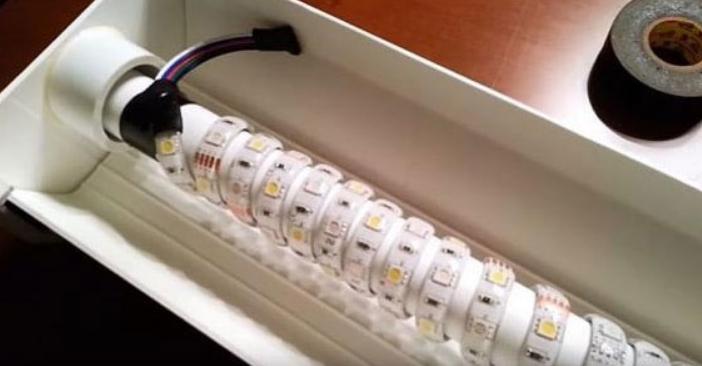
If there is no lamp, you can make it on your own. To do this, the plastic tube must be cut lengthwise to make two halves. LEDs for the aquarium will be mounted inside, and the bend will serve as a reflector. It can be painted white or glued with foil with double-sided tape. Carry out the work like this:
- Choose DIP LEDs for an aquarium with long legs to make it convenient to work. Calculate the quantity according to the required power. Drill two small holes in the tube for each LED, determine the location step in advance to fit all the elements in the blanks.
- Pass the LEDs through the holes, then solder the wire to connect the system. It is better to use a parallel connection, then if one diode burns out, the rest will work. Bring out the wire to connect the power supply and dimmer.
- Fix the lamps in any convenient way, the main thing is that they hold well on the lid or frame and do not fall into the water.Check the operation, adjust the brightness so that the lighting is suitable for the aquarium.
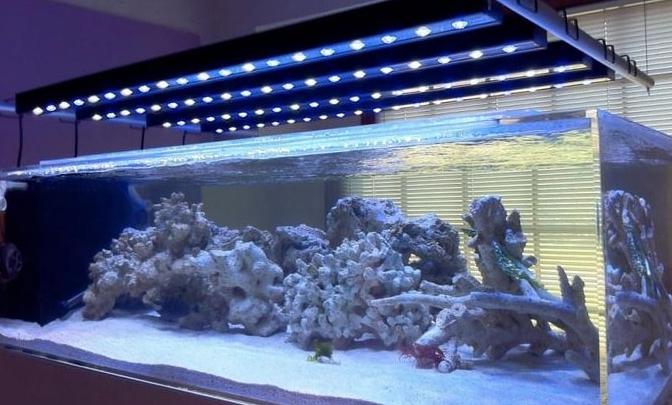
So you can make a lamp from an LED strip, plus this option in a curved reflective surface that directs the light down.
For an aquarium, LED lights and strips are best suited, as they are not afraid of water, do not heat up during long work and consume the least amount of electricity. You can buy ready-made models, but they are easy to make on your own if you calculate the necessary light characteristics and choose the option with optimal brightness and spectrum.
At the end of the video: Making an aquarium lamp from LED strips
