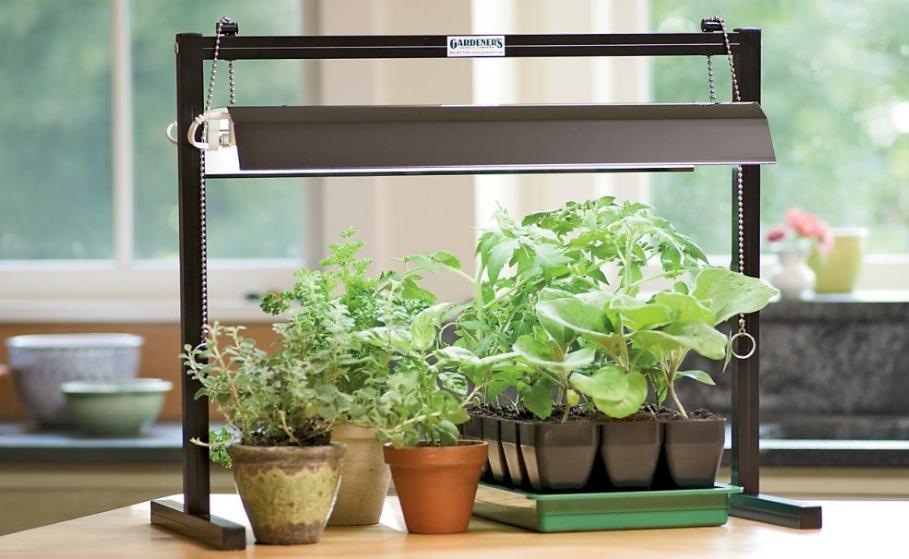
Phytolamps for plants - what is it and how to use it correctly
A phytolamp is a special type of light source, the spectrum of which is specially adapted for the best growth and development of plants. Moreover, this does not include a specific variety, but several types of lamps that have certain characteristics and can be used to illuminate plants in rooms, greenhouses or greenhouses.
What is it and why is it needed
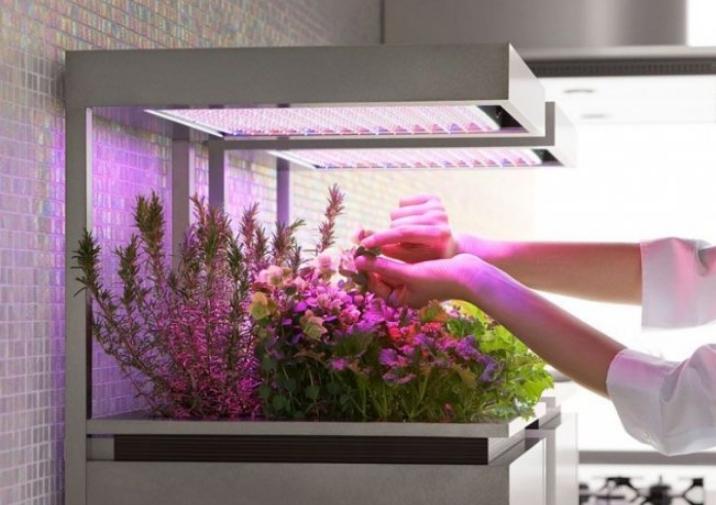
In appearance, the phytolamp for indoor plants almost does not differ from the usual one, the main differences are as follows:
- The equipment is specially designed for growing indoor plants or seedlings. Therefore, its light is adapted for these purposes, its action ensures the normal processes of metabolism and photosynthesis. Information about the appointment is always on the package, so be sure to study it.
- Lamps can be of different configurations: standard flasks for cartridges, tubular options for square or rectangular lamps, small elements with LEDs. There are many options, often they are sold in the form of ready-made fixtures, which simplifies installation and connection.
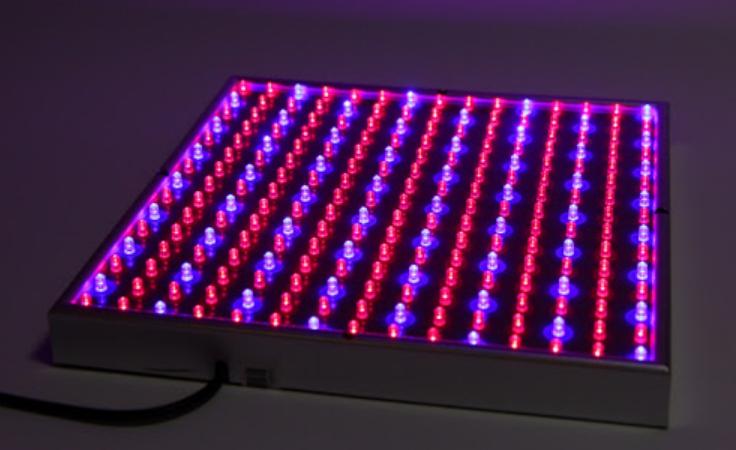
![consists of blue and red LEDs.]() Often the design consists of blue and red LEDs.
Often the design consists of blue and red LEDs. - Since it is necessary to illuminate a small space and provide maximum light intensity, the design almost always has a ceiling that directs the flow to a certain area. It is best if the system allows you to change the height of the lamp and its position in order to adjust the equipment depending on the size of the plant and lighting requirements.
- You can buy a phytolamp only in hardware and gardening stores or in special electrical sections. In smaller towns, there may be problems with the acquisition.
Due to the peculiarities of use and the complexity of manufacturing, options for indoor plants are an order of magnitude more expensive than standard ones. It is impossible to save on quality, since cheap lamps most often do not meet the declared characteristics.
Pros and cons
Fitolamps have advantages and disadvantages that must be remembered when choosing and buying. The advantages are:
- The concentration of light in a small area of space. This allows you to use electricity with the greatest benefit, since the lighting is not distributed around, but only where it is needed.
- Modern lamps last at least 50,000 hours, which allows them to be used for decades. During this period, the characteristics of light almost do not change, which is also important.
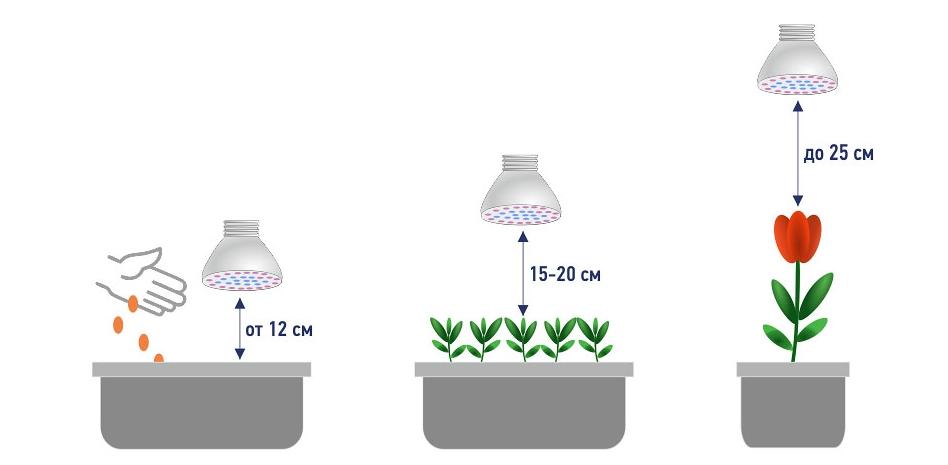
- To properly install and connect the lamp, you do not need to understand complex instructions.Everything is simple and clear, the main thing is to determine the appropriate characteristics and find the optimal height.
![tips for determining the height of fixtures]() It is easiest to use these tips when determining the height of fixtures.
It is easiest to use these tips when determining the height of fixtures. - When using LED equipment, you can adjust the brightness of the lighting, which allows you to adjust it to any plants. You do not have to buy several lamps for different plants, the indicators can be adjusted with one turn of the knob.
Since the LED equipment is powered by 12 V, the lamps are safe to use, the risk of fire is minimal, which is important for systems that operate for a long time without human control.
Of the minuses, the high price of products and dangerous fumes in fluorescent lamps can be noted.
How does a phytolamp differ from a conventional lamp and a fluorescent lamp
To make it easier to understand, you can compare the standard options with special ones. This will help you understand the difference and use what you need:
- Standard incandescent light bulbs produce a yellowish light that is comfortable for human vision but unsuitable for plants. The problem is that the radiation contains mainly red and yellow radiation, and there is no blue radiation, which makes this option unsuitable for use with additional illumination.
- Fluorescent lights can be used for houseplants and seedlings as they provide full spectrum. But at the same time, they consume much more electricity and most often have large sizes, which is not always convenient when attaching a lamp over plants.
- Phytolamps give radiation with peaks in the blue and red segments of the spectrum, since they are necessary for the normal development of plants.It will not work to use them as ordinary light sources, they do not provide the most comfortable light for vision and will not provide normal visibility in the room.
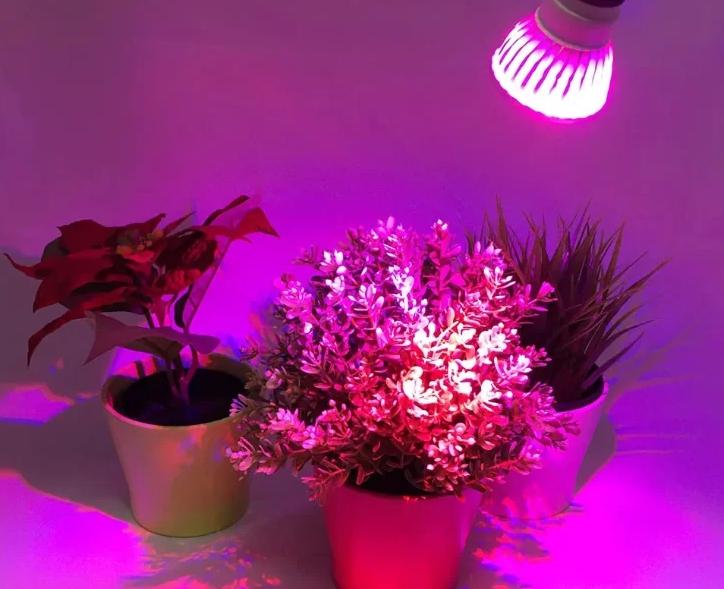
The opinion of many people that phytolamps are harmful to health is erroneous. Blue and red spectra create only visual discomfort, but do not cause damage to the eyes, since their ultraviolet radiation is weak. In addition, the light is usually directed to the plants due to the ceiling and practically does not spread around the room.
Types of phytolamps, main characteristics
To create a comfortable microclimate and use the plant lamp without fear, you need to choose the best option. There are several types used for supplementary lighting, each with its own characteristics:
- Incandescent lamps. This option is almost never used, since it consumes the most electricity and gets very hot during operation, which creates a risk of burns for plants. It is necessary to raise the lamp high, which reduces its effectiveness. For plants, only special models with a blue and red spectrum are suitable, they are much more expensive, but they serve little - about 1000 hours.
- Halogen lamps are an order of magnitude more efficient than filament options, but also do not last very long and get very hot during use. In this case, you can get light that is close to the natural radiation of the sun. There are options that operate on standard voltage and low-voltage fixtures connected via a power supply.
- Fluorescent lamps can be in the form of tubular emitters or with standard socles for cartridges.They give high-quality light with the necessary spectral peaks, flickering can be observed, but this is not important for plants. The surface does not heat up during operation and can be located at a small distance from the leaves, the energy consumption is small, which is also important.
![Fluorescent Options]() Luminescent options are convenient when used on a narrow windowsill.
Luminescent options are convenient when used on a narrow windowsill. - LED options can be both in the form of lamps and in the form of fixtures with certain characteristics. It is better to use low-voltage models powered by a 12 V power supply, it is already built into the design. You can choose an option with any color temperature, if you need daylight, an indicator of 6200-6400 Lm will be optimal. The electricity consumption is the lowest and the life span exceeds 50,000 hours.
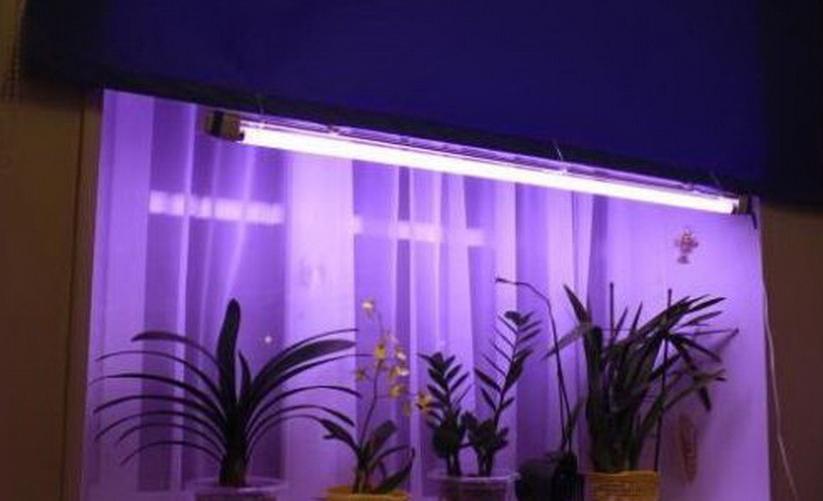
LED lamps are the most durable and safe for today, it is best to choose them for additional illumination of indoor plants and seedlings.
Overview of prices for popular models.
Terms of Use
The principle of operation of the phytolamp is simple - it allows you to provide the optimal length of daylight for plants, regardless of external conditions. But to ensure the best effect, you must follow a few simple rules:
- Select the radiation power for a particular plant. Most often, when using LED lamps, you need from 50 to 150 W of power per square meter, if the size of the container is smaller, then a recalculation is made. You can also use data in lux, each lamp has them, so it's easy to figure it out.
- Consider the height of the lamps above the tops of the plants. The larger it is, the higher the correction factor should be used. So, with a height of 15 cm, you need to increase the lamp power by 1.2.For heights of 30 and 60 cm, use the coefficients 1.4 and 2, respectively.
- Remember that distance is determined not from the ground, but from the tops of plants. Therefore, over time, the position of the fixtures changes and you need to check it at least once a week. In order not to burn the plant, it is easiest to put your palm on and hold it under the light for about a minute, there should not be any discomfort.
- When installing, it is better to use a special design that allows you to quickly change the position of the lamps, fixing them at the desired level. You can make the system yourself and simply change the length of the cable or twine on which the ceiling is suspended.
![You can hang the lamp on a strong cord.]() You can hang the lamp on a strong cord.
You can hang the lamp on a strong cord. - The time of use is selected depending on the daylight hours. It is best to keep the plants on a windowsill so that they receive as much natural light as possible.
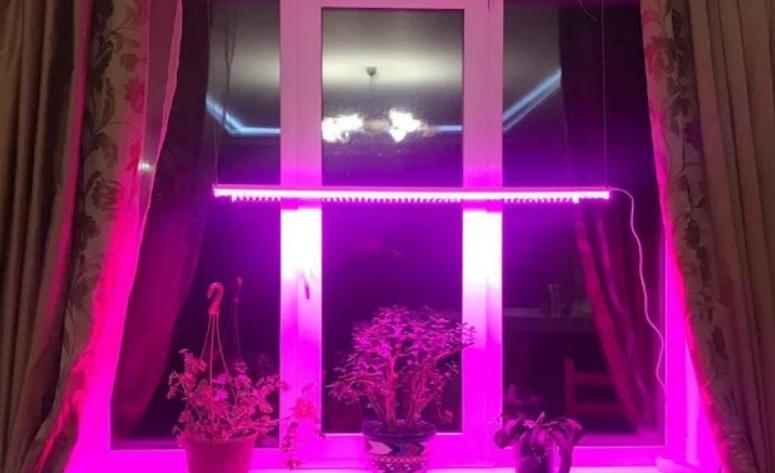
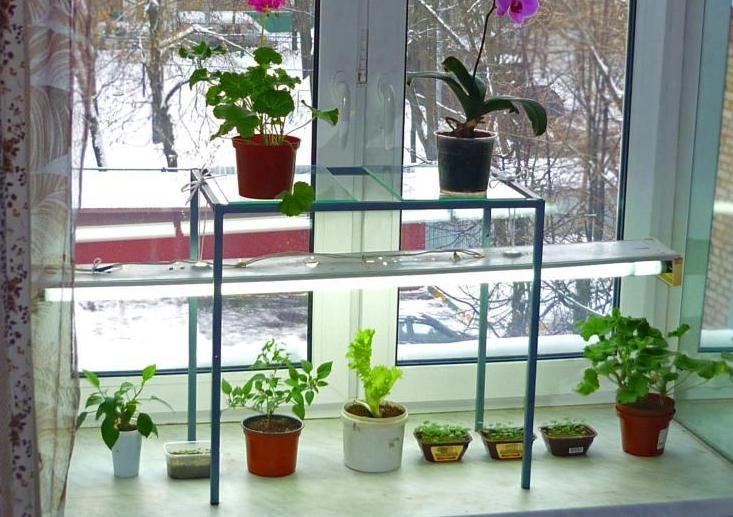
When supplementing, it is better to turn on the lamps in the morning and evening to simulate natural conditions.
Finally video: How to properly place the phytolamp.
If you need a phytolamp for home use, then it is not difficult to find it - there are special models for sale for such purposes. The main thing is to determine the necessary parameters and choose a lamp with the right power. The most effective are LED models.